The Storage Problem Nobody Talks About
Walk through almost any steel service center or fabrication shop, and you will see the same scene: 6-meter pipe bundles leaning against a wall, bar stock stacked on timber dunnage, and a forklift operator threading forks into a gap that looks barely wide enough. Every retrieval disturbs three other bundles. Every wrong pick adds scratches to finished tube. The material is not the problem. The storage method is.
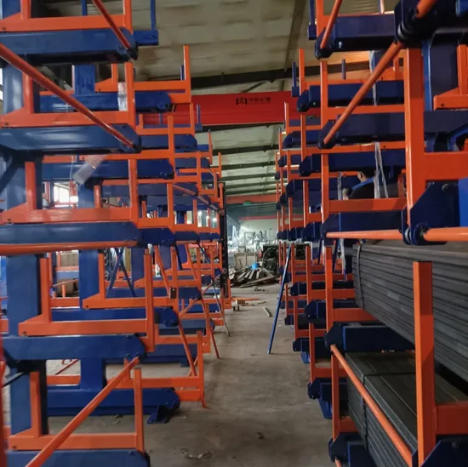
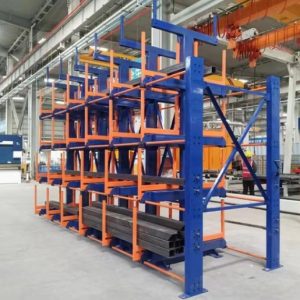
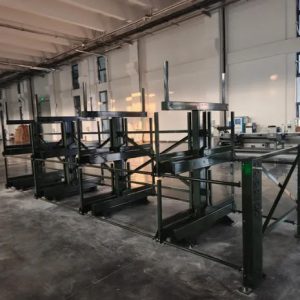
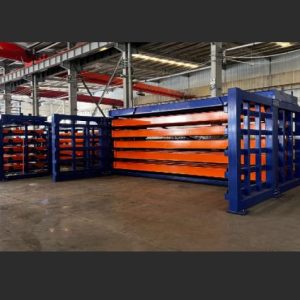
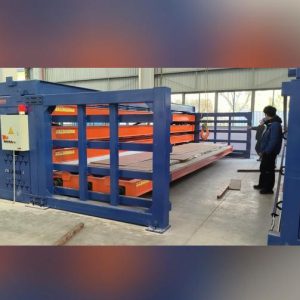
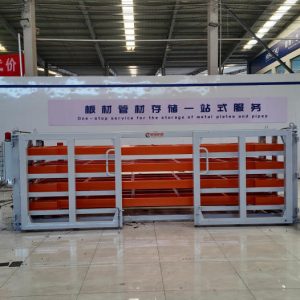
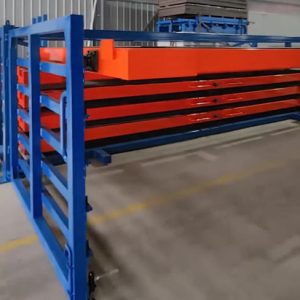
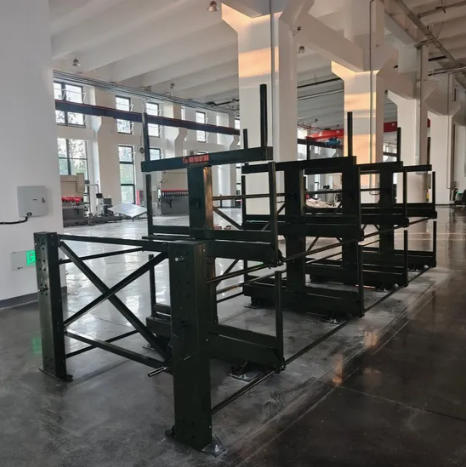
A manual crank-out cantilever pipe storage rack addresses this by changing a simple mechanical fact: the material comes to the operator, not the other way around. Herochu builds this system around a hand-crank carriage that extends each storage tier 100% clear of the rack frame, exposing the full bundle for an overhead crane pick. The operator stays on the floor. The crane lifts vertically. The pipe never gets dragged across a fixed arm.
How the Crank Mechanism Actually Works
The engineering is deliberately uncomplicated. Each cantilever tier rides on a carriage supported by heavy-duty roller bearings within a structural steel frame. A rack-and-pinion drive connects the carriage to the fixed column: a toothed rack runs along the carriage, engaged by a pinion gear mounted on the crank shaft at the column face.
Turn the handle, and the pinion drives the carriage outward at a controlled rate. On a 6-meter compartment, full extension takes roughly 15 to 20 crank turns. The roller bearings eliminate sliding friction, so the effort stays manageable for one person even with a loaded tier. A mechanical lock holds the carriage in the retracted position, and end stops prevent over-travel in both directions.
No electrical power. No compressed air. No hydraulic lines. The Herochu crank-out system works in unheated bays, outdoor covered storage, and older buildings where running services to a rack is impractical.
What Changes on the Floor
The first change is retrieval time. A single piece or a full bundle can be loaded or retrieved in about five minutes because the crane hook lowers straight down onto the exposed arms. No angling the load between uprights. No swinging a 9-meter tube inside a cage of steel.
The second change is damage reduction. Pipe and tube finish defects usually come from two sources: forklift contact and sliding friction against rack components. A crank-out rack removes both. The crane lifts vertically, and the pipe rests on protective liners rather than being dragged. For stainless tube, polished pipe, or aluminum extrusion, that difference shows up directly on the rejection report.
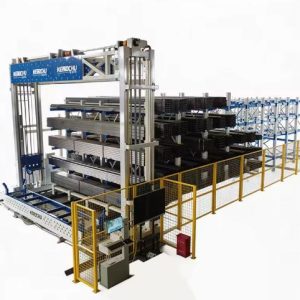
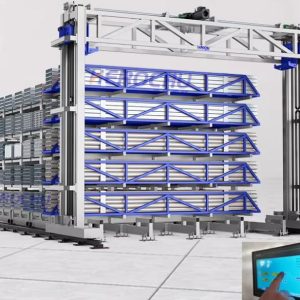
The third change is density. Conventional cantilever aisles must accommodate forklift entry, turning radius, and fork positioning under every arm. A crank-out system shrinks that aisle because the material travels into a narrow operating zone only when needed. Herochu configures single-sided and double-sided units, with up to eight storage levels and arm loads up to 5 tons per level depending on the model. A rack that would otherwise hold four bundles in a fixed-arm layout can, in the same footprint, hold considerably more because the cube above the aisle is no longer dead space.
Material Mix That Fits
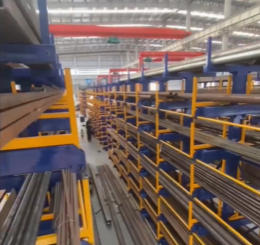
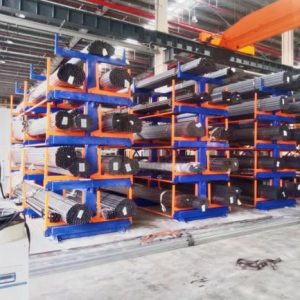
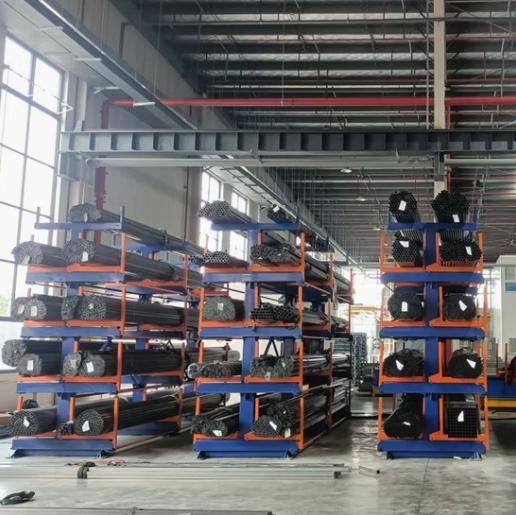
The same Herochu frame handles steel bar, round and rectangular tube, pipe, angle iron, profiles, rollers, mandrels, and bulk long goods. Compartment dividers keep individual bars from rolling across the tier. Dual-beam arm supports carry distributed tube loads without bowing the arms.
For operations that store remnants alongside full bundles, support trays and dividers create separate zones within a single tier, so offcuts do not migrate into the prime stock. Protective finishes are available for hygroscopic or surface-critical materials.
Safety Beyond the Sales Brochure
The safety argument for crank-out storage is not that it eliminates risk. It is that it relocates risk away from the most exposed moment: reaching into a loaded rack with a forklift.
When the arms extend fully and the crane lifts from above, the forklift never enters the storage bay. Operators never climb the rack. Loads never slide laterally against fixed stops. OSHA’s general requirements for cylindrical material storage call for blocking against spreading and tilting, and a crank-out compartment with dividers and end stops provides that geometry as a built-in feature rather than an add-on. Herochu engineers the drive components and layer load ratings together so the mechanism holds position under rated load, not just on the specification sheet.