Telescopic Is Not a Marketing Word Here
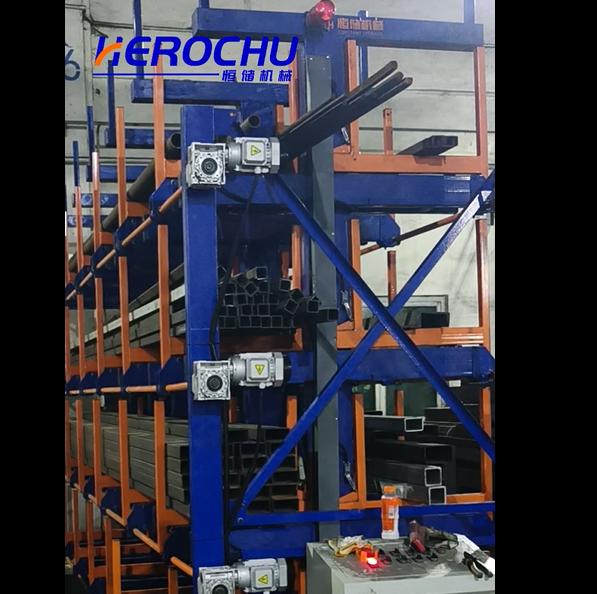
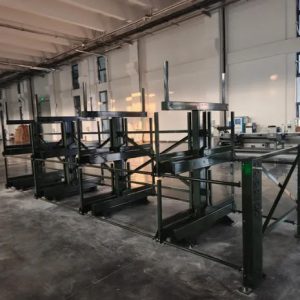
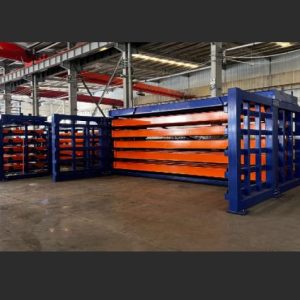
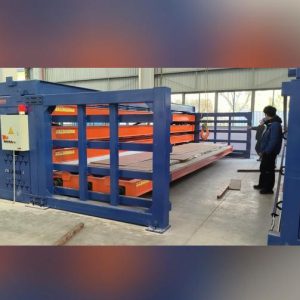
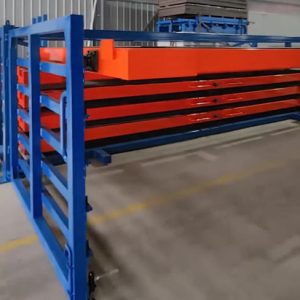
“Telescopic” gets used loosely in storage equipment. On a Herochu telescopic cantilever pipe storage rack with manual crank, it describes a specific mechanical behavior: the cantilever arms and their carriage retract into the rack envelope when not in use and extend outward under load to expose the full storage tier. The arms do not simply project farther into the aisle permanently; they travel only when an operator turns the crank.
That distinction separates a true telescopic crank-out rack from a conventional cantilever with long fixed arms. The parked envelope is compact. The operating envelope is controlled. The aisle is not permanently surrendered to arm length.
How the Telescopic Travel Is Controlled
The crank handle drives a pinion gear against a toothed rack mounted on the carriage. Roller bearings carry the loaded carriage along guide rails, which are aligned during installation to keep travel parallel and prevent binding. A full extension of a 6-meter compartment requires roughly 15 to 20 crank revolutions, and the gear ratio is chosen so one operator can manage the effort at rated load.
End stops at both extremes of travel prevent over-extension and over-retraction. A mechanical lock secures the carriage in the parked position. On telescopic models, the arm sections themselves may retract to a shorter closed length — Herochu’s telescopic cantilever configurations describe a closed arm state of around 200 mm opening to approximately 1,000 mm under load, depending on the model — which further reduces the parked footprint in tight bays.
Where Telescopic Travel Earns Its Keep
Three building conditions make a telescopic crank-out rack more practical than a fixed-arm cantilever:
Low clear height. A bay with limited vertical space cannot afford a crane path that requires threading loads between fixed uprights. The telescopic carriage brings the load out to a clear vertical pick zone without demanding extra building height.
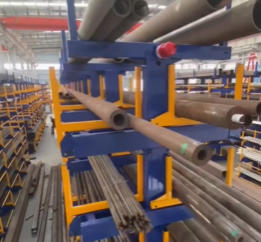
Narrow aisles. In an existing building where the aisle cannot be widened, a fixed cantilever may simply not fit the forklift envelope. A telescopic roll-out rack parks compact and extends into the available aisle only during retrieval.
Mixed-length inventory. A bay that stores 6-meter tube alongside shorter extrusion and bar stock benefits from compartments that can be configured at different depths and widths. The telescopic travel accommodates different load profiles without dedicating a full fixed-arm bay to each material family.
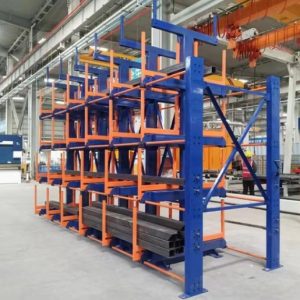
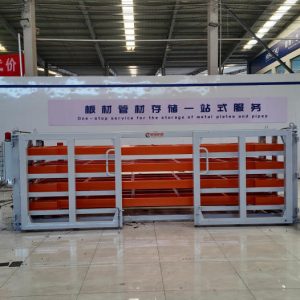
Herochu builds these racks with single-sided or double-sided columns, stacked tiers up to eight levels, and compartment layouts that can be mixed within the same frame. The telescopic mechanism is mechanical and requires no power, compressed air, or hydraulic service, which keeps the installation viable in older facilities where running new services is a capital project of its own.
The Manual Crank Decision
Every telescopic roll-out rack involves a choice between manual crank and powered drive. The manual crank is not a compromise for low-budget projects. It is a deliberate selection for bays where the duty cycle does not justify the infrastructure and maintenance overhead of a motorized system.
A manual crank system has no electrical panel, no motor starter, no control transformer, no lockout/tagout procedure for the drive, and no scheduled motor or brake service. In a steel service center where the crane is already the bottleneck, the crank travel time is a small fraction of the total pick cycle, and the simplicity of the mechanism translates directly into uptime.
Herochu offers both manual and electrically driven roll-out configurations, and the recommendation should follow the actual number of crank cycles per shift, the load per tier, and the maintenance resources available at the site. For a bay that sees a handful of retrievals per shift with a 3-to-5-ton load, the manual crank is usually the more durable answer. For a high-throughput distribution bay with dozens of cycles per shift, powered travel changes the labor equation.
Protective Liners, Dividers, and Material-Specific Detail
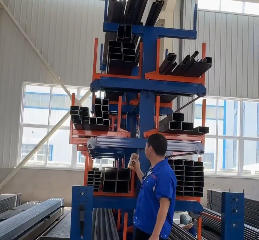
A telescopic crank-out rack is only as good as the contact between the material and the arms. Herochu supplies protective liners for surface-sensitive tube and pipe, support trays that distribute load across arm pairs, and dividers that keep bar stock and bundled material from shifting as the carriage travels.
These details are not accessories in the cosmetic sense. A divider that prevents a bundle from spreading during extension is a safety component. A liner that prevents a scratch on polished tube is a quality-control component. The specification conversation should include the material surface finish, bundle profile, and whether remnants will share the same compartment as prime stock, because those inputs determine the compartment layout more than the rack’s headline capacity does.
A Closing Note on Specification Discipline
Crank-out, roll-out, and telescopic cantilever racks all solve the same core problem: long material stored deep in a fixed rack is slow, damaging, and difficult to retrieve safely. The mechanism differs, but the engineering discipline is the same. Load rating must apply at full extension. Anchor design must account for the shifted center of gravity. The crane’s coverage and hook height must drive the layout before the rack model is selected. Herochu’s specification process starts with those inputs, which is why the resulting rack tends to fit the operation rather than forcing the operation to fit a catalog number.