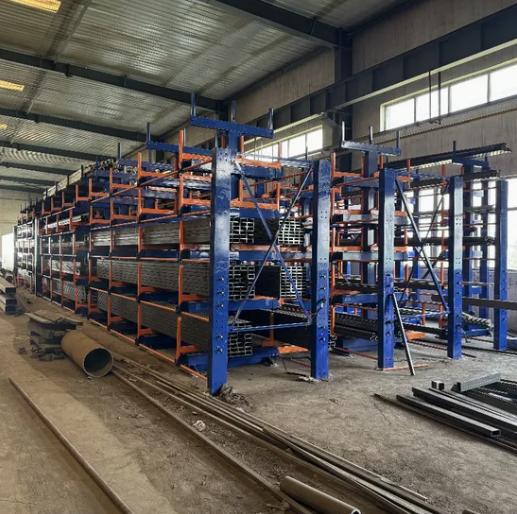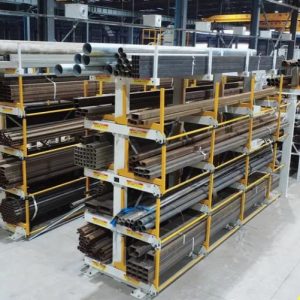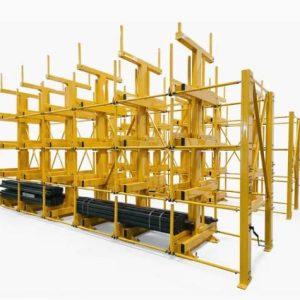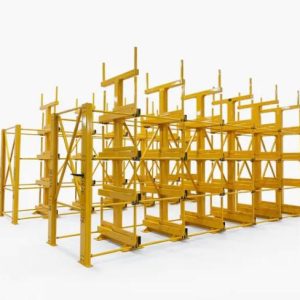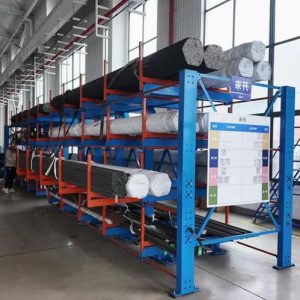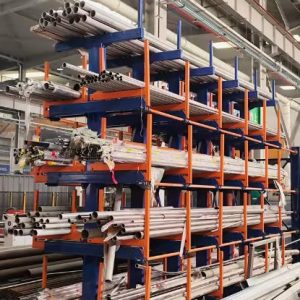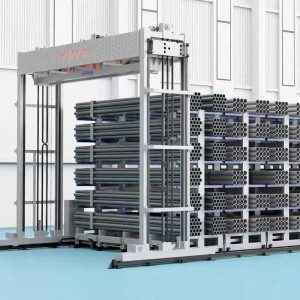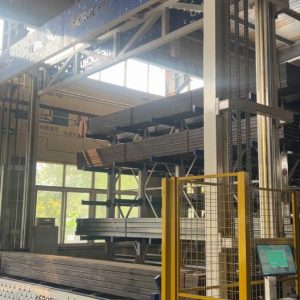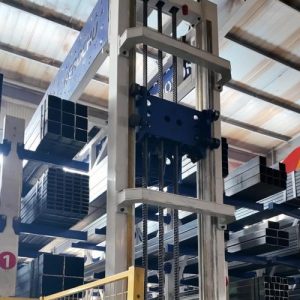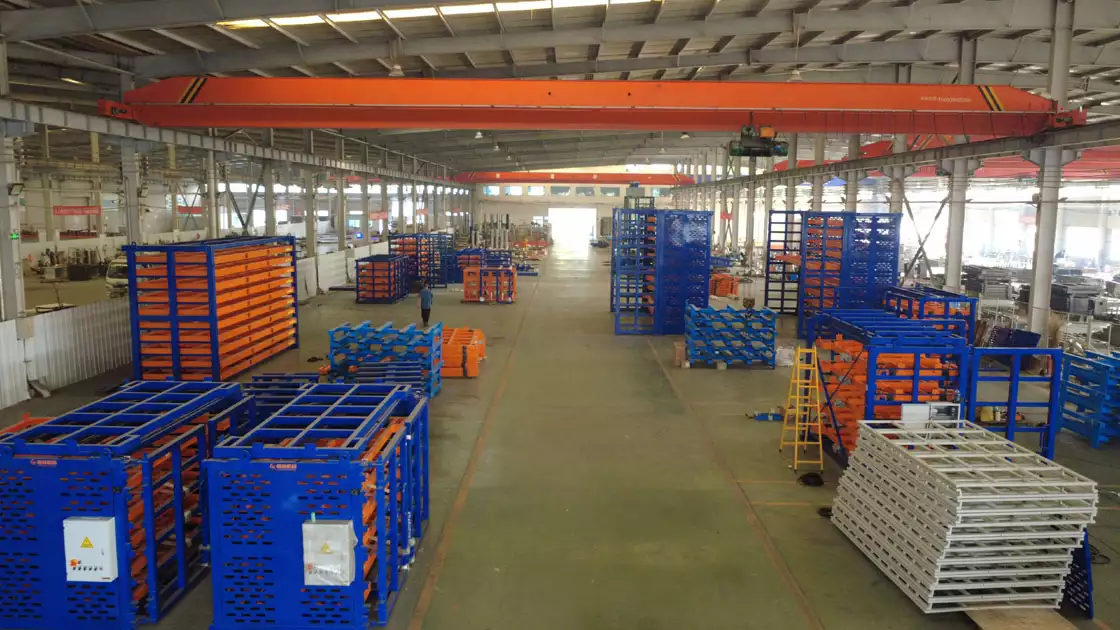
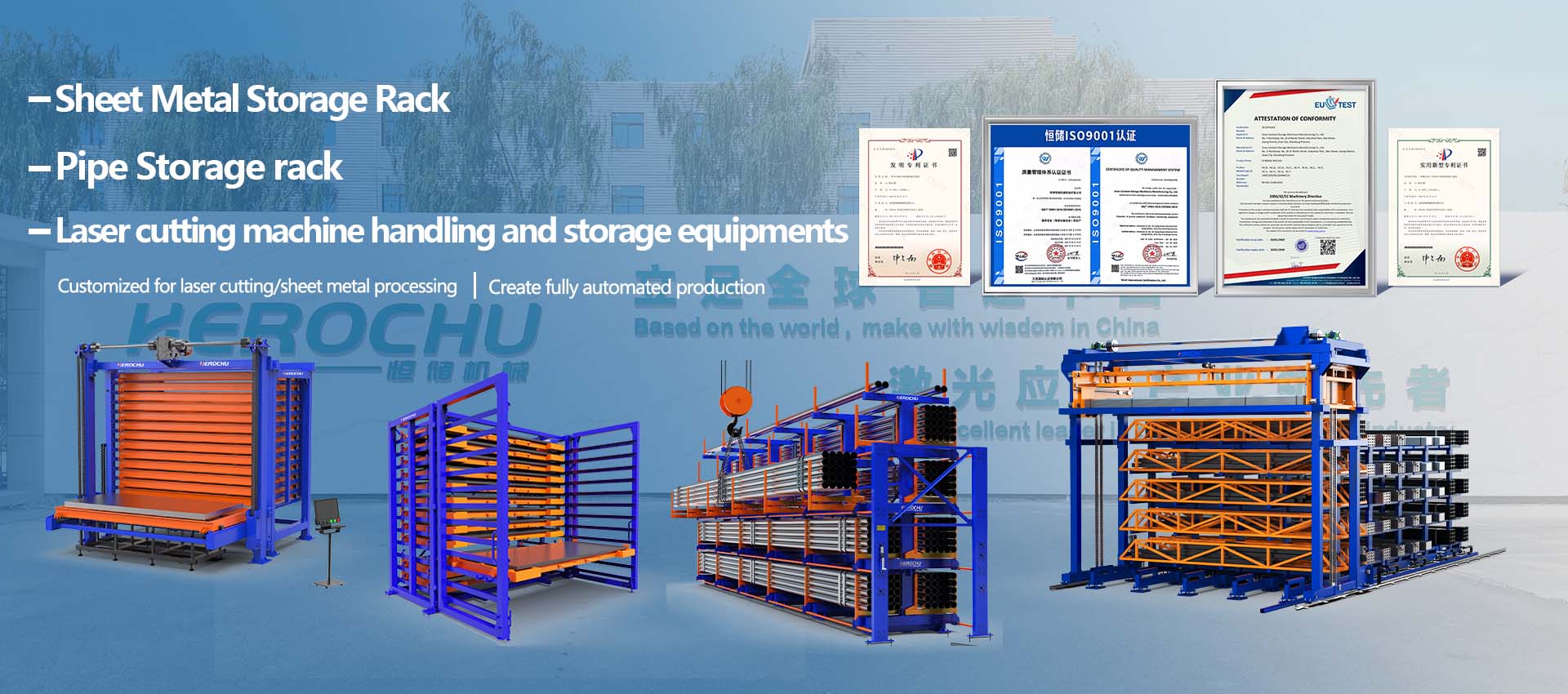
Dense storage of long steel pipes and profiles creates a fundamental conflict: the tighter materials are packed together, the harder they become to access individually. Traditional cantilever racking addresses this with fixed open arms that provide direct aisle access, but at the cost of arm spacing that must accommodate forklift maneuvers. A roll out heavy duty cantilever rack for pipe storage resolves the density-access trade-off through a manual crank mechanism that extends individual storage compartments into the aisle for loading and retracts them into a compact parked configuration.
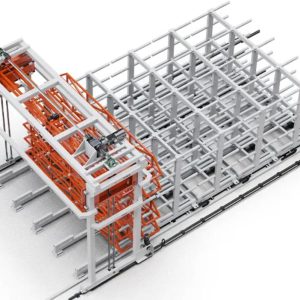
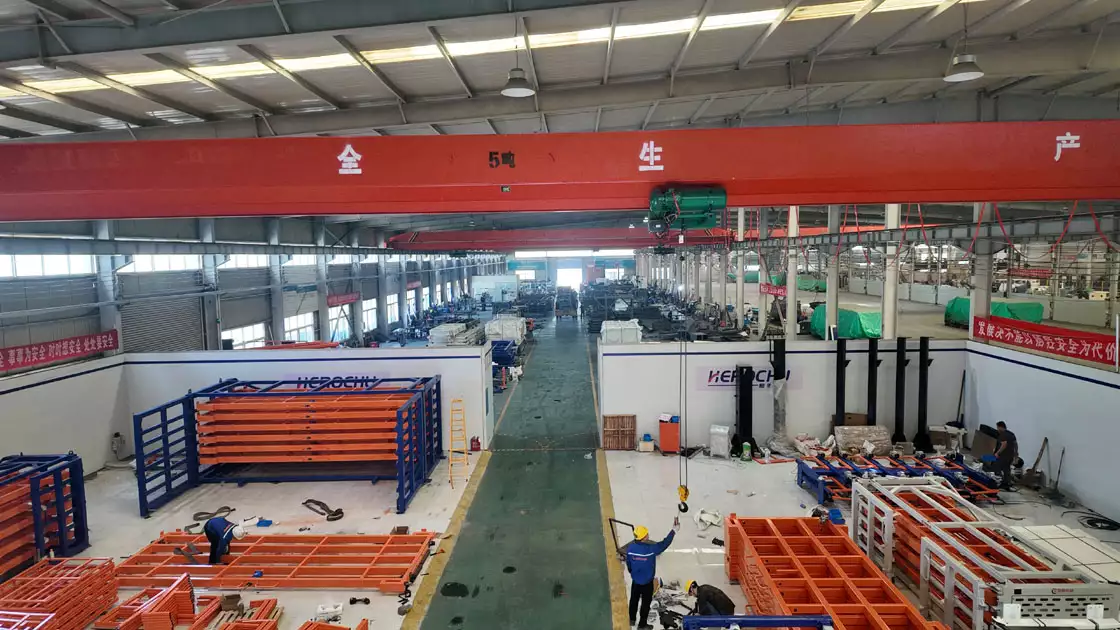
Herochu manufactures roll out heavy duty cantilever rack for pipe storage systems that combine the load capacity of fixed cantilever architecture with the space efficiency of mechanized drawer-style storage. Each storage compartment mounts on a rolling carriage that travels along integrated guide rails. An operator turns a hand crank to extend the desired compartment into the aisle, loads or unloads the material, then returns the compartment to its home position. The mechanism requires no electrical power, compressed air, or hydraulic connections, making it suitable for any warehouse environment.
The Roll-Out Mechanism: How It Functions
The mechanical principle behind the Herochu roll out system is straightforward. Each storage tier rides on heavy-duty roller bearings housed within a structural steel carriage frame. The carriage connects to the fixed rack column through a rack-and-pinion drive: a toothed rack runs along the carriage length, engaged by a pinion gear mounted on a manual crank shaft at the column face. Rotating the crank handle turns the pinion, which drives the carriage linearly along its guide track.
The gear ratio is selected to balance operating effort against travel speed. A single crank revolution advances the carriage by a controlled increment, and a full extension of a 6-meter compartment requires approximately 15 to 20 crank turns. The effort remains manageable for a single operator across the full travel range because the roller bearing support eliminates sliding friction that would otherwise increase resistance as the loaded carriage extends.
Guide rails are precision-aligned during installation to maintain parallel travel within a tolerance that prevents binding or uneven roller wear over years of cycling. End stops at both the fully extended and fully retracted positions prevent over-travel, and a mechanical lock at the retracted position holds the carriage securely when not in use.
Space Efficiency Gains
The primary space advantage of the roll out design comes from eliminating the permanent aisle clearance required by fixed-arm cantilever configurations. In a conventional cantilever rack, the aisle must be wide enough for a forklift to enter, turn, and position forks under every storage arm on both sides of the aisle. This clearance is dead floor space that produces no storage value.
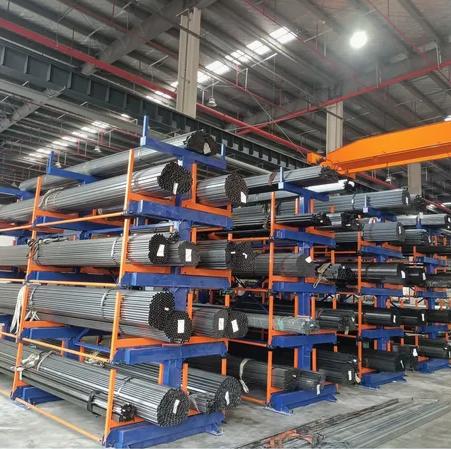
With the roll out heavy duty cantilever rack for pipe storage, parked compartments sit closer together because the mechanism brings the material out to the operator rather than requiring the operator to navigate equipment into the rack. Aisles can be narrowed to the minimum width needed for personnel movement and occasional forklift passage, while the crank mechanism extends individual compartments into a shared access zone as needed. For warehouses where floor area represents a significant operating cost, the space recovered from reduced aisle width translates directly to additional storage positions within the same building footprint.
The dual-side mechanical assistance feature further improves space utilization. Operators can load material from one aisle and retrieve it from the opposite side, allowing the rack to serve as a pass-through staging point between receiving and production areas without duplicating access lanes on both faces.
Load Capacity and Compartment Configuration
Despite the moving carriage assembly, the roll out system maintains load ratings comparable to fixed cantilever racks. Herochu roll out compartments are rated for 3,000 kg to 5,000 kg per level, depending on frame size and carriage length. The HC-G6053 and HC-G6053S models support 3,000 kg per compartment for 6,000 mm pipe lengths, while the HC-G9065 and HC-G12065 handle 5,000 kg for 9,000 mm and 12,000 mm lengths respectively.
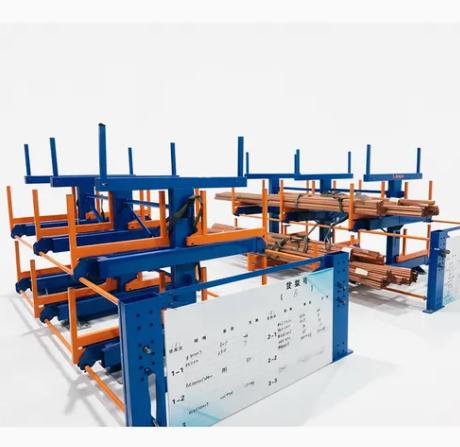
Each compartment functions as an independent storage unit with dedicated support surfaces on both sides of the carriage. This bilateral storage capability doubles the inventory density per compartment compared to single-sided cantilever arms, as pipes and profiles can be stored on both the left and right faces of the extended carriage. When retracted, these materials nest between adjacent compartments with calculated clearance that prevents contact and allows smooth extension and retraction.
The number of layers per rack column is configurable, starting at five layers for 6-meter models and six layers for 9-meter and 12-meter versions. Vertical spacing between layers is set during installation and can be adjusted later to accommodate changes in stored material dimensions.
Operational Workflow and Labor Efficiency
The manual crank operation changes the workflow rhythm compared to forklift-based retrieval. Instead of mounting a vehicle, starting the engine, maneuvering into position, and making a lift, the operator walks to the target compartment, identifies the location by its visual label, extends the compartment with the crank, and performs the material transfer. For lightweight small-diameter tubes and profiles, a single operator can complete the entire sequence without powered equipment.
This manual workflow offers particular value for service centers and fabrication shops where pipe picking involves many small-quantity retrievals rather than full-bundle movements. A worker pulling individual lengths for a cut list can extend one compartment at a time, select the required pieces, and retract the compartment — all without tying up a forklift that could be moving full bundles elsewhere in the facility.
The crank also provides tactile feedback during operation. An operator can feel increased resistance if a compartment encounters an obstruction or if material has shifted during storage, providing an early warning that prompts inspection before damage occurs. This mechanical feedback is absent in powered systems where motor torque overrides resistance until something breaks.
Safety Features in Rolling Storage
Moving storage carriages introduce safety considerations distinct from fixed racking. The Herochu roll out design incorporates several protective measures. The mechanical lock at the retracted position prevents unintended carriage movement during forklift traffic in adjacent aisles or during seismic events. Only one compartment per column can be extended at a time due to the shared guide rail geometry, eliminating the possibility of adjacent compartment interference.
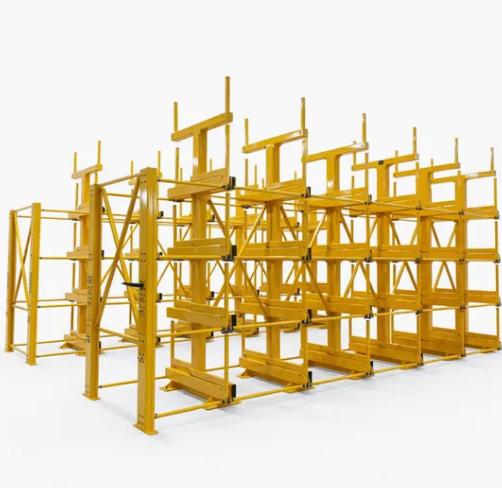
The crank handle position at the column face keeps the operator at a safe distance from the moving carriage during extension and retraction. Load retention features, including arm-end stops and slight upward arm inclination, prevent materials from shifting during carriage travel. The roller bearing design produces smooth, predictable motion without the stick-slip behavior that can cause sudden carriage movement in sliding-contact systems.
Maintenance Requirements
The roll out mechanism adds moving components that require periodic attention compared to all-fixed rack configurations. Maintenance points include roller bearing lubrication, rack-and-pinion mesh clearance verification, guide rail alignment checks, and crank handle bushing inspection. These tasks fall within the scope of standard warehouse maintenance schedules and do not require specialized technicians.
Herochu provides maintenance documentation specifying lubrication intervals, wear inspection criteria, and adjustment procedures. The roller bearings are standard industrial sizes available from multiple suppliers, so replacement parts remain accessible over the long service life of the installation. Guide rails are fabricated from wear-resistant steel and are sized for the anticipated cycle count over the design life of the system.