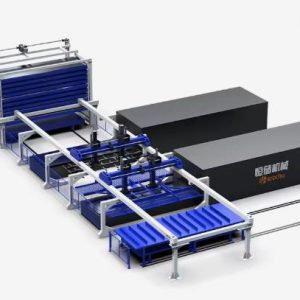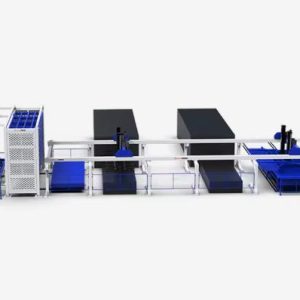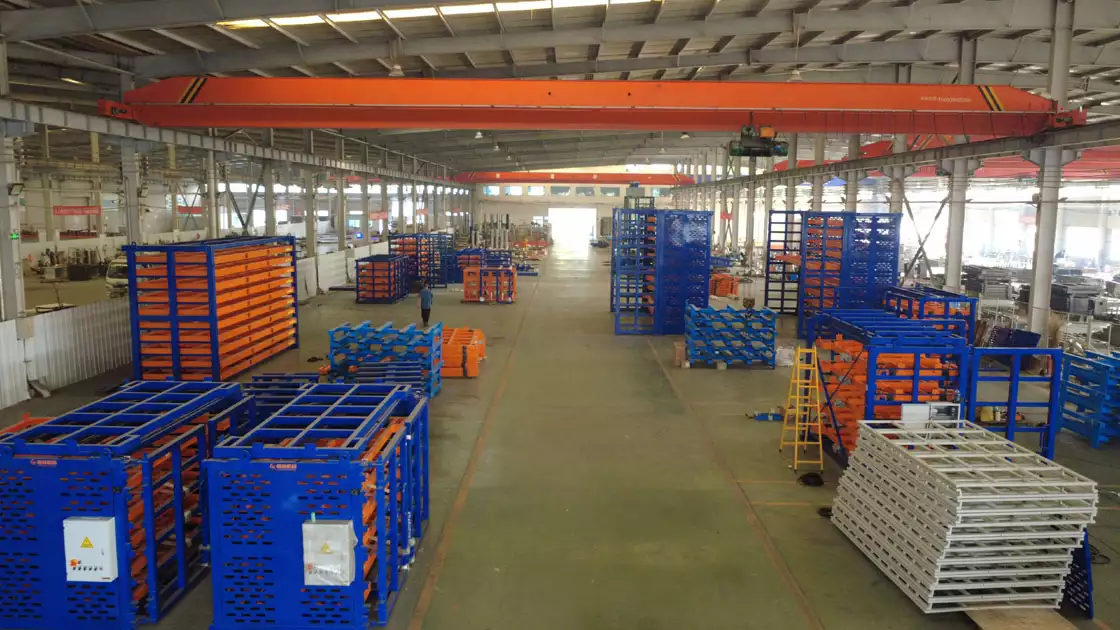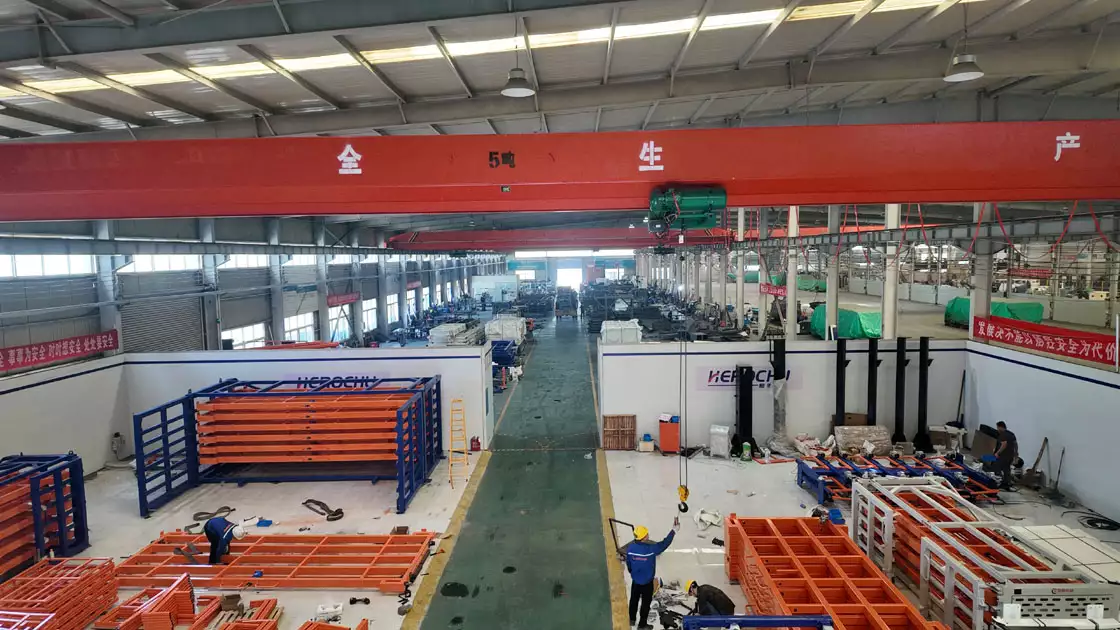
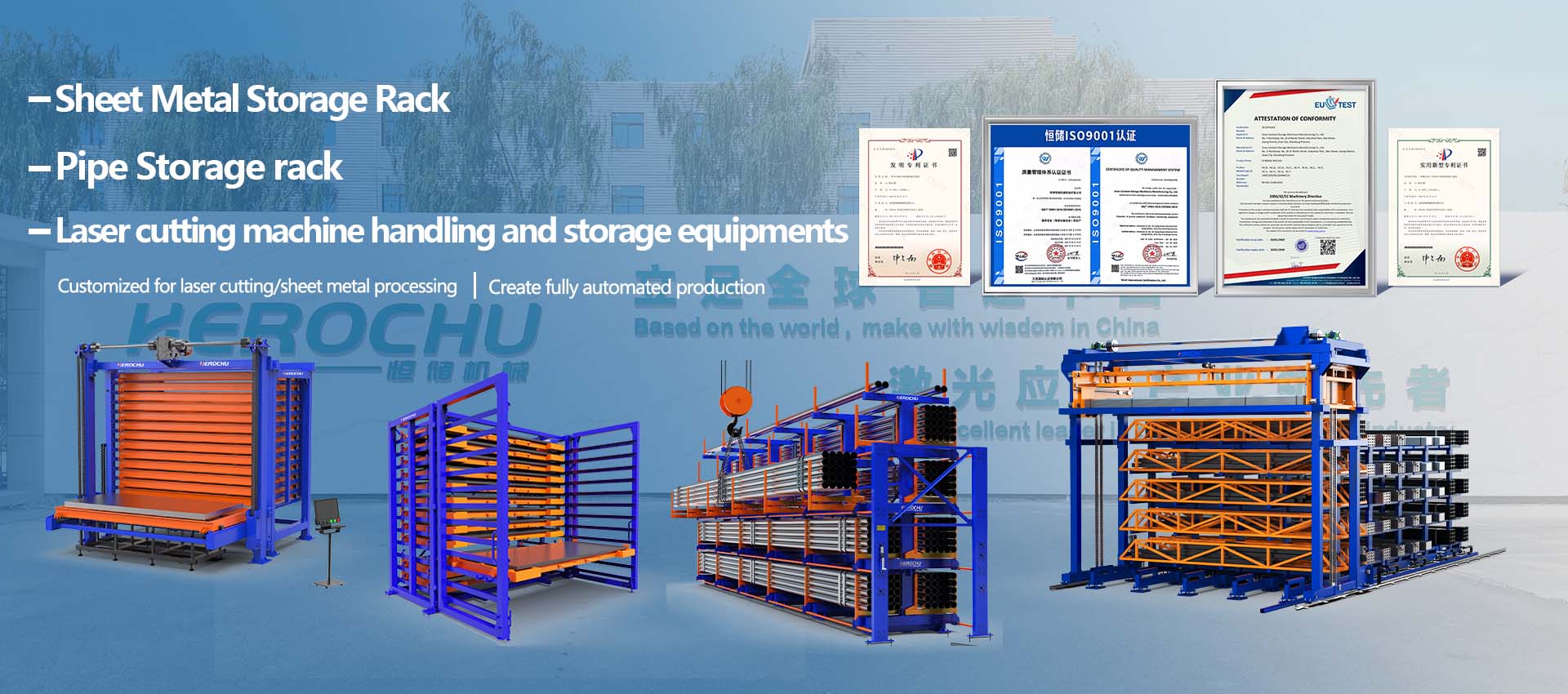
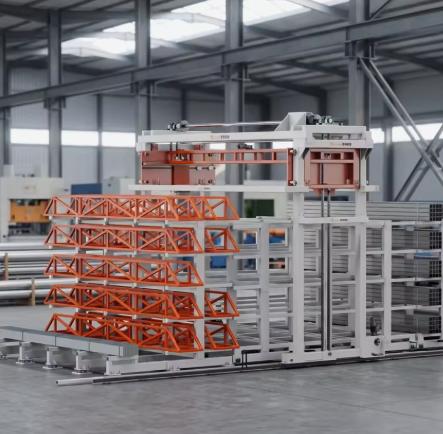
Steel distributors and structural fabricators who store pipe, tube, and profiles at ground level waste floor area and expose material to damage from forklift contact, weather, and disorganized stacking. The countermeasure is vertical — but only if the rack structure can bear the loads involved. A rack holding eight levels of 5-ton pipe bundles demands engineering that goes well beyond standard pallet rack design. Herochu’s heavy-duty ASRS racking system for steel pipe and profile storage combines structural steel fabrication with automated gantry retrieval to handle exactly these demands.
Engineering for Ton-Level Loads
Standard selective pallet rack is rated in the low thousands of pounds per beam level. Pipe and profile storage operates in a different weight class. A single 8,000 mm bundle of heavy-wall structural tube can approach 5,000 kg — roughly the weight of a full-size pickup truck concentrated into a narrow footprint. When a rack tower contains eight or ten such levels, the cumulative static load on the base frames reaches tens of tons, with dynamic forces added during gantry pick-and-place cycles.
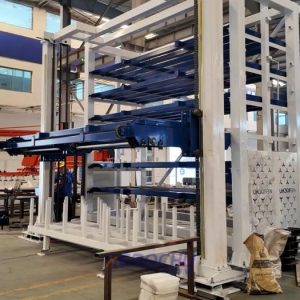
Herochu fabricates the rack uprights, beams, and bracing from Q235B structural steel, using full-penetration welds at critical joints and bolted connections at field assembly points. The frame is designed as a braced moment-resisting structure: horizontal shelf beams tie the uprights together laterally, while diagonal cross-bracing in both longitudinal and transverse planes resists racking forces. Finite element analysis — typically run through SimSolid or Ansys — validates deflection under maximum eccentric load, accounting for the worst case of fully loaded shelves on one side of a bay and empty shelves opposite.
Vertical Density Without Compromise
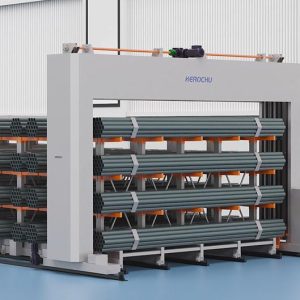
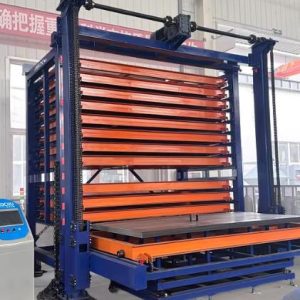
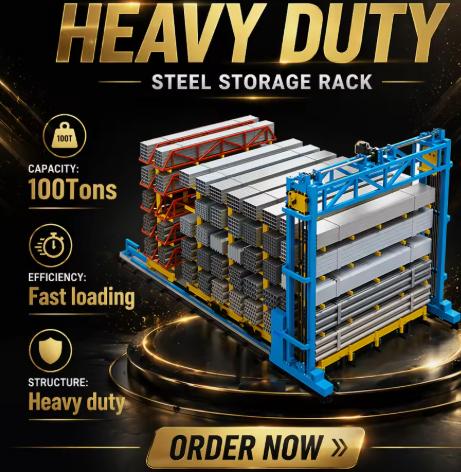
The HC-XG series from Herochu configures from five to thirteen storage levels. Height depends on the facility’s clear ceiling dimension and crane hook height if an overhead bridge crane shares the bay. The standard range covers models handling 6,000 mm and 8,000 mm pipe lengths, with custom lengths available for mills processing non-standard stock.
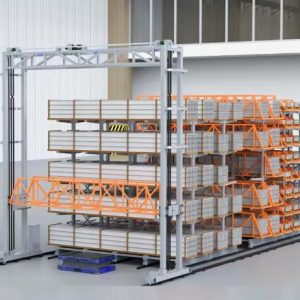
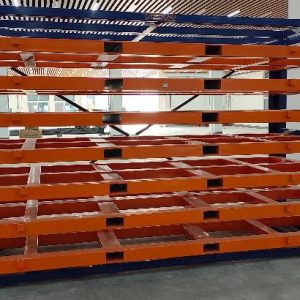
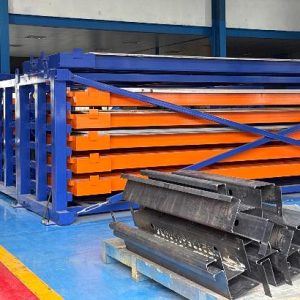
Each rack bay is essentially a deep cantilever shelf system. Unlike pallet rack where loads sit on front-to-back beams, pipe and profile shelves use continuous support arms or cradle-style beds that prevent material from sagging or rolling. The open-front design gives the gantry’s lifting carriage unobstructed access to every shelf position. Dividers between storage lanes keep different material grades or dimensions separated, preventing the common problem of mixed bundles — a frequent source of mis-picks in manual yards.
The Gantry: Precision at Weight
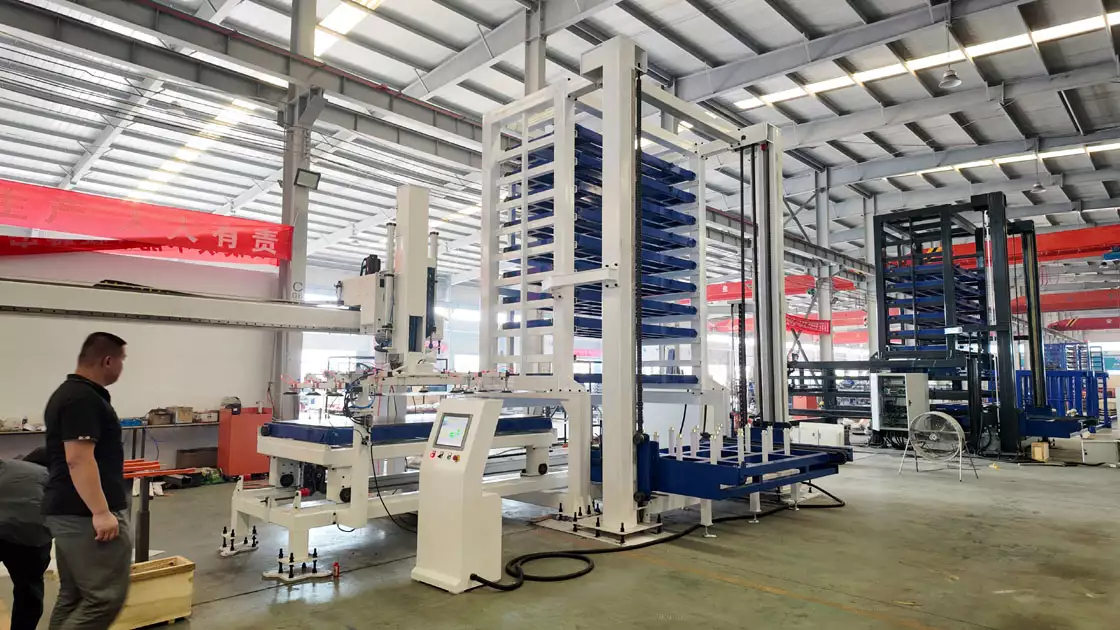
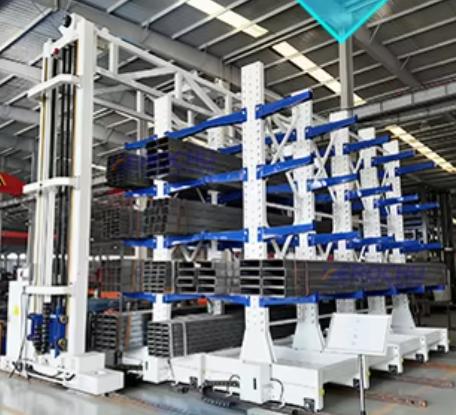
Between the rack faces runs the automated gantry that defines the system as a true ASRS rather than static high-density storage. The gantry rides on precision-ground rail tracks mounted to the warehouse floor or an elevated runway structure. Travel speed ranges from 5 to 30 meters per minute — slow enough for safe heavy-load handling, fast enough to keep retrieval cycle times under two minutes.
The lifting mechanism uses a hoist or screw-driven carriage rated for the maximum per-level load plus a safety factor. Lifting speed of 5 to 15 meters per minute means the vertical travel component of a retrieval cycle completes in seconds for lower shelves and under a minute for the uppermost levels. The carriage’s gripping system — typically fork-style tines or a custom cradle — engages the bundle from below or from the sides, depending on material geometry. Position feedback comes from absolute encoders on both the horizontal travel drive and the vertical lift, with the PLC comparing actual position to target coordinates at a ±2 mm tolerance before engaging the load.
Configurability for Mixed Inventories
A single Herochu heavy-duty ASRS racking system for steel pipe and profile storage often houses multiple material categories. One tower section might store carbon steel mechanical tubing in diameters from 2 to 8 inches. An adjacent section handles structural hollow sections. A third manages stainless steel pipe where segregation prevents carbon steel contamination. The shelf layout adapts to each category: deeper bays for long structural members, subdivided compartments for smaller-diameter tube bundles, and dedicated zones for remnants and partial lengths.
This configurability extends to the rack’s load-bearing design. Heavy-wall pipe in large diameters concentrates weight in fewer pieces per bundle; the shelf arms are spaced and sized accordingly. Lighter profiles like aluminum extrusions or thin-wall tubing spread weight across more pieces, demanding closer arm spacing to prevent sag. Herochu engineers model each customer’s material matrix during the quotation phase and generate a shelf layout drawing that maps every storage position to a specific material type and weight range.
Control Architecture
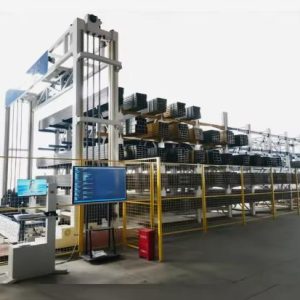
The PLC system governing the gantry and safety interlocks runs on an industrial automation platform — typically Siemens or Mitsubishi depending on customer preference and existing plant standards. The operator interface is a color touchscreen HMI mounted at a control station outside the rack perimeter. The HMI displays a graphical representation of the rack layout with occupancy indicators, material details for each stored bundle, and retrieval queuing controls.
Safety features include light curtains at the retrieval station that stop gantry motion if a person enters the pickup zone, emergency stop buttons at the control station and along the rack perimeter, and overload sensors on the lifting carriage that prevent attempts to lift bundles exceeding rated capacity. The control system logs every retrieval and storage transaction, creating an audit trail for inventory reconciliation and production tracking.
Installation and Commissioning
Rack assembly follows a sequenced erection plan. Base plates anchor to the concrete slab with chemical or mechanical anchors rated for uplift and shear. Upright columns erect in sections, braced and plumbed before shelf arms install. The gantry rail mounts on independent foundations or floor plates isolated from the rack structure to prevent load-induced movement from transferring misalignment to the rail.
Commissioning includes mapping every storage location into the PLC’s coordinate table. A technician drives the gantry to each shelf position using a handheld pendant, records the encoder values, and assigns the digital address. This commissioning run also verifies clearance at every position — critical in dense multi-level racks where a few millimeters of accumulated tolerance can create interference at the highest shelves.
Operating Reality
Once commissioned, the rack system runs with minimal operator involvement. A worker at the HMI selects a material entry for retrieval. The gantry positions, extracts the bundle, and delivers it to the pickup station. The operator confirms receipt, and the inventory record updates automatically. For inbound storage, the process reverses: the operator places a tagged bundle at the intake station, selects an available storage location from the HMI’s suggested list, and the gantry transports and stores it.
For facilities moving hundreds of tons of pipe and profiles weekly, this automated loop eliminates hours of crane time, forklift travel, and manual searching. The rack itself protects material from the dings, bends, and surface damage that accumulate when bundles sit on concrete floors or lean against shop columns. The result is faster retrieval, accurate inventory, and material that arrives at the saw or welding cell in production-ready condition — not requiring rework to fix storage damage. Herochu’s heavy-duty ASRS racking system for steel pipe and profile storage turns the rawest material in the supply chain — structural steel in its longest, heaviest form — into a digitally managed asset.