There is a version of this article that describes a rack. It would list the load capacity, the sheet dimensions, the number of layers, and the structural steel grade. It would be accurate and uninteresting.
The more useful version describes what happens when a heavy-duty vertical tower stops being a static structure and becomes a node in the factory’s material flow network. The 5,000-kilogram load rating is not merely a number on a specification sheet; it is the threshold at which storage ceases to be a manual operation and becomes an automation problem. A plate that weighs five tons cannot be moved by hand. It requires a machine. And once a machine is involved, the question becomes: how much of the material handling process can that machine own?
The Weight Threshold
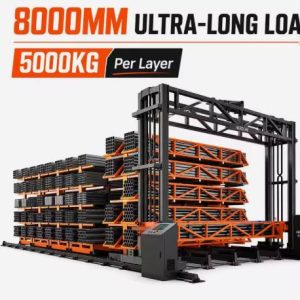
Five thousand kilograms per level is a design specification that changes the nature of the system. At lower load ratings — 500 kg, 1,000 kg — a vertical tower can function as an assisted storage device. The operator still interacts with the material directly, perhaps using a lift assist or a hoist. At 5,000 kg, that model breaks down. The plate is too heavy for any manual intervention. The tower must present the material to a handling device, and that handling device must be integrated into the retrieval workflow.
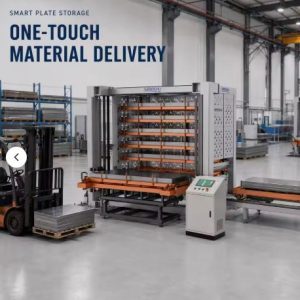
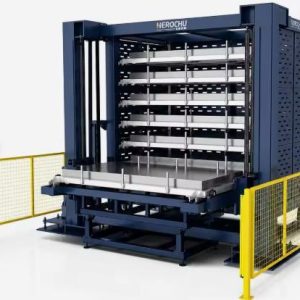
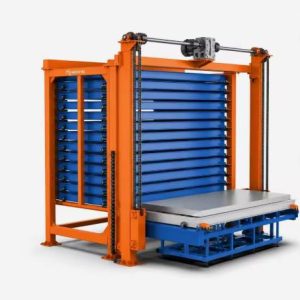
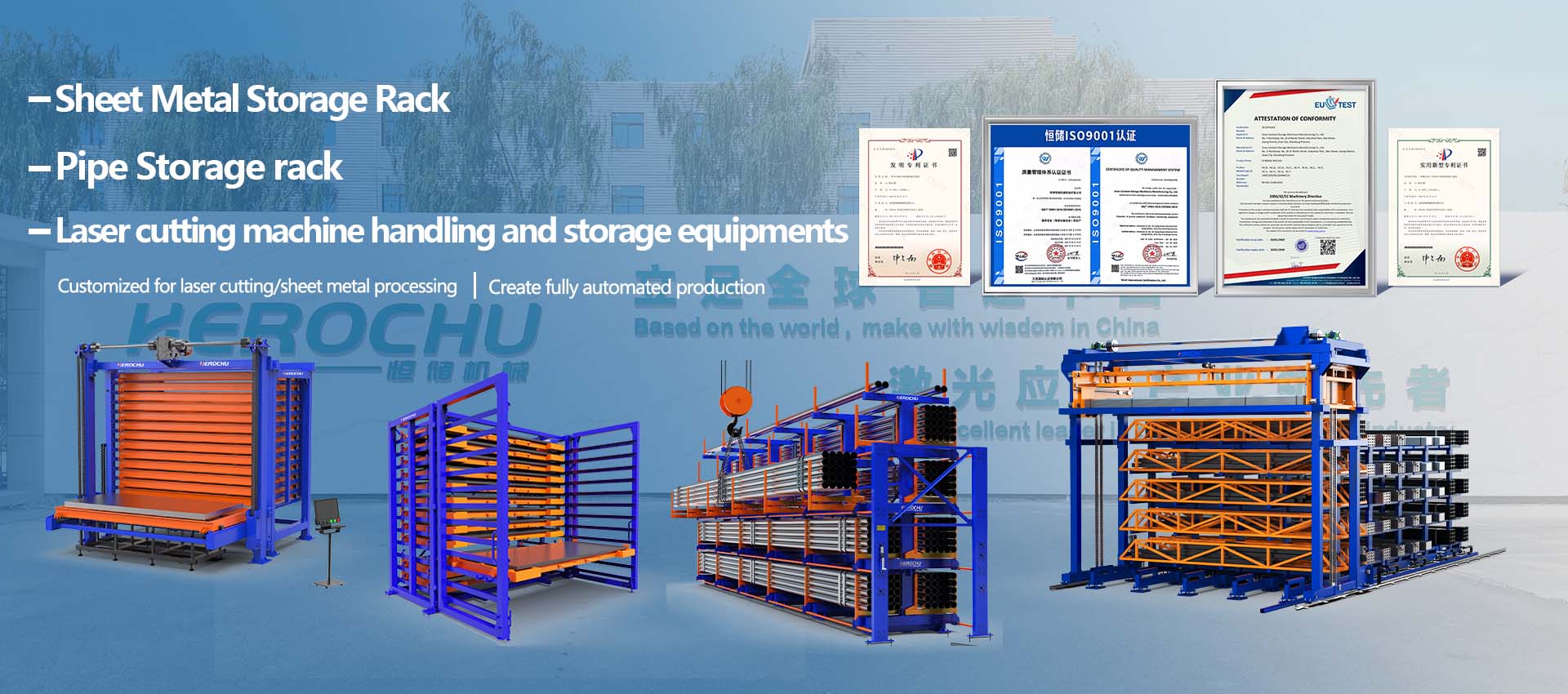
Herochu’s heavy-duty vertical tower is engineered for this regime. The HC-S heavy series spans four standard models covering sheet dimensions from 3,000×1,500mm through 6,000×2,000mm, with per-layer load ratings reaching 5,000 kg on the larger frames. The number of storage levels scales from six to fifteen depending on ceiling height and throughput requirements. A fully loaded fifteen-tier tower with ten storage positions per face holds 750 metric tons of plate within a ground footprint smaller than a standard flatbed trailer.
Structural Design for Sustained Heavy Loading
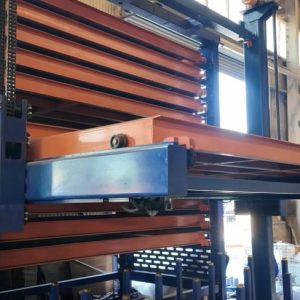
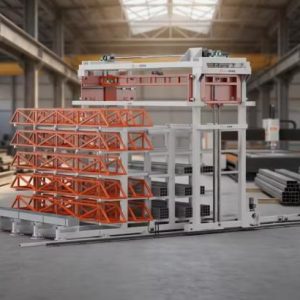
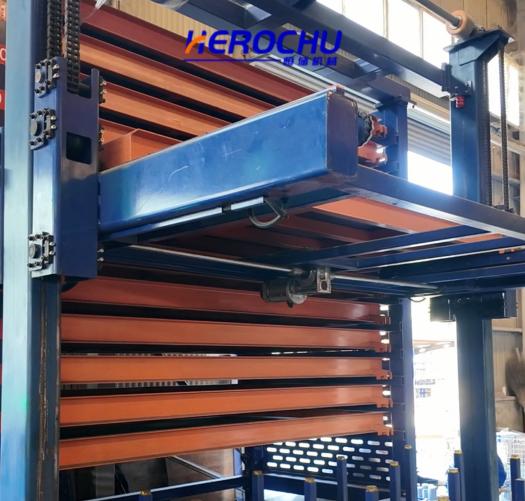
The structural engineering that supports these loads is not visible in a photograph, which is precisely why it deserves attention in prose. The primary columns are fabricated from Q235B high-strength steel in box-section profiles sized to resist vertical compression under full payload. The lateral deflection — the side-to-side sway that occurs when a heavy tray accelerates or decelerates during vertical travel — is controlled by the column geometry and the guide rail system.
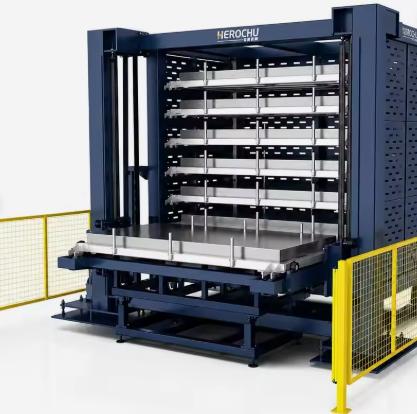
A tower that stores 5,000 kg per shelf across ten or more tiers is subject to cumulative vertical loads that increase with every level. The bottom columns carry the weight of everything above them. Herochu’s design accounts for this with graduated column specifications and reinforced joint details that maintain structural integrity across the full height of the tower.
The Lift System: Precision Under Load
The lift mechanism is the component that converts the tower from a static structure into a functional retrieval system. It must move a 5,000 kg tray from any level to the access opening, stop within ±2 millimeters of the target position, and do so repeatedly without drift or degradation.
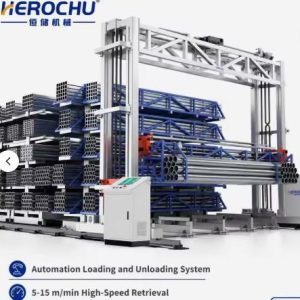
The transfer speed range of 5 to 15 meters per minute is a variable parameter. At the low end, the system is moving heavy loads with the smoothness required to prevent plate shifting on the tray. At the high end, it is cycling lighter loads at a pace that keeps pace with production demand. The system automatically selects the appropriate speed based on load weight and destination.
Robotic Handling and Unmanned Operation
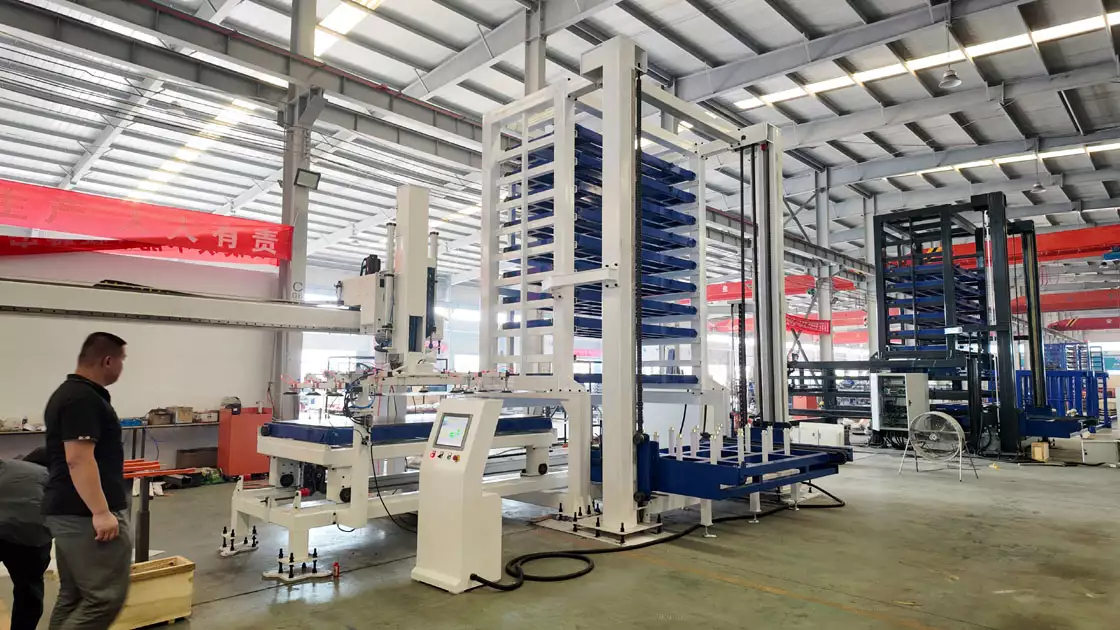
The phrase “unmanned factory operations” appears in industrial automation literature with regularity, but the practical meaning varies. For Herochu’s heavy-duty tower, it means the system can operate autonomously once a retrieval request is received. The operator — or the ERP system — issues the command. The tower locates the tray, brings it to the access position, and presents it to the downstream handling device. The plate is transferred. The tray returns to its storage position. The inventory record updates.
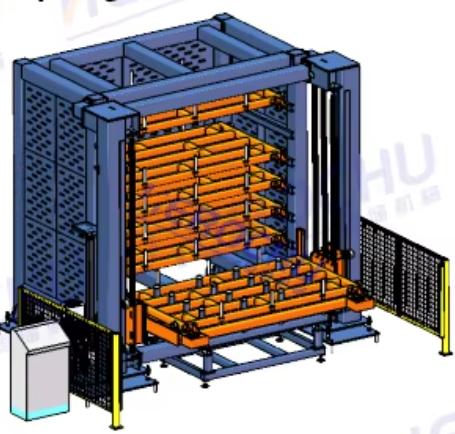
No human hands touch the plate during this sequence. The integration point is the access opening, where the tower’s tray meets the forklift, crane, or automated loading conveyor that moves the plate to the next process step. For facilities running lights-out shifts or operating multiple machines with minimal staffing, this level of autonomy changes the labor calculus. One operator can manage material flow for an entire cutting department when the storage system handles retrieval without human intervention.
Real-Time Inventory with Weight Verification
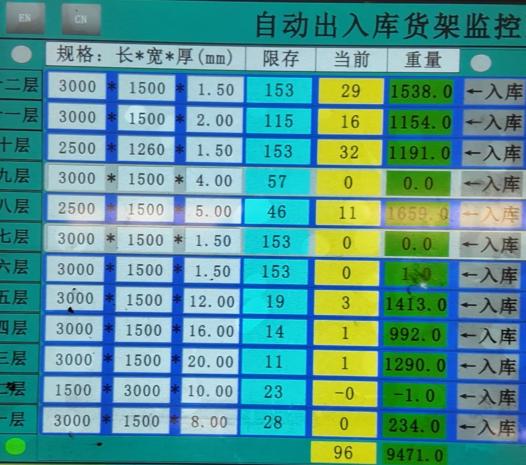
The built-in weighing function on each tray serves two purposes. The first is inventory accuracy: the system confirms that the material placed on a tray matches the material recorded in the database. If a 4,200 kg plate is placed on a tray that the system expects to hold a 4,000 kg plate, the discrepancy is flagged immediately.
The second purpose is consumption tracking. When a plate is retrieved for a job and a remnant is returned, the weight difference tells the system how much material was consumed. Over time, this data produces a consumption profile per job, per material type, per thickness. Production planners can use this information to refine material estimates and reduce waste.
Integration with Factory ERP
The tower’s control system communicates with the factory ERP through a REST API and direct database integration. Work orders pushed from the ERP trigger material reservations in the WMS. When a plate is retrieved for a job, the consumption update flows back to the ERP in real time. The result is a closed-loop material management system where inventory levels, work order status, and production scheduling are synchronized without manual data entry.
For a fabrication shop running dozens of jobs per week across multiple machines, this synchronization eliminates the lag between material consumption and inventory update that plagues manual tracking systems. The ERP sees the material movement as it happens, not at the end of the shift when someone updates a spreadsheet.
Customization for Specific Workflows
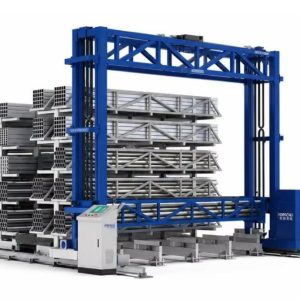
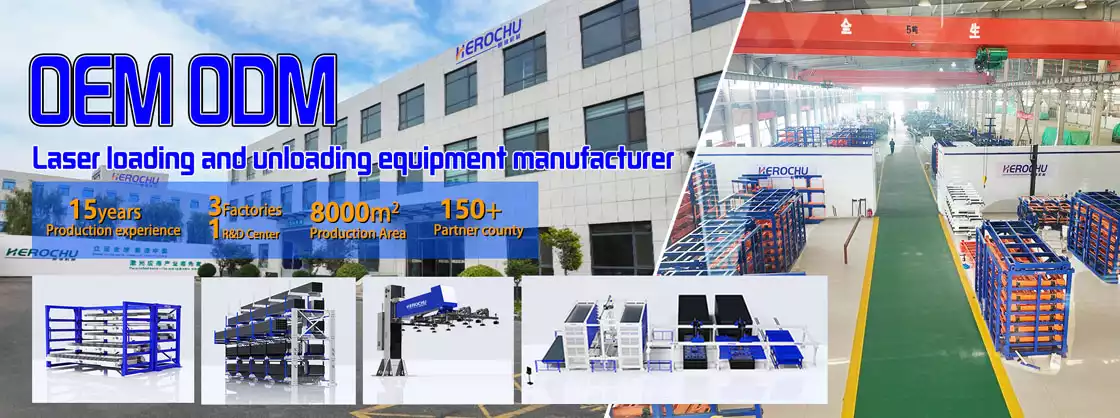
Herochu manufactures the heavy-duty tower to order, with layer count, tower configuration, tray dimensions, load capacity, and clear space between trays all configurable to the customer’s specification. A workshop with a high ceiling can specify fifteen levels to maximize vertical density. A facility handling exceptionally thick plate can specify trays with additional reinforcement. A shop with limited floor space but high throughput can configure multiple narrow towers rather than a single wide one.
This flexibility is the practical expression of a simple principle: the storage system should fit the workshop, not the reverse.