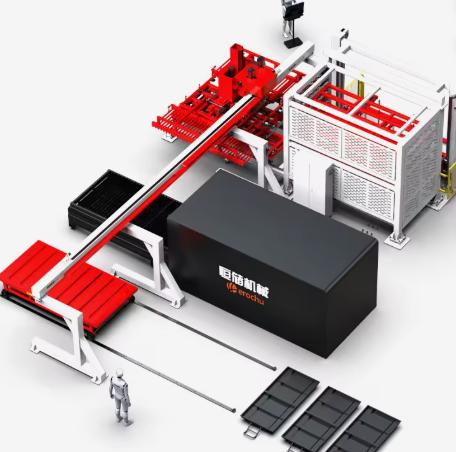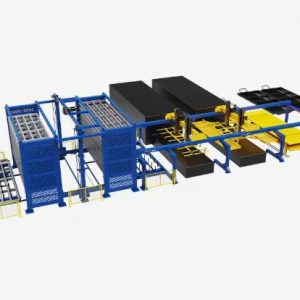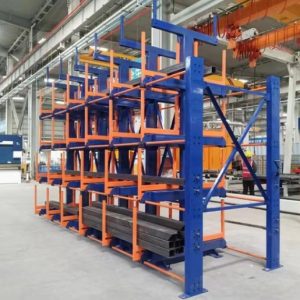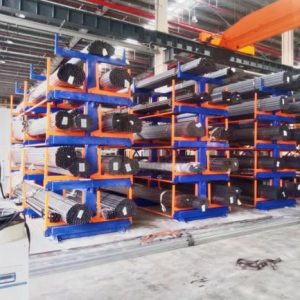
What is included in the system?
Suppliers use the same phrase for very different scopes. Before comparing prices, split the offer into five functions and confirm which are present: loading, unloading, storage retrieval, cut-material return and individual part sorting.
A quote that covers loading only still needs a person at the unloading end, and a quote that covers retrieval may assume someone moves the cassette from the transfer station to the loader. Those assumptions are where budgets slip, so ask for the boundary of each function on a drawing rather than in a sentence.
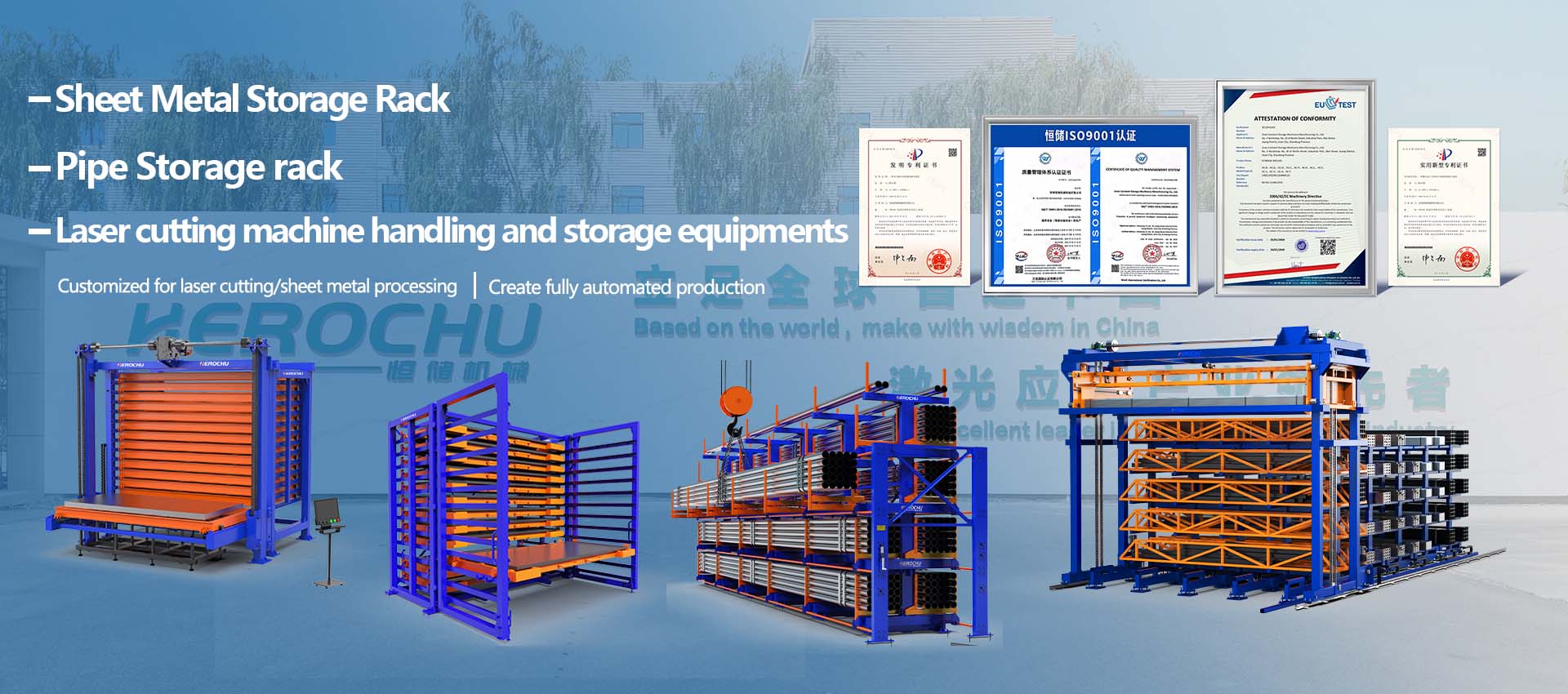
Herochu prices the five functions as modules for this reason. A shop can begin with handling at the machine and add storage later, and the second phase does not require replacing what already works.
What is the laser waiting for today?
Any specification written before this question is answered becomes a wish list. Watch one shift and record every stop longer than a minute against its cause. The pattern usually falls into four groups.
| Observed delay | Configuration to evaluate | Check first |
| Stock is ready; the machine waits for handling | Automatic loading and unloading | Whether the complete handling cycle keeps up with cutting |
| The next material stack must be found or moved | Storage connected to sheet handling | Material identification, available positions, retrieval sequence |
| The unloading position is full | Output buffer and clearing routine | Where cut material goes and when that space frees up |
| Parts accumulate before bending | Sorting and downstream workflow | Whether more cutting output can be processed |
Two of those causes have nothing to do with buying a machine. A full unloading position is solved by space and a routine; parts piling up before the brake is solved downstream. Automation bought for either problem will disappoint, which is why the shift observation belongs in the enquiry.
How do standalone and tower-connected systems differ?
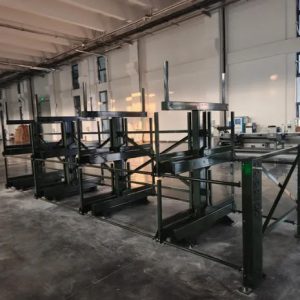
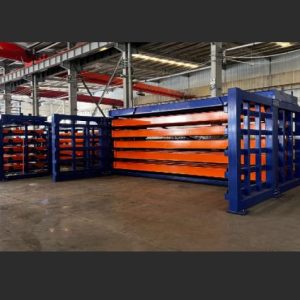
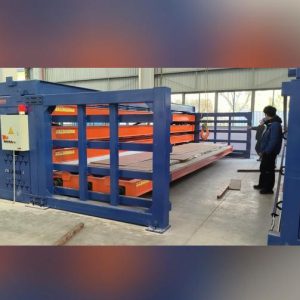
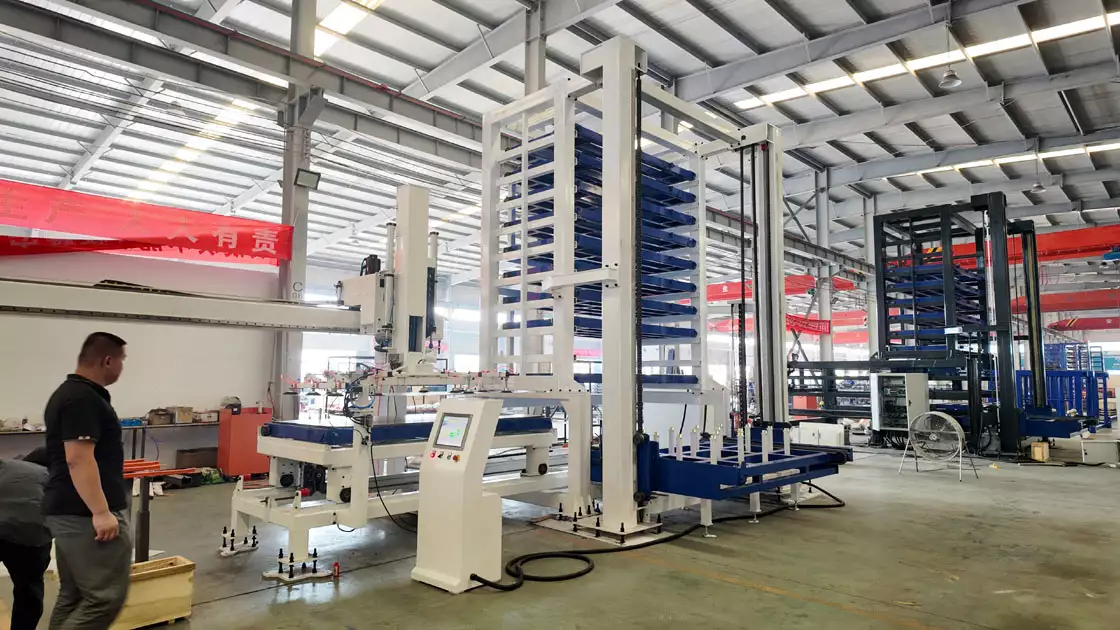
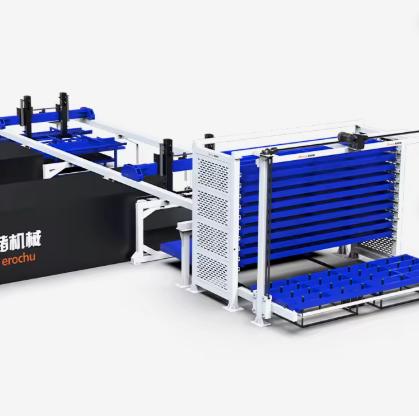
A standalone loader draws from prepared stacks beside the machine. A tower-connected system adds storage positions plus the mechanisms and controls that find and deliver the requested material. Herochu treats that as a control decision, not only a hardware one, because it changes who decides what gets loaded.
| Selection point | Standalone loading and unloading | Tower-connected loading and unloading |
| Material source | Prepared stacks or input stations | Assigned storage positions feeding the handling system |
| Material changes | May require changing stacks or switching input positions | Can call up stored material where the controls support it |
| Continuous supply | Depends on input stock and replenishment access | Depends on usable capacity, stock allocation and retrieval |
| Cut-material destination | Specified unloading stations or pallets | Output stations or supported return-to-storage positions |
| Layout | Stock, handling travel and output clearing | Also tower height, transfer paths, access and floor loading |
What layout data belongs on the drawing?
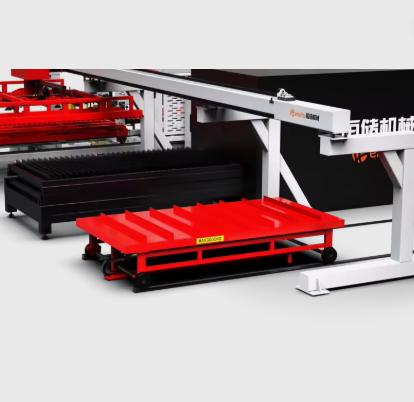
Ask for a plan showing raw-stock positions, destinations for processed material, and any position shared between the two. Shared positions cause trouble later, because a return can occupy the slot the next job needed.
The drawing should also carry clear height for lift travel, floor loading at the tower anchors, the transfer path to the laser, the maintenance side of every mechanism, the forklift route for replenishment, and the fence line with its gates. A layout that fits on paper but leaves no route for a pallet truck is not a layout.
Where one handling resource serves two cutters, add the dispatch logic: which machine has priority, what happens when both call at once, and how a return is queued behind an issue. Herochu tests these sequences against the customer’s order mix before the layout is frozen.
Which questions expose a weak proposal?
Eight questions separate a considered offer from a brochure with a price:
1. On which nests and sheet formats was the quoted cycle time measured?
2. How many storage positions remain usable once returns and remnants are reserved?
3. How is a double sheet detected, and what does the loader do when it finds one?
4. What happens when the output station is full mid-shift?
5. Which controller interface is used, and who writes and tests the handshake?
6. What is the recovery routine after a dropped sheet or a vacuum fault?
7. Which spare parts are recommended for the first year, and at what lead time?
8. Who commissions the cell, who trains the operators, and what is accepted as proof of performance?
The answers reveal whether the supplier has automated a laser before. A cycle time quoted without naming the nests is a marketing figure; a performance acceptance that names them is a commitment.
How long does installation take?
It depends on the modules and the building work. Fencing, foundations and services usually take longer than the mechanical assembly, so Herochu plans them as separate phases with separate owners.
Can the system be extended later?
If the first phase leaves space and interface capacity for it. A standalone loader can usually be connected to storage later, provided the layout reserved the transfer path and the controls support it.
Does a storage tower replace a forklift?
It reduces forklift work at the machine but does not remove deliveries. Pallets still arrive, and someone still loads them at the transfer station.
Buy the stop you can measure
An automatic sheet storage and loading system earns its cost when it removes a specific delay that appears in the shift record. Define the functions, count the usable positions, draw the envelope and name the interfaces, and the prices start to compare like with like.
Herochu builds these cells from the machine backwards, starting with what the laser waits for and ending with the storage and sorting modules that keep it supplied and clear.