What changes when stock is stored, not staged?
In a shop without storage automation, sheet stock lives wherever there is floor: against a wall, under the mezzanine, behind the brake. Finding a grade and thickness becomes a search, and every search is downtime once the laser is ready to cut.
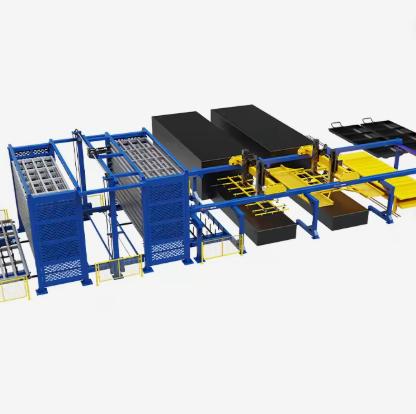
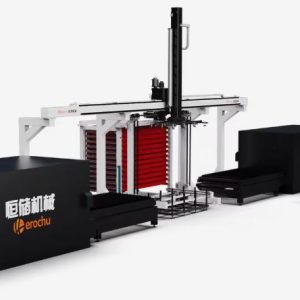
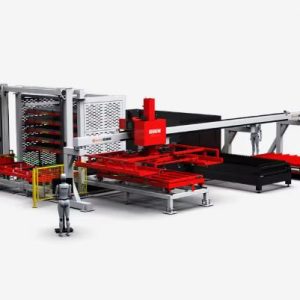
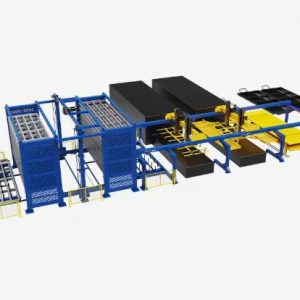
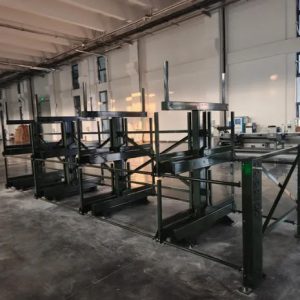
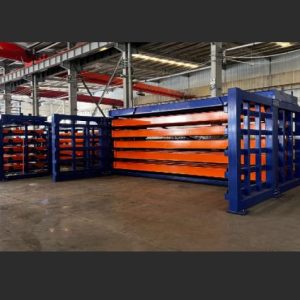
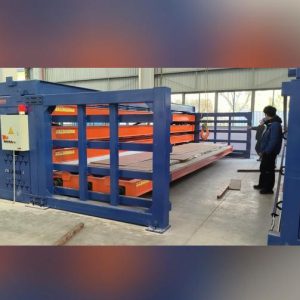
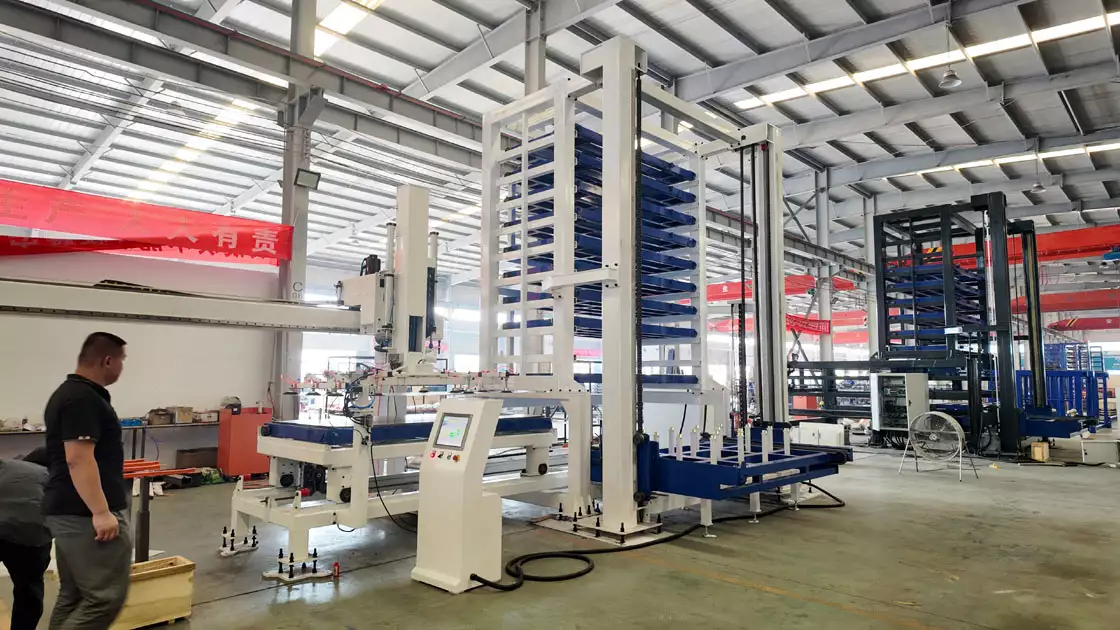
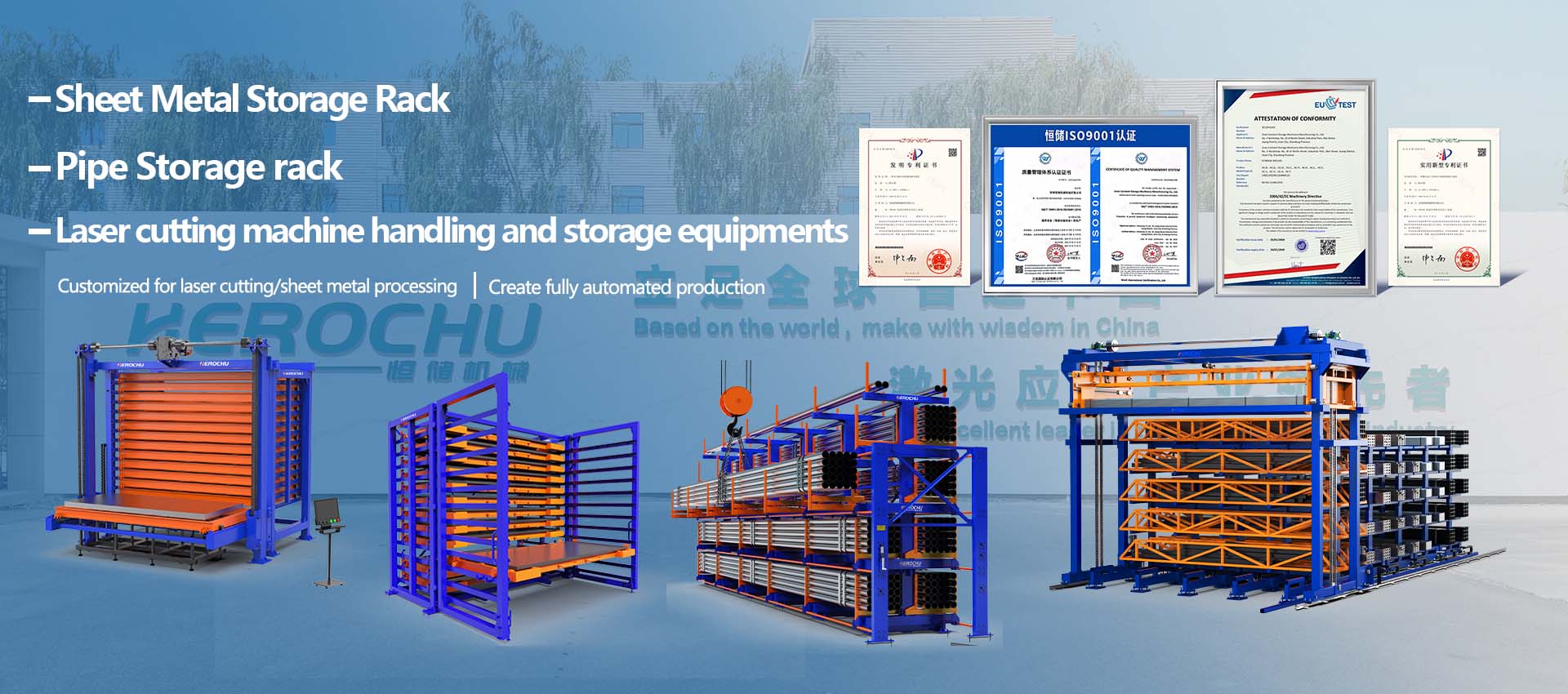
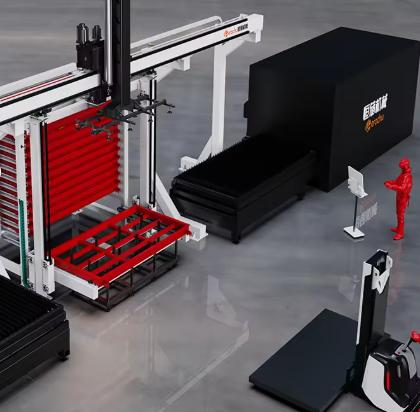
An automated storage and retrieval system turns that stock into addressable positions. The tower holds cassettes of sheet; a lift and extractor bring the requested cassette to a transfer station; the loader takes a sheet from there. When the cutting program calls for three millimetre mild steel, the system knows where it is.
The return path matters as much as the outbound one. Cut sheets, remnants and part-loaded cassettes go back into storage instead of occupying the floor around the machine, which is what keeps a cell tidy over a full week rather than only on the day of the site visit. Herochu plans both flows on the same drawing, because a tower that only issues material runs out of usable positions.
How many positions do you actually have?
A tower with eighteen physical levels does not offer eighteen positions for new stock. Some levels are reserved for material returning from the laser, some hold remnants, and some are inaccessible while the extractor serves another level.
The number that matters is usable positions during a real production plan. Ask for it in writing, with the reservation rules stated: how much space is held for returns, whether remnants share positions with full sheets, and what happens when a return finds no free position.
That question exposes the weak point of many layouts. If returns depend on a position the plan has already allocated, the cell stops at the end of the shift, when paperwork and tower disagree.
What must be identified before retrieval?
Retrieval is only as good as the data behind it. Six attributes decide whether the right cassette arrives, and Herochu specifies the identification method together with the inventory routine:
Material grade, since mild steel and stainless cannot be swapped without scrapping the nest.
Thickness, since cutting parameters and the loader’s separation settings both depend on it.
Sheet format and stack height, which must match the cassette and loader envelope.
Remaining quantity, so a nearly empty stack is flagged before the program needs it.
Position address, updated every time a cassette moves, including after manual intervention.
Job allocation, so material reserved for an order is not issued to a different one.
Identification can be manual entry, barcode or RFID at the transfer station. Whichever is used, the record must be corrected when someone removes a sheet by hand. An inaccurate position map is worse than none, because the system confidently delivers the wrong material.
How do retrieval, cutting and unloading share the cell?
The loop has four movements: raw material leaves storage, the sheet is loaded and cut, the cut sheet is unloaded, and the cut material returns to storage or to an output station. It runs only at the rate of its slowest movement.
A shorter retrieve stroke helps, but the transfer station is usually the tighter constraint: one station serves both issue and return, so a return can delay the next issue. A second transfer position, or a buffer between tower and loader, removes that conflict. Confirm which the layout includes, and how it behaves when a return arrives mid-issue.
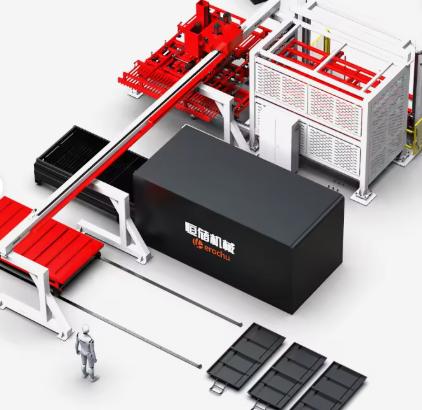
What happens when two cutters share one handling resource?
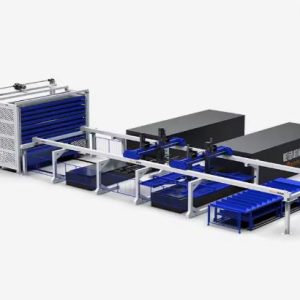
Dual-machine cells look efficient on a drawing and reveal their limits under simultaneous demand. If both lasers finish a nest within a minute, one waits, and the dispatch rule decides which.
Test three scenarios during acceptance: both machines call at once, one requests a grade held at the slowest level, and a return is queued behind an issue. The waiting times you record are the real capacity of the cell, not the sum of its mechanisms.
A dual-tower arrangement is a different configuration from a single tower serving two machines, with its own specifications for height, floor loading and transfer paths. Herochu quotes both layouts separately so the comparison stays honest.
Which site conditions decide the layout?
Storage automation is a building project as much as a machine purchase. Check floor loading and flatness under the tower anchors, clear height for lift travel, the transfer path to the laser, and the fire strategy for a block of oiled sheet and packaging. Operators also need to reach the transfer station without crossing the loader envelope.
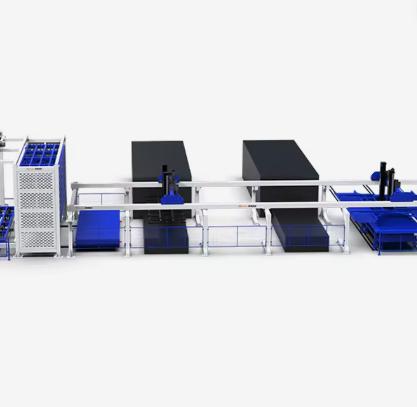
Is a storage tower worth it for a single laser?
It is when a wide material mix makes searching and changing stacks interrupt cutting, or when floor space around the machine is scarce. For one grade run continuously, Herochu would quote a standalone loader instead.
Can a tower store remnants and offcuts?
Yes, if remnant cassettes are in scope. Without a remnant routine, offcuts accumulate on the floor and the storage gain disappears.
What is the difference between a storage tower and an ASRS?
The terms overlap. A tower is one physical form; an automated storage and retrieval system describes the mechanism and controls that address positions and deliver material, whether the structure is a tower, a rack or a multi-level layout.
Design the loop, then the tower
Storage automation pays when retrieval stops being a search and becomes a scheduled movement. That needs usable positions that survive a real plan, identification that stays accurate after manual picks, and a transfer station that can issue and receive without deadlock.
Herochu lays out automated storage and retrieval around those four movements, then sizes the structure to the stock the plan holds, so the tower serves the schedule instead of becoming an expensive place to keep the wrong material.