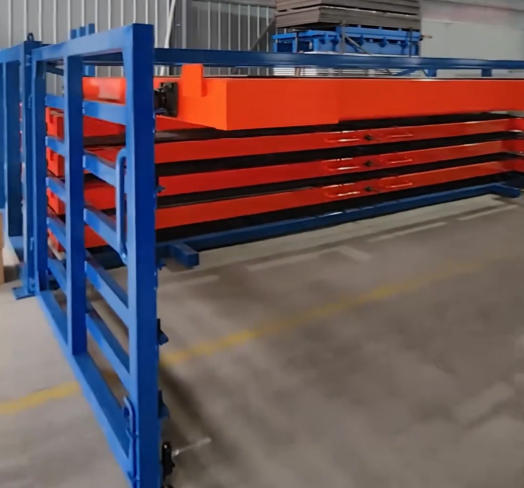
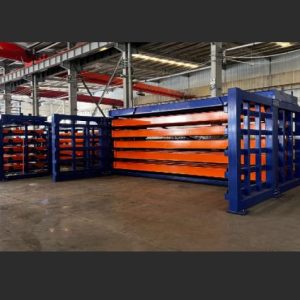
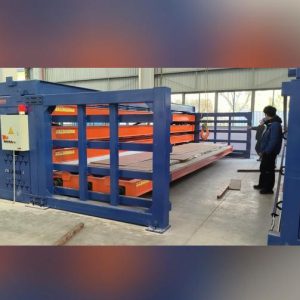
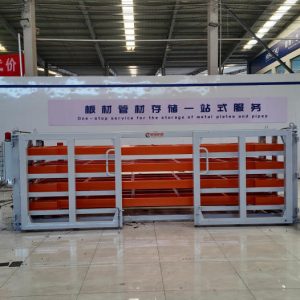
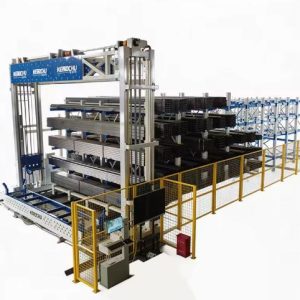
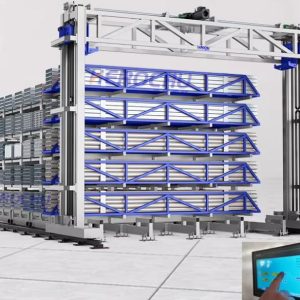
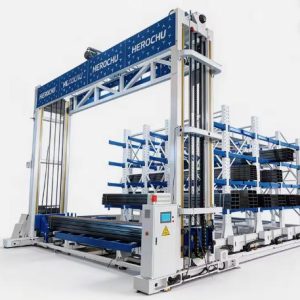
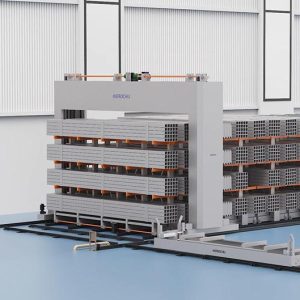
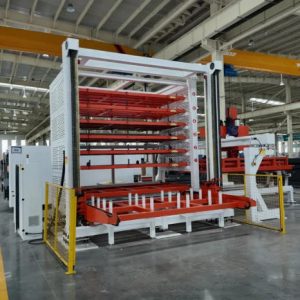
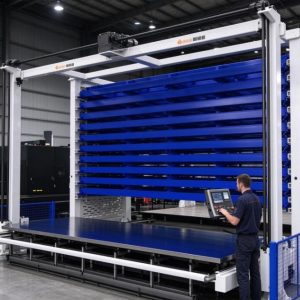
OSHA does not publish a stand-alone standard titled “sheet metal rack safety.” What it publishes is a general duty: storage of material shall not create a hazard, and materials stored in tiers must be stable and secure against sliding or collapse. For a plate magazine holding multi-ton steel or aluminum drawers, that general language translates into three specific failure points: the drawer, the anchorage, and the load rating.
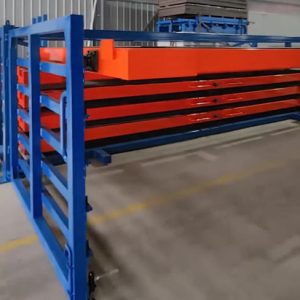
The drawer is the first point because it moves. A motorized drawer carrying 5,000 kg of steel plate is a horizontal load in motion, and the drive system, the rollers, and the frame must manage that momentum without allowing the plate to shift or the drawer to overrun. Herochu’s electric magazine design uses a stepper motor and PLC frequency conversion control on the roll-out mechanism, which allows the drawer speed and acceleration to be regulated rather than run at a fixed rate. The remote control keeps the operator outside the travel path, which removes the most common struck-by or pinch-point exposure in manual cranking.
Anchorage is the second point. OSHA citations for sheet metal storage racks frequently trace back to racks that were not anchored to resist horizontal and vertical loads, or that lacked visible load-capacity plaques. A motorized plate magazine is taller and heavier per square meter than a simple cantilever rack, and the drawer extension changes the center of gravity each time a level is accessed. The foundation and anchor design must be part of the rack specification, not an afterthought at installation.
Load labeling is the third point. A rack without a clearly visible load limit is a rack that invites overloading. Each Herochu magazine tier is rated individually—3,000 kg per level on the HC-B3015E-63, 5,000 kg on the HC-B6015E-65, and 20,000 kg on the HC-B12025E-520—and those ratings should be posted at the rack, not buried in a manual.
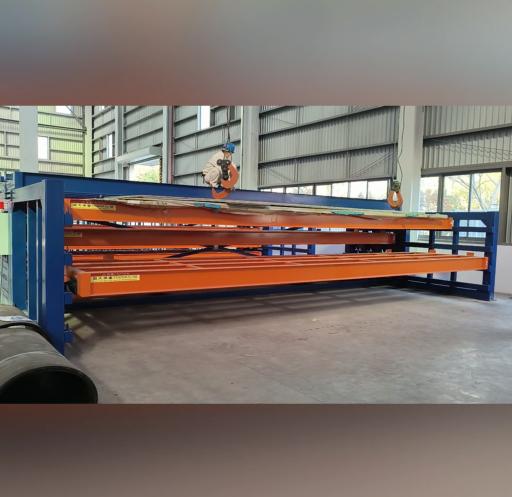
Inspection follows from those three points. Weekly visual checks should look for bent or deflected drawer beams, cracked welds, missing anchor bolts, and worn roller surfaces. A quarterly detailed inspection should verify that the drive chain or screw mechanism is tensioned correctly, that the remote control responds without delay or drift, and that the load plaques remain legible. The Rack Manufacturers Institute’s MH16.1 specification provides the design and utilization framework that OSHA citations commonly reference when a rack failure is investigated.
Herochu’s frame construction—Q235B high-strength steel with a dual-beam crossbar design—is intended to keep the drawer path rigid under load, but the steel is only one part of the safety equation. The maintenance program, the anchor installation, and the operator training around the remote control determine whether the rack stays within its design envelope over years of two- or three-shift use.
For facilities storing stainless steel or aluminum alongside carbon steel, the inspection should also check the drawer surface. A scratched or contaminated deck does not create a structural hazard, but it does create a material-quality hazard. Herochu offers non-marking liner options for mirror-finish and No. 8 surface plate, and the frame can be configured to keep stainless bundles separated from carbon steel contact. That separation belongs in the safety and quality procedure, not just the purchasing specification.
The simplest compliance posture is to treat the motorized magazine as a piece of operating equipment, not as passive shelving. It has a drive, a control, a load rating, and an anchor requirement. Document all four, inspect all four, and the rack stays on the right side of the general-duty language that OSHA actually enforces.