Automated Sheet Metal Buffer Storage with WMS Integration for Laser Cutting
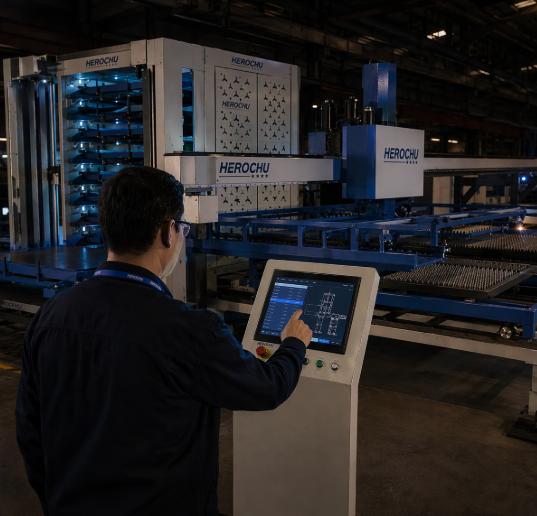
Automated sheet metal buffer storage connects a vertical ASRS tower to the warehouse management system, so every sheet is booked in, stored, retrieved and consumed against a real job. Herochu links the tower control to the WMS and the cutting schedule, which keeps the laser fed and makes stock accuracy a by-product of normal production rather than a monthly count.A tower without a warehouse system is a very expensive cupboard. It moves drawers when someone presses a button, and it has no opinion about whether the sheet inside is the right alloy, the right thickness or reserved for a job that ships on Friday.
Automated Sheet Metal Buffer Storage with WMS Integration for Laser Cutting
Automatedsheet metal buffer storage connects a verticalASRS tower to the warehousemanagement system, so every sheet is booked in, stored, retrieved and consumed against a real job. Herochu links the tower control to the WMS and the cutting schedule, which keeps the laser fed and makes stock accuracy a by-product of normal production rather than a monthly count.
What goes wrong without a WMS link?
A tower without a warehouse system is a very expensive cupboard. It moves drawers when someone presses a button, and it has no opinion about whether the sheet inside is the right alloy, the right thickness or reserved for a job that ships on Friday.
Integration changes the unit of control. The tower stops storing “a stack of 2 mm steel” and starts storing identified sheets against identified orders. That single change fixes three problems that shop managers usually treat as separate: material search, stock accuracy and traceability.
What data actually flows between WMS, tower and laser?
The honest answer is less than vendors imply, and more than most shops use.
| Direction | Data | Why it matters | | WMS to tower | Material code, thickness, sheet size, quantity, level assignment | The tower knows what it holds and where | | WMS to tower | Job reservation and priority | Levels are held for work that is actually scheduled | | Tower to WMS | Pick confirmation, remaining quantity, empty level | Stock updates without manual entry | | Tower to laser | Sheet ready, thickness verified | The machine starts only on a confirmed single sheet | | Tower to WMS | Consumption on cut | Inventory reduces when the sheet is used, not when it is ordered |
The last row is the one that changes behaviour. When consumption is booked at the point of cutting, the stock figure on the planner’s screen matches the steel in the building.
How does buffer storage reduce inventory error?
Most sheet metal stock errors come from three habits: material put away in the wrong bay, offcuts returned without a record, and partial stacks counted by eye. None of them are carelessness. They are the natural result of moving heavy sheets by hand under time pressure.
An automated buffer removes the opportunity. Put-away is assigned, not chosen. A partial stack stays in its level with a recorded quantity rather than migrating to a corner. Counting happens continuously as a side effect of picking.
The commercial effect is working capital. A shop that trusts its stock figure can carry fewer tonnes and still keep the laser fed, because it no longer pads inventory to cover uncertainty.
What does the physical system contribute?
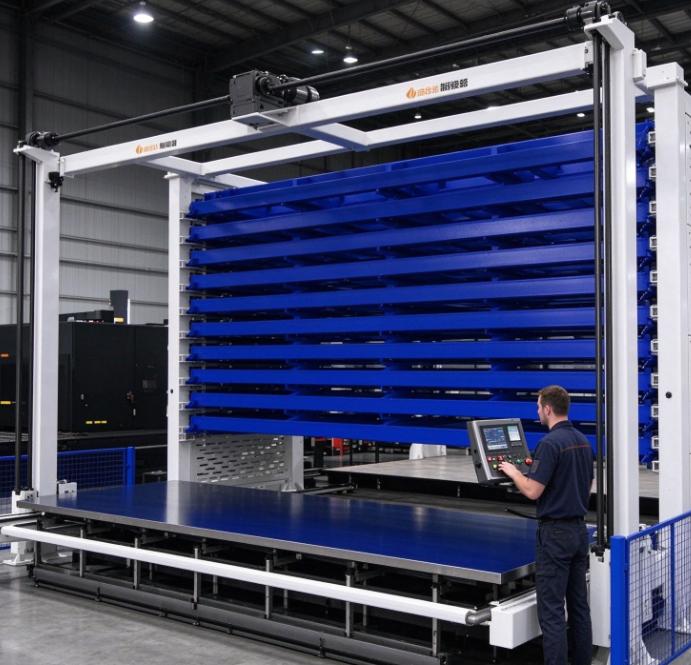
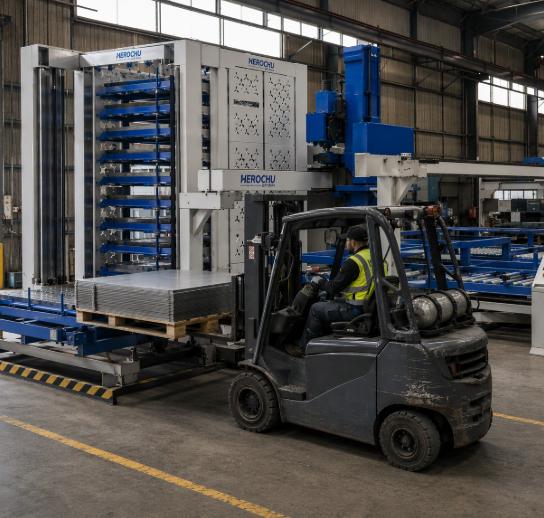
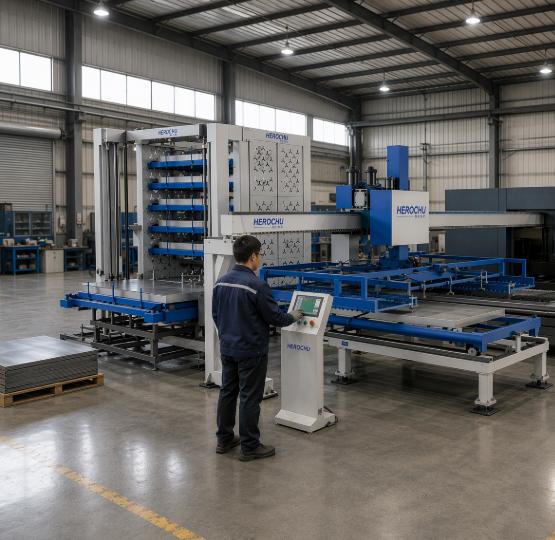
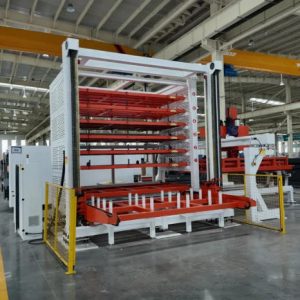
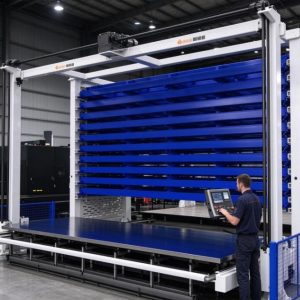
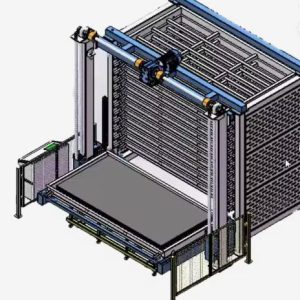
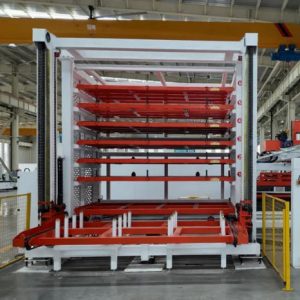
Software accuracy depends on hardware discipline. The Herochu tower takes 3000 x 1500 mm sheets across six levels of 3000 kg each, with 300 mm between levels and servo-driven lift and in-out motion. Loading and unloading to the laser cell runs at up to 800 kg per sheet.
Two hardware features protect the data as much as the material. Pneumatic separation nozzles break the stack before the vacuum picks, and a thickness check confirms the single-sheet pick. Without them, the WMS would record one sheet consumed while the laser actually cut two.
How does the buffer fit a production schedule?
The buffer sits between planning and cutting, and that position is what makes it useful.
Planning releases jobs in batches, often weekly. Cutting consumes material in sequence, often hourly. A buffer covers the gap: it holds the next few nests in physical form, so the laser is not exposed to planning granularity.
In practice the tower holds a shift or two of work across the material families in active use. Older stock stays in the main warehouse; slow movers do not occupy levels that the schedule needs.
What should a shop check before integrating?
Four questions separate a workable project from an expensive one:
Does the WMS hold material at sheet level, or only at tonne level? Sheet-level records are the minimum for automated picking.
Who owns the material master, and how often does it change? Two systems with different thickness conventions will disagree on day one.
How are offcuts treated? If remnants return to stock, the tower needs a rule for partial sheets and a level to hold them.
What happens when the network drops? The tower must keep running from its local queue and reconcile later.
How is the system rolled out without stopping the laser?
Phased. Herochu commissions the tower in manual mode first, proving the mechanics and the level map. The WMS link follows, initially in shadow mode: the system records what the operator does without controlling it. Once the two agree for a couple of weeks, control transfers and the buffer starts staging work automatically.
That sequence costs a little time and saves a lot of argument. Most integration disputes are data disputes, and shadow mode finds them before they reach the shop floor.
Questions shops ask about WMS-linked sheet storage
Does it replace our ERP? No. The tower control and WMS handle physical movement and short-horizon scheduling. The ERP keeps commercial stock and purchasing.
Can we keep manual override? Yes. Operators retain manual control for maintenance and exception handling, with the action logged so stock stays consistent.
What about audit and traceability? Every pick, return and consumption is recorded against a material code and job, which supports customer audits without a separate paperwork trail.
The practical outcome
WMS integration is not an IT project bolted onto a storage machine. It is the point where material handling becomes a data source. When the Herochu tower, the warehouse system and the cutting schedule share one record, the laser has material, the planner has a number they can trust, and the monthly stock count stops being an event.
FAQ
Here are some frequently asked questions about our sheet metal racks and pipe storage solutions. We hope you find them helpful!
Q1: Can I request a custom size or color? Absolutely. We offer complimentary design services and deliver efficient, tailored solutions to meet your specific requirements.
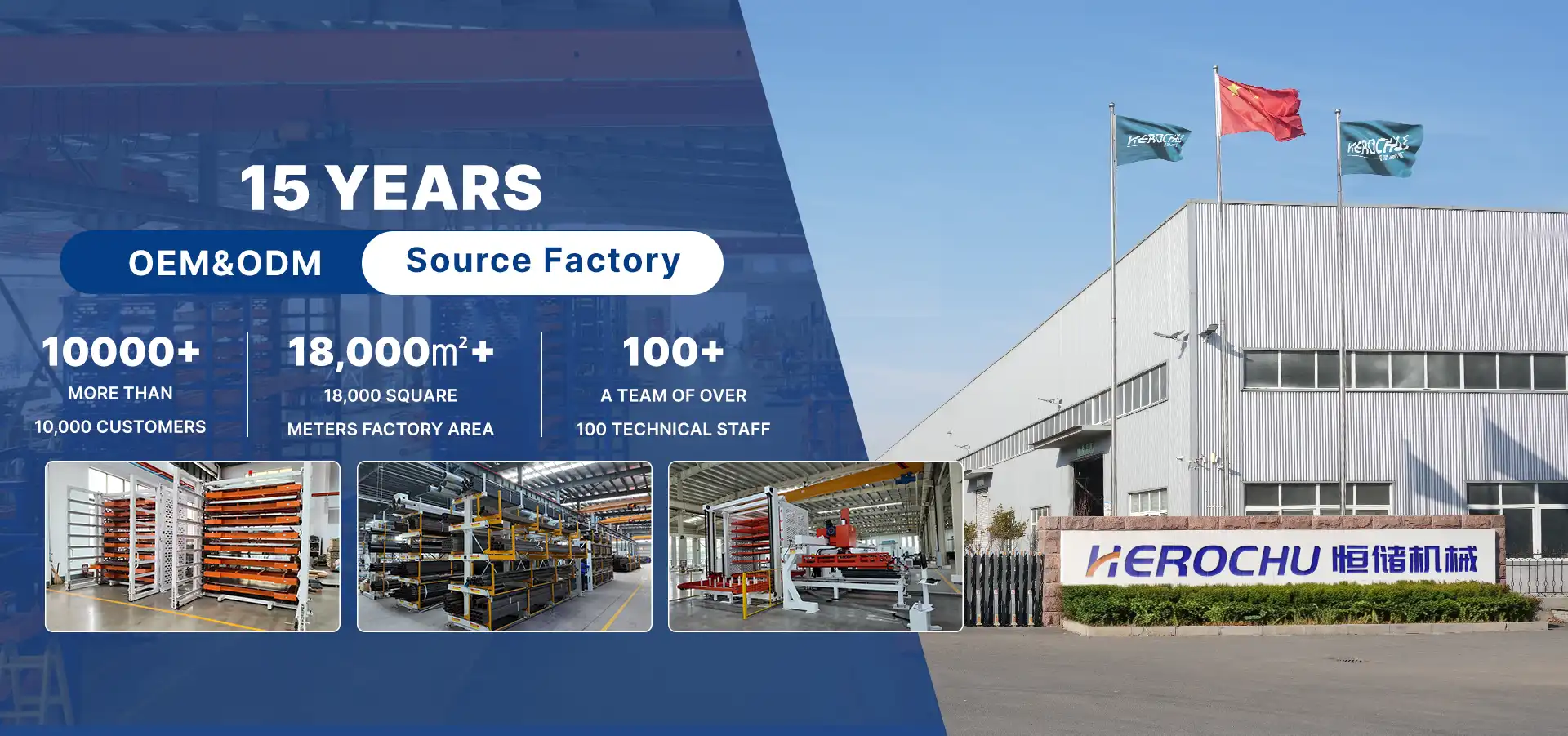
Q2: Are you a manufacturer or a distributor? We are a direct manufacturer with over 15 years of industry experience and expertise.
Q3: Is there a minimum order quantity? No. We welcome orders of any size, starting from a single unit.
Q4: How can I get detailed product information? Click the “Get a Quote” button to receive product images, detailed specifications, and videos. Our team is always ready to assist.
Q5: How do I provide my storage rack requirements? Simply share the type, dimensions, and quantity of materials you plan to store, along with any other specific needs. We will develop a professional storage solution for you. Alternatively, leave your contact details for a personalized consultation.
Q6: Do you offer automated loading systems or robotic arms? Yes. We provide loading robotic arms and integrated loading/unloading systems tailored to your laser cutting machine’s table size and material handling method (e.g., board rack, exchange platform, or material warehouse). Contact us with your details for a customized proposal.
Q7: Do you provide on-site installation and debugging? Yes. Our technicians can travel to your facility for installation and debugging, ensuring successful operation. We have served clients globally, including in the USA, South Korea, Russia, Qatar, Mexico, South Africa, Egypt, and Lebanon.
Q8: How do you ensure product quality? Our quality assurance includes:
A team of over 40 technical engineers for professional debugging and support.
A dedicated quality control department compliant with ISO9001 standards.
CE certification for all exports.
Rigorous load testing before shipment to ensure structural safety and reliability.
Q9: Where is your factory located? Our modern 10,000-square-meter manufacturing facility is located in Jiyang Industrial Park, Jinan, Shandong, China.
Q10: How can I evaluate your company’s capabilities? We offer virtual video factory tours and warmly welcome on-site visits.
Q11: What does your company specialize in? Jinan Constant Storage Machinery Manufacturing Co., Ltd. is a high-tech enterprise specializing in the R&D, production, sales, installation, and service of intelligent storage solutions. Our product range includes sheet material warehouses, drawer-style shelves, cantilever racks, servo manipulators, gantry loaders, and fully automated handling systems. Supported by a skilled technical team and advanced equipment, we are committed to delivering high-performance storage products and solutions to customers worldwide.
Customer visit
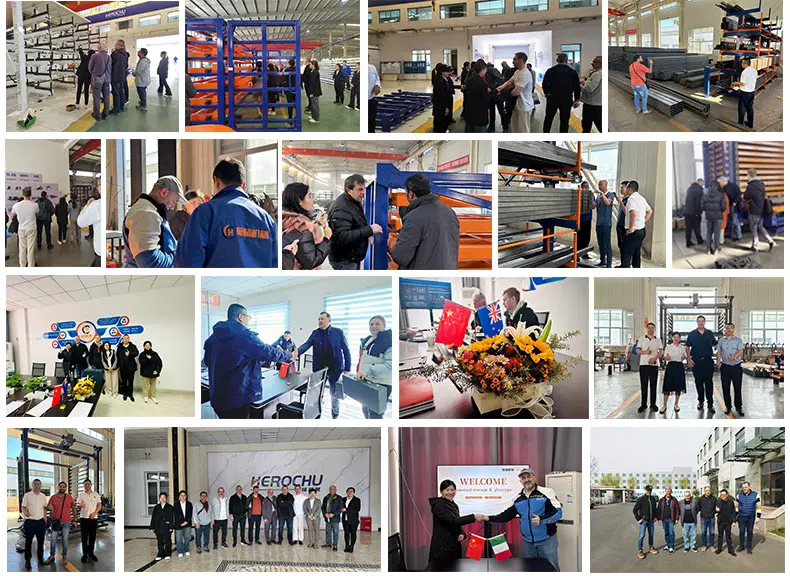
Herochu has always been adhering to the market-centric approach to meet customer requirements to the maximum extent, and the business philosophy of “creating brands with heart and gaining reputation with sincerity”. It provides customers with high-quality products and services with rigorous military quality, professionalism, and excellence, and has won unanimous praise in the Chinese aerospace, Chinese weapons, Chinese railways, automobile manufacturing, engineering machinery, non-ferrous metal titanium alloy and other industries.