What “long goods” automation has to get right
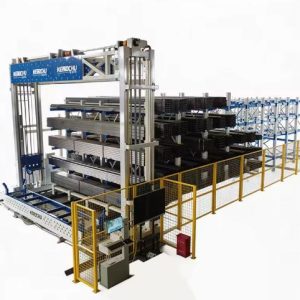
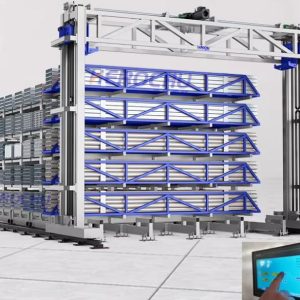
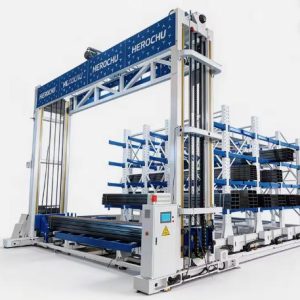
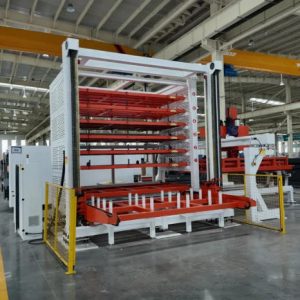
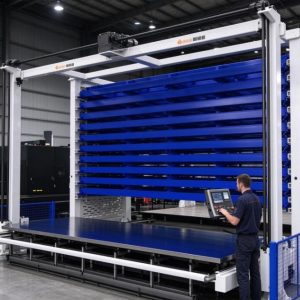
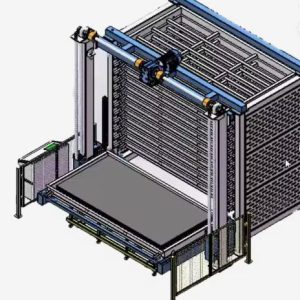
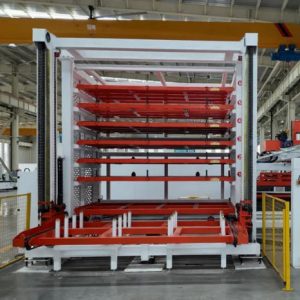
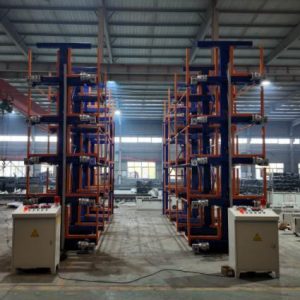
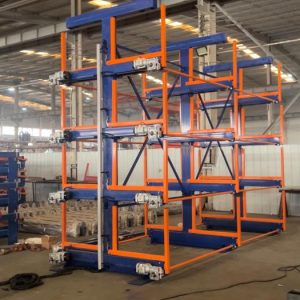
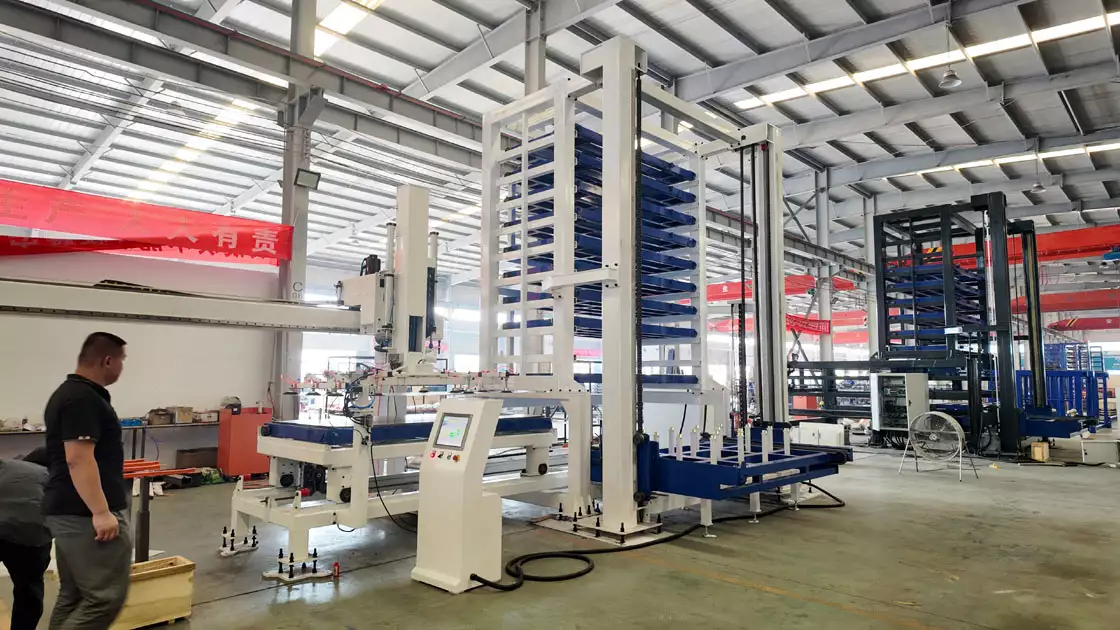
Long goods automation fails when it treats length as the only variable. A steel profile and pipe warehouse carries a mix of lengths, weights, and bundle configurations, and the storage system must retrieve a specific bundle without disturbing the inventory around it. The gantry automated long goods storage system addresses that requirement by combining a rail-mounted gantry, multi-level rack towers, and a digital inventory layer that maps every bin to a material record. Herochu’s system is built around that combination: the gantry travels at 5–30 m/min, lifts at 5–15 m/min, and holds ±2 mm repeatability, while the rack layout and bin configuration are customized to the on-site material schedule.
The space arithmetic of vertical long-goods storage
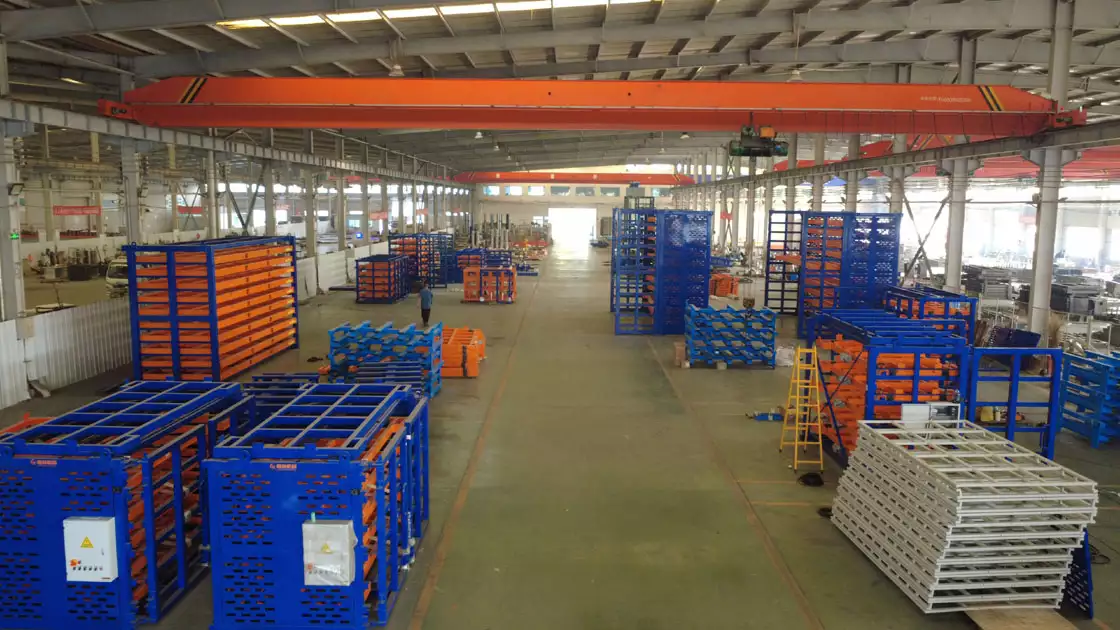
The first economic argument for vertical long-goods storage is floor area. Horizontal storage of 6 m or 8 m material requires floor length equal to the material length, plus retrieval clearance. Vertical storage turns the material length into bin depth and uses tower height as the storage multiplier. The gantry runs along a shared picking aisle at the rack face, so the aisle is not repeated for every rack column. The density gain is not a marginal improvement; Herochu reports 60 to 70 percent recovery of floor area previously used for pipe racks and laydown yards, with a 5,000-square-foot area reducing to approximately 1,500 square feet.
For a steel service center or fabricator, that recovered area has a direct opportunity cost. It can host a processing line, an inspection station, or shipping staging—activities that generate revenue rather than consume floor space. The density calculation should include not just the rack footprint but the eliminated forklift aisles, the eliminated laydown area, and the eliminated temporary storage that accumulates around a manual retrieval zone.
Throughput and the labor equation
Throughput in a long-goods warehouse is less about the speed of a single retrieval and more about the consistency of retrieval. A manual system depends on a forklift operator finding the right bundle, navigating to it, and extracting it without moving other material. Retrieval time varies with inventory density and operator familiarity. A gantry system retrieves the bin identified by the inventory record, and the PLC control sequences the travel, lift, and fork engagement without manual positioning. The result is a retrieval cycle that is repeatable rather than variable.
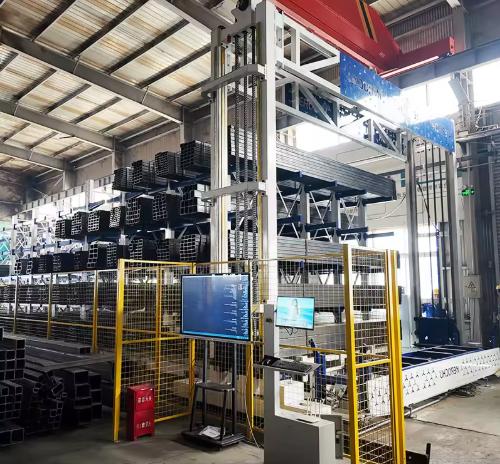
The labor effect is structural. One operator managing automated retrieval replaces multiple workers engaged in manual searching, forklift operation, and material transport. That does not necessarily mean headcount reduction; in many steel operations, it means reassigning scarce labor to processing, quality, or customer-facing roles where the labor shortage is more acute. The gantry system absorbs the repetitive retrieval work that is hardest to staff consistently across shifts.
Material compatibility and the mixed-length reality
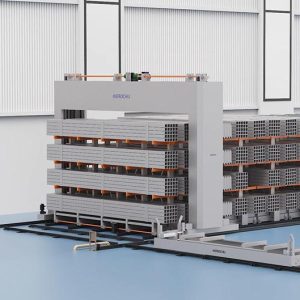
A steel profile and pipe warehouse rarely stores a single length. The HC-X series is built around that reality. The HC-X6053-8 handles 6,000 mm material across 5 layers at 3,000 kg per level. The HC-X7065-10 extends to 7,000 mm, 6 layers, and 5,000 kg per level. The HC-X8085-10 moves to 8,000 mm, 8 layers, and 5,000 kg per level. In all configurations, the number of racks is customized and the shelf layout is tailored to the on-site material requirements. Bins accommodate long and short materials and loose pieces, which reduces the need for separate storage zones for remnants and cut-offs.
That mixed-length capability matters because the alternative—a system optimized for a single length—forces the operation to maintain parallel manual storage for every length that does not fit the automated envelope. The gantry system’s value is highest when it absorbs the majority of the material flow, not just the standard lengths.
Where the gantry fits in the broader long-goods automation landscape
The long-goods automation market offers several architectures: honeycomb cassette warehouses, cantilever racking with automated access, and gantry-served tower systems. Honeycomb systems achieve high density through interchangeable cassettes and can reach system heights of 30 m with payloads up to 6,000 kg per location. The gantry tower approach differs in its access logic: the gantry travels along the rack face on floor rails rather than relying on a cassette extraction mechanism, and the shared picking aisle serves multiple rack columns. For operations that need to handle a heterogeneous mix of profiles and pipes without committing to a single cassette type, the gantry tower offers a flexible density solution.
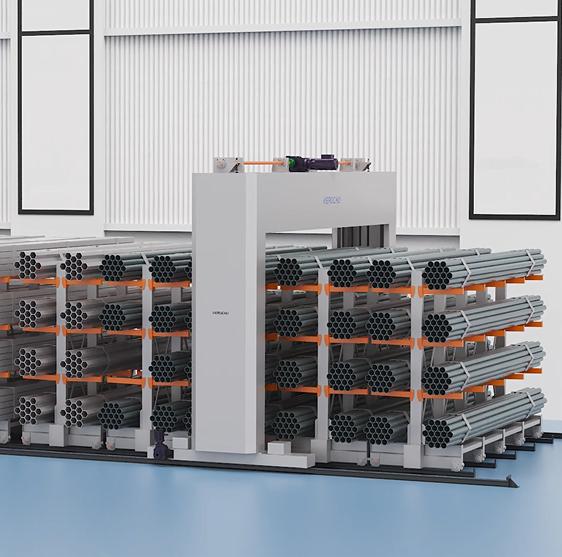
The choice between architectures should be driven by the material schedule and the retrieval pattern. A warehouse that retrieves full cassettes of a single profile may find a honeycomb system efficient. A warehouse that retrieves individual bundles from a mixed inventory, where adjacent material must remain undisturbed, is a stronger fit for a gantry-served tower with independent shelf movement.
Frequently asked questions
What is a gantry automated long goods storage system? It is a storage and retrieval system that uses a rail-mounted gantry to travel along multi-level rack towers and deposit or extract material bins. The gantry moves in three axes—travel, lift, and fork engagement—and is controlled by a PLC with digital inventory management.
How does it compare with a honeycomb cassette warehouse? A honeycomb warehouse uses interchangeable cassettes and a cassette extraction mechanism; it can achieve high density and heights up to 30 m. A gantry tower uses a traveling gantry on floor rails and a shared picking aisle. The gantry approach suits mixed-length inventories where independent bin access is important.
What throughput can a gantry long-goods system achieve? Herochu specifies traveling speeds of 5–30 m/min and lifting speeds of 5–15 m/min, with ±2 mm repeatability. Throughput depends on the rack layout, the number of gantry units, and the retrieval sequence; these parameters are configured during system design.
Can the system handle both steel profiles and pipes in the same rack structure? Yes, provided the bin and rack layout is configured for the combined material mix. The HC-X series bins accommodate long and short materials and loose pieces, and the rack count and layer count are customized to the site.
Bottom line
A gantry automated long goods storage system is a space-and-labor tool before it is a speed tool. It converts horizontal floor consumption into vertical density, replaces variable manual retrieval with repeatable PLC-controlled positioning, and accommodates the mixed lengths that define a real steel profile and pipe warehouse. Herochu’s HC-X series packages that logic in a CE-certified, customizable configuration with ±2 mm repeatability and per-level loads of 3,000–5,000 kg. For an operation where floor space is constrained, retrieval labor is scarce, and the material schedule refuses to simplify, the gantry tower is a way to make the warehouse fit the inventory rather than forcing the inventory to fit the warehouse.