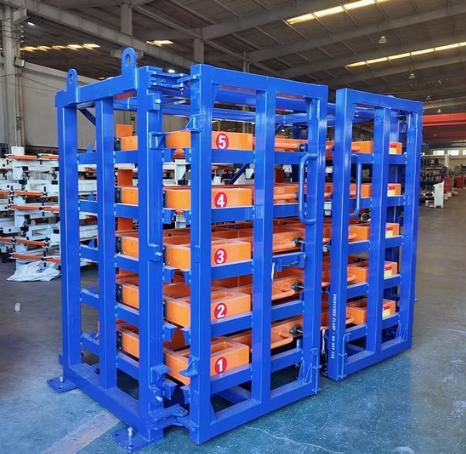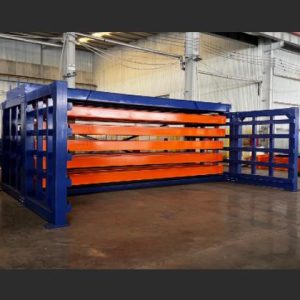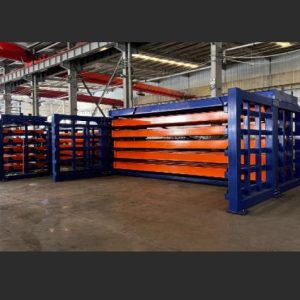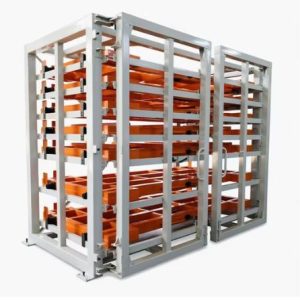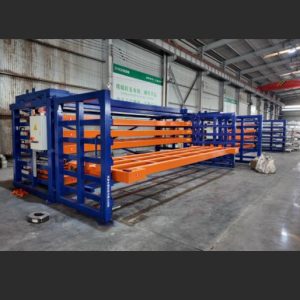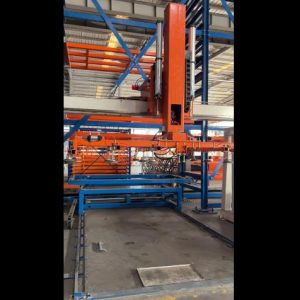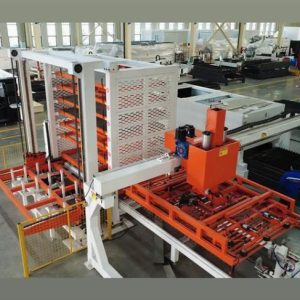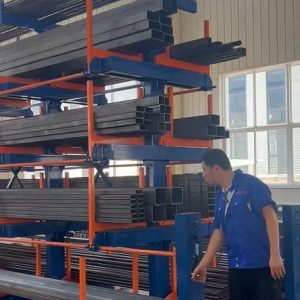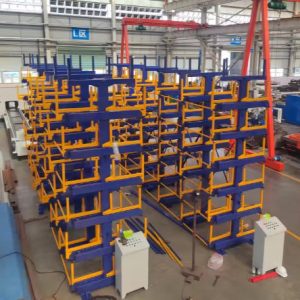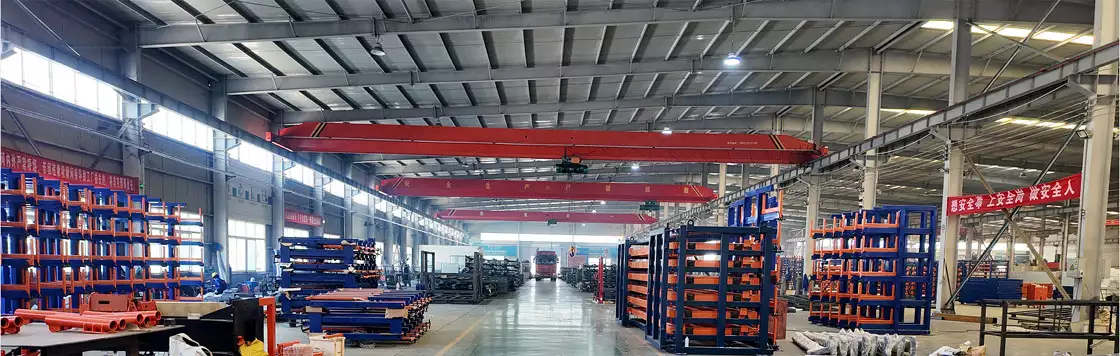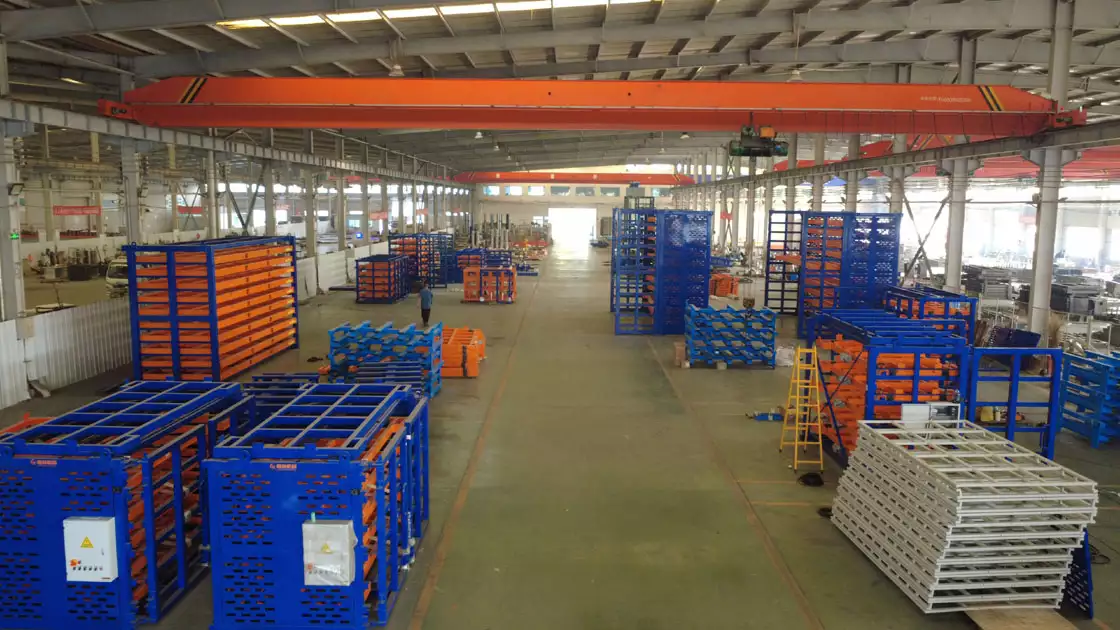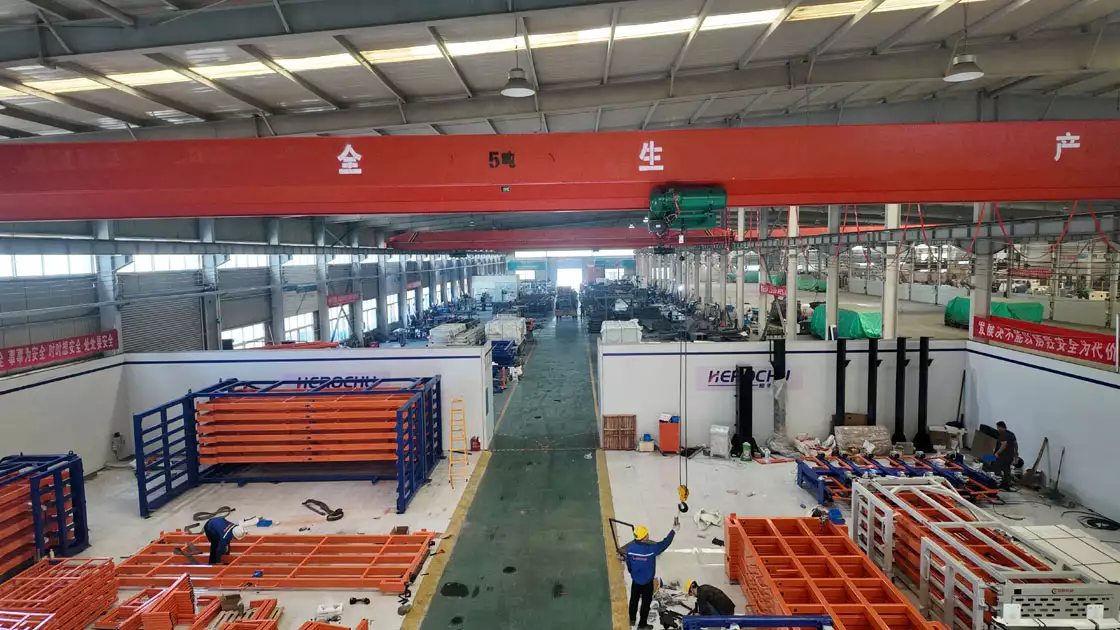
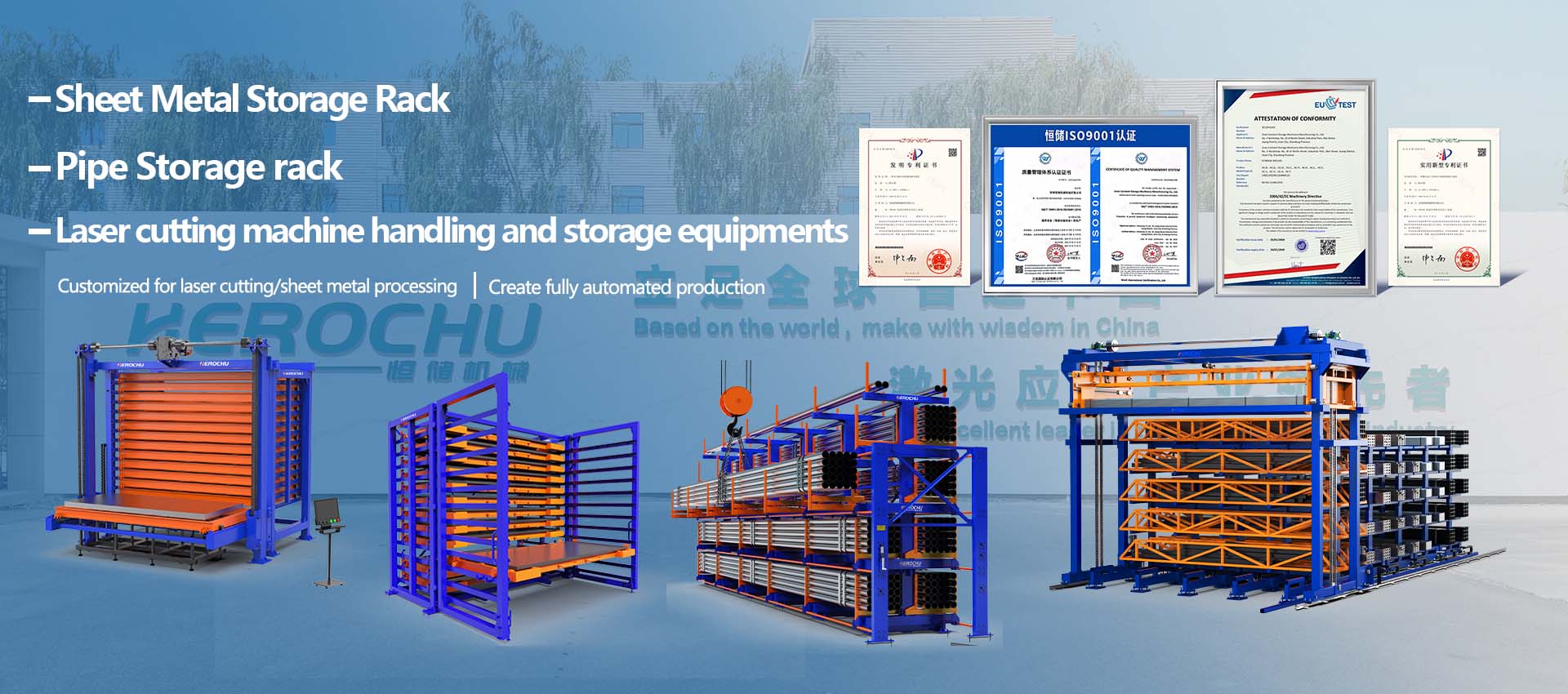
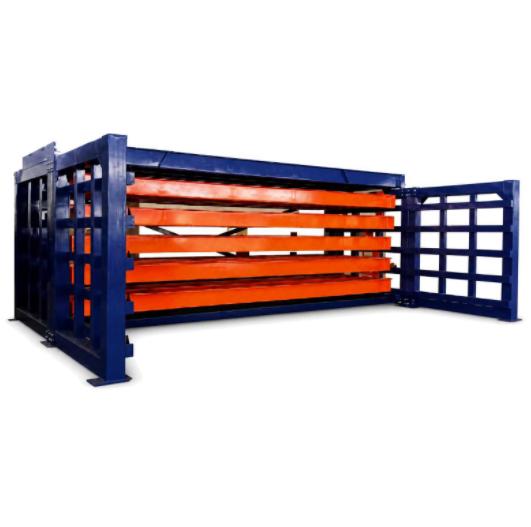
A stainless steel plate storage rack is a multi-tier steel frame that keeps stainless sheets flat in roll-out drawers and releases one plate at a time to a crane, vacuum lifter or forklift. Herochu builds these racks on Q235B high-strength main frames with dual-beam arms and drawer ratings of 3,000 to 5,000 kg per level. The result is a stainless store where sheets stay clean, grades stay separated, and the floor area under the material goes back to production.
Why stainless plate needs its own rack
Stainless steel resists corrosion because of the passive chromium oxide layer on its surface. Free carbon steel dust, grinding sparks and rust particles break that layer down, and the damage often shows up months later as tea staining or pitting that no amount of cleaning reverses.
Floor stacks feed the problem. Forklift tyres drag swarf through the bay, cutting and grinding throw it into the air, and the bottom sheet of a pile takes the worst of it. A rack changes the contact chain. Each bundle sits on its own drawer, the frame is painted or galvanized so no mill scale drops onto the plate, and nothing touches the concrete slab.
There is a planning benefit as well. When 304, 316L and duplex plate share one bay, drawer-by-drawer allocation keeps the grades apart. A job traced back to a heat number can be found without unpacking three stacks to read the stencil.
How the drawer system moves plate
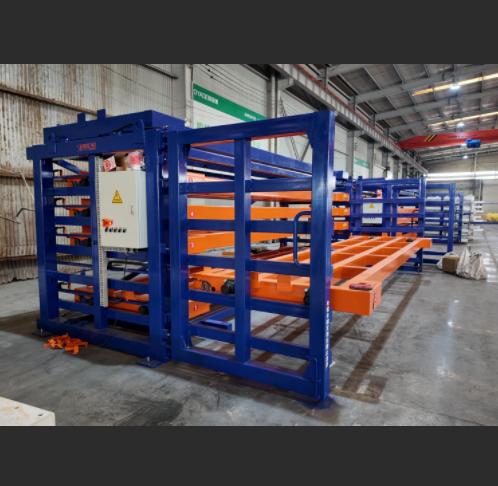
Every drawer runs on a full-extension mechanism, so the plate edge clears the rack frame and the crane or vacuum lifter picks from open air instead of fishing inside a pocket. Clear space between levels is set at 120 mm as standard and adjusted at order stage: a 3 mm laser blank and a 25 mm flame-cut plate do not need the same gap.
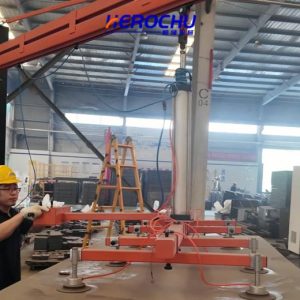
Two drive options cover the load range. Manual glide-out suits lighter sheets and short pulls. Crank-out, with a pinion and rack drive, handles the heavier drawers where one operator should not be pulling three tonnes by hand. Above that, the rack works with mechanical assistance: an overhead crane, a forklift with extended forks, or a vacuum lifter on a jib crane.
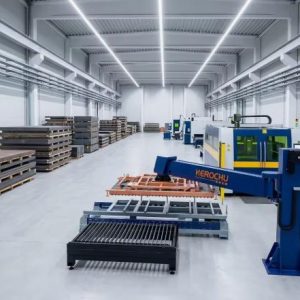
Full extension also exposes both faces of the plate. That counts at the laser or plasma table, where the operator needs to check the nest orientation and the cut edge, not just the top surface.
Model fit for standard sheet sizes
Herochu sizes the frame from the sheet, not the other way round. The standard range covers the formats that most fabrication shops buy:
| Model | Sheet size (mm) | Levels | Load per level |
|---|---|---|---|
| HC-B2513-63 | 2500 × 1300 | 6 | 3,000 kg |
| HC-B3015-63 | 3000 × 1500 | 6 | 3,000 kg |
| HC-B4015-63 | 4000 × 1500 | 6 | 3,000 kg |
| HC-B4020-65 | 4000 × 2000 | 6 | 5,000 kg |
| HC-B6020-65 | 6000 × 2000 | 6 | 5,000 kg |
Six tiers is the standard build, and tier count, clear space and drawer width are all made to order. A bay that has to swallow 6000 × 2500 mm plate, or a mixed load of 1.5 mm and 20 mm sheet, is quoted as a custom frame rather than forced into a stock size.
Density, aisles and hook height
A roll-out rack earns its footprint back in two ways. First, it stacks vertically: six tiers of 3,000 kg is 18 tonnes of plate standing in the area of one floor stack. Herochu quotes up to four times the capacity of conventional floor storage for the same bay. Second, a double-sided frame is served from one aisle, so the aisle count drops and the crane travel shortens.
Three checks belong in the layout drawing before the rack is ordered. Hook height decides how many tiers the building can actually serve. Floor loading decides whether a 5,000 kg drawer needs a spreader plate under the base. Aisle width decides whether the forklift can reverse out with a 6 m plate on the forks, which is usually wider than the rack itself.
Safety points that get missed
Buried material is the quiet cost of floor storage. When the plate a job needs sits at the bottom of a pile, someone lifts four sheets to reach it, and four sheets get scratched in the process. Drawers remove that motion entirely.
Three details make the difference on site. Drawer stops must be rated for the load, not for the handle pull. Load labels per tier keep operators from overloading the top level because it is easier to reach. And a painted walkway line in front of the rack keeps feet out of the swing path when a crane sets a plate down.
Questions buyers ask about stainless plate racks
What is a stainless steel plate storage rack? It is a heavy-duty, multi-tier rack with pull-out drawers that stores stainless sheet horizontally and allows single-plate retrieval by crane, vacuum lifter or forklift. Herochu racks use Q235B steel main frames, dual-beam arms and 3,000–5,000 kg drawer ratings.
How much weight can one drawer hold? Standard Herochu drawers are rated at 3,000 kg for 2500–4000 mm sheet widths and 5,000 kg for 4000–6000 mm formats. Heavier ratings are engineered per project, with the frame, rollers and drawer base sized together rather than upgraded one part at a time.
Will the drawers protect the plate surface? Yes. Separating each bundle removes the abrasion and embedded carbon dust that come from floor stacking. Drawer decks can be fitted with non-marking liners for mirror-finish or No. 8 surface plate, and the frame keeps stainless away from carbon steel contact.
Can a forklift load the rack instead of a crane? Yes. Forklift-loading configurations leave the drawer face open with fork pockets at the right height, so a counterbalance truck can place a bundle without a crane. Herochu confirms the truck model and fork length at design stage.
How many plates fit in one bay? Capacity depends on sheet thickness and clear space. At 3,000 kg per level, a six-tier HC-B3015-63 carries about 18 tonnes: roughly 165 sheets of 3 mm sheet, or about 24 sheets of 20 mm plate. The rack is rated by weight, so sheet count follows thickness.
Choosing the right configuration
Start with the heaviest plate, not the most common one. The heaviest sheet sets the drawer rating, the clear space and the handling method, and the rest of the range follows. From there, Herochu confirms the crane capacity, the aisle, and whether the bay needs single or double-sided access.
Herochu has spent 16 years engineering material storage for metalworking plants, and every rack is built in-house, load-tested before dispatch, and supported from layout drawing through installation.