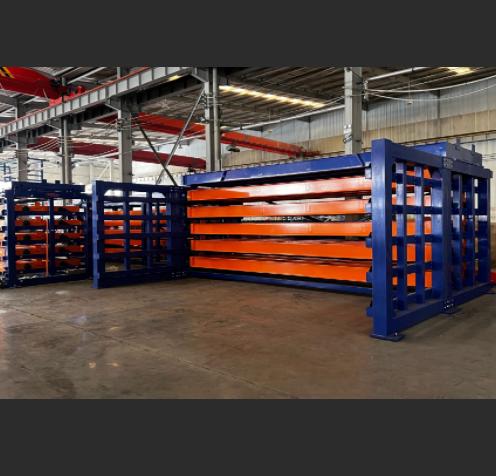
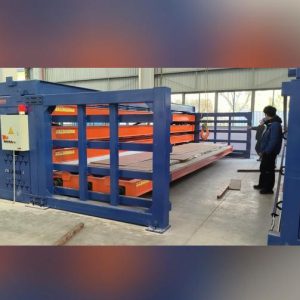
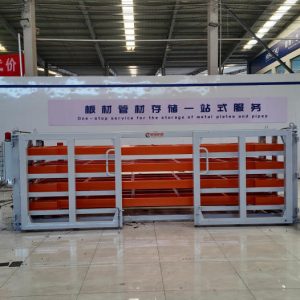
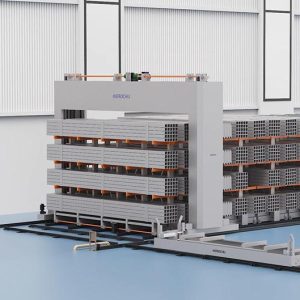
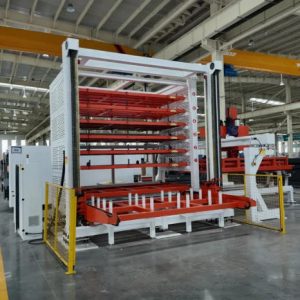
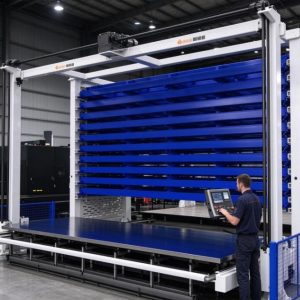
A motorized vertical plate magazine is not a catalog purchase. Two racks with the same layer count and the same nominal load rating can behave very differently depending on sheet format, available headroom, incoming power, and how the drawer discharges material into the next process. The specification sequence below follows the order that prevents expensive redesigns—sheet size first, building constraints second, drive and safety third.
Start with the sheet, not the rack height. The sheet dimensions determine the drawer span, the frame width, and the crane or forklift clearance. A rack sized for 3,000 × 1,500 mm stock cannot be stretched to 6,000 mm plate without changing the beam section and the drive load. Herochu’s model range runs from the HC-B3015E-63 at 3,000 × 1,500 mm through the HC-B4020E-63 at 4,000 × 2,000 mm and the HC-B12025E-520 at 12,000 × 2,500 mm. Each format uses a different pallet traveling speed and a different frame geometry. The purchasing conversation should begin with the largest sheet the rack must hold, not with the number of layers.
Confirm layer load against the real bundle weight, not the catalog maximum. A rack rated at 5,000 kg per level is not necessarily appropriate for a 5,000 kg bundle if the load is concentrated in the center of the drawer or if the bundle includes multiple thicknesses stacked unevenly. The Herochu specification separates standard configurations from customized builds: the HC-B3015E-63 carries 3,000 kg per level, the HC-B6015E-65 carries 5,000 kg, and the HC-B12025E-520 carries 20,000 kg. The right question is not “what is the maximum?” but “what does a normal, fully loaded drawer weigh in this facility, and what margin does the rack provide above that figure?”
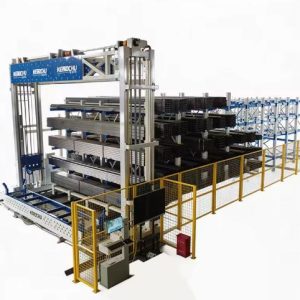
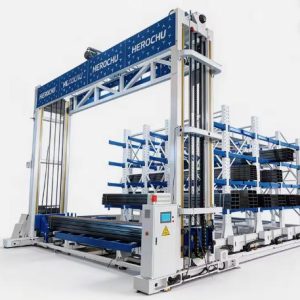
Measure the building before you size the tower. Vertical plate storage gains its floor-space advantage by using height, which means the rack height, the top clearance, and the lifting path for the crane or forklift are fixed constraints. A vertical storage tower in a related application typically requires roughly 5.9 m of building height with about 875 mm of top clearance to install and service. The same discipline applies to a horizontal motorized magazine: the drawer travel and the operator access zone must be clear of overhead obstructions, sprinkler lines, and crane runways. If the building height is not confirmed before the rack is ordered, the layer count or the drawer stroke becomes a change order.
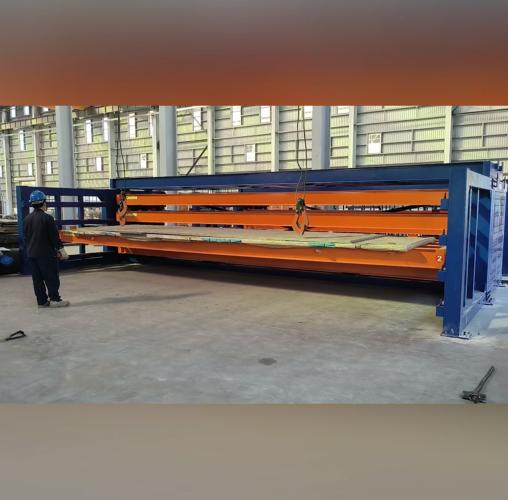
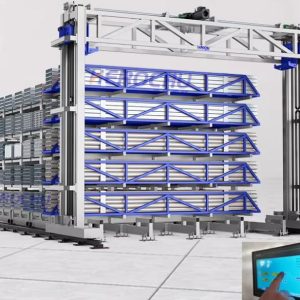
Verify the power supply and the drive architecture. Motorized drawer movement requires an electrical supply matched to the drive system. Herochu’s electric roll-out racks use remote-controlled operation, and the drive can be configured for different traveling speeds depending on the model. The electrical contractor should confirm the available voltage, phase, and circuit capacity at the installation point before the rack arrives. A rack that is mechanically correct but electrically undersized is a commissioning delay.
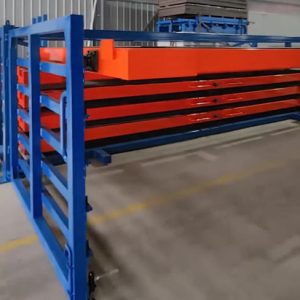
Decide how the drawer discharges to the next process. “Electric assistance” is not a single behavior. In some layouts, the motorized drawer extends and the crane lifts the plate directly from the exposed tray. In others, the drawer indexes to a transfer height or feeds a downstream table. The discharge method affects the drawer stroke, the control logic, and the safety envelope around the rack. The HC-B3015E-63 and the larger models list electric assistance as the material discharge method, but the specific interface—crane pick, forklift access, or transfer table—should be drawn on the layout before fabrication.
Write the safety and acceptance terms into the contract. Load plaques, anchor specifications, drive-system guards, and remote-control functionality should be acceptance items, not assumptions. The rack should arrive with the load rating posted on each tier, the anchor plan reviewed by the structural engineer, and the remote control tested through its full travel under a representative load.
A motorized vertical plate magazine is a capital asset with a long service life. The six checks above cost relatively little time at the quotation stage and prevent the two most common failure modes: a rack that fits the catalog but not the building, and a rack that meets the nominal load rating but not the real drawer weight.