Industrial manipulators have evolved considerably from the manually guided pneumatic balancers that still populate many fabrication shops. Where those first-generation assist devices reduce the physical effort of lifting — but leave every motion decision to the operator — modern servo-driven manipulators execute programmed transfer sequences with speed, precision, and repeatability that human guidance cannot match.
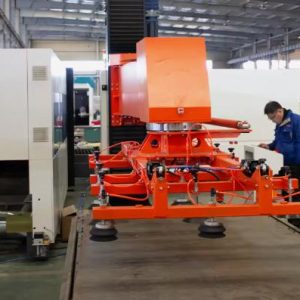
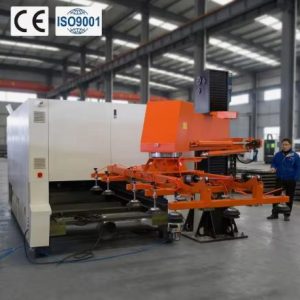
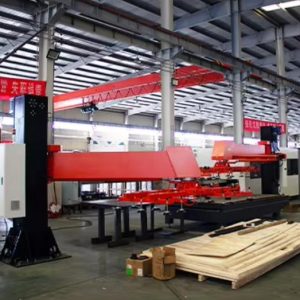
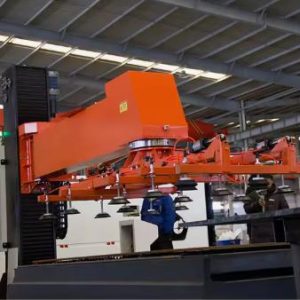
Herochu’s servo swing arm handling manipulator represents this evolution in a form factor engineered for the practical constraints of working fabrication facilities. Rather than a six-axis articulated robot requiring dedicated floor space, safety fencing, and specialized programming expertise, the servo swing arm mounts to a floor column or existing structure and operates within a defined swing arc — making it simpler to integrate into existing production lines while delivering the automation benefits of programmed, unattended operation.
This article examines the multi-axis servo control architecture that enables precise, high-speed workpiece transfer; the payload range and application versatility across picking, forging, welding, and CNC machine tending; and the safety and collaboration features that allow these manipulators to operate in shared production spaces.
Multi-Axis Servo Control: The Core Differentiator
The defining technical characteristic of a servo swing arm handling manipulator is the replacement of manual guidance with programmed servo motor control. Each degree of freedom — typically vertical lift, horizontal swing rotation, and end-effector articulation — receives an independent servo axis governed by a centralized Siemens S7 PLC controller.
The PLC runs stored motion programs that define the complete transfer sequence: approach the pickup point, engage the workpiece, lift through a programmed vertical stroke, swing through a calculated arc to the destination, lower to the placement position, and release. The operator’s role shifts from physical guidance to program selection and production monitoring.
Encoder feedback at each servo drive enables closed-loop position control. The controller continuously compares actual motor position against the commanded trajectory, applying corrective torque if deviation exceeds the configured tolerance. This closed-loop architecture delivers positioning accuracy that open-loop pneumatic systems cannot approach — Herochu specifications call for placement repeatability within plus or minus 0.5 millimeters at the workpiece contact point.
The multi-axis coordination capability distinguishes servo swing arms from single-axis automation devices. During a transfer cycle, the lift and swing axes can move simultaneously along overlapping motion profiles, reducing total cycle time compared to sequential axis movement. The PLC calculates the combined motion trajectory to avoid collisions with surrounding equipment while optimizing for minimum transfer time.
Payload Range and Structural Design
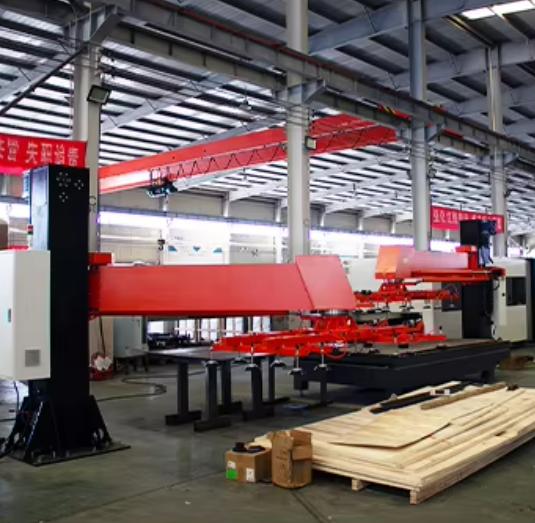
Herochu servo swing arm handling manipulators cover a payload spectrum from 100 kilograms to 800 kilograms, with the specific model selected based on the heaviest workpiece the application requires. The structural design philosophy remains consistent across the range: a welded steel frame column provides the primary load path, with the arm cross-section, gear reducer sizing, and servo motor torque rating scaled to match the payload class.
For applications in the 100-kilogram to 300-kilogram range — typical of small to medium stamping blank transfer and CNC lathe loading — the manipulator uses a lighter column cross-section and smaller-footprint base plate that suit the available floor space around compact machine tools. The swing arm itself can be configured with a shorter reach, trading work envelope for higher structural stiffness and faster achievable cycle speeds.
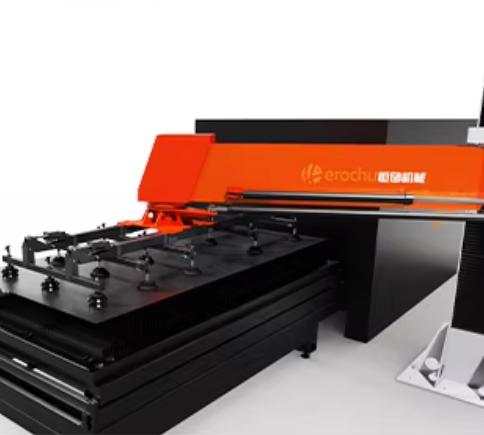
In the 500-kilogram to 800-kilogram class — serving heavy plate loading for fiber laser cutting, large forging blank transfer, and structural steel handling — the column, base anchoring, and gear train are engineered for the proportionally higher static and dynamic loads. The welded steel frame uses box-section construction to resist the torsional loading that occurs when the payload center of mass shifts relative to the arm centerline during swing motion.
All payload classes share the same Siemens PLC control architecture and HMI interface, allowing shops that start with a lighter-capacity unit to add higher-capacity manipulators without retraining operators on a different control platform.
Application Versatility Across Manufacturing Processes
The servo swing arm handling manipulator finds application wherever a workpiece must move between two defined points in a repeatable pattern — and where the transfer currently consumes operator time that could be redirected to higher-value tasks.
In CNC machine tending, the manipulator loads raw stock into the machine and unloads finished parts, operating as a dedicated automation cell. For a machine shop running multiple CNC lathes or vertical machining centers, one servo swing arm unit can service two or more machines if the machine layout and cycle times permit. The manipulator communicates with each machine tool through digital I/O, receiving a load request signal when the machine is ready and executing the transfer within the machine’s door-open window.
In forging operations, the manipulator transfers heated billets from an induction furnace to the forging press or hammer. The high-temperature environment demands an end-effector configured with heat-resistant gripper materials and a motion program that minimizes the billet’s air-exposure time between furnace extraction and press engagement. The servo swing arm’s programmable speed profile allows the operator to tune the transfer time to match the forging process temperature window.
In welding fabrication, the manipulator positions components into welding fixtures and removes completed weldments. This application often pairs the servo swing arm with a two-station layout — while welding proceeds at station one, the manipulator loads components at station two, eliminating the idle time a manual operator would spend positioning parts while the welder waits.
In press brake bending cells, the swing arm feeds blanks to the brake and can rotate or flip the part between bend sequences if the end-effector includes a rotary axis. This turns a single-operator brake cell into a partially automated bending station where the operator specifies the program and monitors quality rather than handling every blank.
Intelligent Control and Operator Interface
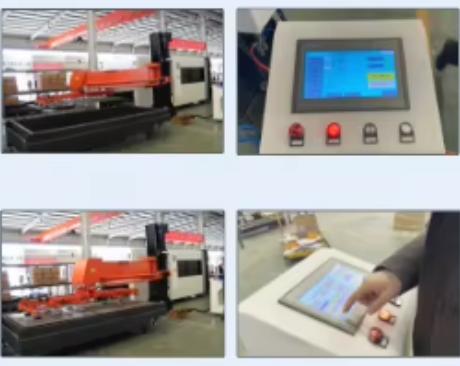
The touch screen HMI on Herochu servo swing arm handling manipulators presents a multi-language interface — English and German standard, with additional language packs available — organized around production tasks rather than machine parameters.
The main operating screen shows the active program name, current cycle status, cycle counter, and any active alarm or warning conditions. Program selection uses descriptive names assigned during setup rather than numeric codes, reducing operator error when switching between different workpiece types.
Program creation and editing happen through a teach-mode interface. The operator uses a pendant or the touch screen jog controls to move the arm through the desired motion sequence — to the pickup position, down to the workpiece, up to transfer height, swing to the destination, down to placement position — recording each point into the program. Speed and acceleration parameters for each motion segment are entered as numerical values or selected from predefined profiles.
For production environments requiring frequent changeovers, the control system stores dozens of programs in non-volatile memory. Programs can be exported to USB storage for backup or transfer to other Herochu manipulators in the same facility, enabling standardized program libraries across multiple production cells.
Safety Architecture for Collaborative Workspaces
A servo swing arm handling manipulator operates in production spaces where personnel may be present in adjacent work zones. The safety architecture addresses this through a layered approach combining physical guarding, sensor-based detection, and control-system safety functions.
The primary safety layer is a physical perimeter — light curtains or interlocked fencing — that defines the manipulator’s motion envelope and prevents personnel entry during automatic operation. If the safety perimeter is breached, the control system initiates an immediate category 1 stop, removing drive power and applying motor brakes.
Emergency stop buttons positioned at the operator panel and at strategic points around the work envelope provide redundant stop initiation. The emergency stop circuit is hardwired — it does not rely on PLC logic to function — ensuring that stop command execution is not dependent on software processing.
All servo drives incorporate safe torque-off functionality, which removes torque-generating current from the motor windings while maintaining encoder feedback so that position tracking is not lost during a safety stop. This allows the manipulator to resume operation from its stopped position after the safety condition is cleared and the system is reset, rather than requiring a re-homing sequence.
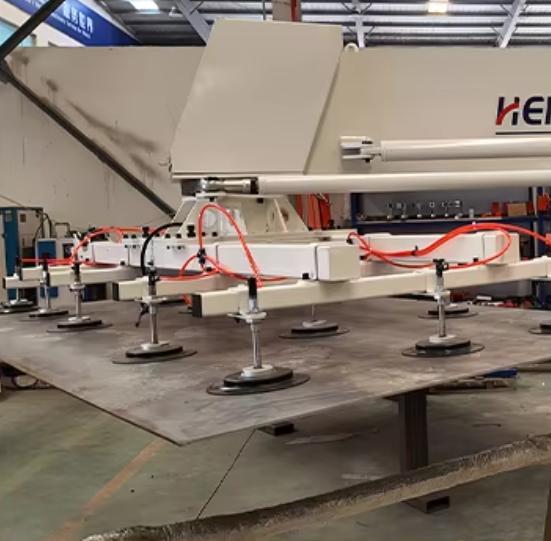
Automatic braking on power loss is inherent in the servo motor design — the motor brakes engage mechanically when drive power is removed, holding the arm in position even during a facility power failure. For vacuum-based end-effectors, vacuum storage tanks integrated into the gripper system maintain holding force for a defined period after air supply interruption, preventing workpiece release during a compressed air system fault.
CE certification applies across the Herochu servo swing arm product line, confirming compliance with the Machinery Directive and relevant harmonized standards for industrial robot safety. ISO 9001 certification covers the manufacturing quality management system.
Return on Investment in Human-Machine Collaboration
The economic justification for a servo swing arm handling manipulator follows a pattern familiar in industrial automation but worth revisiting in the specific context of workpiece transfer. The direct cost saving comes from labor reassignment: the operator who previously spent each shift physically moving workpieces now oversees multiple automated cells, monitors quality, or handles tasks — such as tool setup and program verification — that directly contribute to output value.
Cycle time consistency generates the less obvious but often larger economic return. A human operator’s transfer time varies — faster in the morning, slower toward shift end, inconsistent after breaks. These variations accumulate as lost processing machine capacity across days and weeks of production. The servo manipulator executes every transfer in the same time window regardless of shift hour, removing this hidden productivity drain.
Workpiece damage reduction adds a quality-cost dimension. Manual handling with chains, hooks, and magnets scratches surfaces and dents edges. The servo swing arm’s controlled acceleration profiles and vacuum-based or padded-contact end-effectors eliminate the impact loads and metal-to-metal contact that cause handling damage. For shops processing expensive materials or parts with cosmetic surface requirements, the reduction in rework and scrap from handling damage alone can justify the automation investment.