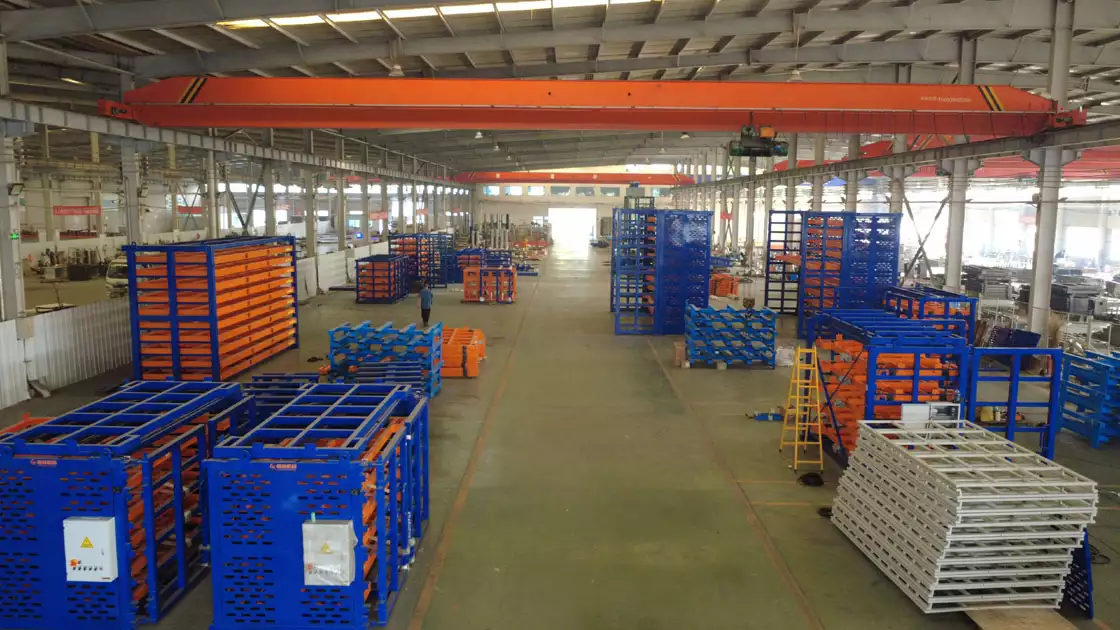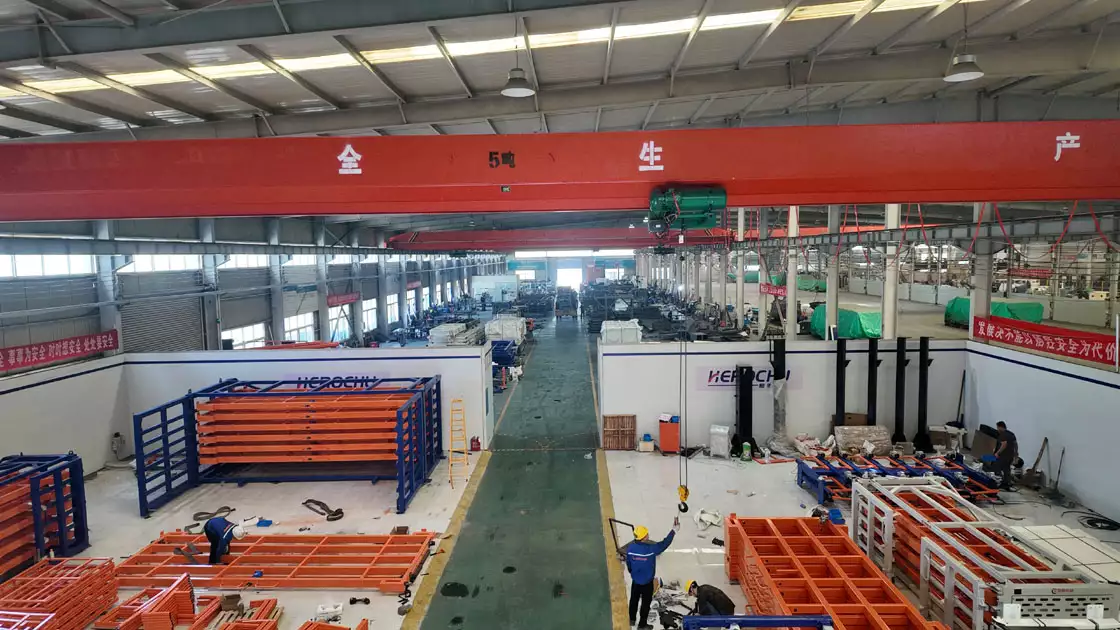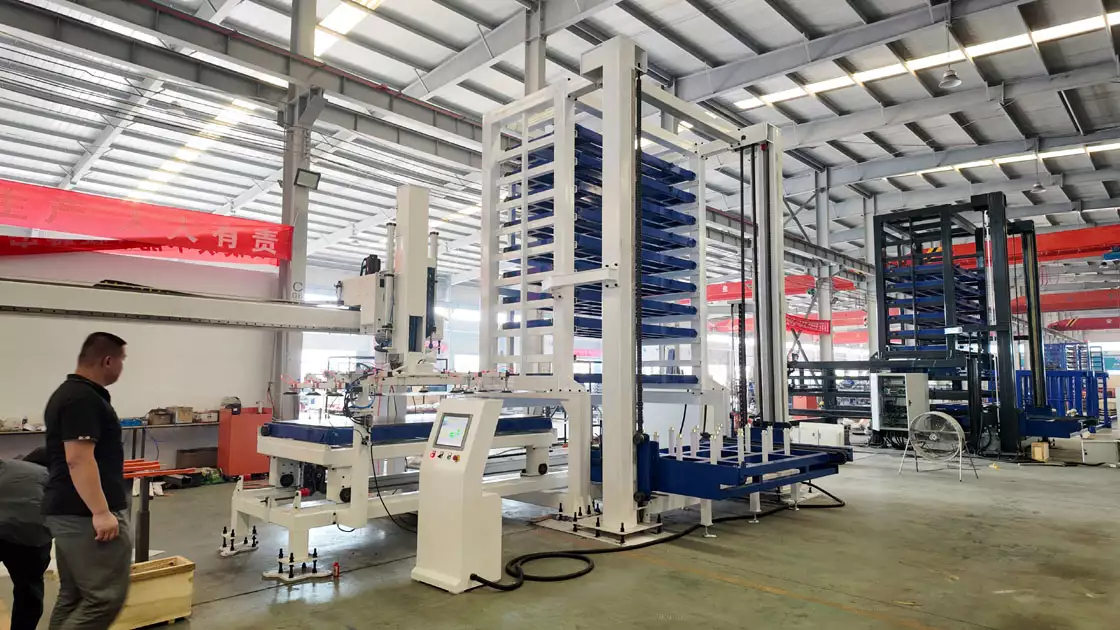
When sheet metal fabrication crosses from standard-gauge processing into heavy plate territory — steel sheets measuring 3,000 mm by 1,500 mm and weighing upwards of several hundred kilograms — the loading challenge changes qualitatively. The forces involved demand more than a scaled-up light-duty manipulator. Column rigidity, motor torque, gear train durability, and base anchoring all become limiting factors that determine whether the automation investment delivers years of trouble-free service or becomes a maintenance burden.
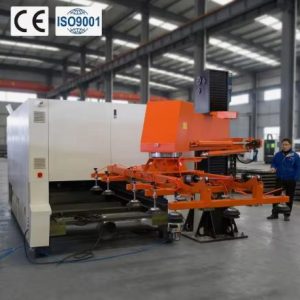
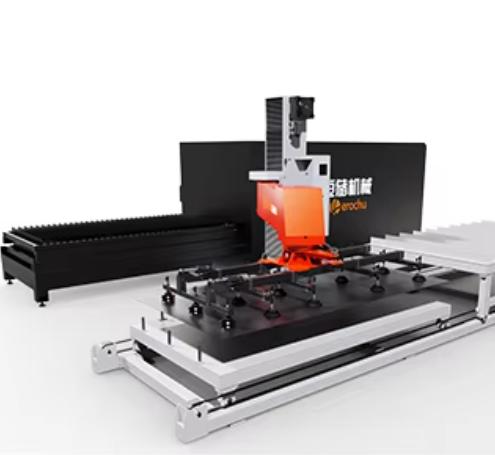
Herochu’s 800KG servo swing arm robot manipulator addresses this heavy-end requirement directly. Rated for steel plate payloads reaching 800 kilograms, the system brings the same Siemens PLC-controlled, fully automatic operation found in Herochu’s mid-range loading robots to applications where sheet weight excludes lighter automation options. The machine handles plate thickness from 1 mm up to 25 mm, covering the full range encountered in structural steel fabrication, shipbuilding sub-supply, heavy equipment manufacturing, and steel service center operations.
This article examines the engineering factors that enable reliable 800-kilogram automated loading, the precision control architecture that ensures consistent sheet placement, and the production economics that make heavy-payload servo automation a defensible capital expenditure.
Structural Engineering for 800-Kilogram Dynamic Loading
The difference between a 500-kilogram and an 800-kilogram payload rating is not simply a matter of larger motors. The entire structural load path — from end-effector through the arm assembly, pivot joints, column, and base anchoring — must handle proportionally higher static and dynamic forces.
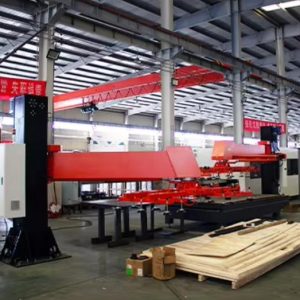
Herochu engineers the 800KG model around a welded steel frame column with a cross-section dimensioned through finite element analysis to limit deflection at full horizontal reach with rated payload. The floor-mounted column base uses a bolt pattern and anchor specification calculated for the overturning moment generated when the arm swings 800 kilograms through its maximum arc radius. On installations where floor slab thickness or condition is uncertain, Herochu provides an engineered base plate that distributes anchor loads across a larger contact area.
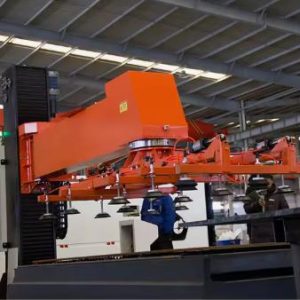
The swing arm itself uses a box-section fabricated structure rather than a simple I-beam profile. The closed box section resists torsional loading — a critical consideration because the payload mass center shifts relative to the arm centerline as the end-effector engages sheets of varying dimensions. Hardened guide rails at each rotary axis interface with precision-ground gear reducers selected for backlash characteristics suitable for positioning repeatability at the half-millimeter level.
Servo Drive Architecture and Motion Control
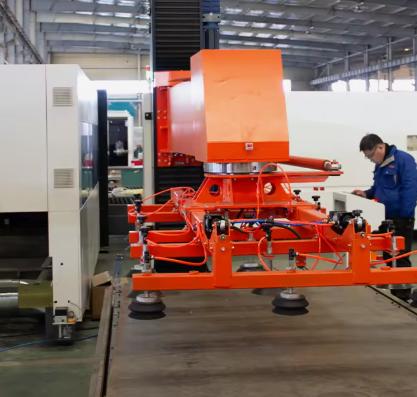
The 800KG servo swing arm robot manipulator runs on a multi-axis servo drive system coordinated by a Siemens S7 PLC. Each motion axis — lift, swing, and any auxiliary functions such as end-effector rotation — receives independent servo motor control with closed-loop encoder feedback.
The lift axis presents the highest torque demand, as it works against gravity across the full payload range. Herochu sizes the lift servo and gear reducer combination for continuous operation at rated load, not peak intermittent rating. This conservative engineering approach eliminates the thermal throttling that can reduce cycle rates in undersized drive systems during extended production runs.
Swing axis motion profiles are programmable through the HMI touch screen interface. Acceleration and deceleration ramps are adjustable to match sheet weight and the required cycle time. Heavier sheets use graduated ramp profiles that prevent inertial overshoot at the swing endpoint, while lighter loads can leverage faster profiles to achieve full cycle times competitive with lighter-capacity loading robots.
The control architecture supports pre-programmed motion paths stored in the PLC memory. An operator selects the sheet profile — specifying dimensions, weight, pickup position, and placement coordinates — and the robot executes the complete loading sequence without further intervention. For job shops processing varied orders, the system stores dozens of profiles covering the full range of sheet sizes and laser cutting table configurations encountered in daily production.
Precision Positioning and Sheet Placement Accuracy
In manual and pneumatic-assisted loading, the operator visually aligns the sheet on the cutting bed and makes final positional adjustments by nudging the plate. This process introduces variability — sheets land a few millimeters off intended position, and depending on the operator’s diligence, the error may or may not be corrected before cutting begins. Over thousands of sheets, uncorrected positioning errors accumulate as wasted edge material.
Herochu’s servo encoder feedback loop eliminates this variability. The PLC compares actual motor position against the programmed target at every control cycle, applying corrective torque if deviation exceeds the tolerance window. The result is sheet placement repeatability within plus or minus 0.5 millimeters at the cutting bed surface.
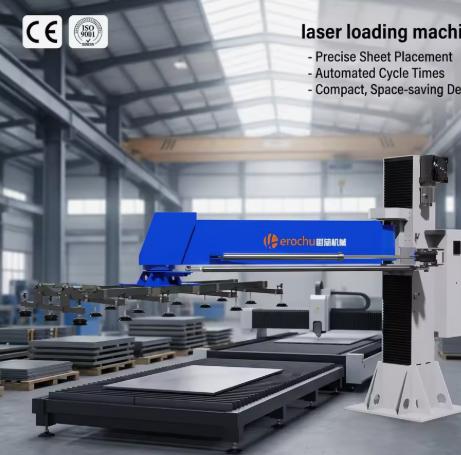
This precision enables the laser cutter’s nesting software to use tighter sheet edge margins, since the operator no longer needs to compensate for expected positioning variation by adding safety offsets. For a fabricator processing hundreds of sheets per week, the material savings from reduced edge waste alone contribute meaningfully to the automation payback case.
High-Speed Automated Loading Cycles
Cycle time in a laser cutting operation breaks down into cutting time and non-cutting time. Non-cutting time — sheet loading, unloading of cut parts, table clearing — represents lost cutting capacity. Every second spent loading is a second the fiber laser is idle.
Herochu’s 800KG servo swing arm completes a full sheet loading cycle — pick from stack, swing to table, place, return to home — in under ten seconds on standard configurations. The actual time depends on swing arc distance and the acceleration profile selected for the sheet weight, but the sub-ten-second benchmark holds for typical shop layouts with raw material staged adjacent to the cutting table.
At this cycle speed, the loading robot keeps pace with even the fastest fiber laser cutting machines on thin-gauge material, where cut times per sheet may run only a few minutes. The robot’s ability to sustain this cycle rate continuously, without the fatigue-induced slowdown that affects human operators during long shifts, makes it suitable for lights-out production schedules where the laser runs unattended through night shifts.
End-Effector Configuration for Heavy Plate
Handling 800-kilogram steel sheets requires an end-effector that maintains secure grip through the full motion sequence — including the acceleration and deceleration phases of the swing arc where inertial forces try to shift the sheet relative to the gripper.
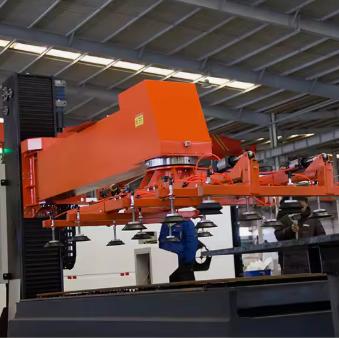
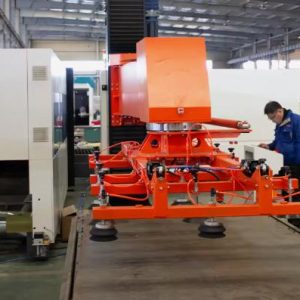
Herochu offers two primary end-effector types for the 800KG model. Multi-point vacuum suction cup arrays, fed by high-flow vacuum generators, distribute holding force across the sheet surface. Each suction cup includes an integrated check valve, so that if one cup loses seal due to surface irregularity, the remaining cups maintain vacuum integrity and the sheet stays secure.
For raw hot-rolled plate with heavy mill scale that may compromise vacuum seal quality, magnetic grippers using electro-permanent magnet technology offer an alternative. These grippers require electrical power only during the engage and release moments — once magnetized, they hold the sheet without continuous power draw, providing an inherent fail-safe characteristic.
The end-effector frame is itself a configurable assembly. Suction cup positions or magnet modules are arranged to match the sheet dimensions processed by the specific installation. For shops running a wide range of sheet sizes, Herochu supplies end-effectors with adjustable arm extensions that the operator can reposition between batch runs.
Continuous Duty and Maintenance Engineering
An 800KG loading robot in a two-shift or three-shift operation accumulates cycle counts that quickly surpass the design life of general-purpose automation components. Herochu addresses this with maintenance engineering focused on accessible wear components and predictable service intervals.
All grease points are routed to centralized lubrication blocks accessible from floor level, eliminating the need for ladders or platform access during routine maintenance. Gear reducers are specified with L10 bearing life calculations based on the maximum expected cycle count over the target service interval — typically five years of continuous production before major bearing replacement.
The control cabinet includes diagnostic LEDs and a fault log accessible through the HMI, enabling maintenance technicians to identify and address issues without connecting external programming hardware. Common wear items — suction cups, vacuum filters, limit switch actuators — are stocked as standard spare parts kits delivered with the machine.
Production Economics and Payback
The labor savings from an 800KG servo swing arm robot are straightforward: one dedicated loading operator per shift becomes unnecessary. At prevailing metal fabrication labor costs, this direct saving alone recovers the equipment investment within six to twelve months.
The larger economic impact comes from increased laser cutter utilization. By compressing the loading interval to a consistent sub-ten-second window and eliminating the positioning verification step that manual loading requires, the robot adds productive cutting minutes to every shift. For a high-power fiber laser cutting heavy plate, where cutting time per sheet may run ten minutes or more, the loading time savings represent a smaller percentage of total cycle time. But for mixed-thickness production where the laser alternates between thin and thick sheets, the loading interval compression on thin-gauge jobs generates substantial additional throughput.
A third factor is reduced material waste. Consistent half-millimeter positioning accuracy means the nesting software can use tighter sheet edge margins without risking that cut geometry falls off the plate edge. For shops processing expensive alloy steels or pre-finished material, the annual value of edge waste reduction can approach or exceed the direct labor savings.