Fiber laser cutting shops handling medium-gauge steel plates face a recurring bottleneck: getting raw sheets onto the cutting bed quickly, accurately, and without tying up skilled labor. Traditional approaches fall into two camps. Manual loading with overhead cranes demands constant operator attention and introduces positioning errors that waste material. Pneumatic manipulators reduce physical strain but still require an operator guiding every movement by hand — the machine never works on its own.
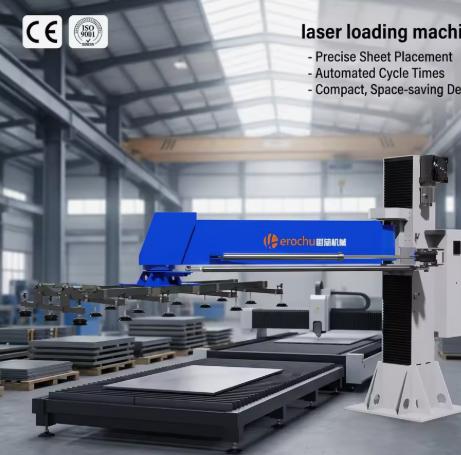
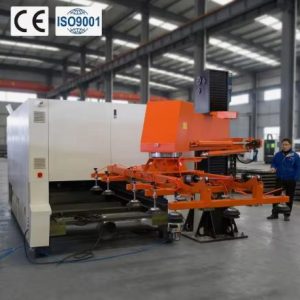
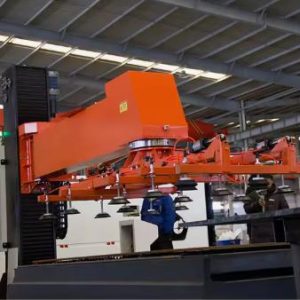
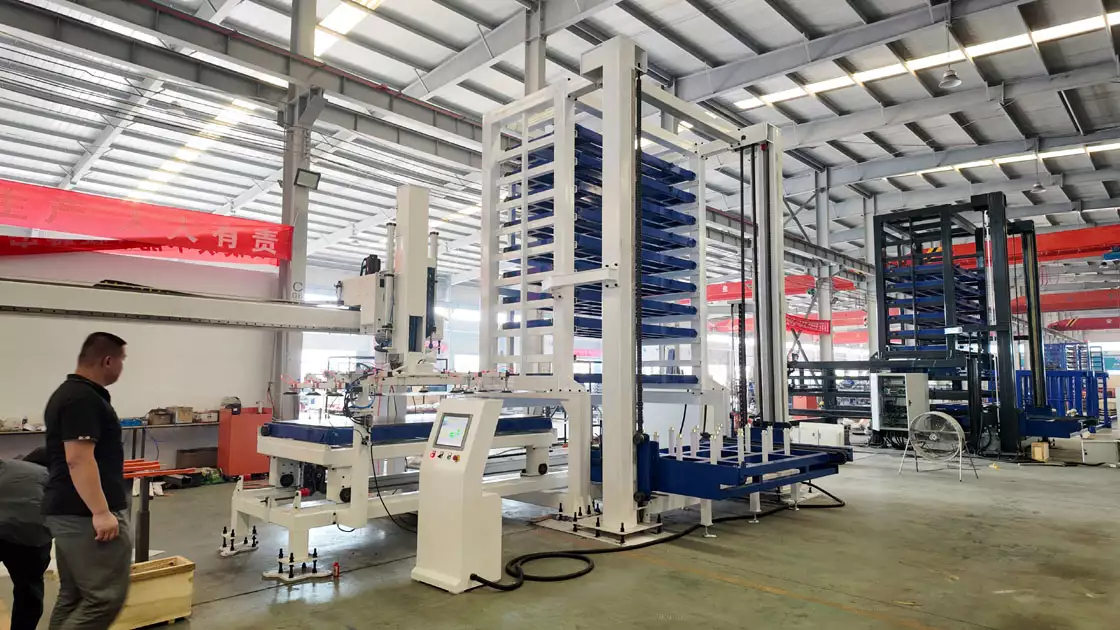
Herochu addresses this gap with a servo swing arm loading robot engineered specifically for automated steel plate transfer. Rated at 500 kilograms payload, the system replaces manual and pneumatic-assisted workflows with programmed, unattended loading cycles. What sets this equipment apart from fixed-configuration alternatives is its modular, customizable architecture — the reach, end-effector, control programming, and mounting configuration adapt to the specific laser cutter model, sheet dimensions, and shop floor layout of each installation.
This article examines the engineering behind Herochu’s 500KG servo swing arm robot, the customization parameters that make it a flexible automation investment, and the operational advantages sheet metal fabricators gain by removing the loading operator from the equation.
Fully Automatic Servo-Driven Operation: No Handle Guidance Required
The fundamental distinction between a pneumatic manipulator and a servo swing arm robot lies in who controls the motion path. Pneumatic units rely on an operator physically gripping a handle and guiding the arm through lift, swing, and lower movements. The machine assists with the weight but contributes no intelligence to the trajectory.
Herochu’s servo swing arm robot reverses this relationship entirely. A Siemens S7 PLC controller paired with servo motor drives executes pre-programmed motion sequences that require zero operator intervention during normal production. Once the operator selects a program from the touch screen control panel — corresponding to a specific steel sheet dimension and weight — the robot handles every subsequent step autonomously.
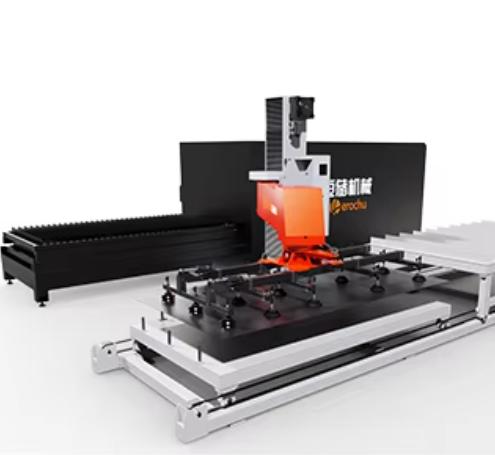
The motion sequence follows a defined workflow. The arm extends to the raw material stack, vacuum suction cups or magnetic grippers engage the top sheet, the arm lifts and swings through a calculated arc to the laser cutting table, and the sheet is released at the precise programmed coordinates. The arm then returns to home position and waits for the next trigger signal from the laser cutter’s controller. Cycle time for a complete pick-place-return sequence runs under ten seconds on standard configurations.
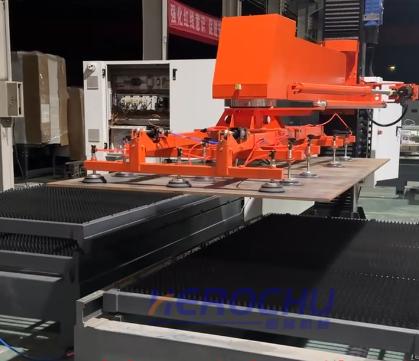
This autonomous operation means one production supervisor can monitor multiple Herochu loading stations simultaneously. The robot does not fatigue, does not slow down toward the end of a shift, and does not introduce the millimeter-scale positioning drift that occurs when a human operator’s attention wavers after hours of repetitive motion.
Customization: Built to Fit Your Shop Floor, Not the Other Way Around
Off-the-shelf automation often forces the factory to adapt its layout to the machine. Herochu takes the opposite approach — the servo swing arm robot is engineered as a configurable platform that molds to existing production conditions.
The primary customization parameters include arm reach, column height, mounting base configuration, end-effector type, and control program complexity. Reach is specified based on the distance between the raw material staging area and the laser cutting bed. A shop feeding a 4,000 mm by 2,000 mm cutting table from a pallet positioned three meters away receives a different arm geometry than one loading a compact 1,500 mm by 3,000 mm machine from an adjacent rack.
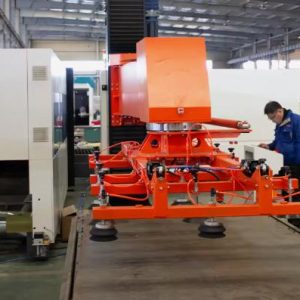
End-effector selection depends on material surface characteristics. Multi-point vacuum suction cup arrays distribute holding force across the sheet surface, preventing localized pressure marks on finished or pre-painted steel. For raw hot-rolled plate with mill scale, magnetic grippers offer faster engagement and release. Herochu engineers assess the production material mix during the specification phase and configure the end-effector accordingly.
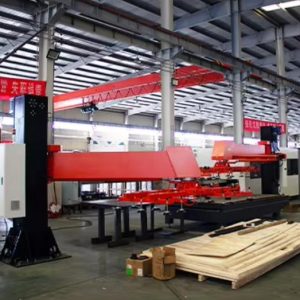
Column height and mounting base design account for ceiling clearance, floor load capacity, and whether the installation requires a freestanding floor-mounted column or integration with existing overhead structure. The control program library scales from a few preset sheet profiles for shops running consistent batch sizes to dozens of stored programs for job shops processing varied orders daily.
Siemens PLC Control: The Intelligence Layer
At the core of every Herochu servo swing arm robot sits a genuine Siemens S7 PLC and matched servo drive package. The choice of Siemens hardware is deliberate — it ensures global parts availability, standardized programming environments familiar to industrial maintenance teams, and communication compatibility with virtually every major laser cutter brand on the market.
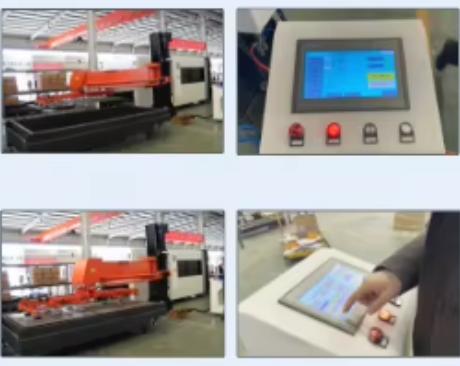
The PLC manages servo motor coordination across lift, swing, and auxiliary axes. Encoder feedback loops running at the drive level deliver positioning repeatability within plus or minus 0.5 millimeters at the sheet placement point. This precision eliminates the common problem of sheets landing slightly off-target on the cutting bed, which in manual loading scenarios forces the operator to nudge the plate into position — a step that adds seconds to every cycle and, over thousands of cycles, hours of non-cutting downtime per month.
The HMI panel presents a multi-language interface including English and German, with additional language packs available. Operators access speed and acceleration parameters directly from the touch screen, enabling fine-tuning of motion profiles to match steel plate thickness — thinner sheets benefit from faster acceleration without risk of vacuum loss, while 20-millimeter-plus plates require graduated ramp profiles to maintain grip stability during the swing phase.
Structural Engineering for Continuous Industrial Duty
A 500-kilogram payload swinging through a multi-meter arc generates substantial dynamic forces at the column base and pivot joints. Herochu addresses this with a welded steel frame structure anchored to a reinforced floor-mounted column. The column cross-section and base plate dimensions are calculated during specification based on maximum reach and payload, ensuring deflection remains within design limits throughout the full motion envelope.
Hardened guide rails and precision gear reducers at each rotary axis handle the continuous start-stop cycling characteristic of laser loading applications. Unlike general-purpose industrial robots that may see intermittent use, a loading robot paired with a fiber laser operating in lights-out production executes thousands of cycles per week. Every bearing surface, gear tooth, and pivot point in the Herochu design is specified for this duty cycle.
The servo motors themselves are sized with thermal headroom — continuous torque ratings exceed the maximum load torque by a margin that prevents overheating during extended production runs. This is a detail that separates purpose-built loading automation from adapted general-purpose robots, which may require derating or additional cooling for sustained high-cycle operation.
Applications and Operational Fit
The 500KG servo swing arm robot integrates with CNC fiber laser cutting lines processing steel from roughly 1 millimeter up to 25 millimeters in thickness. Application environments include sheet metal fabrication job shops, steel service centers feeding multiple laser cutters, automotive stamping plants where cut blanks feed downstream press operations, and heavy steel plate processing facilities.
The system communicates with the laser cutter through dry-contact I/O or fieldbus protocols. When the laser completes a cutting program, it sends a “load next sheet” signal to the robot controller, which initiates the programmed loading sequence. This handshake eliminates the need for the operator to manually trigger each cycle, enabling true unattended operation between material replenishment intervals.
Return on Investment Calculation
The economic case for a Herochu servo swing arm loading robot rests on two factors: direct labor cost reduction and increased laser cutter utilization. A dedicated loading operator whose sole function is moving sheets onto the cutting bed represents a recurring annual cost that the robot eliminates. At typical metal fabrication labor rates, payback on the equipment investment falls within a six- to twelve-month window.
The secondary — and often larger — return comes from increased machine utilization. Manual loading introduces idle time between cutting cycles as the operator retrieves, positions, and verifies each sheet. The robot’s consistent sub-ten-second cycle time compresses this interval, adding productive cutting minutes to every shift. For a shop running two shifts with a high-throughput fiber laser, the additional cutting capacity generated per year can exceed the equipment cost by a multiple.