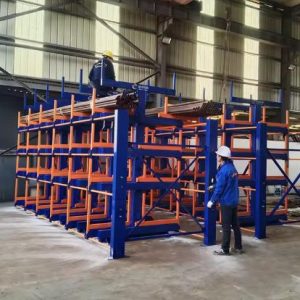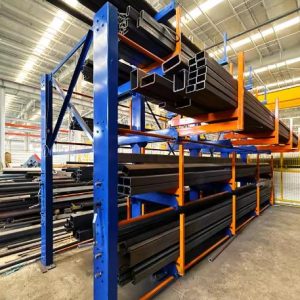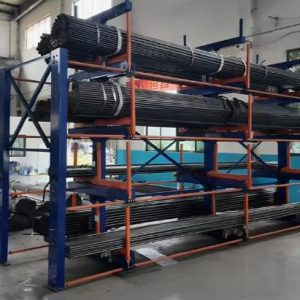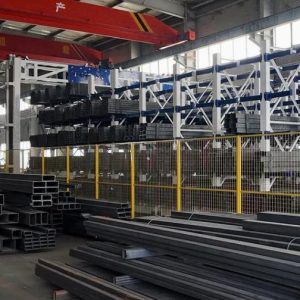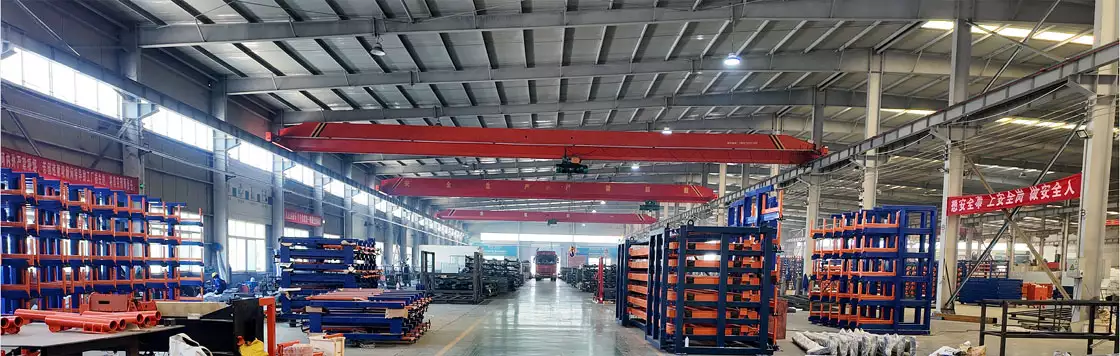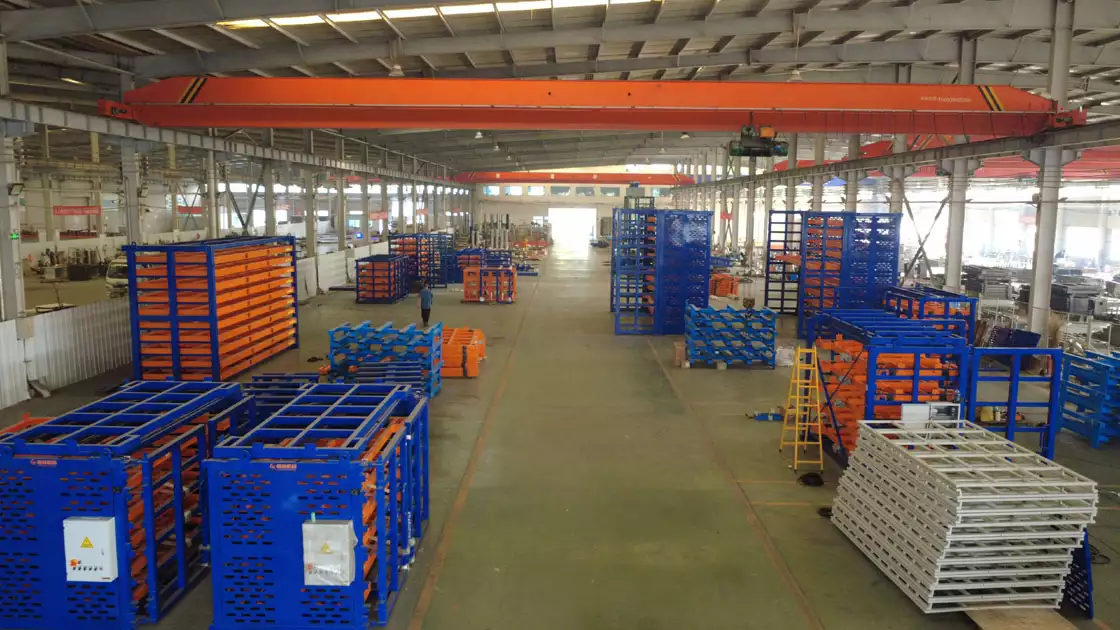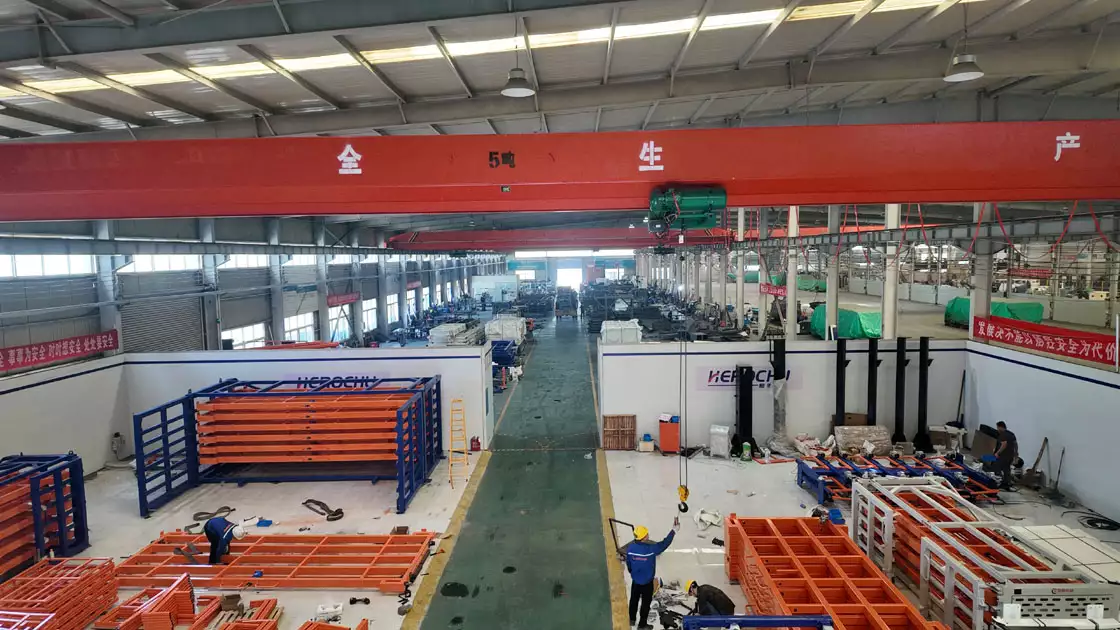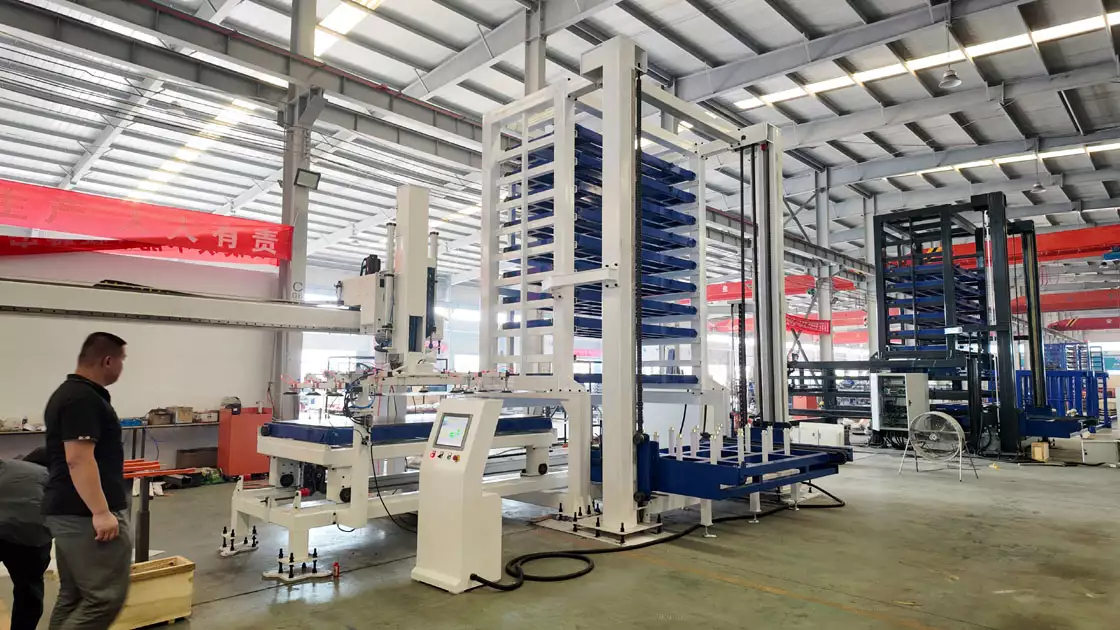
Fixed-arm cantilever racks have served warehouses for decades, and in applications where every stored item on a given layer is identical and always picked in sequence, they work adequately. But for operations that carry dozens or hundreds of distinct pipe and tube SKUs — varying by diameter, wall thickness, material grade, and length — the limitation of a fixed-arm system becomes apparent the moment an operator needs to pull a single piece from the back of a fully loaded layer. Every item in front of it must first be removed, set aside, and then replaced after the target piece is extracted. Over the course of a shift, this constant repositioning consumes hours of labor and introduces opportunities for handling damage.
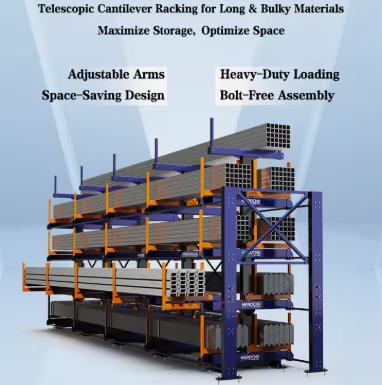
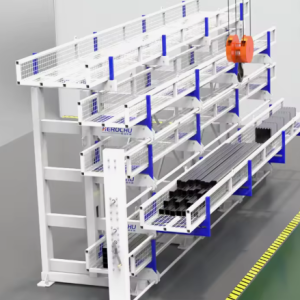
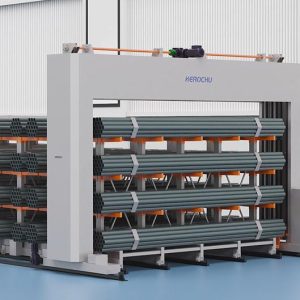
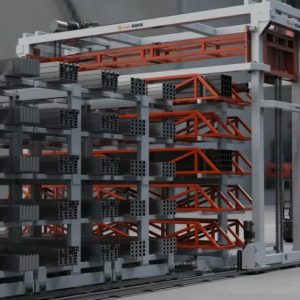
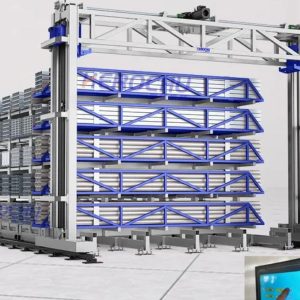
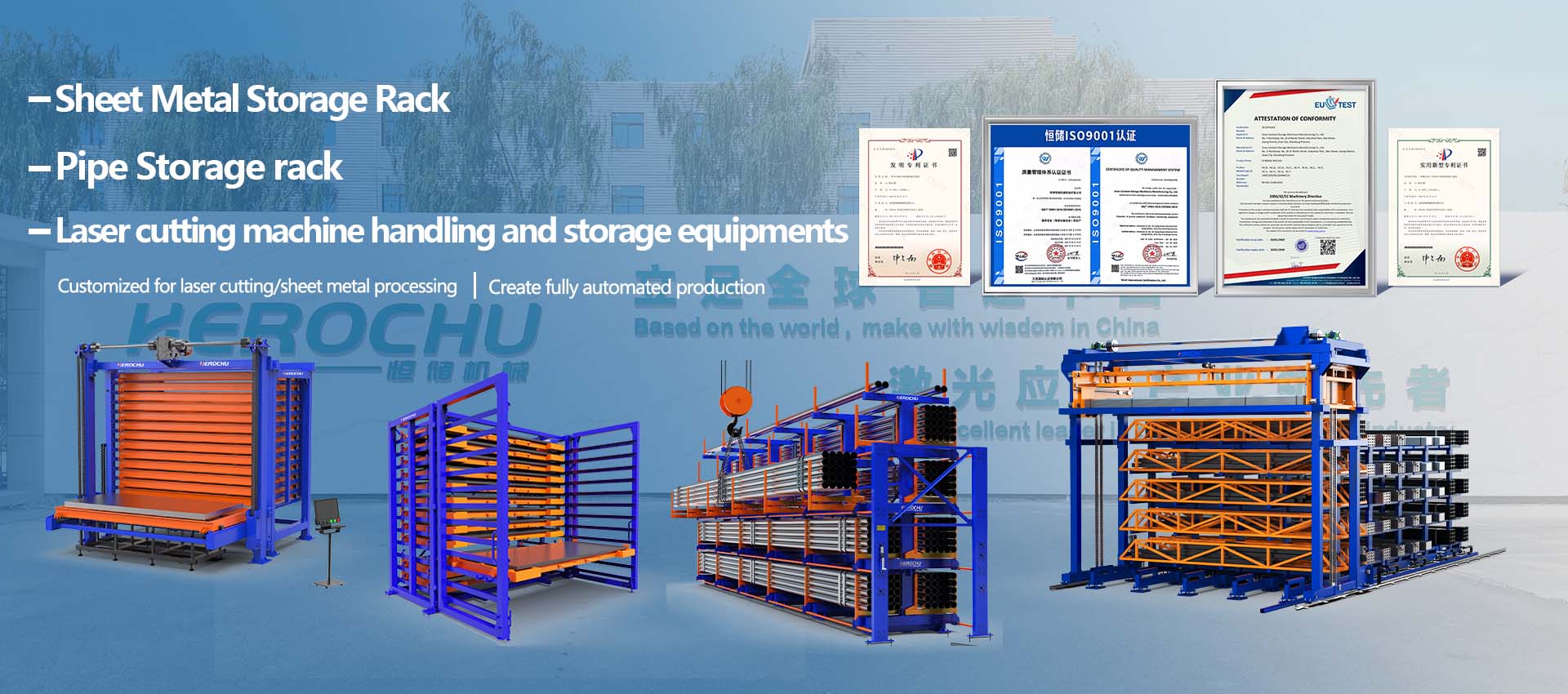
The Herochu roll-out cantilever rack replaces this workflow with a motorized mechanism that extends each storage layer’s arms fully into the aisle. When the arms deploy, the entire stock layer moves outward with them, presenting every piece on that level for direct overhead crane or forklift pickup. After the required item is retrieved, the arms retract. No adjacent stock is disturbed, no pieces are temporarily staged on the floor, and the sequence of material on other layers remains unchanged.
The 100 Percent Extension Mechanism
The core mechanical innovation in a roll-out cantilever rack is the sliding arm assembly mounted on each upright column. Each layer consists of one or more movable arm sets — the number depends on the length of the stored material — that travel along linear guide tracks integrated into the column structure. When the operator initiates extension via the control panel, an electric motor drives a transmission system that moves the arms outward at a rate of 0.1 to 0.2 meters per second.
At full deployment, the arms achieve 100 percent extension relative to their retracted position, meaning the entire load-bearing surface — and therefore the entire stored bundle — sits fully within the aisle. A forklift operator can approach from the side and engage the bundle without entering the rack bay, or an overhead crane can descend directly onto the material without navigating around frame cross-members. This full-access configuration is what distinguishes a powered roll-out system from partial-extension manual alternatives, where only enough movement is provided to create a fork pocket.
The extension speed of 0.1 to 0.2 meters per second represents a deliberate engineering choice balancing cycle time against safety. At the upper end of this range, a 2-meter arm deploys in approximately 10 seconds. Faster speeds are mechanically achievable but introduce higher kinetic energy into the moving assembly, which would require larger motors, heavier guide structures, and more aggressive braking systems — all of which add cost and complexity without proportionally reducing retrieval time, since most of the operation’s duration is spent on crane positioning and rigging rather than arm travel.
Layered Independent Access
Each storage layer on a Herochu roll-out cantilever rack operates its own motor and control circuit, so extending layer three imposes no force on the arms or stock of layers one, two, four, five, or six. This independence confers several operational advantages:
First, inventory stored on lower layers does not need to be cleared before accessing upper layers — a constraint that forces fixed-arm racks to either store identical material on every layer or accept that retrieving a top-layer item requires several intermediate picks.
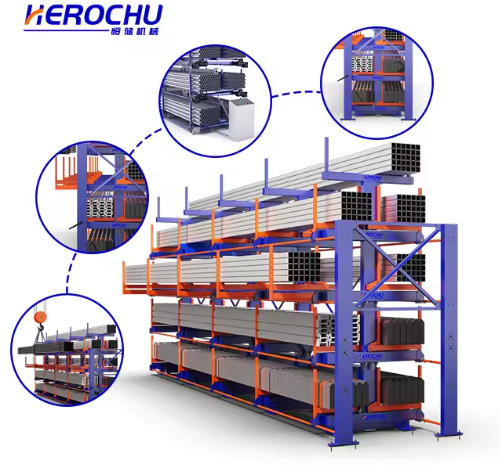
Second, mixed-SKU bays become practical. A single structural bay can hold schedule-40 pipe on layer one, schedule-80 on layer two, square tube on layer three, and round bar on layers four and five, with each layer independently retrievable. For service centers and distributors that carry wide product ranges, this means fewer bays are needed to segregate the inventory, and more of the warehouse footprint can be dedicated to storage rather than aisle space between segregated bays.
Third, the independent layer control supports a picking strategy where the most frequently accessed SKUs occupy the middle layers — at ergonomic height for operator visibility — while slow-moving stock occupies the upper and lower extremes. Because any layer can be brought to the aisle for access regardless of its vertical position, upper-layer material is no harder to retrieve than middle-layer material, eliminating the “top shelf penalty” that complicates putaway decisions in static rack environments.
Comparison with Conventional Cantilever Storage
To understand where a roll-out cantilever rack changes the warehouse operation, consider how a conventional fixed-arm cantilever bay handles a mixed-stock condition:
A fixed-arm bay with four layers holds four different pipe diameters. An order calls for two lengths from layer two. The operator must first remove all stock from layer one — typically by lifting it with a forklift and temporarily placing it in an open area — then access layer two, pick the required pieces, replace layer one’s stock, and then move to the next bay. This sequence might take five to eight minutes per pick, and each repositioning cycle creates a window where material is on the floor and at risk of being struck by passing equipment.
In a Herochu roll-out cantilever rack, the same pick proceeds as follows: the operator presses the layer-two control, the arms deploy, the crane or forklift engages the bundle and extracts the required lengths, the arms retract, and the operator moves on. Layer one’s stock never leaves the rack. The entire sequence might take one to two minutes, and no material touches the floor during the process.
The time savings compound with pick frequency. A service center that executes 60 picks per shift at five minutes each spends 300 minutes — five labor-hours — on retrieval. At two minutes per pick, the same throughput requires 120 minutes, freeing three hours of operator time for other tasks. Across a month of operation, this labor reallocation alone can justify the equipment investment before accounting for the safety improvement and reduced product handling damage.
Control Architecture and Operator Interface
Herochu equips the roll-out cantilever rack with a dual control interface: a touch screen panel integrated into the end column of each bay, plus a set of physical push-button controls. The touch screen displays the current state of each layer — extended, retracted, or in transit — and includes a visual indicator of layer occupancy drawn from the last recorded putaway or retrieval action. While this is not a full inventory management system, it gives forklift operators an at-a-glance reference for which layers contain stock and which are empty, reducing the need to physically inspect upper-level arms before initiating an extension cycle.
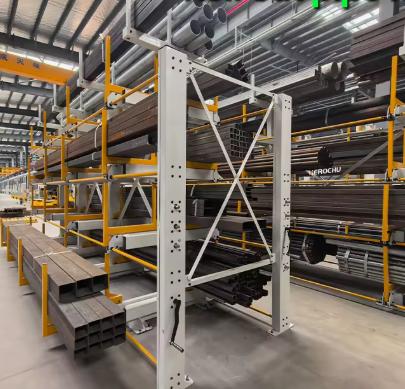
The button panel provides dedicated extend and retract controls for each layer, arranged in a layout that corresponds to the physical layer positions. Operators who handle the same rack bay throughout a shift develop muscle memory for the button positions and can initiate arm movement without reading the screen. For facilities where multiple operators interact with the rack, this tactile interface reduces training time and operator error compared to touch-screen-only systems.
The electrical system operates on a 380-volt three-phase 50 Hz supply as standard. For installations in regions with different voltage or frequency standards, Herochu supplies motors and control components rated for the local grid. The control cabinet includes overload protection on each motor circuit and hardwired emergency-stop circuits that are independent of the programmable controller — pressing an e-stop immediately removes power from all drive motors regardless of software state.
Safety Design for Powered Arm Movement
Powered moving arms in an industrial environment require safeguards beyond those applied to static racking. Herochu addresses this through several design features:
The controlled extension speed gives nearby personnel time to register and respond to arm movement. Unlike hydraulic systems that can lurch under load, the electric drive provides smooth acceleration and deceleration, with the motor controller ramping speed up and down at the start and end of each extension or retraction stroke.
Limit switches at both ends of the travel range prevent over-extension and over-retraction. These are physical switches — not software-defined limits — wired directly into the motor control circuit so that a controller fault cannot override the end-of-travel stop.
The interlocking control logic prevents simultaneous activation of extension and retraction commands on the same layer, and additional logic can be configured to prevent adjacent bay extension if the resulting clearance between extended arms would be insufficient for safe operation. This is especially relevant in double-sided configurations where arms extend into the same aisle from opposite rack faces.
Configuration Parameters
The roll-out cantilever rack is configured around the same parameter set as the broader Herochu cantilever racking family:
- Column heights from 2,000 millimeters to 6,000 millimeters as standard, with taller options up to 9,000 millimeters for high-bay facilities
- Arm load capacities of 0.5 tonnes, 1.0 tonne, 2.0 tonnes, or 3.0 tonnes per arm
- Two to six layers per bay
- Extension length from 1.0 meter to 3.0 meters
- Pipe and profile length accommodation for 3-meter through 12-meter stock
- Single-sided or double-sided layout
- Powder-coated or painted finish in blue, black, or white
The roll-out mechanism itself is an option within the cantilever racking product line. Customers who need powered deployment on some layers but not others — for example, heavy, slow-moving stock on fixed arms with frequently picked material on roll-out arms — can specify a mixed configuration within the same bay structure.
Maintenance and Service Life
The linear guide system that carries the sliding arm assemblies is designed for the duty cycle expected in industrial warehouse service. Guide surfaces are accessible for lubrication without disassembling the arm structure, and replaceable wear pads at the guide interface can be swapped when inspection intervals indicate approaching wear limits.
The motor and transmission components are standard industrial parts sourced from established suppliers, selected for parts availability rather than proprietary exclusivity. A facility maintenance team with general electromechanical experience can perform routine service using the documentation provided with the rack installation. For major service events or reconfiguration projects, Herochu offers factory support including on-site technical assistance.