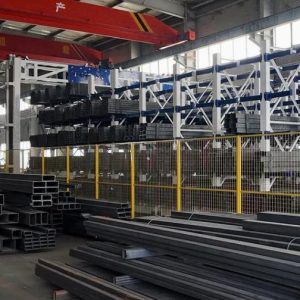
Metal bar and profile inventory presents a contradiction in warehouse design. On one hand, the material is dense, heavy, and expensive per linear meter — a bundle of 316L stainless round bar or 6061-T6 aluminum extrusion carries significant working capital. On the other hand, the storage method in most facilities has barely evolved beyond the outdoor rack and the forklift. Bars sit in cantilever racks accessed by an operator who must travel the aisle, identify the correct bundle by eye, position the forks, extract one or two pieces, and return to the cut station — a cycle that repeats dozens of times per shift and consumes labor hours that add nothing to the product value.
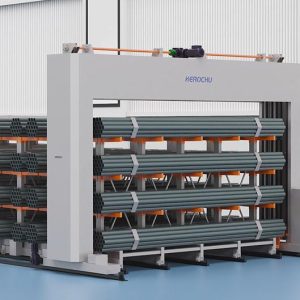
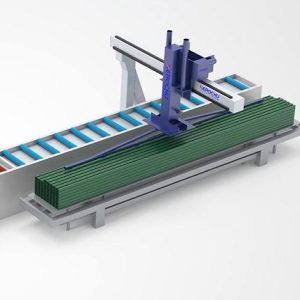
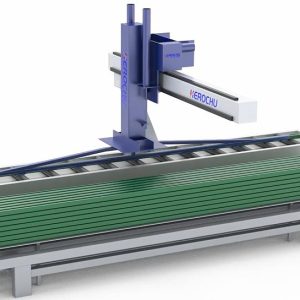
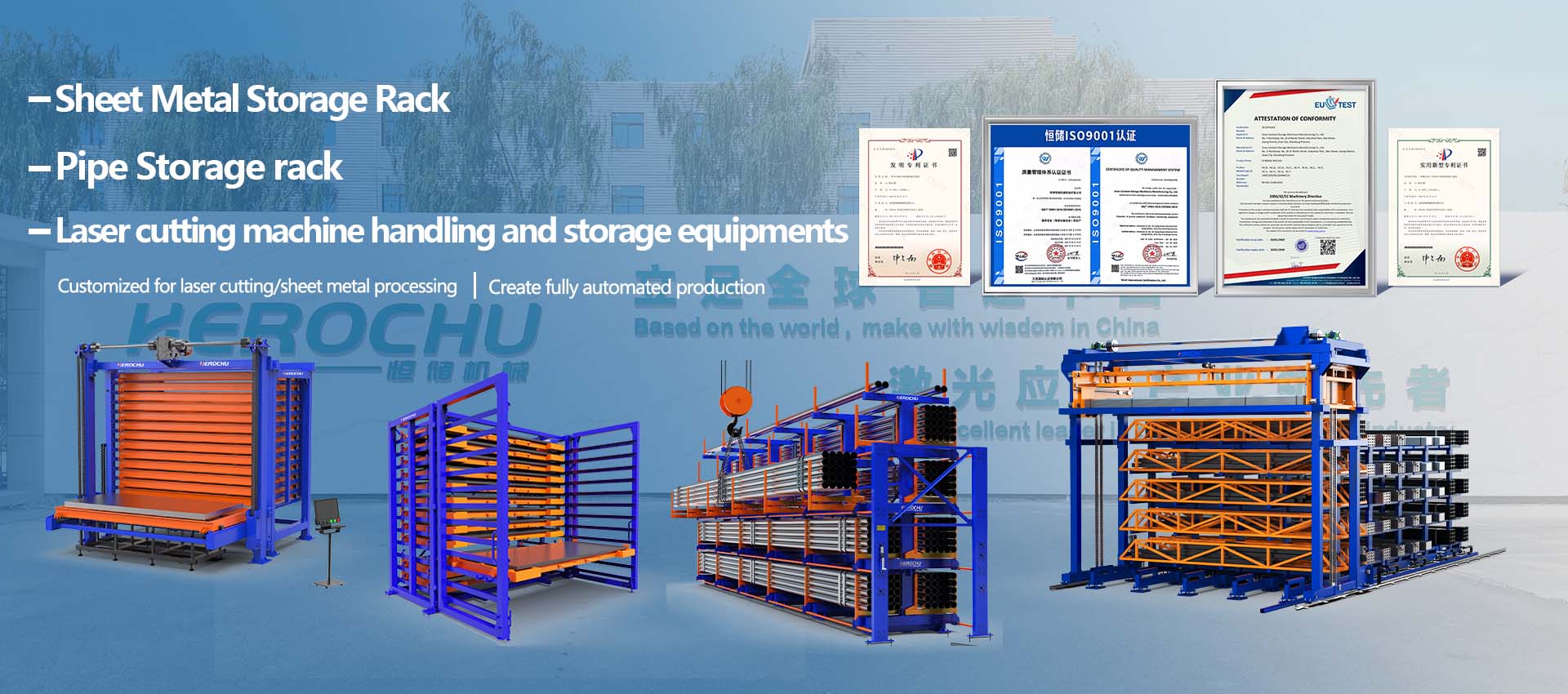
Herochu’s automated gantry metal bar and profile storage rack for warehouse replaces this manual sequence with a high-speed, PLC-controlled gantry retrieval system that delivers the requested material to a fixed operator station in under 90 seconds. The operator stays at the cut station. The machine does the walking.
System Architecture: How the Automated Gantry Rack Works
The system consists of four integrated subsystems working as a closed-loop material handling cell:
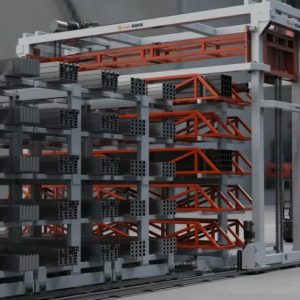
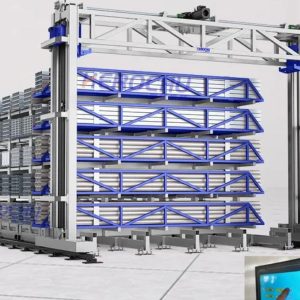
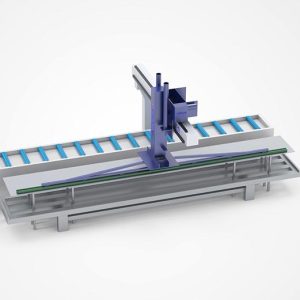
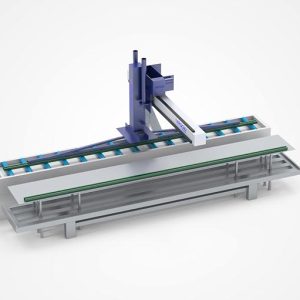
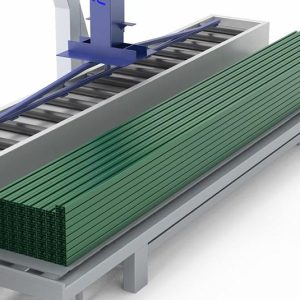
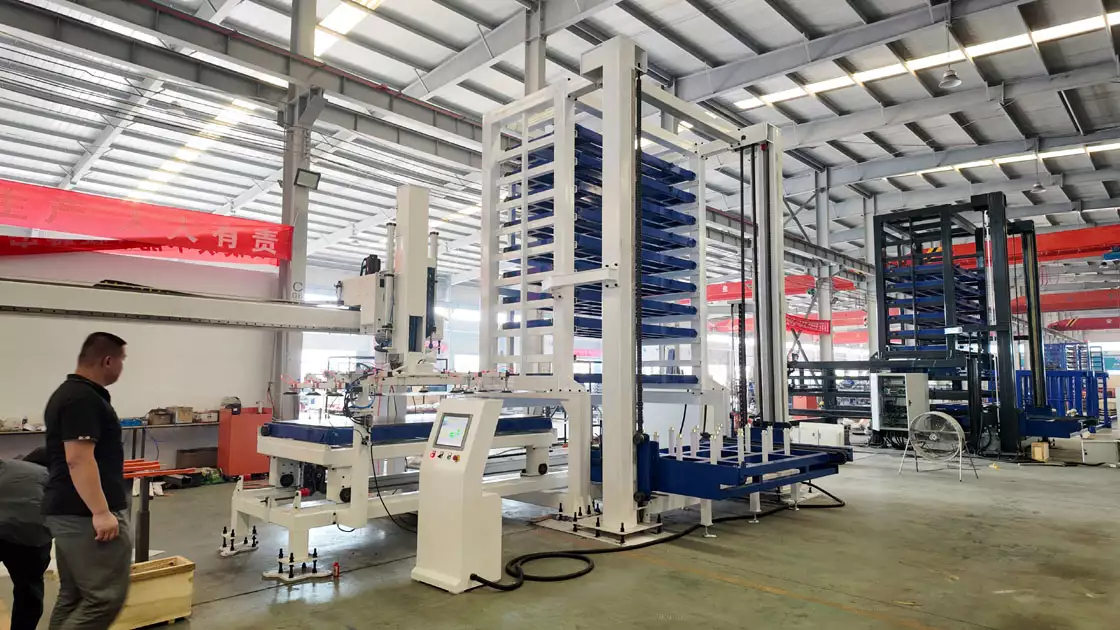
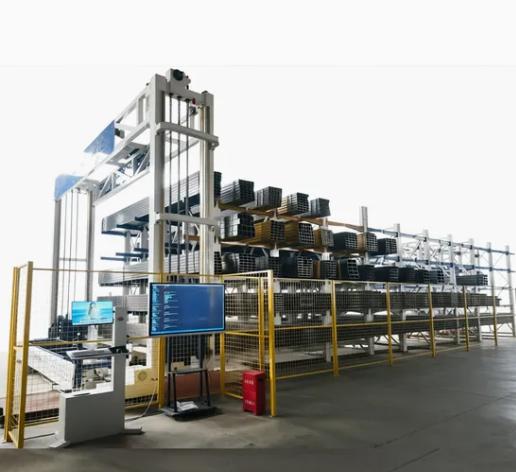
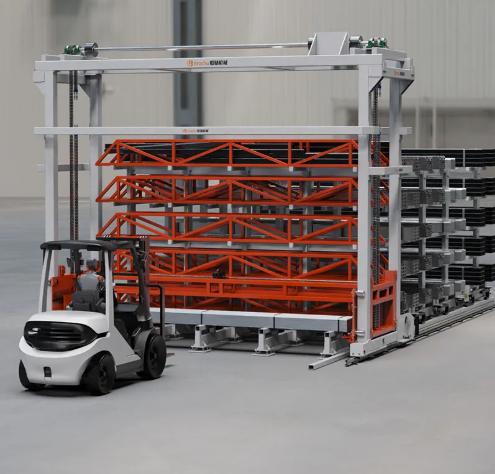
Loading and unloading gantry. A steel bridge structure spans the full width of the storage aisle, supported on linear guide rails embedded in the warehouse floor. The gantry carriage travels horizontally along these rails at variable speeds from 5 to 30 meters per minute, driven by AC servo motors with regenerative braking. A vertical mast assembly mounted on the carriage carries the lifting platform, which descends between the cantilever arm rows to the target storage level.
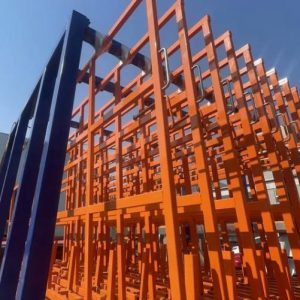
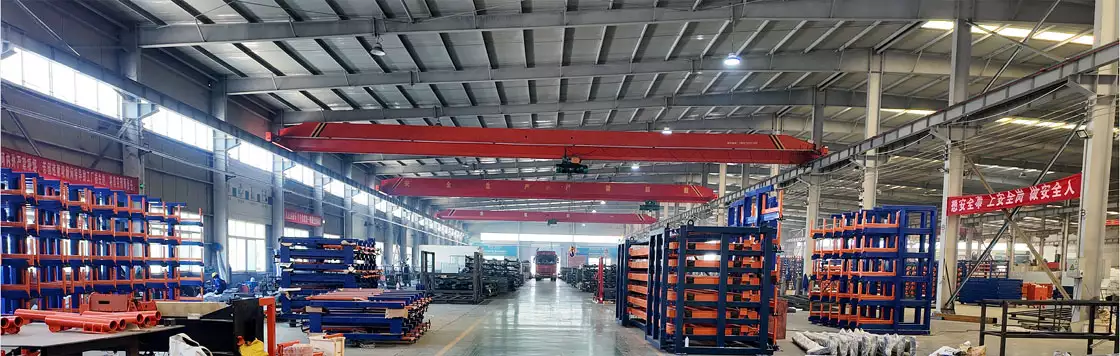
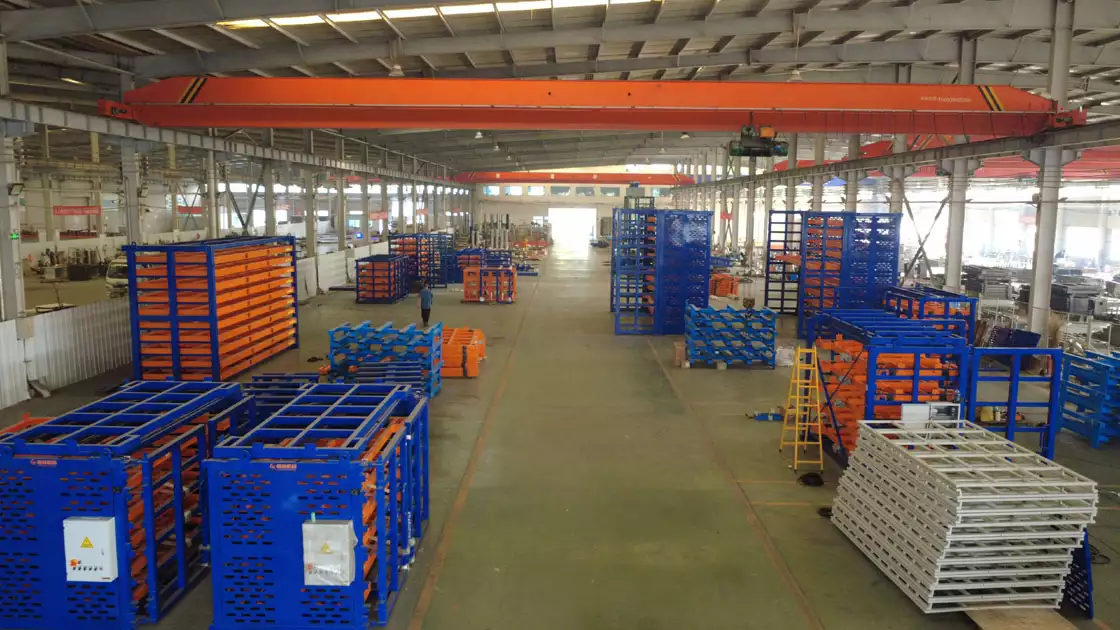
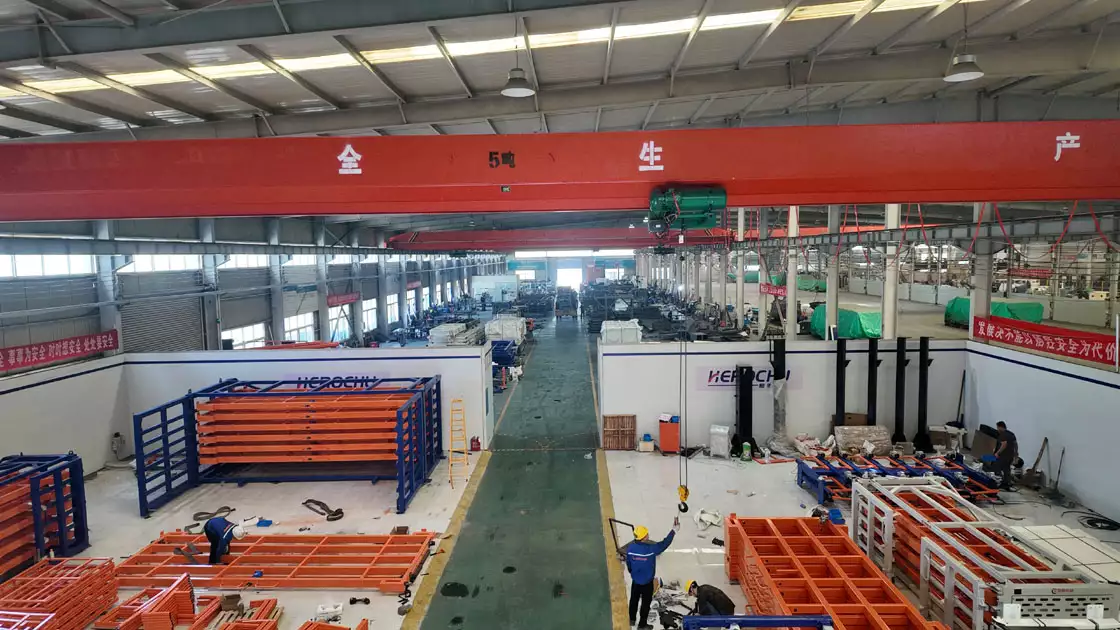
High-capacity profile material racks. These are Herochu’s heavy-duty cantilever storage racks, custom-engineered to match the gantry’s working envelope. Column height, arm spacing, bay width, and the number of storage levels are configured during the project engineering phase based on the customer’s SKU dimensions and inventory volume targets. Each storage cell — defined as one arm level in one bay — receives a unique coordinate in the control system database.
Material frames. Each bundle or individual bar rests in a frame — essentially a reinforced pallet or cradle — that spans between two cantilever arms. The frame design varies by material type: flat-bottom frames for bundled tube and pipe, V-cradle frames for single round bars, and compartmented frames for mixed small-diameter stock. The frame provides a consistent pick-and-place interface that the gantry’s lifting forks engage on every cycle, regardless of the material shape or bundle configuration.
Precision guide rails and positioning. Floor-mounted linear rails, aligned to within 1 mm over 30 meters of travel, provide the gantry’s horizontal reference. The vertical mast uses a rack-and-pinion drive with dual servo motors for synchronized lifting. An absolute encoder on each axis feeds position data to the Siemens S7 PLC, which calculates the travel profile in real time. Laser distance sensors at known rack positions provide periodic absolute position verification, correcting for any cumulative encoder drift.
Operational Performance: Speed, Precision, and Duty Cycle
The automated gantry system achieves vertical lifting speeds of 9 meters per minute and horizontal inlet/outlet movement at 12 meters per minute during standard operation. For a rack bay 6 meters high and 30 meters from the operator station, the total cycle time from order receipt to bundle delivery breaks down approximately as follows: 2.5 minutes for horizontal travel, 40 seconds for vertical descent, 15 seconds for frame engagement, 40 seconds for vertical lift with payload, 2.5 minutes for return travel, and 15 seconds for frame deposit at the operator station. The total — approximately 6.5 minutes — covers a worst-case retrieval from the farthest bay. Retrieval from the nearest bay completes in under 2 minutes.
Positioning repeatability of ±2 mm is maintained across the full working envelope. This tolerance is critical when the lifting forks must enter a 600 mm × 500 mm grid cell without contacting the adjacent stored frames or the rack arms. The PLC continuously monitors motor torque during the vertical descent phase; any unexpected resistance triggers an immediate stop and a fault alert on the HMI.
The system is rated for continuous 24-hour operation with scheduled maintenance intervals at 500 operating hours. Total installed power is 15 kW, supplied at 220V or 380V three-phase at 50 Hz or 60 Hz depending on the installation region. A UPS backup module maintains the PLC and encoder power supply during brief outages, preserving the absolute position reference so the gantry does not require re-homing after a power cycle.
The Three-Dimensional Material Library: Digital Inventory at Cell-Level Resolution
Herochu’s Three-Dimensional Material Library architecture treats every cantilever arm position as a discrete, indexed storage cell in a relational database. The WMS maintains a real-time map of which cell contains which material: SKU, heat number, quantity, receipt date, and physical dimensions. When a production order or sales order generates a picking requirement, the WMS queries this map, identifies all cells containing the requested SKU, applies a configurable retrieval rule — FIFO by receipt date, nearest-to-outfeed for minimum cycle time, or specific heat number for traceable orders — and transmits the target cell coordinate to the gantry PLC.
The operator at the loading station sees only the order queue on the HMI screen. As each order is processed, the HMI displays the SKU description, quantity, and the outfeed conveyor location where the material will arrive. The operator does not need to know the rack layout, the storage strategy, or the current inventory position of any SKU. The system abstracts all of that behind the coordinate-to-cell mapping layer.
Inventory accuracy improves substantially with automated storage. In a manual rack warehouse, inventory records drift because operators occasionally place returns in the wrong bay, forget to log a partial pick, or transpose SKU digits on a handwritten tag. An automated gantry system eliminates these errors because every put-away and every retrieval is a PLC-logged event with a timestamp, cell coordinate, and operator confirmation. The WMS inventory count is not an estimate — it is a transaction log of every movement the gantry has executed since the last physical count.
ERP and MES Integration
The Herochu automated gantry system communicates with the customer’s ERP platform — SAP, Oracle, Microsoft Dynamics, or a custom system — through a middleware interface layer that translates the WMS cell-coordinate logic into ERP inventory transactions. When the gantry retrieves a bundle, the WMS generates a material issue transaction in the ERP, decrementing the on-hand quantity for that SKU and location. When a new bundle arrives at the inbound station, the operator scans the supplier’s barcode or enters the heat number manually; the WMS assigns an available storage cell, the gantry executes the put-away, and the ERP receives an inventory receipt transaction.
For manufacturing facilities that run an MES layer between the ERP and the shop floor, the integration extends to production order scheduling. The MES can reserve material in the rack before the production run starts, and the WMS will lock those cells against other orders. When the production run begins, the gantry retrieves reserved material in the sequence the MES specifies, delivering bundles to the saw or cutoff station at the rate the production schedule demands.
Warehouse Space Economics
A typical manual cantilever rack warehouse serving a steel service center allocates roughly 35% to 40% of its floor area to aisles — the travel paths that forklifts and operators need to reach every bay. An automated gantry system running on floor rails needs a single aisle the width of the gantry carriage plus safety clearance, typically 2.5 to 3 meters. The rack rows on either side of that aisle can be built to the full available building height, up to 9 meters or more depending on the column design and the overhead crane clearance.
The net effect is an 80% reduction in the floor area consumed by aisle space, which translates directly into higher storage density per square meter. A facility that previously needed 1,000 square meters for pipe storage can often consolidate into 500 square meters with an automated gantry rack, freeing the remaining floor area for additional production equipment, expanded sawing capacity, or new product lines without constructing a building addition.
The vertical dimension is equally important. Most manual warehouses do not store material above approximately 3 meters because forklift reach and operator visibility become limiting factors. The gantry has no such constraint. Herochu routinely designs automated rack installations with 8 to 13 storage levels, utilizing the full clearance height of industrial buildings that would otherwise be empty air above the forklift masts.
Safety Systems and Operator Protection
Automated equipment operating at 30 meters per minute in a space that maintenance personnel may need to enter requires layered safety measures. The Herochu gantry system includes:
Light curtains at the operator station that stop gantry movement if the operator reaches into the load/unload zone during an active cycle. The light curtain status is monitored by a safety PLC that is independent of the motion control PLC.
Perimeter fencing with interlocked access gates around the gantry travel zone. Opening any gate triggers an emergency stop that removes power from the gantry drive motors and engages the brake. Restart requires a manual reset at the gate key switch.
Laser scanners mounted on the gantry carriage that detect obstacles in the travel path. If a person, forklift, or fallen object enters the scanner’s protective field, the gantry decelerates to a stop before contact.
Load monitoring on the vertical hoist that compares the measured motor torque against the expected torque for the known frame weight. A deviation beyond ±15% indicates either an overloaded frame, a partially disengaged frame, or a mechanical obstruction, and the hoist stops immediately.
Customization and Scalability
Every Herochu automated gantry installation is a custom-engineered project, not a catalog product. The engineering scope covers: rack bay dimensions and column sizing matched to the customer’s SKU length and weight distribution; gantry speed and acceleration profiles tuned to the warehouse length and target throughput; gripper or lifting fork design matched to the frame type; control system architecture including the PLC model, HMI screen layout, network topology, and ERP interface protocol; and safety system zoning based on the warehouse traffic patterns and pedestrian access points.
Scalability is built into the modular design. A system initially commissioned with four rack rows and one gantry can be extended with additional rack rows and a second gantry running on the same rail system, increasing throughput without disrupting the existing operation. The WMS database is designed to accommodate additional cells, and the PLC program supports multi-gantry collision avoidance through zone reservation logic — each gantry reserves its destination zone before moving, and the second gantry waits if the reservation conflicts with its own path.
Herochu’s automated gantry metal bar and profile storage rack represents a step change in how metal service centers, fabrication shops, and pipe distributors manage long-product inventory. It turns storage from a cost center measured in labor hours per pick into an automated function measured in picks per hour per kilowatt, with the accuracy and audit trail that digital manufacturing demands.