Bar stock inventory is working capital trapped in steel. Every length of round bar, square bar, hollow section, or extruded profile sitting in a warehouse rack represents money that has already left the company’s bank account but has not yet returned as revenue. The speed at which that inventory turns — from receipt at the dock to shipment to the customer or consumption on the shop floor — determines the return on that capital. Slow turning inventory, buried in a manual rack where finding a specific diameter and grade takes twenty minutes of aisle searching, costs more than the interest on the material value. It costs machine utilization when the saw operator waits for stock. It costs floor space when safety stock piles up because the warehouse team does not trust the inventory records. It costs customer goodwill when a promised shipment goes late because the material was in the rack all along but nobody could locate it.
Herochu’s automated bar stock storage system for bars, tube, and profiles addresses these costs at their operational root. It automates the put-away, location tracking, retrieval, and delivery of long metal products so that inventory turns faster, records stay accurate, and operators spend their time cutting and shipping rather than walking and searching.
Material Library Architecture: Every Bar Has an Address
The core concept behind Herochu’s automated bar stock storage is the Three-Dimensional Material Library — a structured storage grid in which every cantilever arm position in the rack is mapped to a unique three-coordinate address: rack row number, bay number within the row, and arm level number within the bay. The warehouse control system database stores this address alongside the material SKU, heat number or batch code, quantity in the cell, length, and put-away timestamp.
When a new shipment arrives at the inbound station, the operator measures or scans the bundle, verifies the material grade and heat number against the supplier’s documentation, and places the bundle onto a material frame — the standardized pallet or cradle that serves as the handling unit throughout the system. The WMS queries the cell map for the nearest available empty cell that fits the bundle dimensions and weight, assigns the cell address, and dispatches the gantry to execute the put-away. The operator does not decide where the material goes. The system does, using logic that optimizes travel distance for frequently picked SKUs and reserves heavier cells at lower rack levels to minimize lifting energy.
This cell-level indexing eliminates the gap between physical inventory and system records that bedevils manual warehouses. Every movement — put-away, retrieval, relocation — is a PLC-logged transaction. The WMS inventory count is not based on periodic cycle counts that may be weeks out of date. It is the running balance of all gantry movements, reconciled against the receipt log at the inbound station and the shipment log at the outbound station. Discrepancies surface immediately, not at year-end physical inventory.
System Components: What Makes Up an Automated Bar Stock Storage Installation
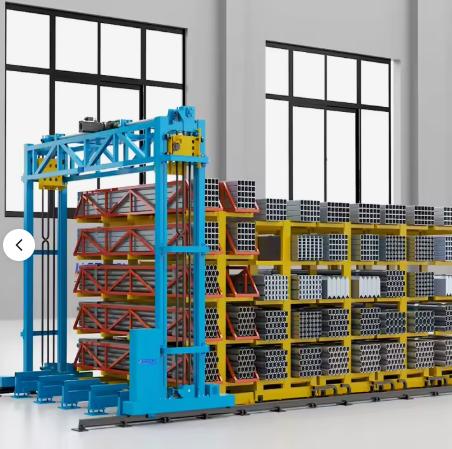
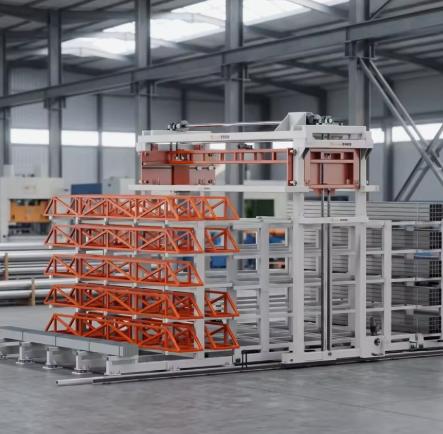
A complete Herochu automated bar stock storage system comprises six major component groups:
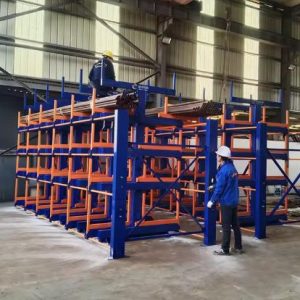
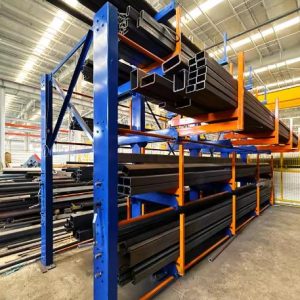
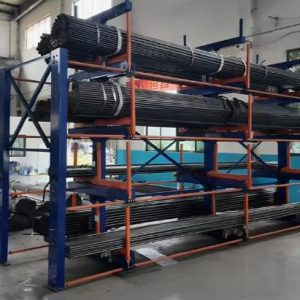
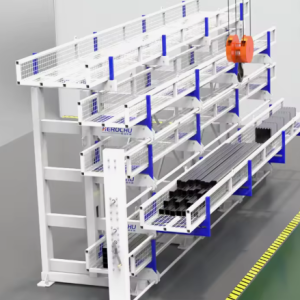
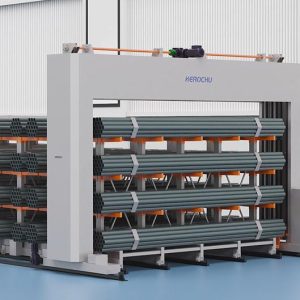
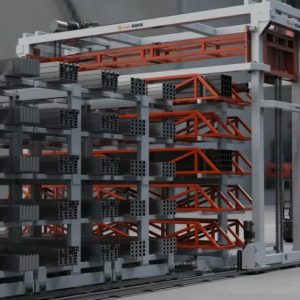
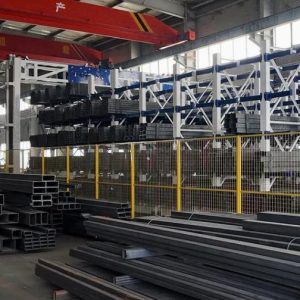
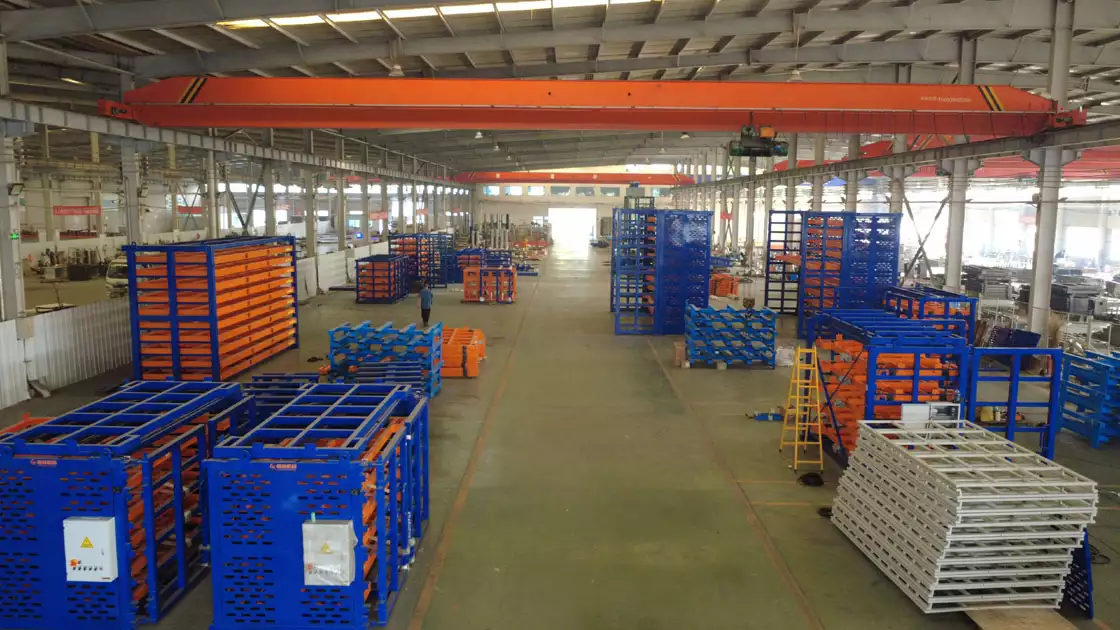
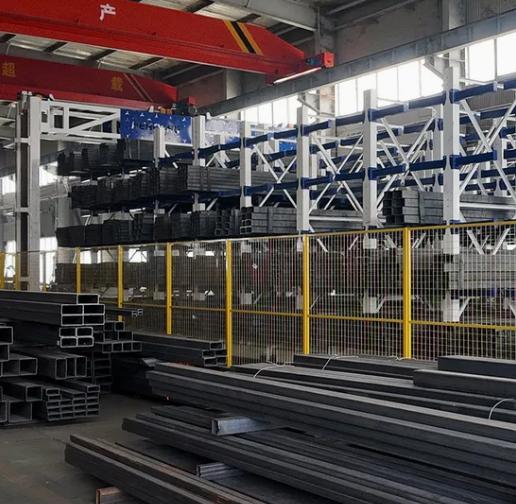
Cantilever storage racks. Heavy-duty steel structures engineered for the specific material lengths, bundle weights, and building dimensions of the installation. Column height typically ranges from 4,500 mm to 9,000 mm. The number of storage levels — arm rows per bay — falls between 8 and 13 for most projects, though taller configurations are achievable. Each arm is individually rated, with standard capacities of 3,000 kg and heavy-duty options to 5,000 kg per level.
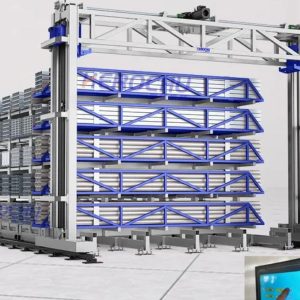
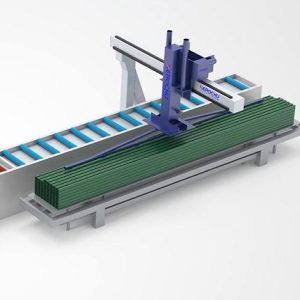
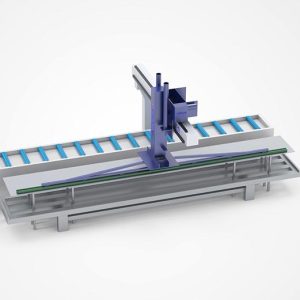
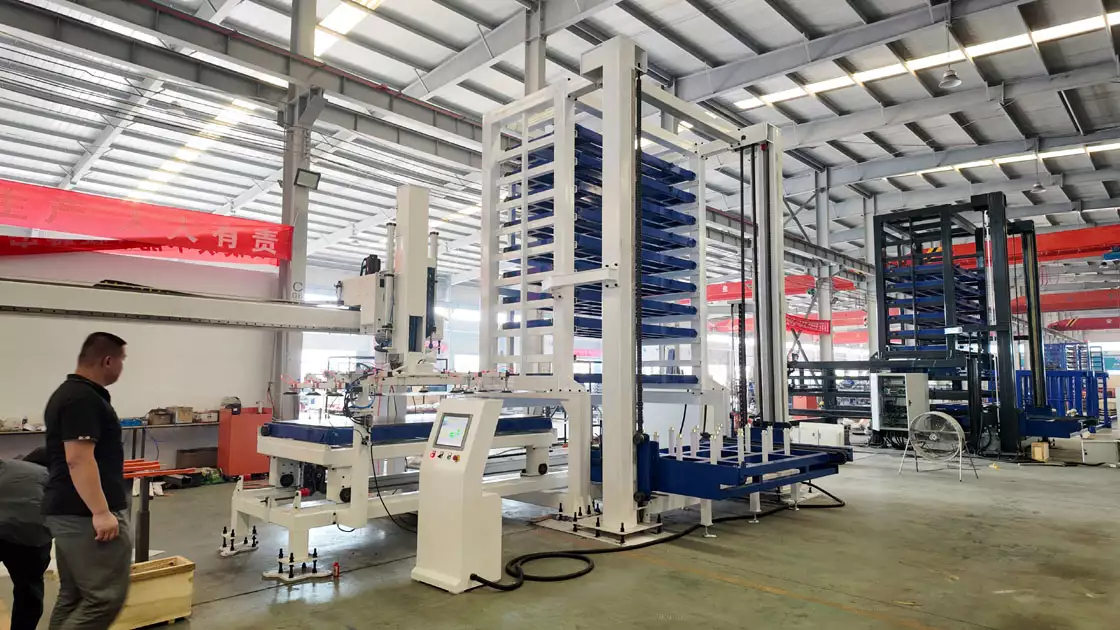
Automated gantry crane. A steel bridge structure that spans the rack aisle and travels on precision floor rails. The carriage carries a vertical mast with a lifting platform, powered by AC servo motors driving through rack-and-pinion or chain transmission. Horizontal travel speed is adjustable from 5 to 30 meters per minute. Vertical lift speed ranges from 5 to 15 meters per minute with a creep-speed mode for final positioning.
Material frames and cradles. The standardized interface between the stored product and the handling equipment. Frame types include flat-bottom pallets for bundled tube and pipe, V-cradle frames for single round bars that must not roll, compartmented frames for mixed small-diameter stock, and extended-length frames for bars exceeding 8 meters. Each frame type has a defined weight and dimension envelope that the WMS uses to match frames to compatible storage cells.
Guide rail system. Floor-mounted linear rails with hardened and ground running surfaces, aligned to within 1 mm over the full travel length. The rails serve double duty as the gantry’s horizontal reference plane and as the primary constraint against lateral forces during acceleration and braking. Rail mounting plates are grouted to the warehouse slab with high-strength, non-shrink epoxy grout to maintain alignment over years of cyclic loading.
Control system. A Siemens S7-series PLC handles motion control, safety interlocking, and I/O management. A 10-inch or 15-inch HMI touch panel at the operator station provides the user interface for order management, inventory inquiry, and system status monitoring. Communication with the customer’s ERP and WMS runs over industrial Ethernet — Profinet, Modbus TCP, or Ethernet/IP — through a managed network switch in the control cabinet.
Safety enclosure. Perimeter fencing with interlocked access gates, light curtains at the operator load/unload station, laser obstacle scanners on the gantry carriage, and emergency stop pushbuttons at multiple positions around the installation. The safety circuit is hardwired through a dedicated safety relay that removes drive power independently of the PLC program.
Multi-Material Handling: One System, Many SKUs
A metal distributor does not stock one product. A typical bar stock warehouse holds carbon steel round bar in diameters from 10 mm to 200 mm, alloy steel bar in multiple grades, stainless round and hex bar, aluminum flat bar and extrusion, brass and copper round stock, and structural profiles including angles, channels, and beams. Lengths range from 3-meter random mill lengths to 12-meter cut-to-order pieces. Surface finishes include hot-rolled black, cold-drawn bright, galvanized, and polished.
Herochu’s automated bar stock storage system handles this diversity through the combination of modular material frames and adaptive WMS logic. The frame type — selected at put-away based on the material geometry — ensures that each bundle is supported correctly regardless of cross-section. The WMS cell-matching algorithm considers frame dimensions, weight, and any material-specific storage rules — for example, routing polished stainless bar to indoor cells only, or grouping all hex bar in a dedicated rack zone for picking efficiency.
Material length up to 12 meters is accommodated through the rack bay configuration. For lengths beyond the standard bay width, the system uses a multi-support arrangement in which the material frame rests on two or three consecutive arm positions, distributing the bending load. The WMS recognizes these multi-cell frames and treats them as a single logical storage unit that cannot be partially retrieved.
Loading weight per storage cell ranges up to 5,000 kg for single-layer storage, with the total system capacity determined by the number of racks, levels per rack, and bays per level. A medium-scale installation with eight rack rows, ten levels each, and twenty bays per level provides 1,600 individually addressable storage cells. If every cell holds an average of 2,000 kg of material, the total live load on the structure exceeds 3,000 tonnes — a figure that underscores why the rack engineering, foundation design, and structural calculation package are critical deliverables in every Herochu project.
Industry 4.0 Integration: From Standalone Machine to Connected Factory
The automated bar stock storage system is designed to function as a node in a digital manufacturing network, not as an isolated machine. The PLC continuously publishes operational data — cycle counts, fault logs, motor current trends, and throughput statistics — to the WMS and, through the middleware layer, to the ERP system. This data feed supports several Industry 4.0 use cases:
Predictive maintenance. By trending hoist motor current against the known payload weight over thousands of cycles, the system can detect gradual increases in friction that indicate bearing wear, rail misalignment, or chain stretch. The maintenance team receives an alert before the deviation reaches a level that would trigger a fault stop, allowing scheduled intervention rather than reactive repair.
Real-time KPI dashboards. Production managers can view picks per hour, average cycle time, equipment utilization percentage, and inventory accuracy metrics on a web-based dashboard that pulls data from the WMS database. These metrics support labor planning, throughput target setting, and capital expenditure justification for system expansion.
Automated replenishment. When the ERP system detects that a particular SKU’s on-hand quantity has fallen below the reorder point — taking into account both the physical stock in the rack and the open purchase orders — it generates a replenishment suggestion for the purchasing department. Because the inventory count is transaction-based rather than cycle-count-based, the reorder trigger is based on accurate data.
Quality traceability. For aerospace, oil and gas, and medical device supply chains that require full material traceability, the cell-level indexing links every stored bar to its mill test certificate, heat number, and receiving inspection record. If a material non-conformance is discovered after shipment, the system can identify every customer order that consumed material from the same heat, enabling targeted recall rather than a blanket notification.
Space Optimization and Throughput Economics
The floor space economics of automated bar stock storage are straightforward. A manual rack warehouse serving 200 tonnes of bar stock inventory with 3-meter aisles between every second rack row allocates approximately 40% of its footprint to travel lanes. An automated system with a single gantry aisle serving rack rows on both sides allocates roughly 15% to the aisle and gantry zone. The difference — 25% of the original floor area — is freed for additional storage capacity, expanded processing equipment, or a reduced building lease footprint.
Vertical utilization compounds the space advantage. Manual warehouses rarely use storage height above approximately 3.5 meters because forklift visibility, mast deflection, and operator comfort impose practical limits. An automated gantry has none of these constraints. Herochu routinely specifies rack heights of 6 to 9 meters, multiplying the storage capacity per square meter of floor area by a factor of 2 to 3.
Labor economics follow a similar pattern. A manual warehouse with 200 tonnes of bar stock inventory and 50 picks per day typically requires two to three full-time warehouse operators per shift — one for put-away, one for picking, and a lead for inventory management and paperwork. The automated system reduces the operator requirement to one person per shift — the loading station operator who handles receipt verification, frame staging, and outbound order consolidation. The gantry handles all travel, lifting, and positioning. Over a two-shift operation, the labor saving alone often recovers the capital cost of the automation within three to five years, depending on local wage rates.
Implementation and Support
A Herochu automated bar stock storage project follows a defined engineering and delivery process. The project begins with a data-gathering phase in which the customer provides SKU dimensions, annual throughput volumes, building dimensions, foundation specifications, and the ERP/WMS interface protocol. Herochu’s engineering team produces a system layout drawing, a rack structural calculation package, a gantry specification, a control system architecture diagram, and a project schedule.
Installation is managed by Herochu’s site supervision team working alongside a locally contracted installation crew. The rack steel and gantry components ship in containerized lots with assembly drawings and bolt schedules. Mechanical installation — rack erection, rail mounting and grouting, gantry assembly — typically requires four to six weeks for a medium-scale project. Electrical installation and PLC commissioning follow, with a further two to three weeks for I/O checkout, motion tuning, and safety system validation.
System acceptance testing includes a 72-hour continuous run test during which the gantry executes a randomized sequence of put-away and retrieval cycles while the engineering team monitors positioning accuracy, cycle time, and fault frequency against the specification. Operator training runs concurrently with commissioning, covering daily startup and shutdown procedures, HMI operation, fault recovery, and basic preventive maintenance tasks.
Post-commissioning support includes a 12-month warranty on all mechanical and electrical components, remote diagnostic access through a secure VPN connection, and optional annual service contracts that cover preventive maintenance visits, software updates, and emergency call-out response.
For metal distributors, fabrication shops, and steel service centers that manage bar, tube, and profile inventory, automated storage is no longer a future-state concept. It is a capital equipment decision with measurable returns in floor space, labor, inventory accuracy, and throughput. Herochu’s automated bar stock storage system provides the engineering depth, the control system reliability, and the project delivery discipline to convert that decision into an operating asset.