Why heavy-duty long goods need a different racking logic
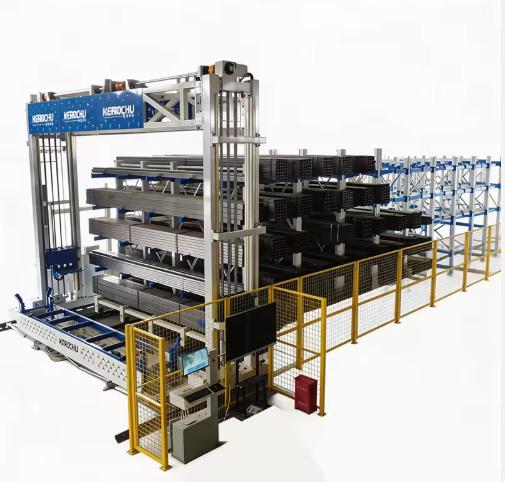
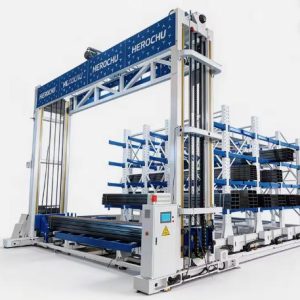
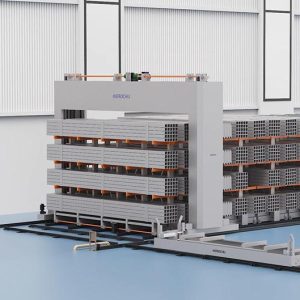
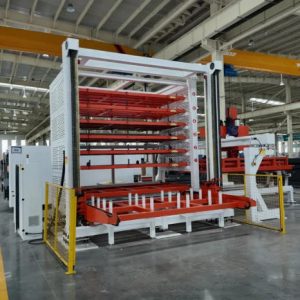
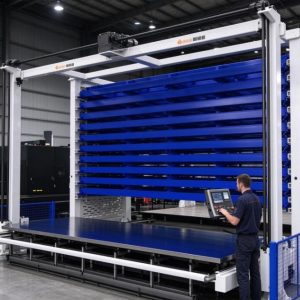
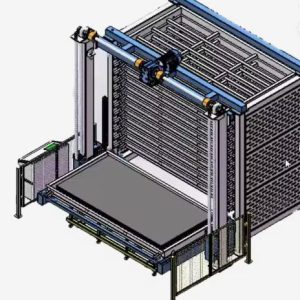
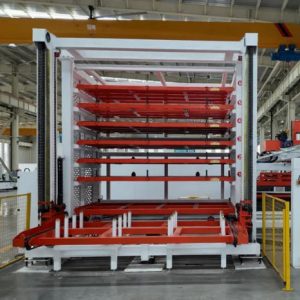
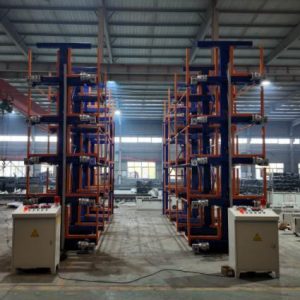
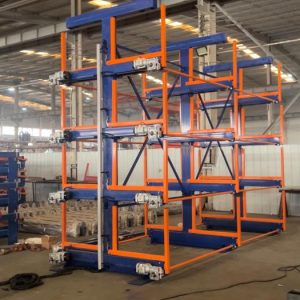
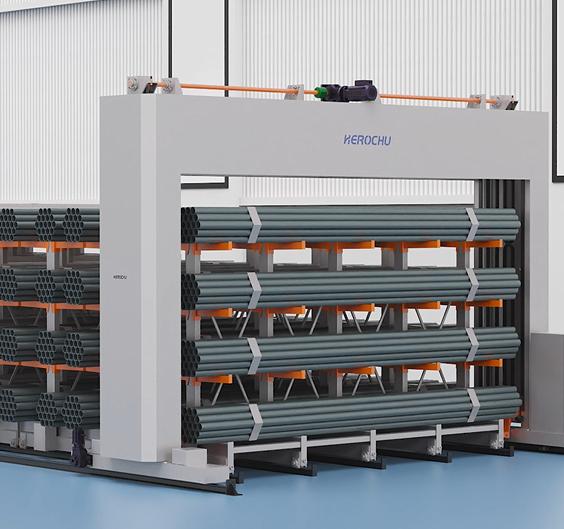
Steel pipe and heavy profile warehouses operate under loads that ordinary warehouse racking was never designed to carry. A single bundle of 8,000 mm pipe at 5,000 kg per level, repeated across 10 rack columns and 8 levels, produces a concentrated structural demand that cantilever racks and floor stacking handle inconsistently. Gantry automatic heavy-duty racking treats the rack as part of a machine system rather than a passive shelf. The gantry travels on floor-mounted rails, lifts along a vertical mast, and engages bins directly, while the rack structure is engineered around the gantry’s positioning envelope and the material’s load profile.
The CE certification question
For a European steel service center or profile fabricator, the procurement conversation usually begins with CE marking. Machinery placed on the EU market falls under the Machinery Directive 2006/42/EC, which establishes essential health and safety requirements and requires CE marking for compliant equipment. From 20 January 2027, the Machinery Regulation (EU) 2023/1230 replaces the Directive, but the core conformity logic remains: the equipment must be assessed against applicable essential requirements, technical documentation must be compiled, and the CE mark must be affixed before the machine enters service.
A CE-certified gantry racking system is therefore not simply a rack with a CE sticker. Certification covers the integrated machine: the gantry drive system, the control cabinet, the safety interlocks that prevent gantry movement while a person is inside the rack zone, the lifting mechanisms, and the structural interfaces between the rack and the rail system. Herochu supplies the HC-X series as CE-certified gantry storage and retrieval equipment, with the certification scoped to the configuration delivered.
What CE certification means in daily operation
The practical value of CE conformity appears in three areas. First, safety integration: a gantry ASRS removes operators from the storage zone during retrieval, but maintenance and commissioning still require access. The safety concept must define how the gantry is brought to a safe stop, how access gates interlock with the drive, and how residual energy is managed. Second, documentation and traceability: the technical file supports insurance, site safety audits, and customer qualification processes that steel distributors increasingly face. Third, regulatory durability: equipment certified under the Directive framework will need to be assessed against the Regulation from 2027, and a supplier that understands the conformity pathway is better positioned to support that transition.
Load, length, and configuration beyond the catalog
The HC-X series covers three baseline configurations. The HC-X6053-8 handles 6,000 mm pipe across 5 layers with 3,000 kg per level. The HC-X7065-10 extends to 7,000 mm, 6 layers, and 5,000 kg per level. The HC-X8085-10 moves to 8,000 mm, 8 layers, and 5,000 kg per level. Across all three, gantry travel runs at 5–30 m/min, lifting at 5–15 m/min, with ±2 mm repeatability.
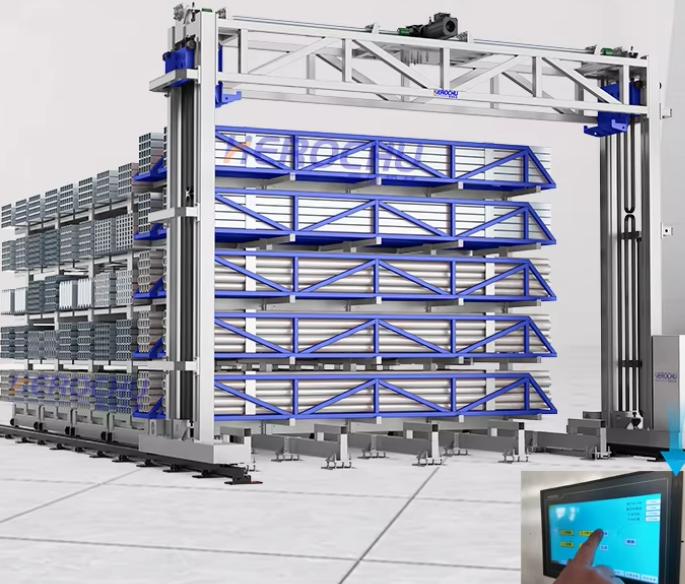
But heavy-duty racking for steel pipe warehouses rarely fits a catalog exactly. The number of racks is customized, the shelf layout is tailored to the on-site material mix, and the layer count can be adjusted within the tower structure. A warehouse that runs 6 m and 9 m pipe in the same bay needs a rack map that reflects that mix rather than forcing material into a single length assumption. The configuration process should begin with the material schedule—diameters, wall thicknesses, bundle weights, and length distribution—and then build the rack and bin layout around it.
Safety and structural considerations that CE assessors examine
A heavy-duty gantry racking installation presents load cases that a static rack does not. The gantry introduces dynamic forces during acceleration and braking, and the rail foundation must accommodate those forces without transmitting unacceptable vibration to the rack structure. The rack itself must be designed for the concentrated load of a fully loaded bin being set down or picked up, not merely for static storage. CE conformity assessment will look at the structural calculations for the rack and rail system, the guarding around the gantry travel path, the emergency stop architecture, and the logic that prevents the gantry from traveling into an occupied maintenance zone.
Herochu’s gantry frame is described as an integrated high-strength structure designed for anti-vibration and anti-deformation under long-term high-frequency operation. That structural approach is relevant to CE assessment because it reduces the position deviation that would otherwise trigger repeated re-alignment and increase wear on the rail and rack interfaces.
Frequently asked questions
Is CE certification mandatory for a gantry racking system sold in the EU? Yes. Machinery placed on the EU market must comply with the applicable machinery directive or regulation, and CE marking is the visible declaration of that conformity. The relevant framework is Directive 2006/42/EC until 19 January 2027, and Regulation (EU) 2023/1230 from 20 January 2027.
Does CE certification cover the rack structure as well as the gantry? Certification covers the machinery as placed on the market. The rack, rail, gantry, and control system function as an integrated machine, so the conformity assessment addresses the interfaces between them as well as the individual components.
What load can a CE-certified heavy-duty gantry rack hold per level? In the Herochu HC-X series, per-level loads range from 3,000 kg on the 6 m, 5-layer configuration to 5,000 kg on the 7 m and 8 m configurations with 6 or 8 layers. Final load ratings depend on the customized rack layout and the structural assessment for the specific installation.
Can the rack layout be customized without losing CE conformity? Customization within the certified design envelope is possible, but changes to load ratings, layer counts, or safety architecture should be assessed against the technical file. Herochu configures the rack count and shelf layout to the site, and the certification scope should be confirmed for the delivered configuration.
Bottom line
CE certification on a heavy-duty gantry racking system is a statement that the integrated machine—gantry, rail, rack, controls, and safety logic—has been assessed against the applicable EU requirements. For a steel pipe or profile warehouse, it is both a market-access requirement and a discipline that forces the rack layout, load assumptions, and safety architecture to be documented before installation. Herochu builds the HC-X series as CE-certified equipment and configures the rack count, layer count, and shelf layout around the material schedule rather than the other way around.