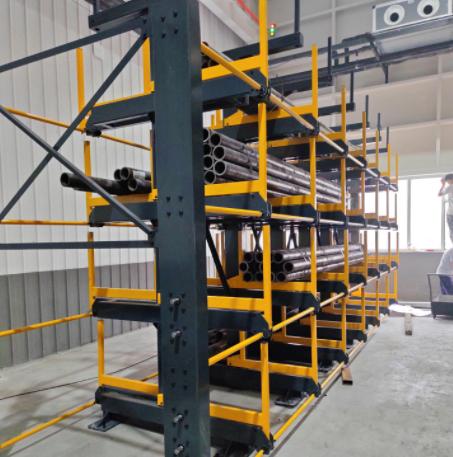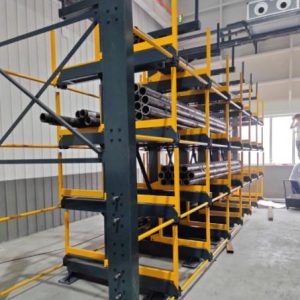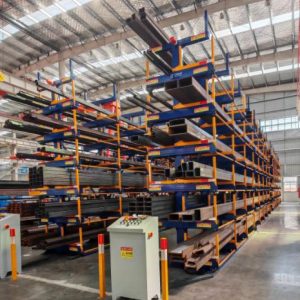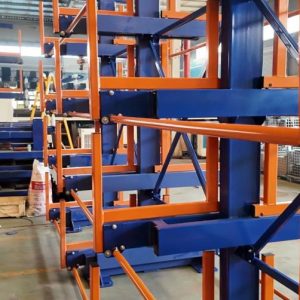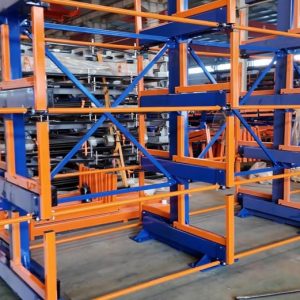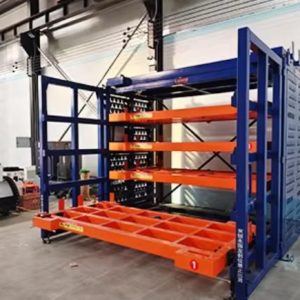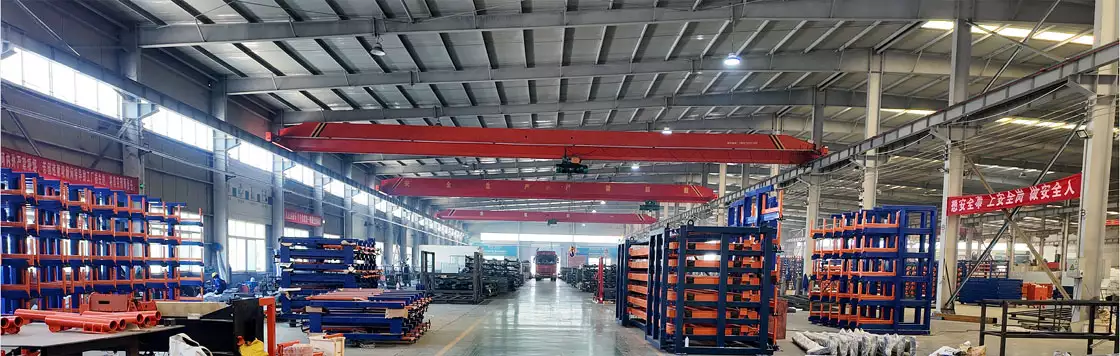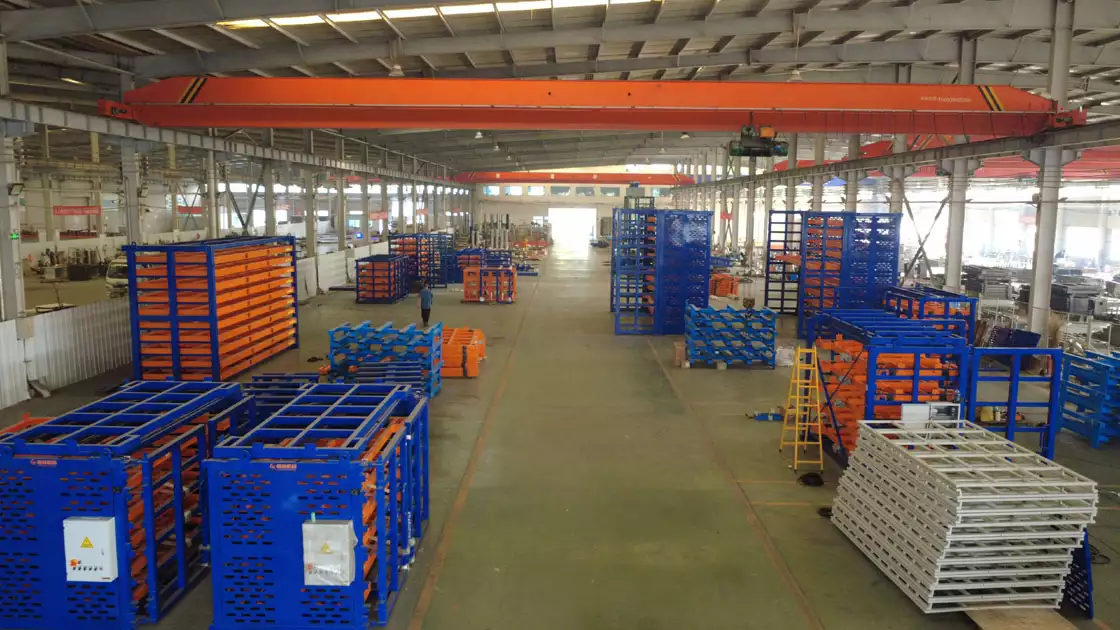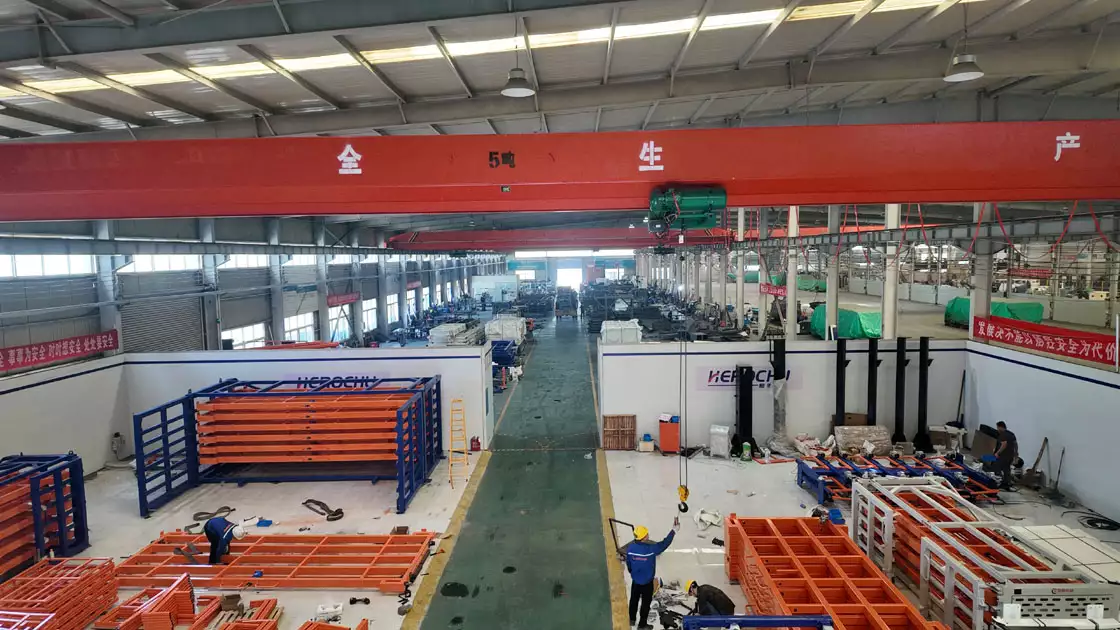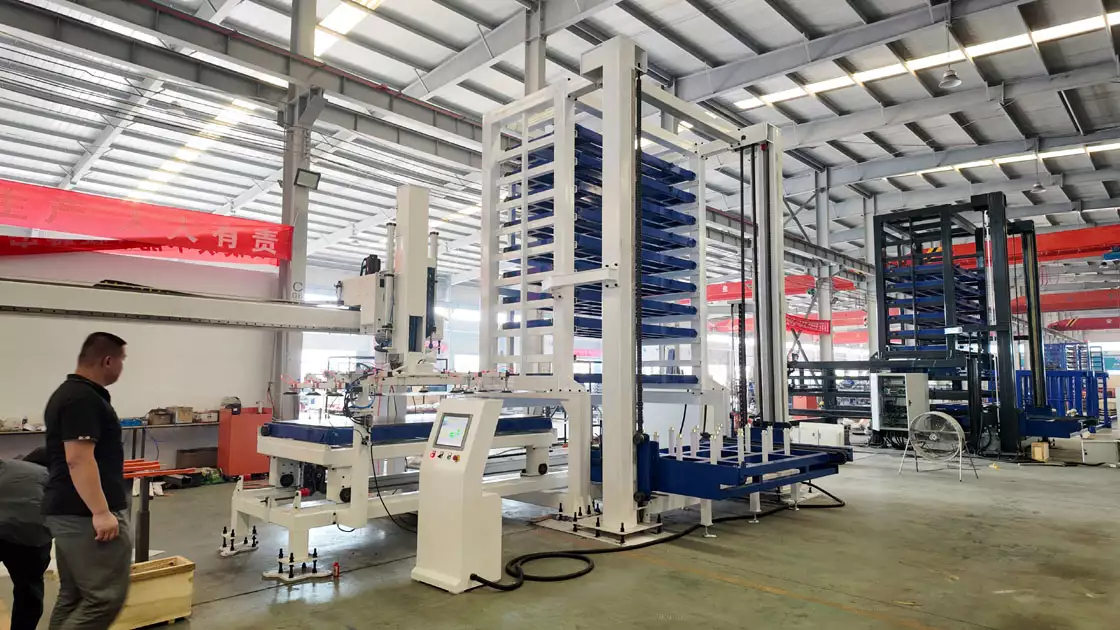
The manual hand-crank cantilever rack works. A floor-level transmission, positive mechanical locking, and arms that extend on demand have served steel warehouses for years without electrical supply. But the manual crank imposes a constraint that grows with rack height and usage frequency: every extension requires an operator at the crank, and every tier operates on the schedule of whoever is turning the handle. In a warehouse that retrieves twenty bundles an hour across five tiers, the hand crank is the bottleneck the crane operator waits on.
The automatic movable cantilever racking system was developed to remove that bottleneck. Herochu builds the HC-G electric series with a dedicated motor per level and single-button control, so each tier extends independently, on demand, without an operator stationed at a crank handle. The mechanics of the telescopic arm — dual-beam crossbars, dual-side discharge, Q235B construction — remain identical to the manual series. What changes is the drive, and with it the throughput, the labor model, and the resilience of the system under sustained picking loads.
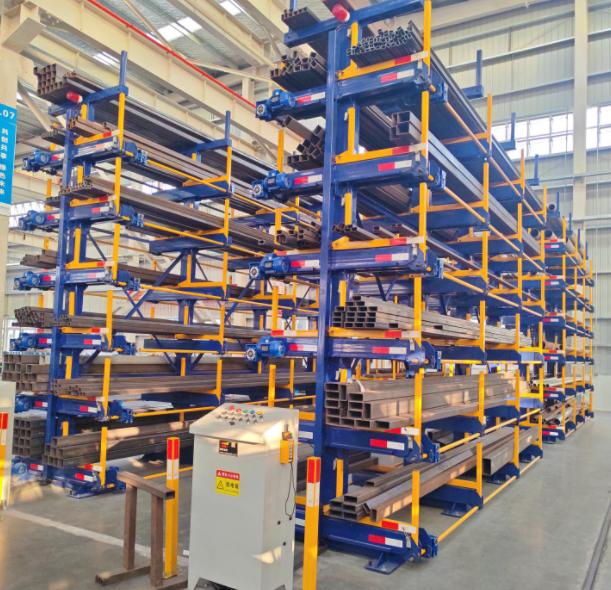
Dedicated Motors Per Level: Independent Tier Extension
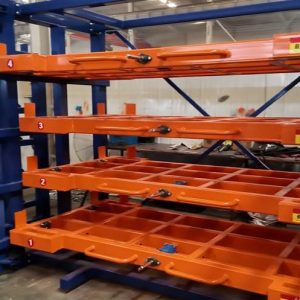
The defining feature of the Herochu electric series is that each tier has its own motor. This is not a single motor driving a transmission that engages one tier at a time through a clutch — it is a motor dedicated to each arm carriage, allowing any tier to extend while the others remain retracted.
The operational consequence is significant. In a manual system, extending the third tier means cranking that tier out, retrieving the bundle, cranking it back, then moving to the next tier the pick list requires. The operator walks the full sequence. In the electric system, the crane operator presses the button for the target tier, that tier extends, the bundle is retrieved, the tier retracts, and the operator immediately selects the next tier on the list — all from the crane cab or a wall-mounted panel. Tiers that are not in use stay retracted, keeping the aisle clear and the frame compact. The result is that a multi-tier pick sequence that took minutes on the hand crank takes seconds on the electric drive.
Single-Button Operation and Throughput
The electric series is controlled through a single-button interface per tier. Press to extend, press to retract. There is no multi-step engagement sequence, no clutch to shift, no manual lock to release — the drive engages the tier directly and the mechanism holds position under load through the motor and its transmission.
Throughput gains are most visible in high-frequency picking environments. A steel service center that fulfills cut-to-length orders throughout the day retrieves bundles from multiple tiers in sequence, often with a crane operator working alone. On a manual rack, that operator descends from the crane, walks to the crank, extends the tier, returns to the crane, retrieves the bundle, descends again, retracts the tier, and repeats. On the electric rack, the same operator presses the tier button from the crane cab or a remote panel, the tier extends, the bundle is retrieved, the tier retracts, and the operator selects the next pick — without leaving the crane. The labor hours saved across a shift compound into the labor cost that pays for the electric drive.
Manual Crank and Electric: Two Configurations, One Frame
Herochu offers both drive configurations on the same HC-G frame, and the choice between them is a decision about the operation, not the structure. Both share the Q235B dual-beam crossbar, the telescopic arm carriage, the dual-side discharge mechanism, and the independent compartment layout. The difference is how the arms are driven.
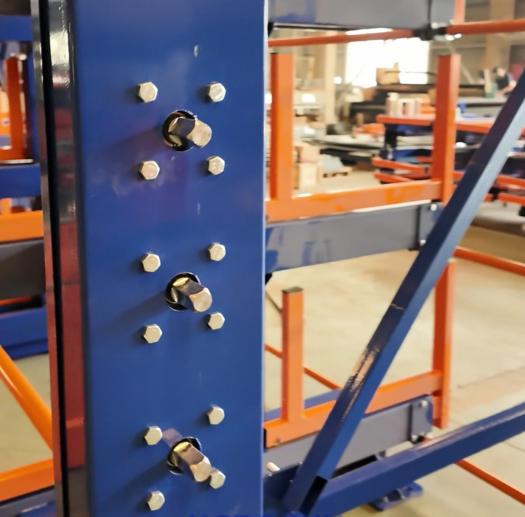
The manual hand-crank series uses a floor-level mechanical transmission that maintains positive holding power without electrical supply. This is the configuration for unpowered halls, remote yards without reliable power, and operations that need outage resilience — a warehouse that cannot afford to lose rack access during a power failure keeps the manual crank as a fail-safe against downtime. The crank is robust, simple, and field-serviceable without specialized electrical skills.
The motor-driven electric series trades that simplicity for speed and autonomy. It is the configuration for operations where picking frequency justifies automation — high-volume distribution centers, production-feeding racks that cycle tiers every few minutes, and warehouses where labor cost makes crane-cab-only operation the target. For sites that want both, the electric frame can be specified with a manual override that allows the crank to drive the transmission if power is lost, combining the throughput of the motor with the resilience of the manual drive.
Outage Resilience and the Manual Override
Power outages are the objection raised most often against motorized racking. A rack that stops working when the power stops is a rack that blocks the production schedule it was installed to support. Herochu addresses this with two layers of resilience. First, each tier motor and its control are independent — a fault on one tier does not disable the others, and the remaining tiers continue to operate normally. Second, the manual override on the electric frame allows the transmission to be engaged by hand crank, so a warehouse without power can still extend and retract tiers, retrieve material, and fulfill orders, though at the manual pace rather than the motorized one.
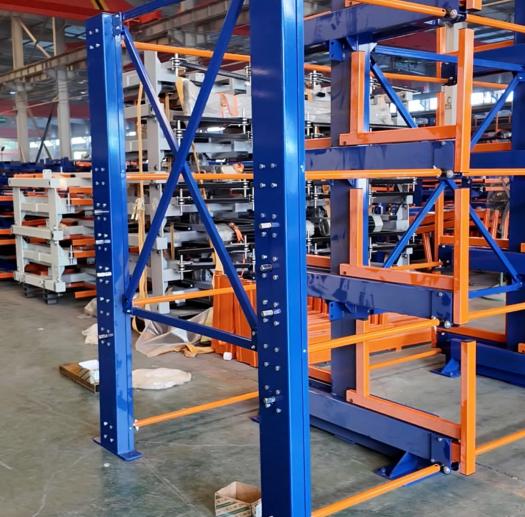
This is the practical middle ground that makes the automatic movable cantilever racking system viable for operations that cannot tolerate a single point of failure. The electric drive delivers the throughput; the manual override delivers the continuity. A warehouse that installs the electric series is not betting its picking capacity on the reliability of the local grid — it is gaining the speed of the motor while retaining the fallback that the manual series was built to provide.
Where Automation Pays and Where It Does Not
The electric series is not the right answer for every warehouse, and specifying it without considering the operation is a common procurement mistake. A low-volume yard that retrieves a bundle every few hours gains little from motorized extension — the manual crank handles that pace without strain, and the electric drive adds cost and maintenance without throughput benefit. A high-volume service center that cycles tiers continuously, feeds a cut-to-length line, and operates a single crane on multiple picks per hour is the operation where the electric drive pays for itself in labor and crane time saved.
Herochu configures the HC-G electric series to the same stock lengths and load ratings as the manual frame — the HC-G6053 at six meters and three tons per level, the HC-G12065 at twelve meters and five tons — so the drive configuration does not constrain the material the rack can store. The question is not what the rack holds but how often it moves. For operations where the answer is constantly, the automatic movable cantilever racking system is the configuration that turns the telescopic arm from a storage mechanism into a production-feeding tool.