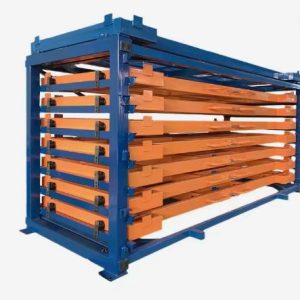
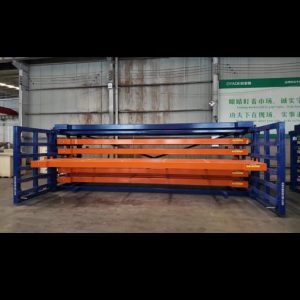
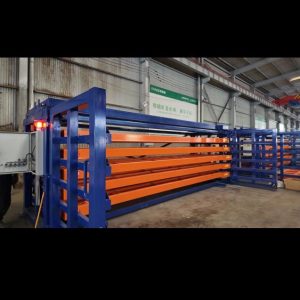
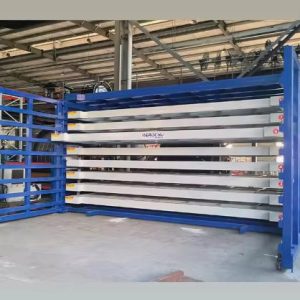
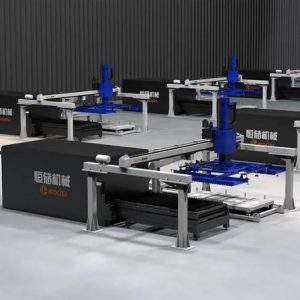
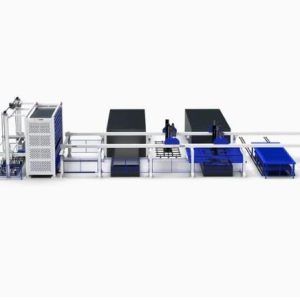
A vertical lift system (VLS) for sheet metal is not a single product with one configuration. The architecture splits into two fundamental layouts: single-tower and dual-tower. Each layout serves a different production scale, throughput requirement, and facility layout. Choosing between them — or combining them — determines whether the storage system keeps pace with the cutting equipment or becomes the constraint that slows it down.
Herochu manufactures both configurations, and the engineering team approaches the selection decision as a throughput calculation rather than a preference call.
Single-Tower VLS: The Entry Point to Automated Storage
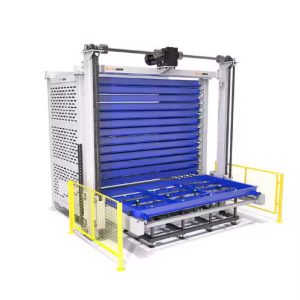
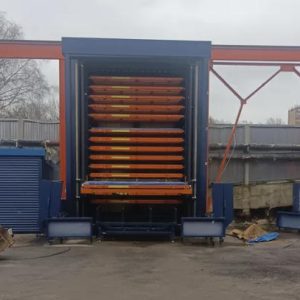
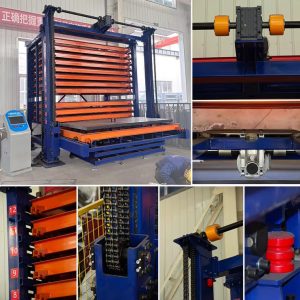
A Herochu single-tower VLS uses one vertical storage column with a central elevator mechanism that retrieves trays and delivers them to an access bay. The layout is straightforward: sheets enter the tower, the PLC tracks their position, and when an operator or robot requests a specific plate, the elevator travels to the correct level, extracts the tray, and presents it at the access opening.
The single-tower configuration suits fabrication shops running one or two cutting machines with moderate retrieval frequency. A shop cutting 3000 x 1500 mm sheets on a single fiber laser, changing plate every 30 to 45 minutes, generates a retrieval demand that one tower handles comfortably. The HC-S3015-63 model with six layers and 3,000 kg per-level capacity covers this profile. For shops processing larger plates, the HC-S4020-85 with eight layers at 5,000 kg extends the single-tower capacity without changing the architecture.
What defines the single-tower layout is its retrieval cycle. The elevator can serve only one request at a time. When two cutting machines demand material simultaneously, the second machine waits. At moderate throughput, that wait is negligible — the retrieval cycle completes in under 60 seconds, and the next machine’s request queues behind it. But as production volume grows, that queue becomes the bottleneck.
Dual-Tower VLS: Doubling Throughput With a Shared Extractor
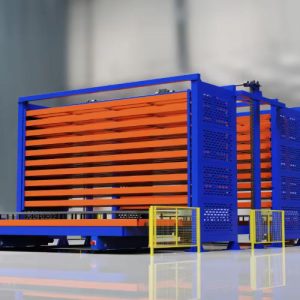
The Herochu dual-tower configuration addresses the throughput ceiling of a single tower. Two parallel storage columns share one central extraction crane that operates between them. The extractor can retrieve a tray from Tower A, deliver it to the access bay, then immediately retrieve from Tower B while the first tray is being unloaded — effectively halving the cycle time between consecutive retrievals.
This architecture matters in two scenarios. First, high-volume shops where two or more cutting machines run continuously and the retrieval queue under a single-tower layout would exceed the laser cutter’s idle tolerance. Second, dual-station laser cutting lines where one machine cuts while the other loads — the dual-tower configuration supplies both stations from a shared storage base without the extractor becoming the rate-limiting step.
The dual-tower layout also expands storage volume without doubling the control complexity. One PLC touchscreen manages both towers. The WMS inventory system tracks material across both columns, presenting a unified stock view. An operator requesting a specific plate sees which tower holds it and the extractor routes accordingly. Herochu designs the dual-tower configuration so that the two columns operate as one logical storage unit from the control perspective, even though the physical layout doubles.
Throughput Comparison: When the Architecture Matters
The decision point between single and dual-tower layouts comes down to a simple metric: retrieval frequency. If a shop’s production schedule generates one material request every two minutes or less, a single tower handles it. If the schedule generates requests more frequently — typically when three or more cutting machines run concurrently — the dual-tower configuration prevents the storage system from constraining production.
Herochu calculates this threshold during the configuration phase using the shop’s actual production data: number of cutting machines, average cycle time per sheet, plate changeover frequency, and whether the line includes automated loading. A shop with two lasers and manual loading may function well on a single tower because the loading time itself absorbs the retrieval wait. A shop with two lasers and robotic loading — where the robot expects a new sheet every 90 seconds — needs the dual-tower throughput.
Scaling From Single to Dual
A fabrication shop does not need to commit to the dual-tower configuration on day one. Herochu engineers the single-tower frame and foundation to accept a second tower when production volume justifies the expansion. The central extractor mechanism, PLC control system, and WMS software are specified to manage dual-tower operation from the outset, even when only one tower is installed initially. When the second tower is added, the mechanical connection, control network, and inventory database accommodate it without replacing the existing infrastructure.
This forward-compatible engineering means a shop investing in a single-tower VLS today does not face a fork-in-the-road decision. The path to dual-tower capacity remains open. The structural pad, rail mounting points, and PLC I/O capacity are specified for the dual-tower configuration during the initial installation, and the second tower connects when the throughput demand arrives.
Material Handling Compatibility Across Both Layouts
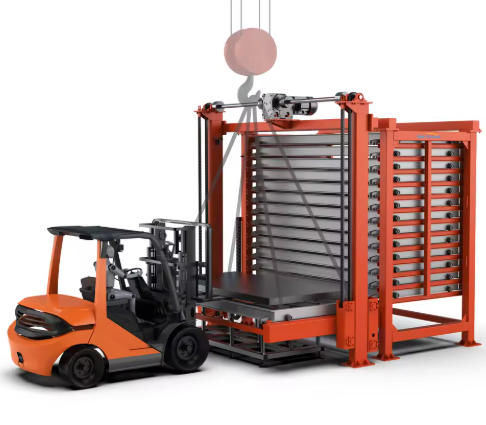
Regardless of tower count, the Herochu VLS interfaces with the same material handling equipment. Trays delivered to the access bay are compatible with forklift pickup, overhead crane engagement, and automated guided vehicle collection. In a dual-tower configuration serving a robotic laser line, the access bay positions the tray for the loading arm to extract the sheet directly — no intermediate handling, no operator intervention, no delay between retrieval and machine loading.
The access bay height is set at an ergonomic working level for manual operations and at a machine-matched height for automated lines. This dual-mode positioning means a single Herochu VLS can serve a manual loading station during day shift and a robotic loader during unattended night operation without physical reconfiguration.