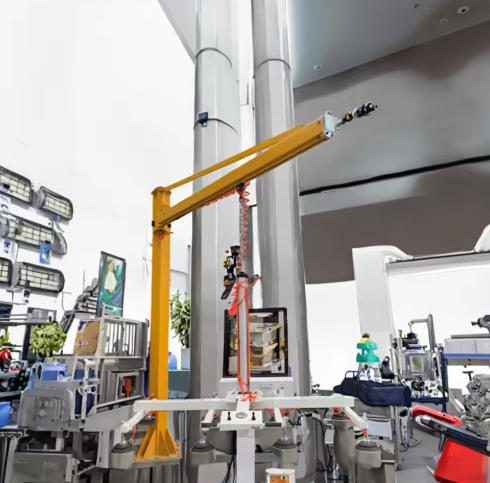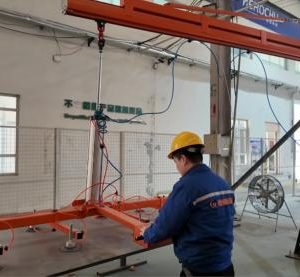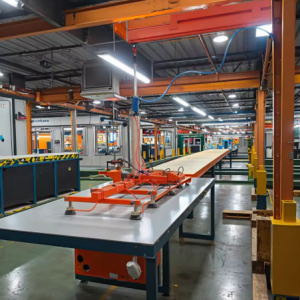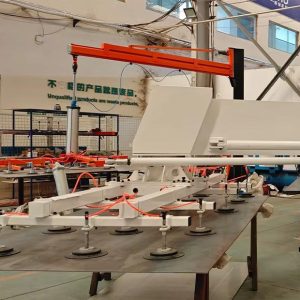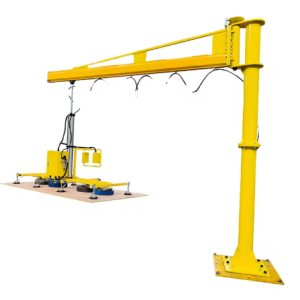
Lifting a 500-kilogram steel plate with a vacuum seems counterintuitive. Most people associate vacuum with household chores—dust collection, food storage—not with suspending half a ton of metal in midair. Yet vacuum lifting has been the preferred method for non-marking, high-speed sheet metal handling in European fabrication shops for over three decades. The physics checks out: eight vacuum cups, each 200 millimeters in diameter, generate a combined holding area of roughly 0.25 square meters. At a modest vacuum level of 60 percent below atmospheric pressure, the theoretical holding force exceeds 1500 kilograms—a safety factor of three on a 500-kilogram rated load. Herochu heavy-duty vacuum lifting equipment applies this principle in a package engineered for the daily abuse of a production fabrication environment.
Why Vacuum Instead of Magnets or Clamps
The alternatives to vacuum lifting each carry a compromise. Permanent magnetic lifters work only on ferrous materials, leaving aluminum, stainless steel, and copper alloys out of reach. Electromagnetic lifters handle a broader material range but consume continuous electrical power, generate heat, and introduce a risk of load drop during a power outage unless backed by a battery system that requires regular maintenance. Mechanical clamps and slings mark the sheet surface, require careful rigging for each lift, and cannot release the load as quickly as a vacuum system can vent to atmosphere.
Vacuum grips anything with a reasonably flat, non-porous surface. Carbon steel, stainless steel, aluminum, copper, brass, and painted or coated sheets all lift without special preparation. The release is instantaneous when the vacuum valve opens, so the operator can set the sheet down and disengage in one fluid motion. The distributed holding pattern avoids creating high-stress points that can dent thin-gauge material or leave witness marks on brushed and polished finishes. For a shop running architectural stainless or pre-painted aluminum coil, vacuum is often the only acceptable lifting method.
The Herochu Heavy-Duty Vacuum Lifter Architecture
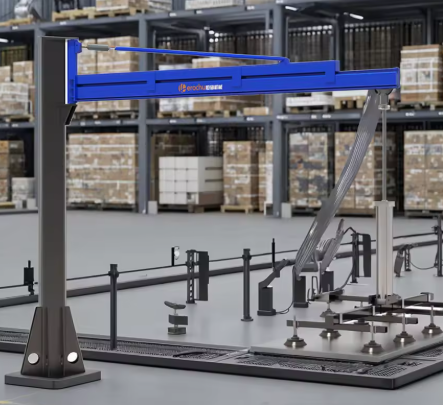
A Herochu heavy-duty vacuum lifter consists of four subsystems: the structural frame, the vacuum generation and distribution circuit, the motion system, and the control and safety package. Understanding how these subsystems interact helps in specifying the right equipment for a given material handling task.
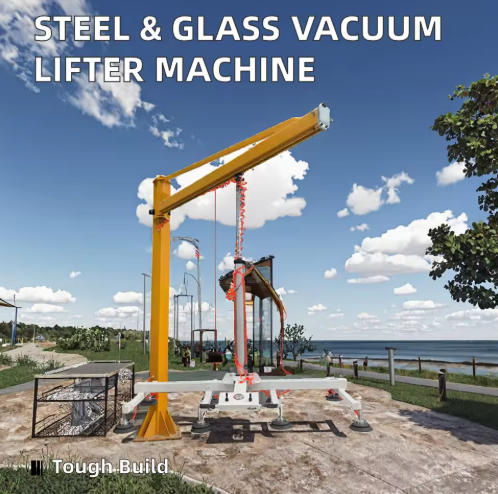
The structural frame centers on a vertical column, typically 3600 millimeters tall, anchored to a reinforced foundation pad. A cantilever boom extends from the top of the column, also 3600 millimeters in length on standard models. The boom terminates in a pivoting head that carries the vacuum cup array. The column and boom are fabricated from welded Q235B structural steel plate, stress-relieved after welding to prevent distortion over years of cyclic loading. The pivoting joints use sealed roller bearings sized for the full rated load plus the dynamic forces generated during acceleration and deceleration of the loaded boom.
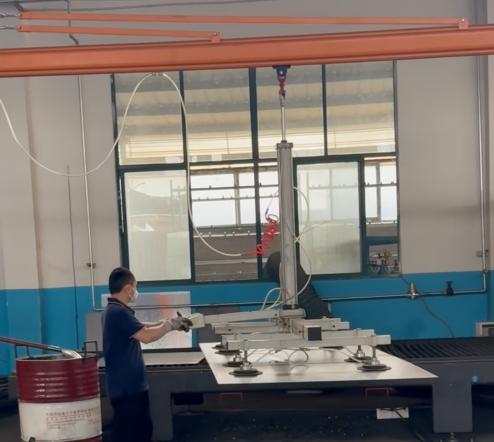
The vacuum circuit starts with shop compressed air at 6 to 8 bar fed through a filter-regulator-lubricator unit at the column base. The regulated air drives a multistage ejector pump that pulls vacuum in a reservoir tank. From the reservoir, vacuum lines run through the boom to each cup group, with individual check valves at each cup to isolate a failure. A vacuum switch monitors the reservoir pressure and triggers an alarm if the level drops below the safe threshold. The system recovers vacuum quickly after each release, so the operator does not wait between cycles.
Load Capacity and the Safety Factor
Herochu rates its heavy-duty vacuum lifters conservatively. The HC-RP4020-500 model carries a maximum load rating of 500 kilograms, but the theoretical holding force at nominal vacuum is substantially higher. The rating accounts for several real-world derating factors: a reduction in effective cup area due to surface roughness, a drop in vacuum level if the compressor supply pressure fluctuates, and an allowance for dynamic loading when the operator accelerates or decelerates the boom.
The safety factor also covers the scenario where one cup group loses grip—perhaps over a weld seam, a punched hole, or a patch of heavy mill scale. Because each of the eight cup groups has its own check valve, the remaining seven groups continue to hold. The system is designed such that even with two cup groups fully vented, the remaining six can still support the rated load. This redundancy is a fundamental advantage of multiple small cups over a single large vacuum pad.
For exceptionally heavy or awkward loads, Herochu can configure custom vacuum heads with additional cup groups, larger cup diameters, or auxiliary mechanical supports that engage once the load is lifted. These customizations fall outside the standard HC-RP catalog but are routine for the Herochu engineering team, which has delivered lifting solutions for plates up to 1500 kilograms in specialized applications.
Material-Specific Handling Considerations
Different sheet materials present different challenges to a vacuum lifting system, and the operator needs to understand the distinctions to avoid mishandling.
Cold-rolled carbon steel typically arrives with a light oil film that actually helps the vacuum cup seal by filling microscopic surface valleys. The oil does not degrade the cup material over time, provided the cups are the correct compound. Herochu uses a nitrile-based cup material for general steel handling. The oil film should not be wiped off before lifting; it is part of the grip mechanism.
Stainless steel often carries a brushed or polished surface finish that is smooth enough for an excellent vacuum seal, but the material’s lower magnetic permeability means magnetic lifters cannot be used as a backup. Vacuum is the primary lifting method, and the cup pressure should be set slightly lower than for carbon steel because the smoother surface requires less deformation of the cup lip to achieve a seal.
Aluminum plate, particularly in thicker gauges, tends to have a mill finish that includes shallow rolling marks. These marks do not prevent a vacuum seal, but they can reduce the effective contact area by 5 to 10 percent. The operator should verify that the vacuum gauge reads in the green zone before lifting. If the gauge drops into the yellow, a quick visual inspection of the cup lips for embedded aluminum oxide particles usually identifies the issue. A stiff brush and a wipe with isopropyl alcohol restores full grip in under a minute.
The Role of the Operator in Vacuum Lifting
A vacuum lifter is not a fully autonomous robot, and the operator remains central to safe and efficient operation. The operator controls the lift, the swing, and the placement. The pneumatic assist reduces the physical effort to near zero, but the spatial awareness, the timing, and the judgment of when a sheet is properly seated on the machine table all belong to the person at the controls.
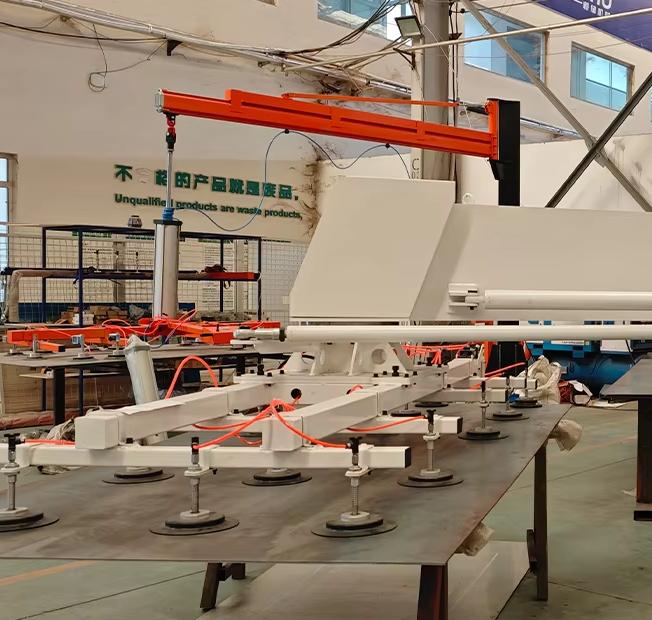
Herochu designs its control interfaces with this operator-centric philosophy in mind. The control pendant hangs from the boom at a comfortable height for a standing operator. It carries a two-hand actuation requirement for the lift function—both hands must be on the pendant grips, and both must squeeze to initiate a lift. This prevents the operator from having a free hand in the path of a moving sheet. The vacuum gauge and the system pressure gauge are positioned on the pendant display panel so the operator sees them in peripheral vision throughout the lift cycle.
Training a new operator on a Herochu vacuum lifter takes about two days. The first day covers the safety systems, the control functions, and practice lifts with an unloaded boom. The second day introduces real sheet stock under supervision, starting with smaller sheets and building up to the full rated load. By the end of the week, most operators can execute a complete pick-move-place cycle in under two minutes without conscious thought about the control sequence.
Maintenance Intervals and Common Service Points
Heavy-duty vacuum lifting equipment sees rough service. Shop air can carry moisture and particulates, sheet metal sheds sharp burrs and abrasive scale, and the boom cycles thousands of times per month. A disciplined maintenance routine prevents most failures before they interrupt production.
Daily checks should include draining the water trap on the compressed air filter, visually inspecting all vacuum cups for cuts or embedded metal fragments, and cycling the boom through its full rotation to listen for bearing noise. Weekly checks add a vacuum decay test: grip a clean test sheet, close the vacuum valve, and confirm that the gauge holds steady for at least five minutes. A drop of more than 10 percent in five minutes indicates a leak somewhere in the circuit, most commonly at a cup lip or a hose fitting. Monthly checks cover bolt torque on the column base plate, lubrication of the boom pivot bearings, and a functional test of the emergency stop circuit.
The vacuum cups are the highest-wear component and should be replaced when the lip shows cracking, tearing, or a permanent set that prevents full contact with the sheet surface. Replacement takes about two minutes per cup with a socket wrench. Cups are stocked as a consumable item, and Herochu recommends keeping at least two full sets on the shelf so that a partial swap never leaves the lifter out of service waiting for parts.
Comparing Total Cost of Ownership
The purchase price of a vacuum lifter is only part of the financial equation. The ongoing costs—compressed air consumption, cup replacement, bearing service, and the occasional hose replacement—are modest compared to the productivity gain and the reduction in worker injury costs. Compressed air is the largest operational expense. At typical industrial electricity rates, the air consumed by a Herochu HC-RP manipulator in continuous operation costs less than a dollar per hour. Cup replacement runs a few hundred dollars per year in a high-volume shop.
Offsetting these costs is the elimination of crane rental or purchase, the reduction in sheet damage and rework, the faster machine loading cycle, and the lower workers’ compensation insurance premium that often follows the removal of manual heavy lifting from a job description. Herochu application engineers can prepare a site-specific total cost of ownership projection as part of the quotation process, and most customers find the payback period falls between six and eighteen months depending on production volume.
Sheet metal handling does not need to wear out operators or damage product surfaces. Herochu heavy-duty vacuum lifting equipment turns a half-ton plate into a weightless workpiece that one person can position with fingertip control. The vacuum grip holds without marking, releases without hesitation, and fails safe if the air supply drops. For any fabricator moving more than a few sheets per hour, the case for vacuum lifting writes itself.