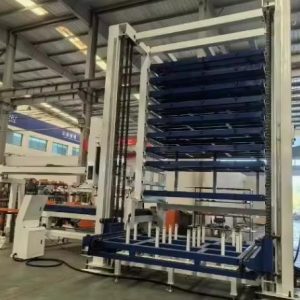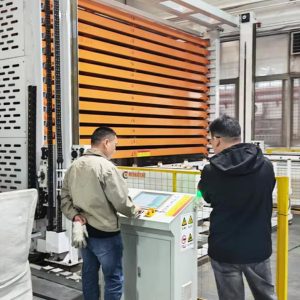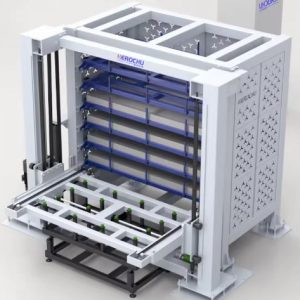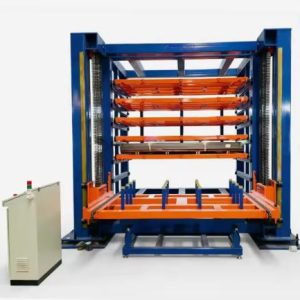
Moving heavy sheet stock from a storage rack to the bed of a CNC machine is one of the most physically demanding tasks in any fabrication shop. A single steel plate measuring 4 meters by 2 meters can weigh half a ton. Doing this by hand, or even with a basic overhead crane, slows production and puts operators at risk. Herochu has engineered a direct answer to this problem: the pneumatic cantilever loading manipulator, a purpose-built lifting device that bridges raw material storage and CNC sheet feeding with speed, control, and a safety envelope that manual methods cannot match.
How a Pneumatic Cantilever Manipulator Works
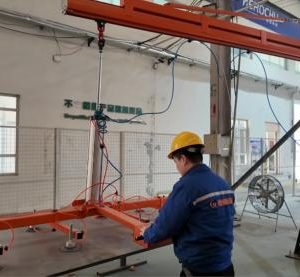
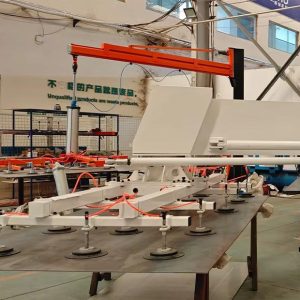
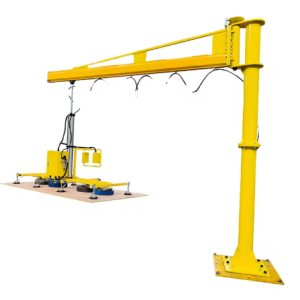
At its core, the Herochu pneumatic cantilever manipulator functions as a balanced-arm lifting system. A column-mounted boom extends over the work area, carrying an array of vacuum suction cups at its tip. Compressed air powers the lift and the vacuum grip. The operator guides the boom by hand, and the pneumatic circuit counterbalances the load so that a plate weighing 300 or 500 kilograms feels nearly weightless in the operator’s hands.
The boom rotates through 220 degrees, giving the workstation a wide service footprint. A lifting stroke of 700 millimeters covers the vertical difference between a pallet stacked on the floor and the table height of a typical fiber laser cutter or CNC punch press. Because the arm holds its position at any point along the arc, the operator can pause mid-air to inspect the sheet surface or adjust alignment before setting it onto the machine bed. This stop-at-any-position behavior is a defining advantage over chain hoists and floor cranes, where the load tends to drift or swing.
Herochu HC-RP Series: Two Models, Two Capacity Classes
Herochu offers the pneumatic cantilever manipulator in two standard configurations under the HC-RP series designation. The HC-RP3015-300 handles sheets up to 3000 millimeters by 1500 millimeters with a maximum load capacity of 300 kilograms. The larger HC-RP4020-500 accommodates sheet dimensions of 4000 millimeters by 2000 millimeters and lifts up to 500 kilograms.
Both models share a column height of 3600 millimeters and a boom length of 3600 millimeters. The vacuum gripping system employs eight suction cup groups, each with a cup diameter of 200 millimeters. This distributed gripping pattern spreads the holding force evenly, eliminating the concentrated stress points that mechanical clamps create. Materials that can be handled include carbon steel, stainless steel, and aluminum, and the system copes with the slight surface variations common to mill-finish sheet stock.
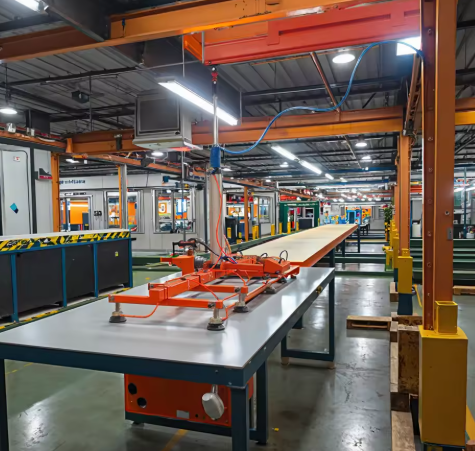
The modular construction of the HC-RP series deserves attention. The column, boom, and vacuum head assemble from bolted sections, so the entire unit can be dismantled and trucked to a new facility or repositioned on the shop floor without cutting or welding. For manufacturers that reconfigure their production lines every few years as product mixes change, this is a practical consideration that avoids sunk cost in fixed infrastructure.
Emergency Air-Cut Protection and Operator Safety
A compressor failure or a ruptured airline in the middle of a lift would be a serious hazard with any pneumatic lifting device. Herochu addresses this with an emergency air-cut protection system built into every HC-RP manipulator. When supply pressure drops suddenly, check valves isolate the vacuum circuit and the lift cylinder, maintaining holding force and boom position for well over 15 minutes. The operator has ample time to lower the sheet onto the nearest stable surface and clear the area. This passive safety mechanism requires no electrical power, no backup battery, and no operator intervention to activate.
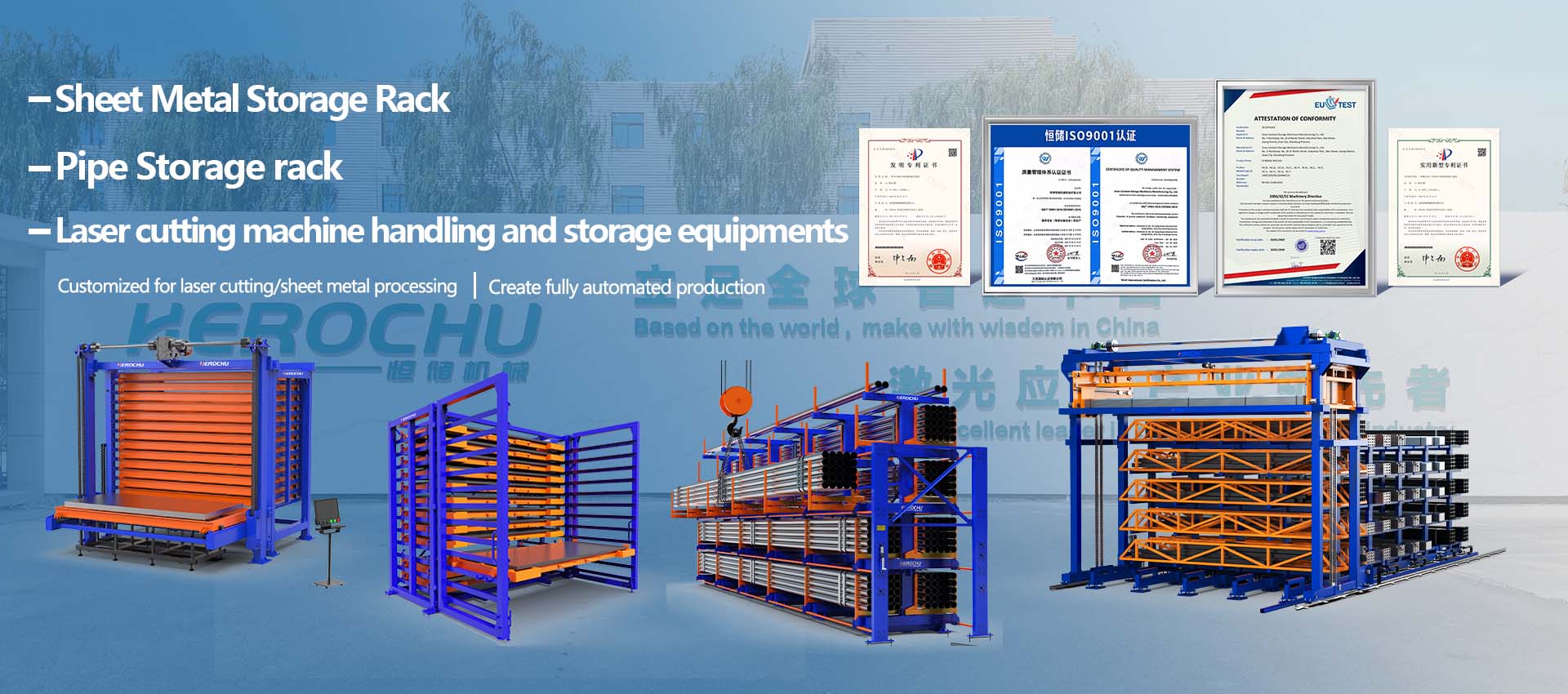
Beyond the air-cut system, the HC-RP design incorporates several layers of operational safety. The vacuum cups are equipped with individual check valves, so the loss of one cup does not cascade into a full release. A pressure gauge mounted at eye level on the control panel gives the operator continuous visibility of system status. The emergency stop button, positioned within easy reach on the control pendant, cuts all pneumatic supply and engages the holding circuit in a single action. These features collectively meet the requirements of CE and UKCA certification, and Herochu manufactures the HC-RP series under an ISO 9001 quality management framework.
Material Versatility and Surface Protection
Sheet metal fabricators often work with a mix of materials across a single shift—mild steel in the morning, stainless after lunch, aluminum plate in the afternoon. The Herochu pneumatic cantilever manipulator handles all three without changing tooling. The vacuum cups conform to the surface finish of each material type, and the operator adjusts the vacuum level through a regulator on the control panel. For materials with an oil film, as is common with laser-grade cold-rolled steel, the cup material provides sufficient grip without supplementary cleaning.
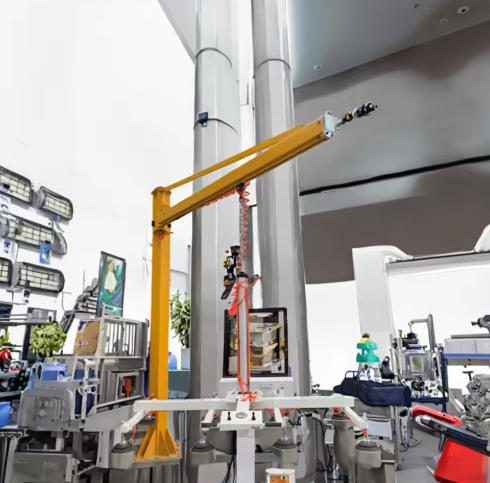
Surface protection is another area where vacuum lifting outperforms mechanical clamping. Steel jaws, magnetic lifters, and chain slings all leave marks on sheet metal. On pre-finished material destined for architectural cladding, appliance panels, or automotive body parts, those marks translate into rework or scrap. Herochu’s vacuum suction cups distribute holding force across a wide contact patch, so the sheet arrives at the cutting head in the same condition it left the warehouse. For shops running high-margin cosmetic parts, this non-marking handling method eliminates a persistent quality headache.
Reducing Machine Idle Time at the Laser Cutter
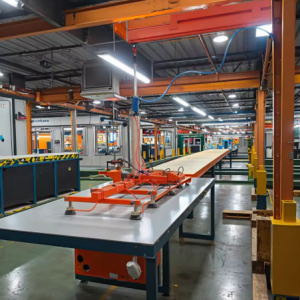
A fiber laser cutting center represents a six-figure capital investment. Every minute the cutting head sits idle between sheets is a minute of lost throughput. The Herochu HC-RP manipulator compresses the loading cycle to well under a minute once the operator becomes familiar with the motion pattern. The worker walks to the storage rack, engages the vacuum cups on the top sheet, guides the boom across the 220-degree arc to the laser table, and releases the load onto the cutting grid. The entire sequence is smooth enough that the previous sheet is often still being unloaded by the downstream operator while the next sheet is already in position.
This rhythm changes the economics of the cutting cell. Instead of staffing each laser with two workers—one to load, one to unload—a single operator can manage the entire material flow for one machine, and in some layouts for two machines arranged in a shared work envelope. The productivity gain compounds when running thin-gauge sheet at high cutting speeds, where the cutting cycle itself may be only a few minutes and manual loading becomes the bottleneck.
Integration with Downstream Processes
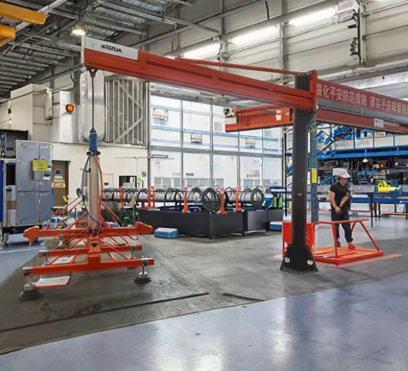
The HC-RP manipulator does not operate in isolation. In a typical Herochu installation, the cantilever arm sits between a raw material staging area and the infeed side of a laser cutter, CNC turret punch, or shearing line. The column footprint is compact enough to fit beside existing machine enclosures without requiring structural modifications to the building. Ceiling height is the primary clearance consideration, and at 3600 millimeters the column fits under most industrial roof trusses.
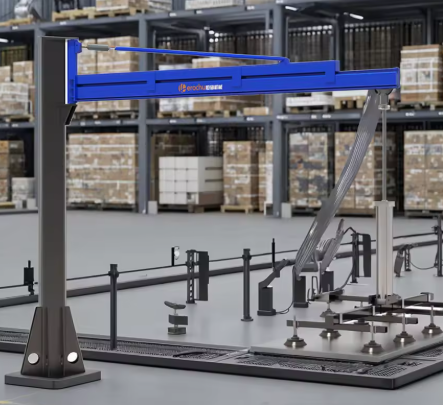
For shops that run a mixed workflow—some sheets go to the laser, others to the shear, still others to a press brake for bending—the 220-degree rotation arc can cover multiple machine infeeds from a single column location. This multi-machine serving capability avoids the cost of installing a dedicated manipulator at each workstation, though Herochu can certainly configure a one-to-one setup where production volume justifies it.
Operator Training and Daily Operation
A pneumatic manipulator is simpler to learn than a servo-driven robot, and this matters in fabrication shops where the workforce includes operators who have never programmed CNC equipment. Herochu provides on-site commissioning and operator training for every HC-RP installation. The training covers vacuum cup inspection, pressure regulator adjustment, emergency procedures, and the lift-and-carry technique that produces the smoothest load transfer.
Daily maintenance consists of draining the compressed air filter bowl, checking vacuum cup surfaces for cuts or embedded debris, and verifying that the boom rotates freely without binding. The vacuum cups are a wear item and can be replaced in minutes with standard hand tools. Because the system uses standard industrial compressed air at shop pressure, there are no hydraulic fluids to monitor, no oil filters to change, and no motor brushes to replace. The total cost of ownership over a decade of operation compares favorably against electric chain hoists and floor-mounted jib cranes, particularly when the reduction in worker injury claims and sheet damage is factored into the calculation.
Selecting the Right Model for a Specific Shop Layout
Choosing between the HC-RP3015-300 and the HC-RP4020-500 comes down to sheet size and weight. If the largest raw stock the shop processes is a 3-meter by 1.5-meter sheet of 10-millimeter mild steel weighing roughly 350 kilograms, the 300-kilogram model falls short and the 500-kilogram model is the correct choice. If the heaviest sheet is 6-millimeter aluminum at 2.5 meters by 1.25 meters, weighing under 100 kilograms, the 300-kilogram model provides comfortable headroom.
Beyond the load rating, the workspace geometry matters. The 3600-millimeter boom length defines the maximum reach from the column centerline. A fabricator should measure the distance from the proposed column location to the farthest corner of the machine table and confirm that the boom covers that radius with the vacuum head positioned at the sheet center of gravity. Herochu application engineers can review a floor plan and recommend the optimal column placement, and custom boom lengths are available for non-standard layouts.
Sheet metal handling does not need to be the bottleneck it has been for decades. With the Herochu HC-RP pneumatic cantilever manipulator, a single operator can move full-size plates from rack to machine in under a minute, stop the load anywhere along the arc, and rely on passive air-cut protection if the compressor trips. The modular design means the equipment moves when the shop layout changes. For any fabricator looking to raise laser cutter utilization and reduce the physical strain on the shop floor, the HC-RP series offers a straightforward, proven approach to CNC sheet feeding automation.