
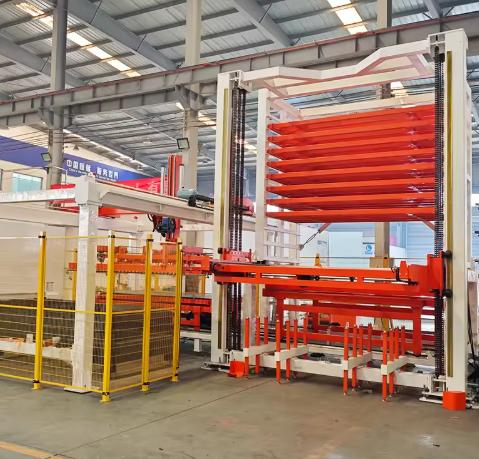
Intelligent 3D Automated Warehouse Rack for Steel Plate Storage
Steel service centers and heavy fabrication plants manage two fundamentally different material formats under one roof: flat sheet and coiled strip. The handling requirements for each differ sharply. Sheets demand flat, deflection-free support across their entire surface to prevent permanent set. Coils require saddle or cradle support that distributes weight along the cylindrical axis while allowing rotation for decoiling feed. Combining both into a single automated storage architecture is an engineering challenge that few racking suppliers address at the system level. Herochu’s intelligent 3D automated warehouse rack bridges this gap with a configurable high-bay storage platform engineered for mixed-format metal inventory.
Intelligent 3D Automated Warehouse Rack for Steel Plate Storage
Steel service centers and heavy fabrication plants manage two fundamentally different material formats under one roof: flat sheet and coiled strip. The handling requirements for each differ sharply. Sheets demand flat, deflection-free support across their entire surface to prevent permanent set. Coils require saddle or cradle support that distributes weight along the cylindrical axis while allowing rotation for decoiling feed. Combining both into a single automated storage architecture is an engineering challenge that few racking suppliers address at the system level. Herochu’s intelligent 3D automated warehouse rack bridges this gap with a configurable high-bay storage platform engineered for mixed-format metal inventory.
The Dual-Format Inventory Problem
A plant processing 8,000 tonnes of steel per month might receive half of that volume as mill-standard flat sheets — typically 3000×1500 mm, 4000×2000 mm, or 6000×2500 mm in gauges from 0.8 mm to 25 mm — and the other half as hot-rolled or cold-rolled coils weighing anywhere from 5 to 25 tonnes each. The two formats share nothing in common from a handling perspective except the material itself.
Conventional practice separates sheet and coil storage into different zones, often in different bays or even different buildings. Each zone requires its own overhead crane, its own aisle clearance, its own operator, and its own material tracking system. The duplication drives up capital cost and floor-space consumption while introducing a logistical fracture point: material that should flow continuously from receiving to cutting instead pauses at a zone boundary where coils and sheets get staged, re-identified, and manually transferred between handling systems.
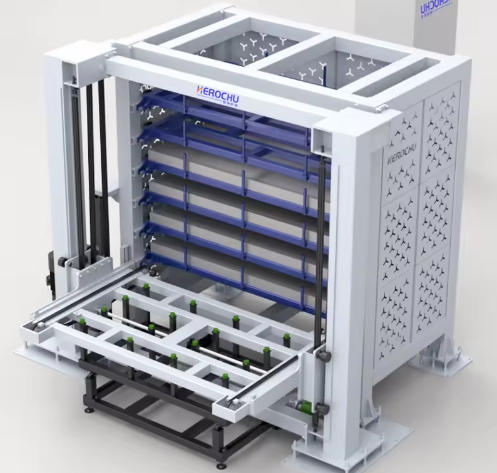
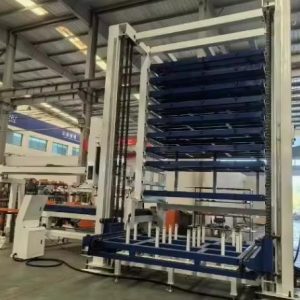
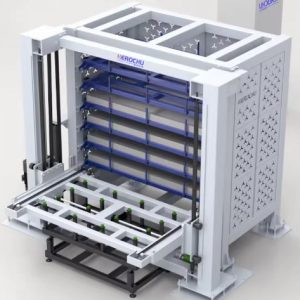
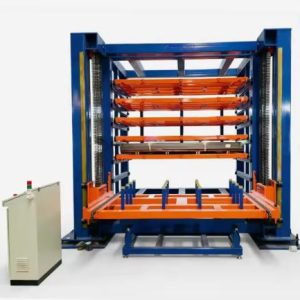
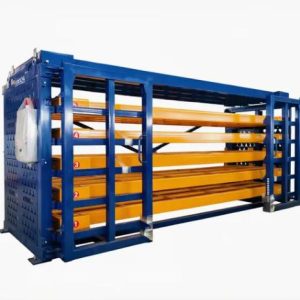
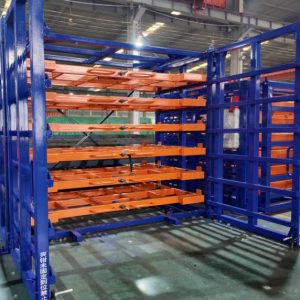
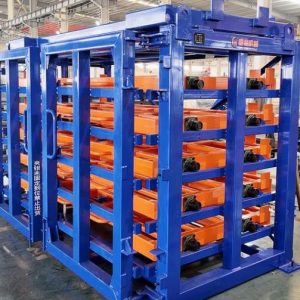
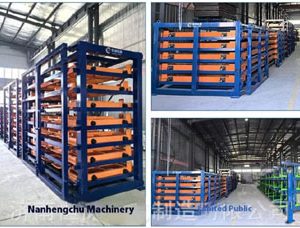
Herochu’s 3D automated warehouse rack collapses these separate zones into a single integrated storage architecture. The system uses a common structural framework with interchangeable cassette modules — flat-deck cassettes for sheet plate, saddle-type cassettes for coil — that share the same racking bay dimensions, the same gantry access envelope, and the same inventory management software layer.
Structural Engineering for High-Bay Mixed Loads
The racking framework of a Herochu 3D automated warehouse is a bolted hot-rolled steel structure designed to seismic zone requirements specified at the project level. Column sections are selected based on the combined vertical load from fully loaded storage levels plus the lateral forces generated by gantry acceleration and deceleration cycles.
For coil storage positions, the load path runs through a pair of hardened steel saddles with a included angle of 120 degrees machined into the contact surface. The saddle geometry self-centers the coil through gravity, eliminating the need for active clamping or strapping. A wear-resistant polymer liner bonded to the saddle face prevents galvanized coating abrasion during coil placement and retrieval.
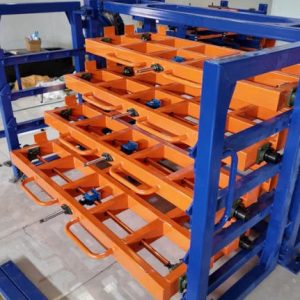
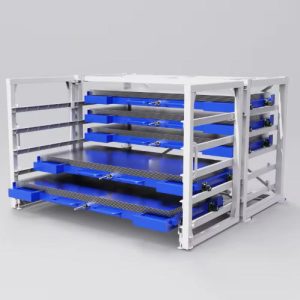
Sheet storage positions use a flat cassette deck fabricated from laser-cut and press-brake-formed steel plate. The deck surface incorporates a pattern of threaded insert points on a 200 mm grid, allowing the customer to install and reposition alignment guides, separator posts, or material-grade identification tags as their inventory mix changes over time. The modular insert system means the rack adapts to new product lines without welding or structural modification.
Corrosion protection is specified at two levels. The primary structure uses hot-dip galvanizing to ASTM A123 standards with a minimum coating thickness of 85 microns. For facilities in coastal or chemically aggressive environments, a duplex coating system adds an epoxy intermediate layer and a polyurethane topcoat over the galvanized substrate. All fasteners are grade 10.9 hot-dip galvanized with a minimum coating of 50 microns.
Automated Gantry Handling Across Format Types
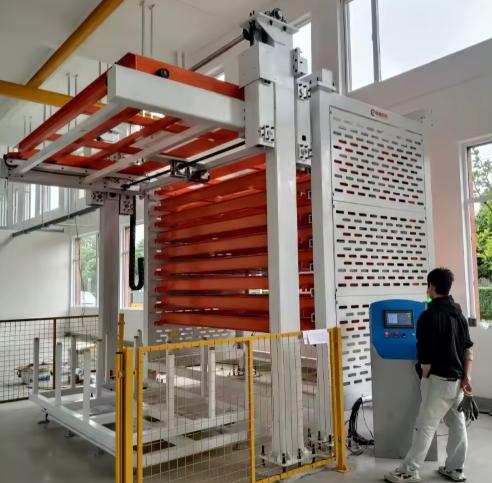
The gantry manipulator serving a Herochu 3D warehouse employs a quick-change end-effector interface that allows the system to switch between sheet-gripping and coil-handling attachments in under 60 seconds without operator intervention. The tool-change station mounts at one end of the gantry travel range, equipped with proximity sensors that confirm proper engagement of the mechanical coupling and the pneumatic and electrical quick-connects before the gantry resumes motion.
The sheet-handling end-effector uses the zoned vacuum matrix described in the standard sheet storage configuration. The coil-handling end-effector takes a different approach entirely: a pair of telescoping arms with hardened steel C-hooks that engage the coil’s inner diameter. The arms extend under servo control until the load cells in each C-hook register contact with the coil bore, then lift slightly to confirm weight capture before the gantry begins horizontal travel.
This dual-capability architecture eliminates the need for a dedicated coil-handling crane and its associated operator. The same WCS that schedules sheet deliveries to the laser cutting line also schedules coil deliveries to the decoiling and blanking line. The operator managing either downstream process sees a unified material queue rather than negotiating with a separate coil-yard crew for each production order.
The Third Dimension: Vertical Density Economics
The economic argument for a 3D automated warehouse over conventional flat storage is straightforward arithmetic on floor-space cost. Consider a facility occupying 5,000 square meters of industrial space at a monthly lease rate of 45 RMB per square meter. Floor-level coil and sheet storage consuming 800 square meters of that footprint costs 36,000 RMB per month in lease allocation alone — before accounting for the overhead crane, the forklift, and the labor to operate them.
A Herochu 3D warehouse occupying a 180-square-meter footprint with ten storage levels provides equivalent or greater storage capacity while releasing 620 square meters of floor space for revenue-generating production equipment. At 45 RMB per square meter, that recovered space carries a lease value of 27,900 RMB per month — over 334,000 RMB annually — that shifts from storage overhead to productive capacity.
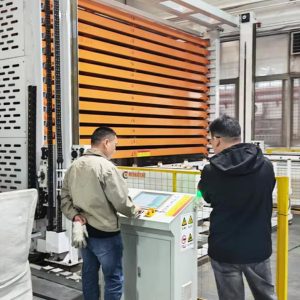
Beyond the lease arithmetic, vertical storage eliminates the safety hazards inherent in ground-level coil storage. A 20-tonne coil resting on the floor represents a potential-energy hazard to every forklift operator and pedestrian in the vicinity. A coil stored in a locked, instrumented rack position at third-level height removes the human proximity risk entirely. The gantry operates in a fenced exclusion zone with safety-rated light curtains that trigger an emergency stop if any person or vehicle breaches the perimeter during automated motion.
Intelligent Inventory Management Across Formats
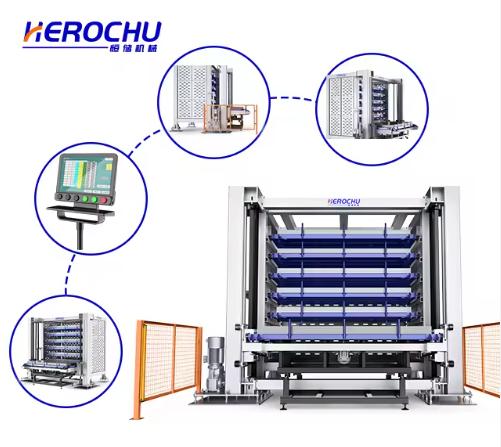
The WMS layer in a Herochu 3D warehouse treats sheet plate and coil inventory as a unified dataset with format-specific attributes. A coil record includes coil ID, mill heat number, grade, gauge, width, inner diameter, outer diameter, net weight, and coating specification. A sheet record includes the same grade and gauge fields plus length, width, and piece count. Both record types share a common location hierarchy — bay, level, position — that the WCS uses to plan retrieval paths.
When a production order for 500 pieces of 2.0 mm galvanized bracket blanks hits the queue, the WMS evaluates whether to fulfill it from sheet inventory or from coil inventory routed through the decoiler. If sheets of the correct specification are available in storage, the system allocates them directly. If not, it checks for a coil of matching grade and gauge, calculates the lineal meters required to produce 500 blanks including decoiler scrap allowance, and routes the coil to the blanking line instead.
This format-aware inventory logic prevents a scenario familiar to every production manager: coils sitting idle in the yard while the purchasing department orders new sheets of the exact same material grade because nobody realized the coil inventory could serve the requirement. The WMS makes the connection automatically and presents it as a standard production option rather than a discovery that depends on one experienced planner noticing the overlap.
Seamless Integration with Downstream Processing
The 3D warehouse is not an isolated storage island. It functions as the material-origination node in a continuous automated flow that extends through decoiling, blanking, and laser cutting. For coil-fed blanking lines, the gantry retrieves the scheduled coil, transports it to a powered coil car at the decoiler infeed, and deposits it on the mandrel. The decoiler operator — or the decoiler’s own automation controller — confirms receipt, and the WCS updates the coil’s status from “in storage” to “in process.”
For sheet-fed laser cutting, the flow follows the same pattern described in the sheet storage system architecture: gantry retrieval, vacuum verification, laser bed placement, and post-cut skeleton extraction.
The key integration advantage is that both flows trace back to a single inventory database with a single source of truth. There is no reconciliation step where the sheet inventory system and the coil inventory system must be manually cross-checked against each other and against the ERP system. The WMS is the ERP’s real-time inventory proxy for all raw metal stock, regardless of format.
Environmental Monitoring and Material Protection
Galvanized coil and sheet stock represent a significant working-capital investment. A full ten-layer Herochu tower loaded with 5,000 kg per position can hold 400 tonnes or more of material valued at several million RMB depending on grade and coating specification. Protecting that inventory from environmental degradation is a design requirement, not an afterthought.
Each storage bay in the Herochu 3D warehouse includes distributed temperature and humidity sensors that report to the WMS at five-minute intervals. If the relative humidity in a coil storage position exceeds a configurable threshold — typically 60 percent for galvanized products susceptible to wet-storage staining — the system generates an alert and can automatically activate bay-level dehumidification if the facility is equipped with ducted climate control.
For operations in northern climates where coils arrive cold from outdoor receiving and condensation forms as they warm to indoor ambient temperature, the WMS can apply a conditional storage rule: recently received coils are held in a designated tempering zone for 24 hours before transfer to the main storage tower. This prevents condensation-driven corrosion that appears as white rust on galvanized surfaces, a defect that fabricators often do not discover until the formed and welded assembly reaches the painting stage.
Scalability and Phased Deployment
The modular cassette architecture of the Herochu 3D warehouse supports phased deployment. A facility can commission the system initially with 60 percent sheet positions and 40 percent coil positions to match its current product mix, then convert cassette modules as the business shifts toward more coil-fed or more sheet-fed production. A sheet cassette can be swapped for a coil cassette — or vice versa — during a scheduled maintenance window without structural modification to the racking frame.
Additional storage towers connect to the existing gantry rail system as production volume grows. The WMS and WCS software licenses scale with tower count rather than requiring a platform migration. A single-tower pilot installation that proves the concept can expand to a four-tower production system sharing two gantries without software re-architecture or operator retraining.
Safety Architecture and Regulatory Compliance
Automated industrial storage systems operating at height with multi-tonne payloads require safety engineering that goes well beyond standard racking codes. Herochu 3D warehouse installations comply with EN 528 for rail-dependent storage and retrieval machines, ISO 13849 for safety-related control systems, and applicable regional standards for seismic design.
The safety architecture follows a layered defense model. Primary safeguards include the fenced exclusion zone with monitored access gates wired into the safety PLC. Secondary safeguards include the gantry’s onboard laser scanners that detect obstacles in the travel path and trigger a category 1 stop if the path is obstructed. Tertiary safeguards include the mechanical overload protection built into the lifting mechanism — a shear-pin coupling calibrated to fail at 125 percent of rated load, preventing structural damage to the gantry or racking in the event of a control-system fault that commands a lift against an obstructed payload.
Every safety event is logged with a timestamp, a position stamp, and the state of all relevant sensors at the moment of activation. This forensic record supports both regulatory compliance audits and root-cause investigation of intermittent faults that might otherwise evade diagnosis.
Conclusion
Material diversity should not force facility diversity. A fabrication plant that processes both sheet and coil should not need two storage systems, two inventory databases, and two material-handling crews. Herochu’s intelligent 3D automated warehouse rack treats format as a configuration parameter rather than a separate system boundary, collapsing sheet and coil storage into a single vertically dense, robotically served, software-unified platform.
FAQ
Here are some frequently asked questions about our sheet metal racks and pipe storage solutions. We hope you find them helpful!
Q1: Can I request a custom size or color?
Absolutely. We offer complimentary design services and deliver efficient, tailored solutions to meet your specific requirements.
Q2: Are you a manufacturer or a distributor?
We are a direct manufacturer with over 15 years of industry experience and expertise.
Q3: Is there a minimum order quantity?
No. We welcome orders of any size, starting from a single unit.
Q4: How can I get detailed product information?
Click the “Get a Quote” button to receive product images, detailed specifications, and videos. Our team is always ready to assist.
Q5: How do I provide my storage rack requirements?
Simply share the type, dimensions, and quantity of materials you plan to store, along with any other specific needs. We will develop a professional storage solution for you. Alternatively, leave your contact details for a personalized consultation.
Q6: Do you offer automated loading systems or robotic arms?
Yes. We provide loading robotic arms and integrated loading/unloading systems tailored to your laser cutting machine’s table size and material handling method (e.g., board rack, exchange platform, or material warehouse). Contact us with your details for a customized proposal.
Q7: Do you provide on-site installation and debugging?
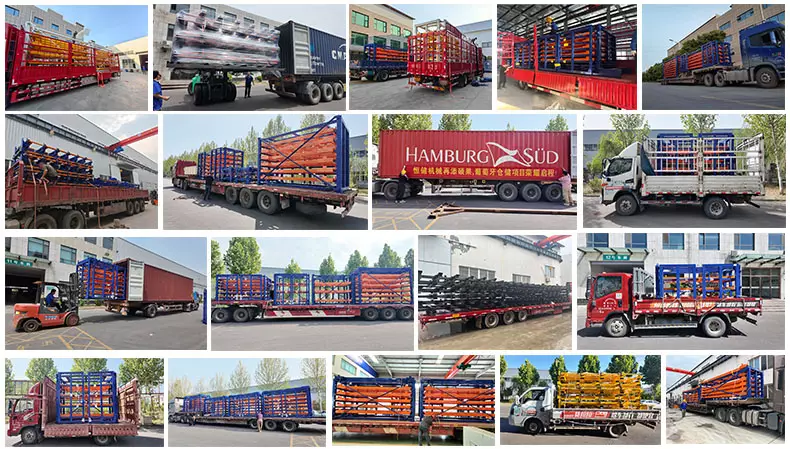
Yes. Our technicians can travel to your facility for installation and debugging, ensuring successful operation. We have served clients globally, including in the USA, South Korea, Russia, Qatar, Mexico, South Africa, Egypt, and Lebanon.
Q8: How do you ensure product quality?
Our quality assurance includes:
A team of over 40 technical engineers for professional debugging and support.
A dedicated quality control department compliant with ISO9001 standards.
CE certification for all exports.
Rigorous load testing before shipment to ensure structural safety and reliability.
Q9: Where is your factory located?
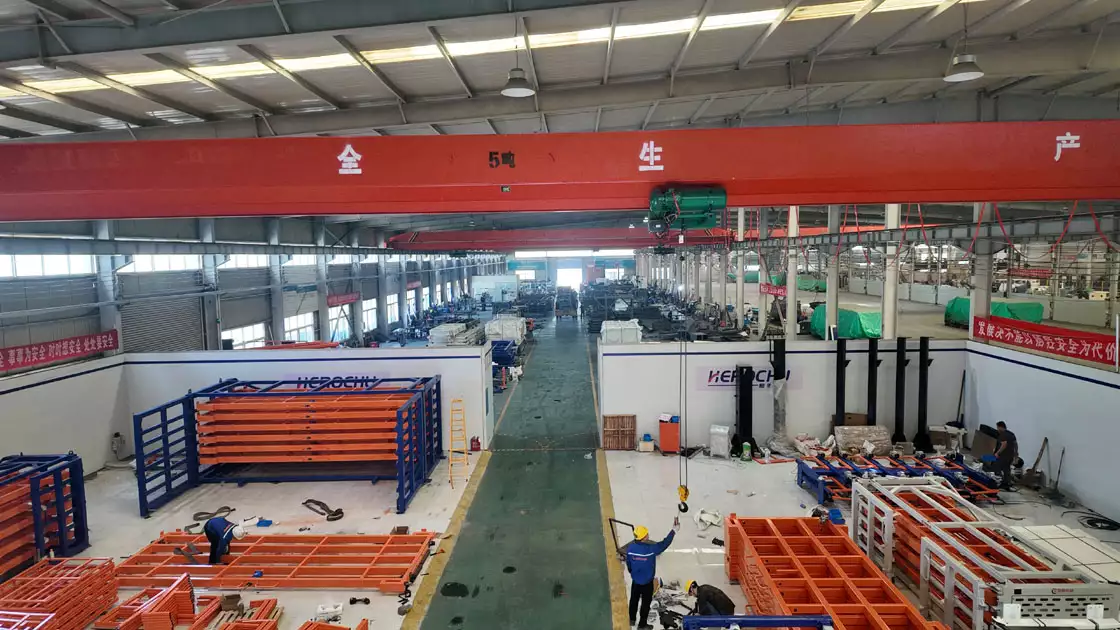
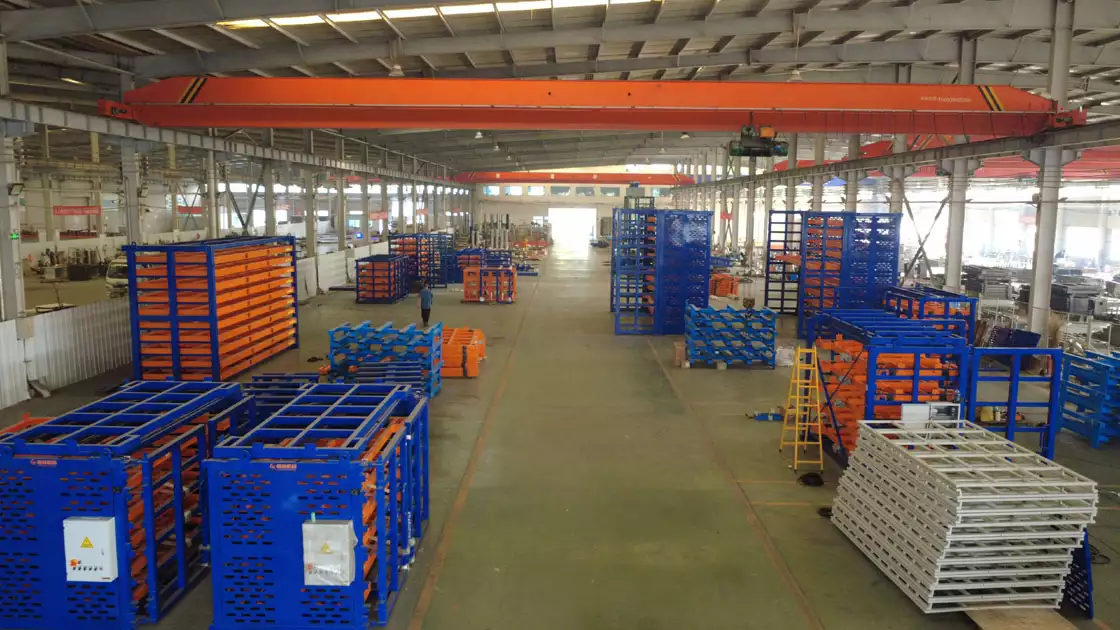
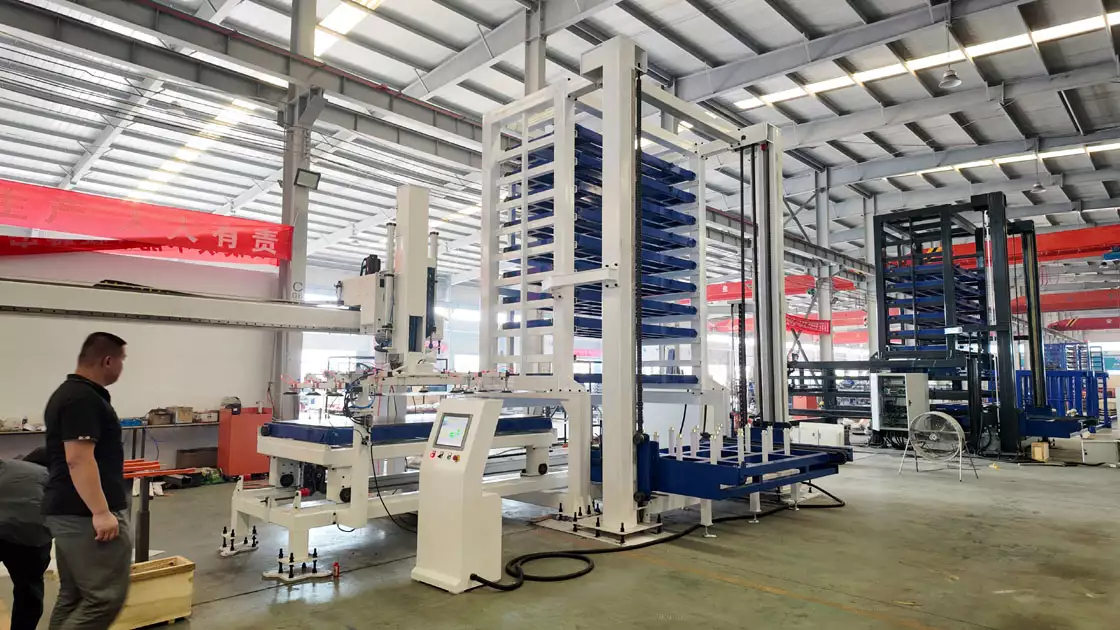
Our modern 10,000-square-meter manufacturing facility is located in Jiyang Industrial Park, Jinan, Shandong, China.
Q10: How can I evaluate your company’s capabilities?
We offer virtual video factory tours and warmly welcome on-site visits.
Q11: What does your company specialize in?
Jinan Constant Storage Machinery Manufacturing Co., Ltd. is a high-tech enterprise specializing in the R&D, production, sales, installation, and service of intelligent storage solutions. Our product range includes sheet material warehouses, drawer-style shelves, cantilever racks, servo manipulators, gantry loaders, and fully automated handling systems. Supported by a skilled technical team and advanced equipment, we are committed to delivering high-performance storage products and solutions to customers worldwide.
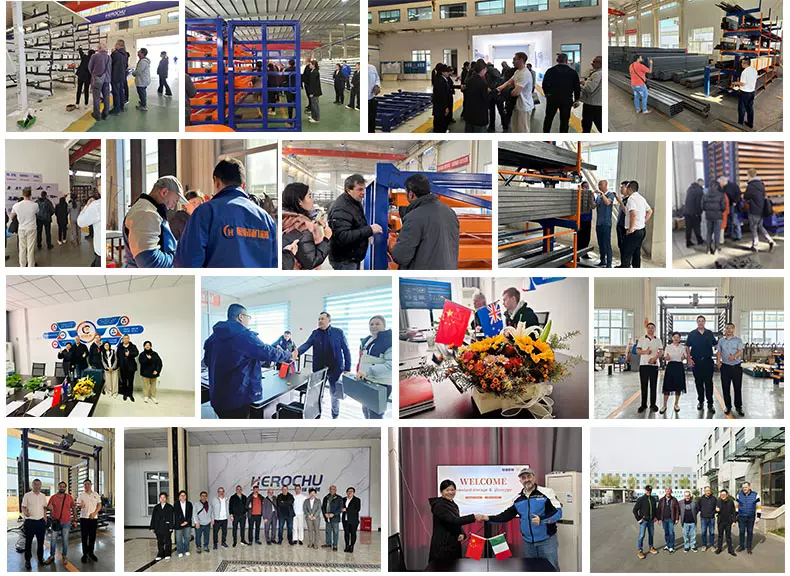
Customer visit
Herochu has always been adhering to the market-centric approach to meet customer requirements to the maximum extent, and the business philosophy of “creating brands with heart and gaining reputation with sincerity”. It provides customers with high-quality products and services with rigorous military quality, professionalism, and excellence, and has won unanimous praise in the Chinese aerospace, Chinese weapons, Chinese railways, automobile manufacturing, engineering machinery, non-ferrous metal titanium alloy and other industries.
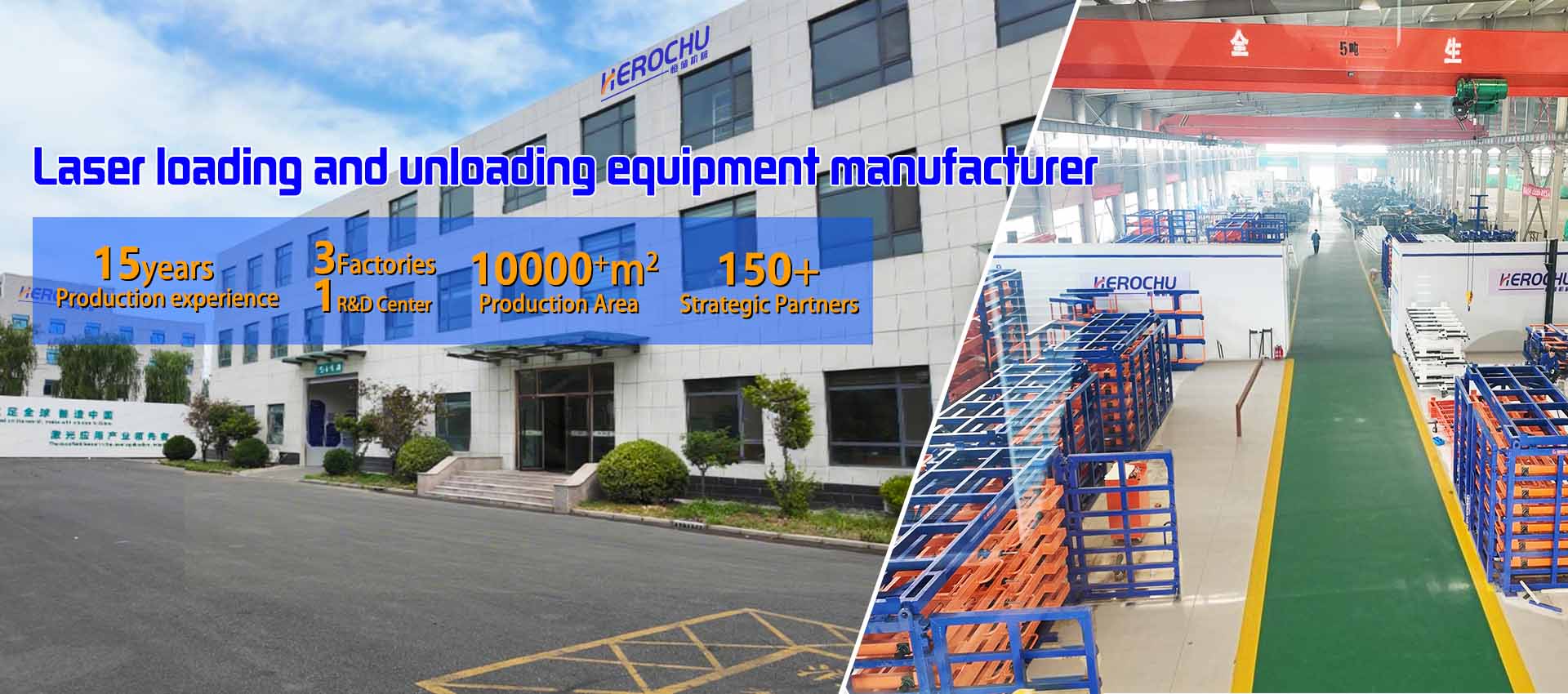
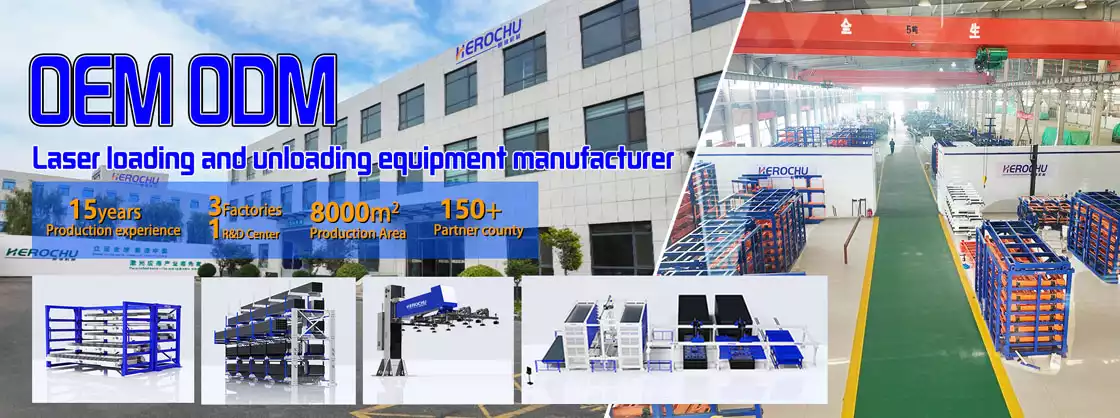
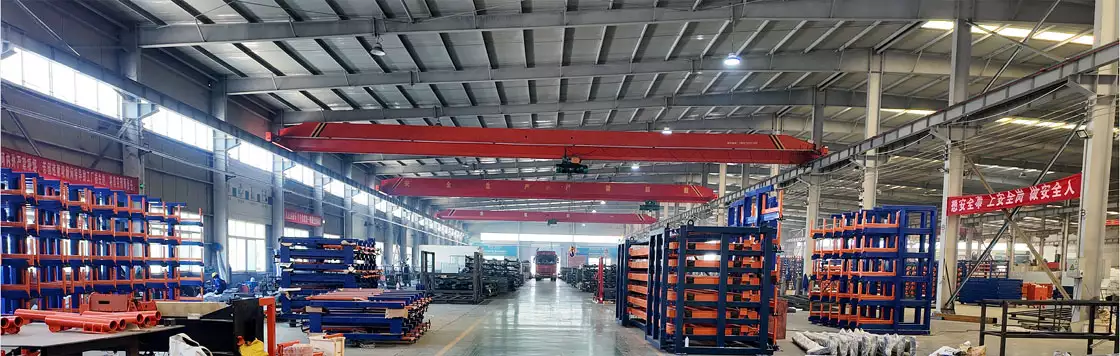
Factory

Hot Selling Machines
-
Automatic Sheet Metal Storage System
Automated Multi-Level Plate Depot with Robotic Retrieval for Laser and Punch Fabrication
Read moreRated 0 out of 5 -
Automatic Sheet Metal Storage System
Smart High-Density Vertical Storage Carousel with Auto-Feeding for Laser Cutting
Read moreRated 0 out of 5 -
Automatic Sheet Metal Storage System
Intelligent 3D Automated Warehouse Rack for Steel Plate Storage
Read moreRated 0 out of 5 -
Automatic Sheet Metal Storage System
AI-Enabled Automated Sheet Metal Storage System for Laser Cutting Production
Read moreRated 0 out of 5 -
Sheet Metal Storage Systems
Sheet Metal Storage Racking System for Plasma Cutting Stations
Read moreRated 0 out of 5 -
Sheet Metal Storage Systems
Sheet Metal Stack Systems for Laser Cutting Stations
Read moreRated 0 out of 5 -
Roll out sheet metal racks
Roll-Out Sheet Metal Racks for Laser Cutting Center
Read moreRated 0 out of 5 -
Heavy duty sheet metal storage racks
Large Heavy Sheet Metal Storage for Metal Fabrication Shop
Read moreRated 0 out of 5
Related products
-
Heavy duty sheet metal storage racks
Hand-cranked Pull-out Carbon Steel Sheet Metal Storage Racks
Read moreRated 0 out of 5 -
Heavy duty sheet metal storage racks
Aluminum Sheet Storage Rack: Heavy-Duty Roll-Out Shelving Units
Read moreRated 0 out of 5 -
Heavy duty sheet metal storage racks
Modular sheet metal storage system for large quantities of flat goods
Read moreRated 0 out of 5 -
Heavy duty sheet metal storage racks
Heavy-Duty Multi-Layer Pull-Out Steel Plate Rack Forklift Drawer Type Factory Stacking Racks & Shelves
Read moreRated 0 out of 5
Product Categories