
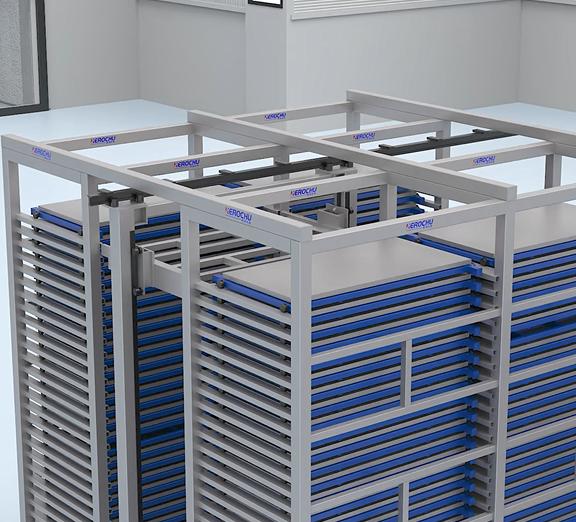
AI-Enabled Automated Sheet Metal Storage System for Laser Cutting Production
Raw material handling remains one of the most persistent choke points in modern sheet metal fabrication. Shops running multiple fiber lasers or punch presses often discover that the cutting machine itself is not the constraint — the real bottleneck sits upstream, where operators spend a third of each shift locating, lifting, and loading steel plates one sheet at a time. Herochu addresses this gap with a purpose-built automated sheet metal storage and retrieval architecture that combines multi-tier vertical racking, gantry-based robotic handling, and an intelligent warehouse management controller into a single synchronized production loop.
AI-Enabled Automated Sheet Metal Storage System for Laser Cutting Production
Raw material handling remains one of the most persistent choke points in modern sheet metal fabrication. Shops running multiple fiber lasers or punch presses often discover that the cutting machine itself is not the constraint — the real bottleneck sits upstream, where operators spend a third of each shift locating, lifting, and loading steel plates one sheet at a time. Herochu addresses this gap with a purpose-built automated sheet metal storage and retrieval architecture that combines multi-tier vertical racking, gantry-based robotic handling, and an intelligent warehouse management controller into a single synchronized production loop.
Why Conventional Flat Storage Falls Short
Most fabrication facilities begin with horizontal stacking. Plates rest on pallets or floor-level racks arranged by thickness and material grade. On paper, the layout looks serviceable. In practice, the footprint swells rapidly. A modest inventory of 3000×1500 mm blanks in four grades and three thicknesses can sprawl across 200 square meters of floor space before factoring in aisle clearance for forklifts and overhead cranes.
Horizontal storage also introduces handling delays that compound with each retrieval cycle. A forklift operator must navigate to the correct bay, verify the material tag, strap the load, transport it to the laser cutting station, and return the pallet — a sequence that routinely consumes four to seven minutes per sheet. Across a single shift handling 80 sheets, that equates to five to nine hours of non-value-added material movement.
Beyond the time cost, flat storage exposes raw stock to shop-floor contamination. Mill scale, cutting dust, and ambient humidity settle on exposed plate surfaces. Galvanized coils stored at ground level risk edge corrosion where condensation pools. These environmental factors drive up rejection rates at downstream welding and coating stages.
The Herochu Multi-Tier Vertical Architecture
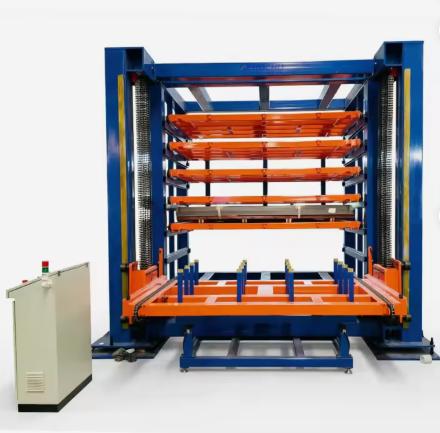
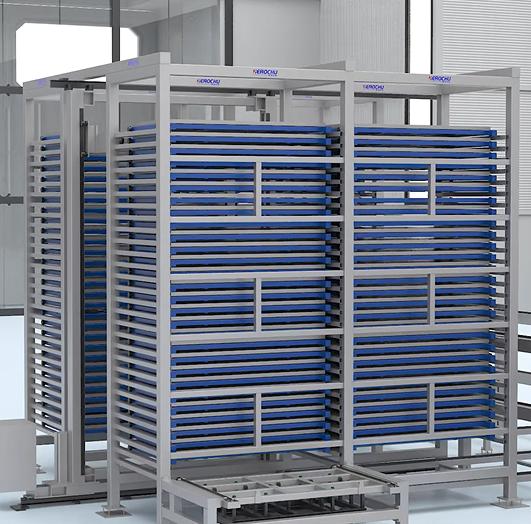
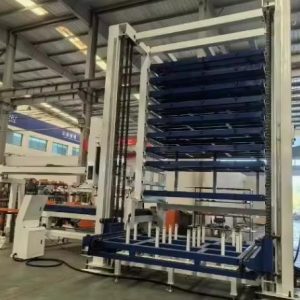
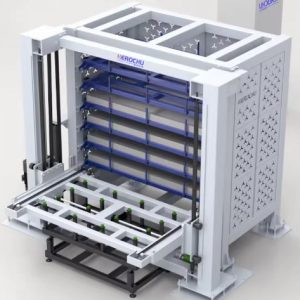
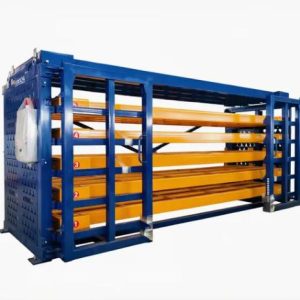
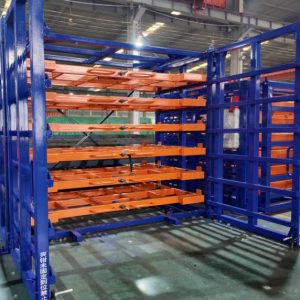
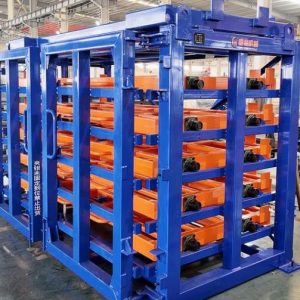
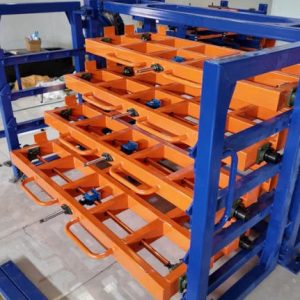
Herochu’s automated sheet metal storage system replaces horizontal sprawl with vertical density. The core structure consists of modular storage towers fabricated from double-sided galvanized steel sheet rated at 275 grams per square meter of zinc coating. All structural fasteners use hot-dip galvanized bolts, selected specifically for their resistance to the mildly acidic atmosphere common in laser cutting environments where nitrogen and oxygen assist gases circulate.
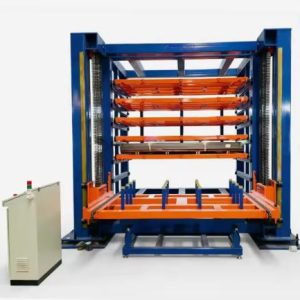
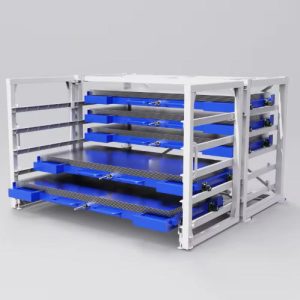
Each tower accommodates eight to ten storage layers as standard, with layer count and clear-space dimensions configurable at the engineering stage. The standard lineup spans four model sizes:
- HC-A3015-83: Designed for plates up to 3000×1500 mm, eight layers, 3,000 kg per-layer capacity
- HC-A4015-85: Accommodates 4000×1500 mm sheets across eight layers at 5,000 kg per layer
- HC-A4020-85: Extended to 4000×2000 mm plates, eight layers, 5,000 kg capacity
- HC-A6020-105: The heavy-duty variant handling 6000×2000 mm stock, ten layers at 5,000 kg per layer
Clear space between layers measures 350 mm as the default, configurable upward for facilities storing irregularly profiled blanks or stacked cut skeletons awaiting secondary processing.
The racking geometry prioritizes structural stiffness over material economy. Rather than thin-gauge cold-formed profiles, Herochu specifies hot-rolled structural sections for the primary load-bearing columns. Each column assembly is designed to resist the combined moment generated by a fully loaded cantilever arm supporting 5,000 kg at a reach depth of 2,000 mm. Finite element analysis using Simsolid confirms deflection remains under 3 mm at full rated load — well within the positional tolerance required for robotic end-effector pick-and-place accuracy.
Gantry Robot Loading and Unloading Mechanics
The bridge between the storage tower and the cutting machine bed is a gantry-style robotic manipulator traveling on precision-ground linear rails. Horizontal traverse speed ranges from 10 to 30 meters per minute depending on the stroke length and payload class. Vertical lifting motion operates at 5 to 10 meters per minute through a servo-driven rack-and-pinion assembly with redundant braking on both axes.
The end-effector employs a zoned vacuum suction matrix governed by a Siemens PLC. The gripper surface divides into independently valved sectors, each monitored by a digital pressure transducer with a sampling rate sufficient to detect vacuum decay within 200 milliseconds of a seal breach. This zoned architecture solves a problem unique to sheet metal automation: handling perforated plates and skeletal cut nests.
When the system retrieves a raw blank from storage, all vacuum zones activate to distribute suction force evenly across the full sheet surface. After the laser completes its nesting program and the sheet returns as a perforated skeleton, the PLC references the known cut geometry from the nesting file. It deactivates vacuum zones that align with cutout regions, maintaining grip only on the remaining solid bridges. The result is reliable extraction without the blind-grip failures that plague single-zone vacuum systems when confronted with Swiss-cheese skeletons.
Each loading cycle includes a thickness verification step. Before the gantry deposits a sheet onto the laser bed, a laser displacement sensor mounted on the end-effector carriage scans the plate surface at three points. If the measured thickness deviates from the job-sheet specification by more than the programmed tolerance, the system flags the discrepancy and routes the plate back to its storage location. This prevents the common and costly scenario where a 2.0 mm plate gets loaded into a laser programmed for 1.5 mm material, producing an entire nest of out-of-spec parts before anyone notices.
Multi-Machine Synchronization for Continuous Production
A single Herochu storage tower with one gantry manipulator can serve up to three fiber laser cutting machines simultaneously. The warehouse control system (WCS) maintains a real-time schedule of every machine’s current nesting job, estimated completion time, and the material specification for the next queued job.
While Laser 1 executes a 12-minute nest on 3.0 mm mild steel, the WCS dispatches the gantry to retrieve a 1.5 mm stainless blank from storage and stage it at Laser 2’s pre-load station. When Laser 2 finishes its current cycle and signals readiness, the gantry completes the handoff in under 90 seconds. The operator at Laser 1 never pauses to hunt for material; the system delivers it before the machine asks.
This synchronized workflow eliminates the idle gaps that accumulate when operators manage material logistics manually. Across an eight-hour shift with three machines cutting an average of four nests per hour each, eliminating just two minutes of idle time per nest recovers 48 minutes of cutting capacity per shift — effectively adding a half-shift of production without additional equipment or labor.
The WMS/WCS Control Layer
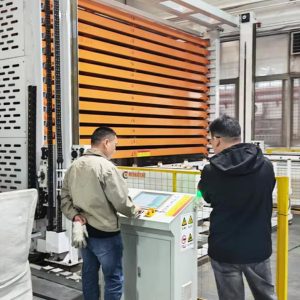
Operators interact with the Herochu system through a 15-inch Siemens industrial touchscreen running a custom HMI built on the TIA Portal framework. The interface presents a live schematic of the storage tower showing occupied and vacant positions, material grade and thickness for each stored plate, and the real-time status of every connected laser cutter.
Two levels of software govern the system’s behavior. The Warehouse Management System (WMS) handles inventory logic: tracking inbound raw material receipts, recording consumption against production orders, and generating low-stock alerts based on configurable reorder thresholds. The Warehouse Control System (WCS) executes the physical layer: motion commands, vacuum zone mapping, interlock safety logic, and machine-to-machine handshake protocols.
Both layers integrate with enterprise ERP and MES frameworks through OPC-UA and REST API endpoints. A production planner working in SAP can query current raw material inventory by grade, thickness, and location within the Herochu storage tower without walking to the shop floor. When an MRP run generates a purchase requisition for 2.0 mm galvanized coil, the quantity is validated against actual consumption data logged by the WMS rather than a manual stock card that may or may not have been updated last Tuesday.
Intelligent Weighing and Inventory Accuracy
Each storage position in a Herochu tower incorporates a high-precision load cell with a rated accuracy of 0.05 percent of full scale or better. When a plate is deposited into its storage slot, the system records the measured weight and compares it against the theoretical weight calculated from the plate’s declared dimensions, thickness, and material density.
A 4000×1500×3.0 mm mild steel plate should weigh approximately 141.3 kg. If the recorded weight is 152 kg, the discrepancy triggers a material verification alert. The plate may be a different grade, a different thickness, or may retain surface contamination that should be addressed before cutting. The WMS flags the slot for operator inspection without halting production on other lanes.
Over time, this continuous weighing data builds a consumption audit trail. The system knows exactly how many kilograms of each material grade entered the tower on a given date and how many kilograms were delivered to each laser cutter. Month-end physical inventory counts, traditionally a multi-day exercise involving cranes, tally sheets, and a lot of guesswork about partially consumed plates, collapse to a simple verification of the WMS digital ledger against what is physically present in the tower.
Layout Customization and Site Integration
Herochu does not ship a standard rack and ask the customer to reorganize their floor around it. The engineering team works from the customer’s CAD floor plan, existing machine positions, overhead clearance constraints, and material flow patterns to design a storage layout that slots into the current production environment.
Single-tower configurations suit small to mid-size shops with two to three cutting machines. Twin-tower arrangements, with a shared gantry running on a common rail between them, double storage density without doubling the required gantry footprint. For high-volume operations processing 200 or more plates per shift across five or more lasers, multi-silo installations with dedicated gantries per tower group provide the throughput headroom to match cutting capacity.
Overhead clearance is a common constraint in existing buildings. Where ceiling height prohibits a full eight-layer tower, Herochu can reduce the layer count while widening the footprint — the trade-off between vertical and horizontal space utilization is a deliberate engineering decision made during the layout design phase, not a compromise imposed by a fixed catalog specification.
Material Cart Integration and End-to-End Flow
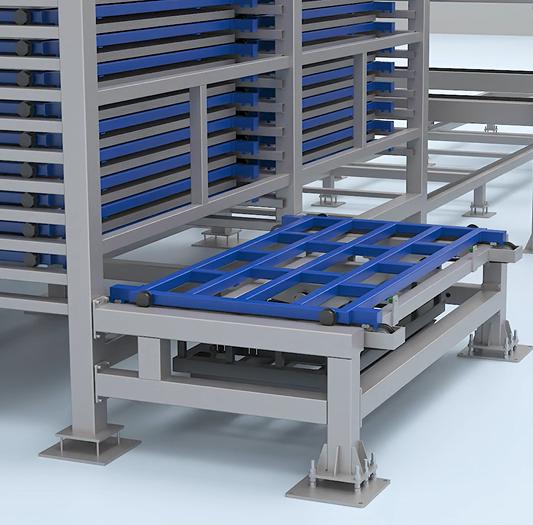
The storage-and-retrieval function is one segment of a broader automated material flow that Herochu designs as an integrated chain. Inbound raw plates arrive on hydraulic lift carts or roller conveyors positioned at the loading station. An operator places the stack on the receiving platform and scans the material certificate barcode. The WMS registers the plate count, dimensions, grade, and heat number, then assigns storage locations based on proximity to the cutting machines that will consume that material and on separation rules that prevent incompatible grades from occupying adjacent slots.
The gantry picks from the receiving station and distributes plates to their assigned storage positions. When a production order calls for a specific material, the reverse flow executes: gantry retrieves from storage, deposits onto the laser bed, extracts the finished skeleton after cutting, and routes it to a scrap discharge conveyor or a finished-part sorting station.
The entire sequence runs without forklift intervention between receipt of raw material and discharge of cut parts. This closed-loop material flow is the mechanism that enables lights-out production — the ability to run an unmanned night shift where the last operator at 6 PM loads the receiving station with sufficient raw stock to supply the cutting schedule through 6 AM.
Maintenance and Long-Term Reliability
The mechanical systems in a Herochu installation are designed for accessibility. Linear rails mount at working height with grease nipples positioned on the accessible face. The vacuum pump assembly sits in a sound-dampened enclosure at floor level with quick-disconnect couplings that allow a replacement pump to be swapped in under 30 minutes. All sensor brackets use slotted mounting holes with engraved alignment reference marks so that a displaced or replaced sensor can be repositioned without recalibration.
The Siemens PLC logs all motion events, vacuum pressure traces, weight readings, and interlock activations to an onboard historian with 90 days of rolling storage. When a fault occurs, maintenance technicians can replay the sequence log to identify the root cause rather than relying on operator accounts of what happened. Remote access via VPN allows Herochu service engineers to diagnose issues and push PLC parameter adjustments without waiting for an on-site visit.
Galvanized structural components require no painting and no scheduled corrosion maintenance beyond periodic inspection of bolt torque. In facilities where the atmosphere carries cutting dust or coolant mist, quarterly cleaning of linear rail surfaces and annual replacement of wiper seals constitute the primary preventive maintenance tasks.
Return on Investment Drivers
The economic case for automated sheet metal storage rests on three measurable factors. First, floor space recovery: a single eight-layer Herochu tower with a 4000×2000 mm footprint consolidates the equivalent of 64 square meters of horizontal storage into roughly 12 square meters of vertical racking, a space compression ratio exceeding 5:1. For facilities paying industrial rent in Tier 1 urban zones, recovered floor area alone can justify the capital expenditure.
Second, labor displacement from non-value-added tasks. Forklift drivers reassigned from material hunting to value-added operations represent a direct cost recovery that accrues monthly. Third, machine utilization uplift from eliminating material-related idle time. A 15-percentage-point improvement in overall equipment effectiveness on three laser cutters, each with an hourly operating cost including amortization, consumables, and utilities, generates a return that compounds with every additional shift.
For operations already running at or near capacity, automated storage provides a path to throughput expansion without purchasing additional cutting machines. The capital cost of a Herochu storage and handling system typically runs well below the installed cost of a high-power fiber laser, while unlocking latent capacity already present in the existing machine fleet.
FAQ
Here are some frequently asked questions about our sheet metal racks and pipe storage solutions. We hope you find them helpful!
Q1: Can I request a custom size or color?
Absolutely. We offer complimentary design services and deliver efficient, tailored solutions to meet your specific requirements.
Q2: Are you a manufacturer or a distributor?
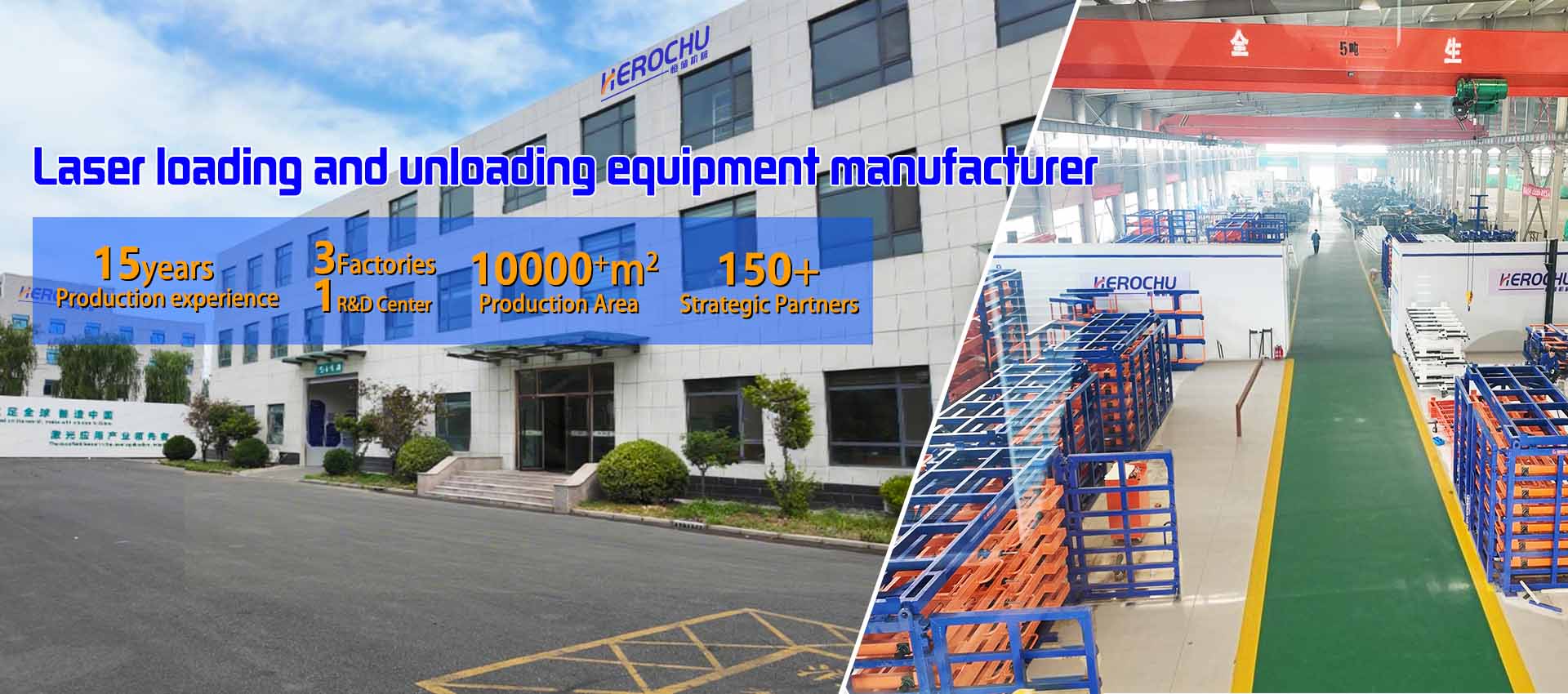
We are a direct manufacturer with over 15 years of industry experience and expertise.
Q3: Is there a minimum order quantity?
No. We welcome orders of any size, starting from a single unit.
Q4: How can I get detailed product information?
Click the “Get a Quote” button to receive product images, detailed specifications, and videos. Our team is always ready to assist.
Q5: How do I provide my storage rack requirements?
Simply share the type, dimensions, and quantity of materials you plan to store, along with any other specific needs. We will develop a professional storage solution for you. Alternatively, leave your contact details for a personalized consultation.
Q6: Do you offer automated loading systems or robotic arms?
Yes. We provide loading robotic arms and integrated loading/unloading systems tailored to your laser cutting machine’s table size and material handling method (e.g., board rack, exchange platform, or material warehouse). Contact us with your details for a customized proposal.
Q7: Do you provide on-site installation and debugging?
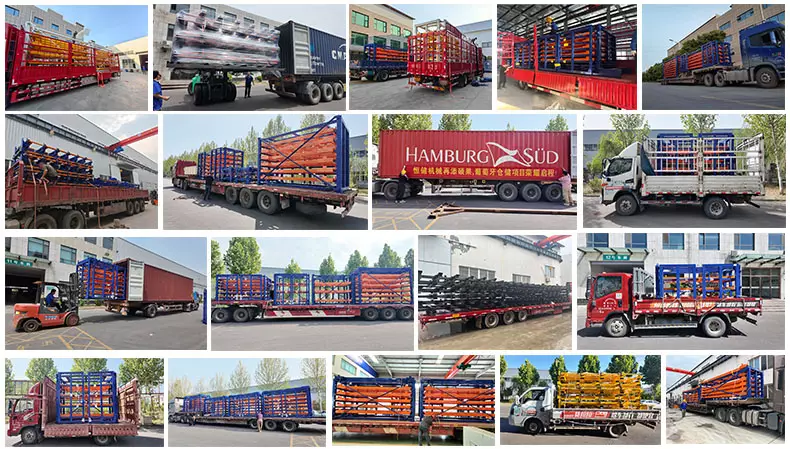
Yes. Our technicians can travel to your facility for installation and debugging, ensuring successful operation. We have served clients globally, including in the USA, South Korea, Russia, Qatar, Mexico, South Africa, Egypt, and Lebanon.
Q8: How do you ensure product quality?
Our quality assurance includes:
A team of over 40 technical engineers for professional debugging and support.
A dedicated quality control department compliant with ISO9001 standards.
CE certification for all exports.
Rigorous load testing before shipment to ensure structural safety and reliability.
Q9: Where is your factory located?
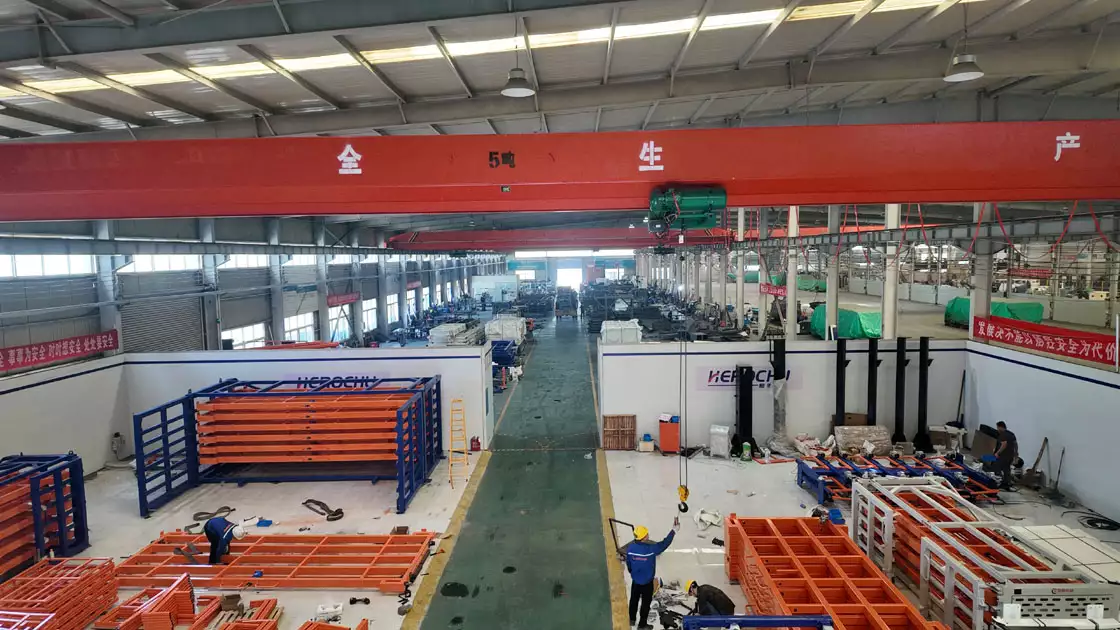
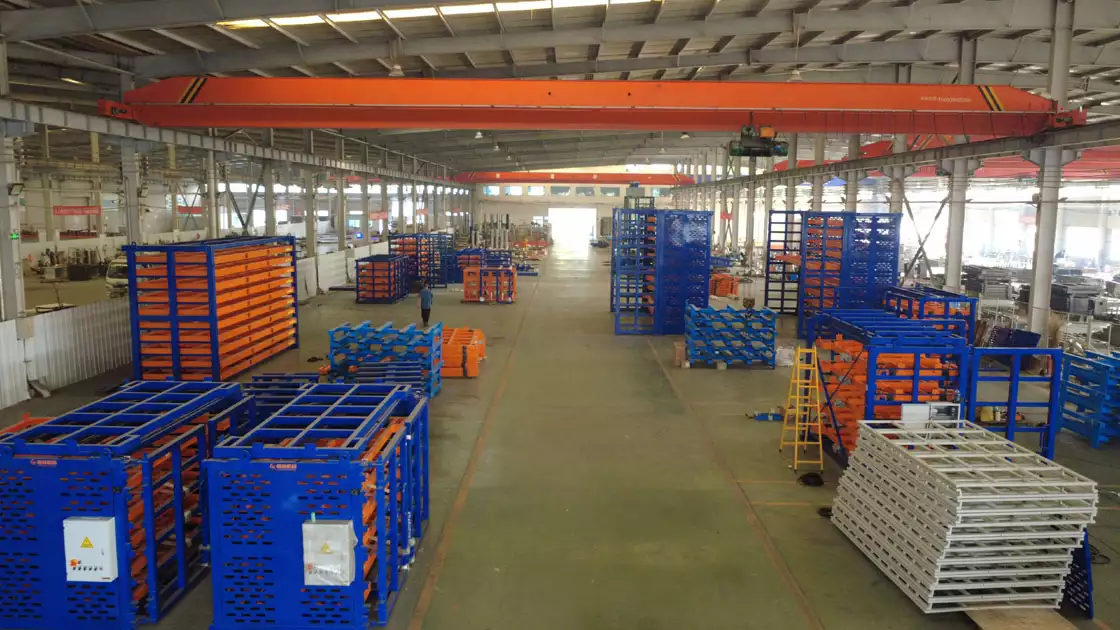
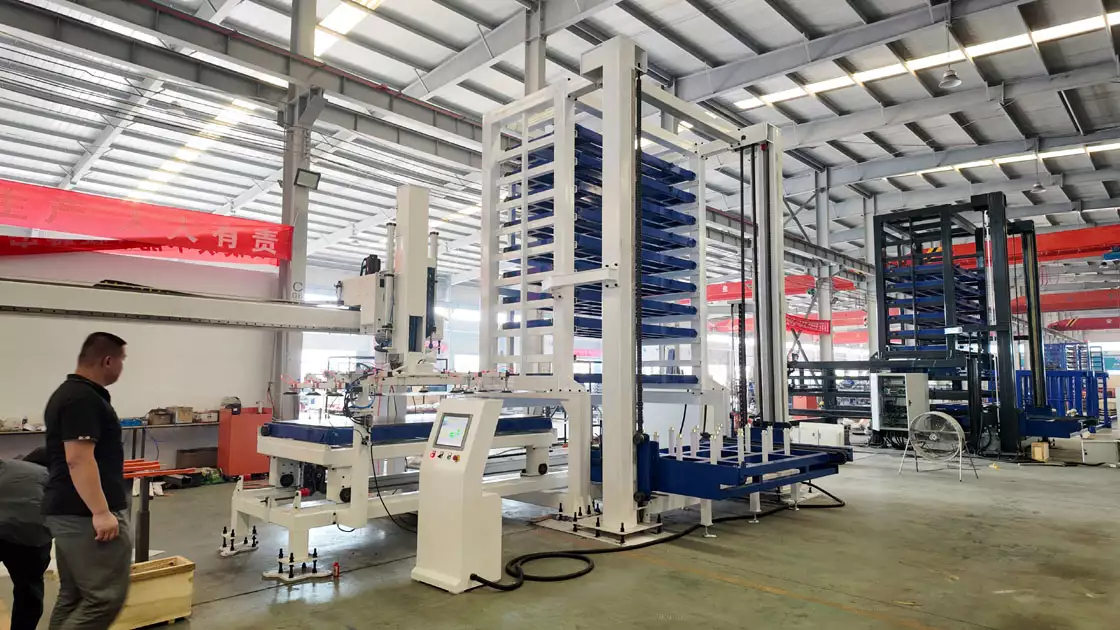
Our modern 10,000-square-meter manufacturing facility is located in Jiyang Industrial Park, Jinan, Shandong, China.
Q10: How can I evaluate your company’s capabilities?
We offer virtual video factory tours and warmly welcome on-site visits.
Q11: What does your company specialize in?
Jinan Constant Storage Machinery Manufacturing Co., Ltd. is a high-tech enterprise specializing in the R&D, production, sales, installation, and service of intelligent storage solutions. Our product range includes sheet material warehouses, drawer-style shelves, cantilever racks, servo manipulators, gantry loaders, and fully automated handling systems. Supported by a skilled technical team and advanced equipment, we are committed to delivering high-performance storage products and solutions to customers worldwide.
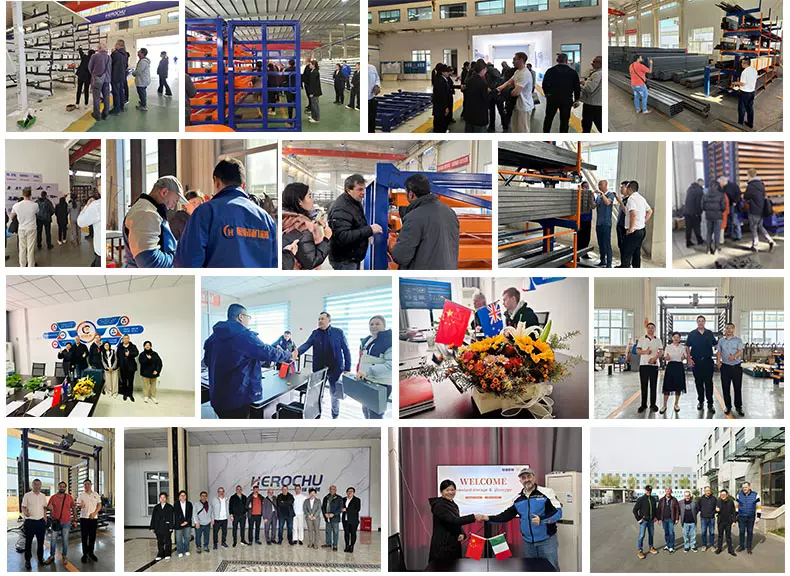
Customer visit
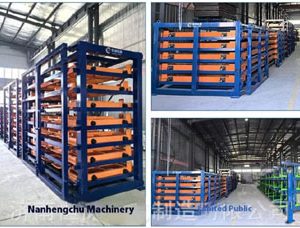
Herochu has always been adhering to the market-centric approach to meet customer requirements to the maximum extent, and the business philosophy of “creating brands with heart and gaining reputation with sincerity”. It provides customers with high-quality products and services with rigorous military quality, professionalism, and excellence, and has won unanimous praise in the Chinese aerospace, Chinese weapons, Chinese railways, automobile manufacturing, engineering machinery, non-ferrous metal titanium alloy and other industries.
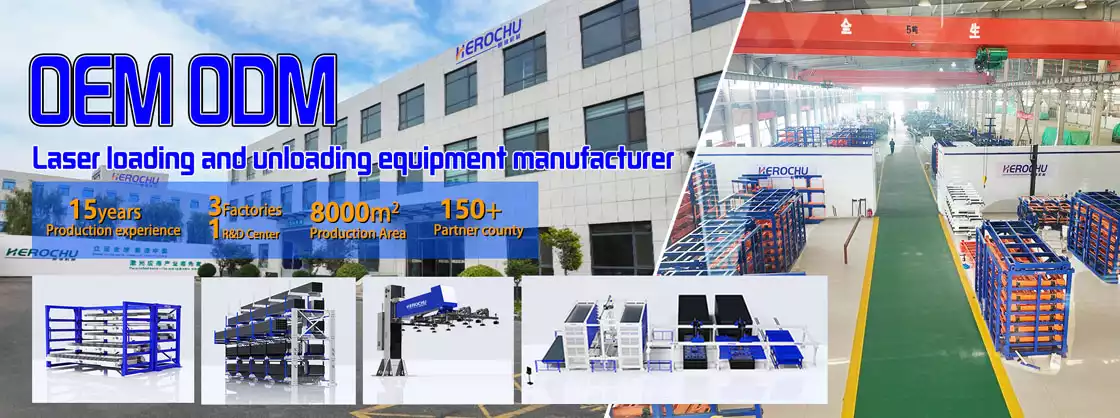
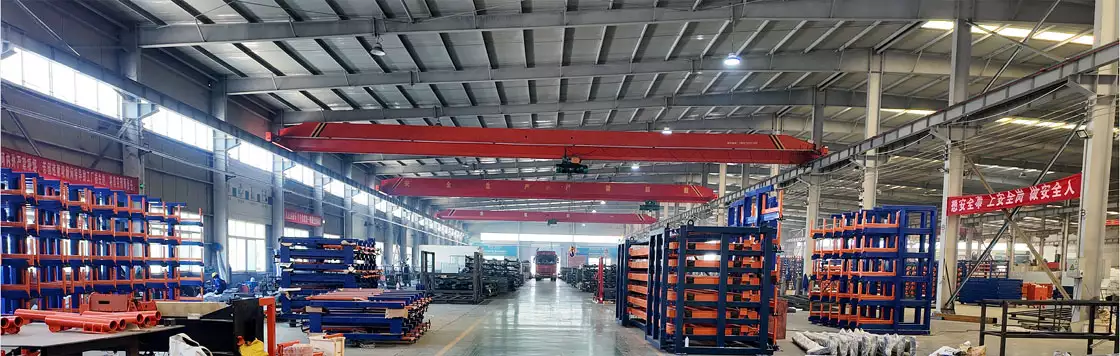
Factory

Hot Selling Machines
-
Automatic Sheet Metal Storage System
Automated Multi-Level Plate Depot with Robotic Retrieval for Laser and Punch Fabrication
Read moreRated 0 out of 5 -
Automatic Sheet Metal Storage System
Smart High-Density Vertical Storage Carousel with Auto-Feeding for Laser Cutting
Read moreRated 0 out of 5 -
Automatic Sheet Metal Storage System
Intelligent 3D Automated Warehouse Rack for Steel Plate Storage
Read moreRated 0 out of 5 -
Automatic Sheet Metal Storage System
AI-Enabled Automated Sheet Metal Storage System for Laser Cutting Production
Read moreRated 0 out of 5 -
Sheet Metal Storage Systems
Sheet Metal Storage Racking System for Plasma Cutting Stations
Read moreRated 0 out of 5 -
Sheet Metal Storage Systems
Sheet Metal Stack Systems for Laser Cutting Stations
Read moreRated 0 out of 5 -
Roll out sheet metal racks
Roll-Out Sheet Metal Racks for Laser Cutting Center
Read moreRated 0 out of 5 -
Heavy duty sheet metal storage racks
Large Heavy Sheet Metal Storage for Metal Fabrication Shop
Read moreRated 0 out of 5
Related products
-
Heavy duty sheet metal storage racks
Hand-cranked Pull-out Carbon Steel Sheet Metal Storage Racks
Read moreRated 0 out of 5 -
Heavy duty sheet metal storage racks
Aluminum Sheet Storage Rack: Heavy-Duty Roll-Out Shelving Units
Read moreRated 0 out of 5 -
Heavy duty sheet metal storage racks
Modular sheet metal storage system for large quantities of flat goods
Read moreRated 0 out of 5 -
Heavy duty sheet metal storage racks
Heavy-Duty Multi-Layer Pull-Out Steel Plate Rack Forklift Drawer Type Factory Stacking Racks & Shelves
Read moreRated 0 out of 5
Product Categories