
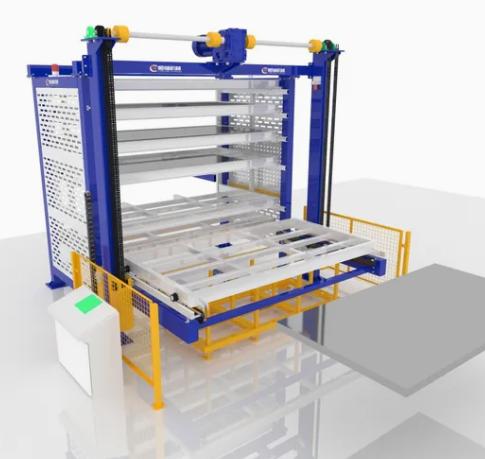
Smart High-Density Vertical Storage Carousel with Auto-Feeding for Laser Cutting
The throughput of a modern fiber laser cutting machine depends as much on the speed of material changeover as on the cutting head traverse rate. A laser that cuts a nest in eight minutes but waits four minutes between nests for the operator to crane-lift the skeleton off the bed, locate the next sheet, and position it on the cutting slats is running at two-thirds of its rated productivity. Herochu’s high-density vertical storage carousel with integrated auto-feeding eliminates this inter-nest gap by combining dense material buffering with direct-to-bed sheet delivery — a configuration that keeps the laser running at its engineered cycle time rather than at the pace of manual material handling.
Smart High-Density Vertical Storage Carousel with Auto-Feeding for Laser Cutting
The throughput of a modern fiber laser cutting machine depends as much on the speed of material changeover as on the cutting head traverse rate. A laser that cuts a nest in eight minutes but waits four minutes between nests for the operator to crane-lift the skeleton off the bed, locate the next sheet, and position it on the cutting slats is running at two-thirds of its rated productivity. Herochu’s high-density vertical storage carousel with integrated auto-feeding eliminates this inter-nest gap by combining dense material buffering with direct-to-bed sheet delivery — a configuration that keeps the laser running at its engineered cycle time rather than at the pace of manual material handling.
The Inter-Nest Productivity Gap
To understand the scale of the problem, consider a fabrication cell running three 6 kW fiber lasers on a two-shift schedule. Each laser completes an average of five nests per hour, with each nest consuming one sheet. Manual handling between nests averages three and a half minutes for skeleton removal, sheet retrieval, placement, and alignment verification. Across 16 hours of operation and 240 total sheet changes, manual handling consumes 840 minutes — 14 hours of non-cutting time across the three machines.
The lasers themselves are capable of cutting for roughly 50 minutes of every hour. Manual handling drops that to about 33 minutes. The difference — 17 minutes per machine-hour, or 816 minutes per day across the cell — represents lost cutting revenue. At a shop rate of 400 RMB per hour for laser cutting time, that is over 5,400 RMB in unrealized revenue per day, every day the machines run.
Herochu’s vertical storage carousel addresses this gap by automating the entire sheet-change sequence. The carousel serves as both the material buffer and the delivery mechanism, eliminating the separate steps of “go get the sheet” and “bring it to the laser” that consume operator time between cutting cycles.
Carousel Architecture and Storage Density
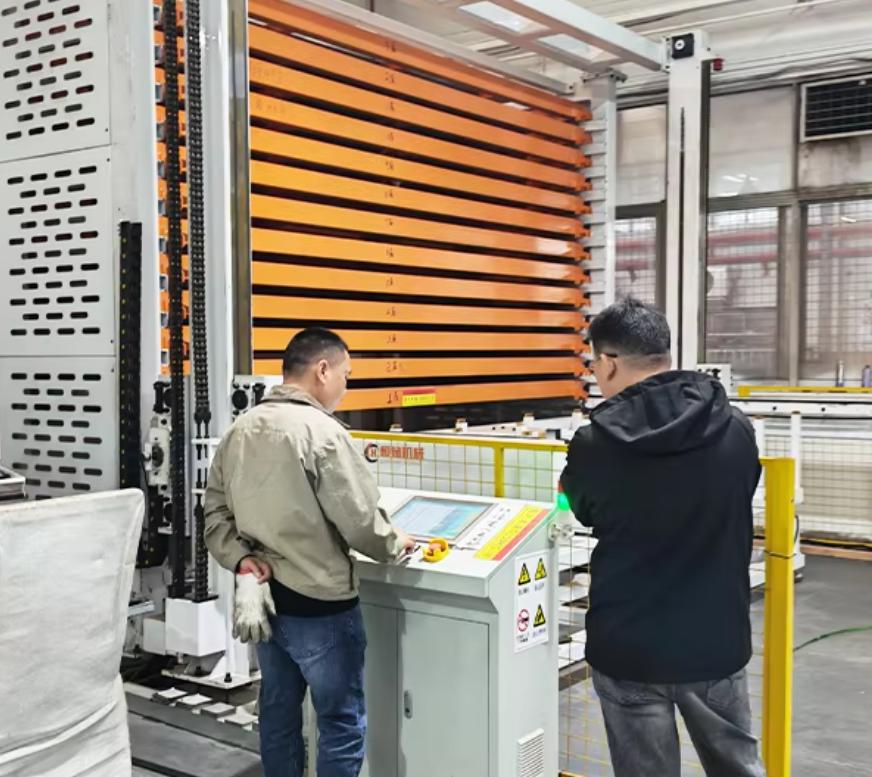
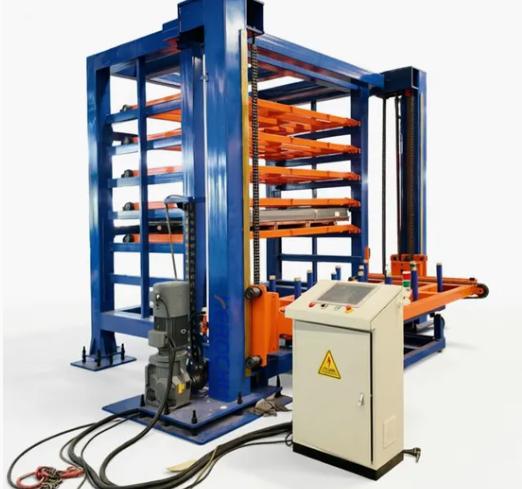
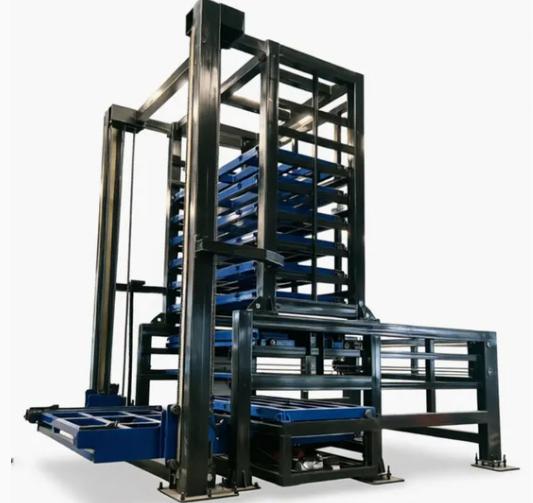
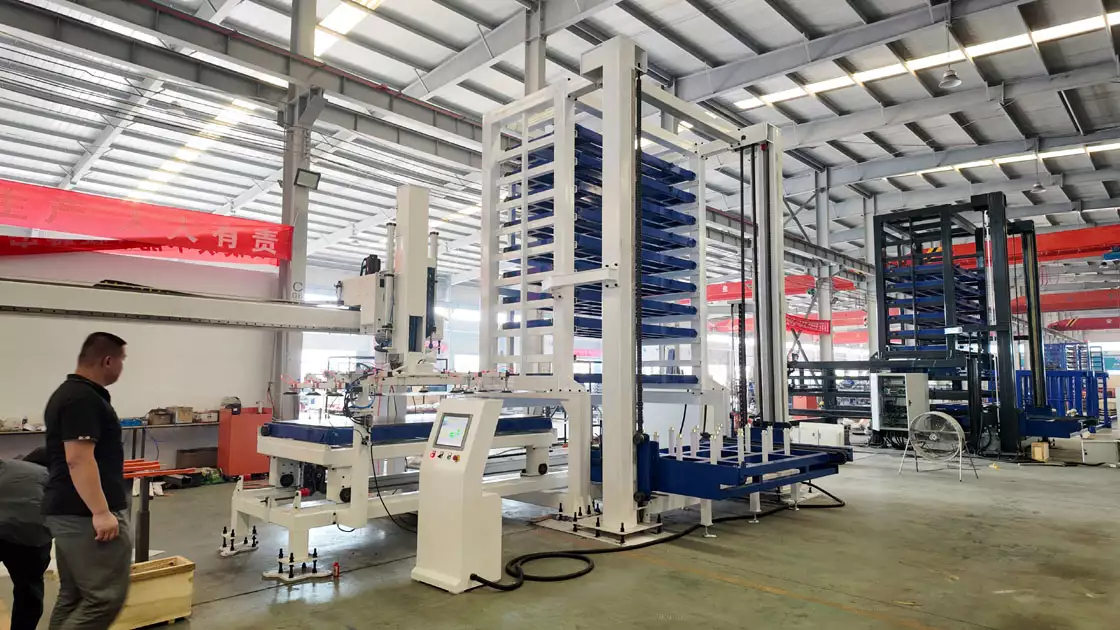
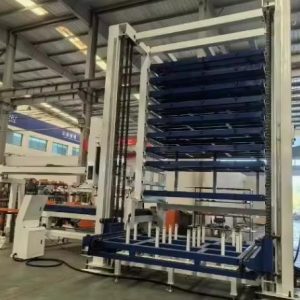
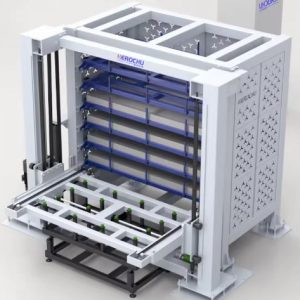
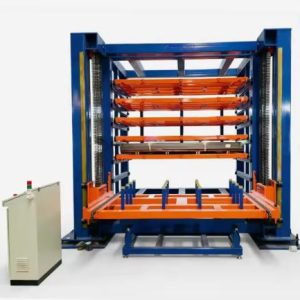
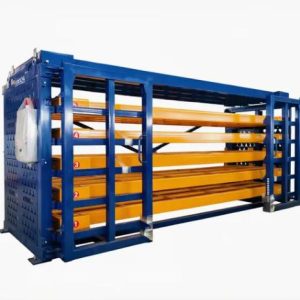
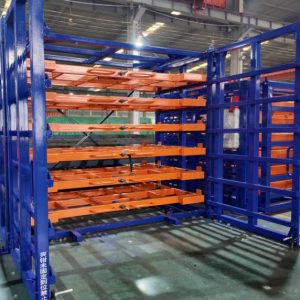
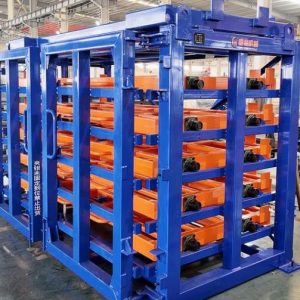
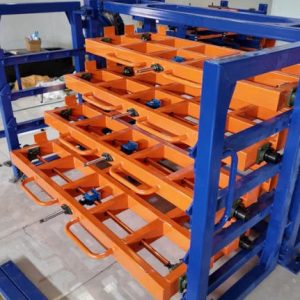
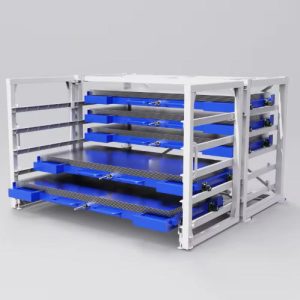
The Herochu vertical carousel is a multi-level rotating storage assembly in which sheet-loaded cassettes circulate on a vertical loop driven by a servo motor through a precision chain or rack-and-pinion transmission. The carousel occupies a footprint roughly equivalent to the plan area of the largest sheet it stores plus clearance for the pick-and-place mechanism — typically 10 to 14 square meters for a system handling 4000×2000 mm plate.
Within that footprint, a standard eight-level carousel stores eight sheets of up to 5,000 kg each across the occupied levels, with one level reserved as the pick station. For a fabrication cell consuming 40 sheets per shift, the carousel provides approximately one shift of buffer capacity in a footprint that would hold at most two sheets in a horizontal stack.
The storage density advantage is geometric rather than incremental. Horizontal stacking stores sheets on the floor plane, where the quantity scales with square meters. A vertical carousel stores sheets on the elevation plane, where the quantity scales with the cube of the building height divided by the layer pitch. In a facility with 8 meters of usable interior height, a carousel with 350 mm pitch between levels accommodates 22 theoretical positions — a storage density more than ten times that of floor-level stacking within the same footprint.
The Auto-Feeding Sequence
When the laser completes a cutting cycle and signals readiness for the next sheet, the carousel controller initiates an auto-feeding sequence that executes without operator input. The sequence proceeds through five stages:
Stage 1 — Skeleton Extraction. The gantry’s vacuum end-effector descends onto the cut skeleton, activates vacuum in the zones that correspond to solid material bridges, and lifts the skeleton clear of the cutting bed. The system references the nesting file to determine which vacuum zones should engage — zones aligned with cutout regions remain sealed to avoid loss of suction.
Stage 2 — Skeleton Discharge. The gantry traverses to a discharge conveyor or scrap bin positioned adjacent to the cutting bed and releases the skeleton. A brief reverse-pressure pulse clears any residual cutting dust from the vacuum cups before the end-effector returns to the carousel.
Stage 3 — Sheet Retrieval. The carousel indexes to the position holding the next scheduled sheet. The gantry end-effector descends, engages full vacuum across all zones, and lifts the sheet. A laser displacement sensor confirms single-sheet pickup — if two sheets are lifted due to oil adhesion or electrostatic attraction, the thickness reading exceeds the expected value and the system executes an automated separation routine involving a brief lateral shake and re-pick.
Stage 4 — Sheet Placement. The gantry transports the sheet to the laser bed and lowers it onto the slat supports. The end-effector releases vacuum after confirming through position sensors that the sheet is resting on the slats, not still suspended by suction. The laser’s own sheet-position detection system — typically a laser head touch probe or camera-based edge finder — confirms alignment before the cutting program starts.
Stage 5 — Carousel Reset. The carousel returns to its home position, and the WCS updates the inventory record for the consumed sheet position. If the consumed position was the last sheet of a particular material grade in the carousel, the system alerts the operator to reload.
The complete sequence from skeleton extraction to new sheet placement completes in 90 to 120 seconds depending on the distance between the carousel and the cutting bed.
Multi-Machine Carousel Configurations
A single eight-level carousel serving one laser provides a comfortable one-shift buffer. For cells with two or three lasers cutting at high utilization, Herochu offers multi-carousel configurations with a shared gantry system. Two eight-level carousels provide 16 sheet positions; three provide 24.
The WCS manages the carousel fleet as a pooled resource. Rather than dedicating carousel A to Laser 1 and carousel B to Laser 2 — which would leave Laser 1 starved when its dedicated carousel empties while carousel B still holds material — the pool model routes the next sheet request from any laser to the carousel holding the required material at the position closest to the requesting machine.
This pooled architecture also supports mixed-material scheduling. A carousel loaded with eight sheets of 1.5 mm stainless, eight of 2.0 mm mild steel, and eight of 3.0 mm aluminum can serve three lasers cutting three different materials simultaneously, with the WCS optimizing retrieval paths to minimize gantry travel distance between successive picks.
Integration with the Laser Control System
The carousel auto-feeding system communicates with the laser cutting machine controller through a hardwired digital I/O interface supplemented by an Ethernet-based protocol for job data exchange. The hardwired signals handle safety interlocks and basic handshake commands — “ready to unload,” “unload complete,” “ready to load,” “load complete.” The Ethernet channel carries the nesting file, which the carousel controller uses to map vacuum zones for skeleton extraction, and the production schedule, which tells the WCS which material specification to deliver next.
This dual-channel architecture provides a safety advantage: if the Ethernet link drops, the hardwired interlocks prevent the gantry from initiating motion while the laser is cutting. If the hardwired signals fail, the Ethernet channel carries a heartbeat signal whose absence triggers a controlled stop on both the carousel and the laser. Neither communication path is a single point of failure for safety-critical functions.
The integration works with fiber laser cutting machines from major manufacturers including Trumpf, Bystronic, Amada, Mazak, and HSG, as well as with CO2 laser systems still in service. The interface specification is published and can be implemented by any laser manufacturer’s field service team without requiring Herochu to write custom integration firmware for each machine brand.
Operator Interface and Exception Handling
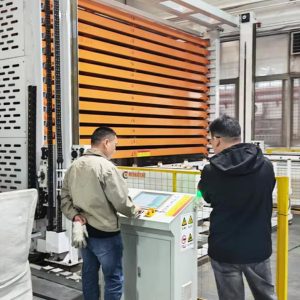
The carousel’s HMI runs on a 15-inch Siemens touchscreen mounted at operator height on the gantry support column. The primary screen displays a live schematic of carousel contents — position number, material grade, thickness, sheet dimensions, and the production order number that each sheet is allocated to.
A color-coded status indicator beside each carousel position shows green for “available for retrieval,” yellow for “allocated to a scheduled job,” red for “empty,” and blue for “material under quality hold.” The operator can tap any position to view detailed information including the material certificate reference, the date the sheet was loaded into the carousel, and the cumulative weight logged by the position’s load cell.
Exception handling follows a principle of “pause, don’t stop.” When the system encounters a condition it cannot resolve autonomously — a failed thickness verification, a vacuum pressure anomaly during skeleton extraction, or a material-grade mismatch between the scheduled job and the sheet detected in the expected carousel position — it pauses the affected lane and continues serving other lanes. The operator receives a notification on the HMI with a description of the fault and a suggested resolution, but production on unaffected lasers proceeds without interruption.
Material Traceability and Quality Assurance
Every sheet loaded into a Herochu carousel is associated with a digital record that includes the mill certificate data, the receiving inspection results if the facility performs incoming quality checks, and the production orders that consumed portions of the sheet if it was a remnant returned to storage after partial use.
This traceability record serves two operational purposes. First, it enables backward traceability from a finished part to the specific heat of steel from which it was cut — a requirement for fabricators supplying automotive, aerospace, or pressure-vessel customers who mandate full material pedigree documentation. Second, it enables pattern analysis across production history: if laser operators consistently report cutting-quality issues on a particular material grade from a particular supplier, the WMS data provides the evidence to support a supplier quality discussion with batch-level granularity.
The system also logs every auto-feeding cycle with a timestamp, the carousel position accessed, the sheet weight before and after cutting (for partial sheets returned to storage), and the duration of each stage in the sequence. This data supports continuous improvement analysis: a gradual increase in skeleton extraction time across a shift might indicate vacuum cup wear that should be addressed before it causes a drop event.
Cold-Start and Shift-Change Procedures
At the beginning of a production shift, an operator loads the carousel with sheets according to the production schedule for the day. The loading procedure uses a hydraulic lift cart or a dedicated loading station equipped with a powered roller conveyor. The operator places a stack of sheets on the loading station, scans the material certificate barcode, and selects the carousel positions to fill. The carousel indexes each target position to the loading station elevation, and the gantry transfers sheets from the stack to the carousel positions one at a time.
A full eight-level carousel loads in approximately 15 to 20 minutes depending on sheet size and gantry travel distance. During loading, the operator can queue material for multiple carousels simultaneously; the WCS manages the loading sequence to fill carousels in priority order based on the production schedule.
At shift end, the operator can command a “drain to empty” sequence that retrieves all remaining sheets from the carousel and deposits them at the unloading station. Alternatively, the operator can leave sheets in the carousel for the next shift, with the WMS maintaining inventory continuity across shift boundaries. The overnight lights-out scenario — where the carousel is fully loaded at 6 PM and runs unmanned until 6 AM — is a standard supported operating mode.
Energy Efficiency and Compressed Air Consumption
The vacuum system on a Herochu auto-feeding carousel uses a side-channel blower rather than a Venturi-type compressed-air ejector for primary vacuum generation. A side-channel blower produces vacuum through mechanical displacement, consuming electrical power directly rather than converting compressed air — which has already incurred compressor energy losses — into vacuum through a nozzle.
For a system handling 120 sheet changes per day at 60 seconds of vacuum engagement per change, the compressed-air consumption of a Venturi system would be approximately 120 cubic meters per day at 6 bar, representing a compressor energy cost of roughly 15 kWh per day — or 5,400 kWh per year. The side-channel blower equivalent draws power only during active vacuum cycles and consumes approximately one-third the energy.
The compressed-air system on the carousel is reserved for the reverse-pressure pulse that clears vacuum cups between cycles and for the pneumatic actuators on the quick-change end-effector coupling — functions that require high-pressure, low-volume air delivery rather than sustained flow.
Conclusion
A laser cutting machine’s nameplate cutting speed is a theoretical maximum that manual material handling cannot sustain. Herochu’s high-density vertical storage carousel with auto-feeding closes the gap between rated cutting speed and realized throughput by automating the sheet-change sequence that manual operations force into every nest cycle. The outcome is not a faster laser but a laser that cuts for a higher percentage of each operating hour — which, in fabrication economics, amounts to the same thing.
FAQ
Here are some frequently asked questions about our sheet metal racks and pipe storage solutions. We hope you find them helpful!
Q1: Can I request a custom size or color?
Absolutely. We offer complimentary design services and deliver efficient, tailored solutions to meet your specific requirements.
Q2: Are you a manufacturer or a distributor?
We are a direct manufacturer with over 15 years of industry experience and expertise.
Q3: Is there a minimum order quantity?
No. We welcome orders of any size, starting from a single unit.
Q4: How can I get detailed product information?
Click the “Get a Quote” button to receive product images, detailed specifications, and videos. Our team is always ready to assist.
Q5: How do I provide my storage rack requirements?
Simply share the type, dimensions, and quantity of materials you plan to store, along with any other specific needs. We will develop a professional storage solution for you. Alternatively, leave your contact details for a personalized consultation.
Q6: Do you offer automated loading systems or robotic arms?
Yes. We provide loading robotic arms and integrated loading/unloading systems tailored to your laser cutting machine’s table size and material handling method (e.g., board rack, exchange platform, or material warehouse). Contact us with your details for a customized proposal.
Q7: Do you provide on-site installation and debugging?
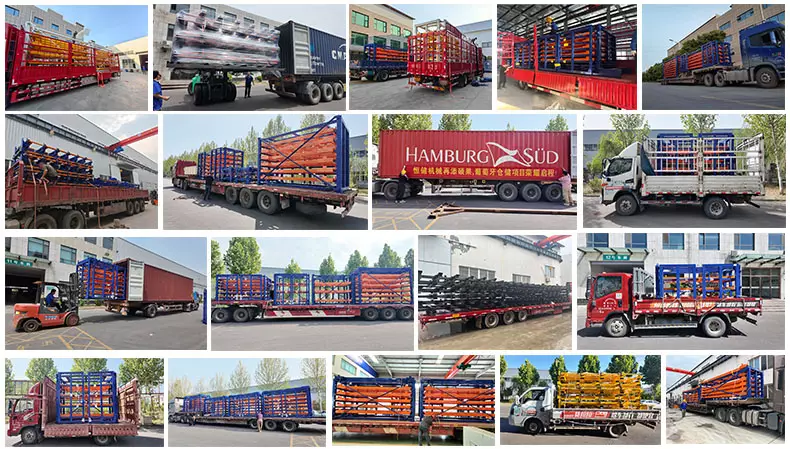
Yes. Our technicians can travel to your facility for installation and debugging, ensuring successful operation. We have served clients globally, including in the USA, South Korea, Russia, Qatar, Mexico, South Africa, Egypt, and Lebanon.
Q8: How do you ensure product quality?
Our quality assurance includes:
A team of over 40 technical engineers for professional debugging and support.
A dedicated quality control department compliant with ISO9001 standards.
CE certification for all exports.
Rigorous load testing before shipment to ensure structural safety and reliability.
Q9: Where is your factory located?
Our modern 10,000-square-meter manufacturing facility is located in Jiyang Industrial Park, Jinan, Shandong, China.
Q10: How can I evaluate your company’s capabilities?
We offer virtual video factory tours and warmly welcome on-site visits.
Q11: What does your company specialize in?
Jinan Constant Storage Machinery Manufacturing Co., Ltd. is a high-tech enterprise specializing in the R&D, production, sales, installation, and service of intelligent storage solutions. Our product range includes sheet material warehouses, drawer-style shelves, cantilever racks, servo manipulators, gantry loaders, and fully automated handling systems. Supported by a skilled technical team and advanced equipment, we are committed to delivering high-performance storage products and solutions to customers worldwide.
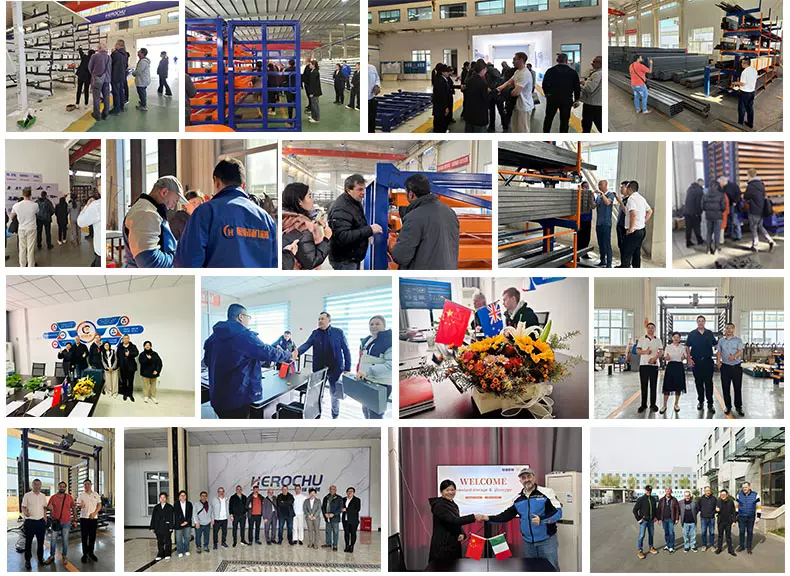
Customer visit
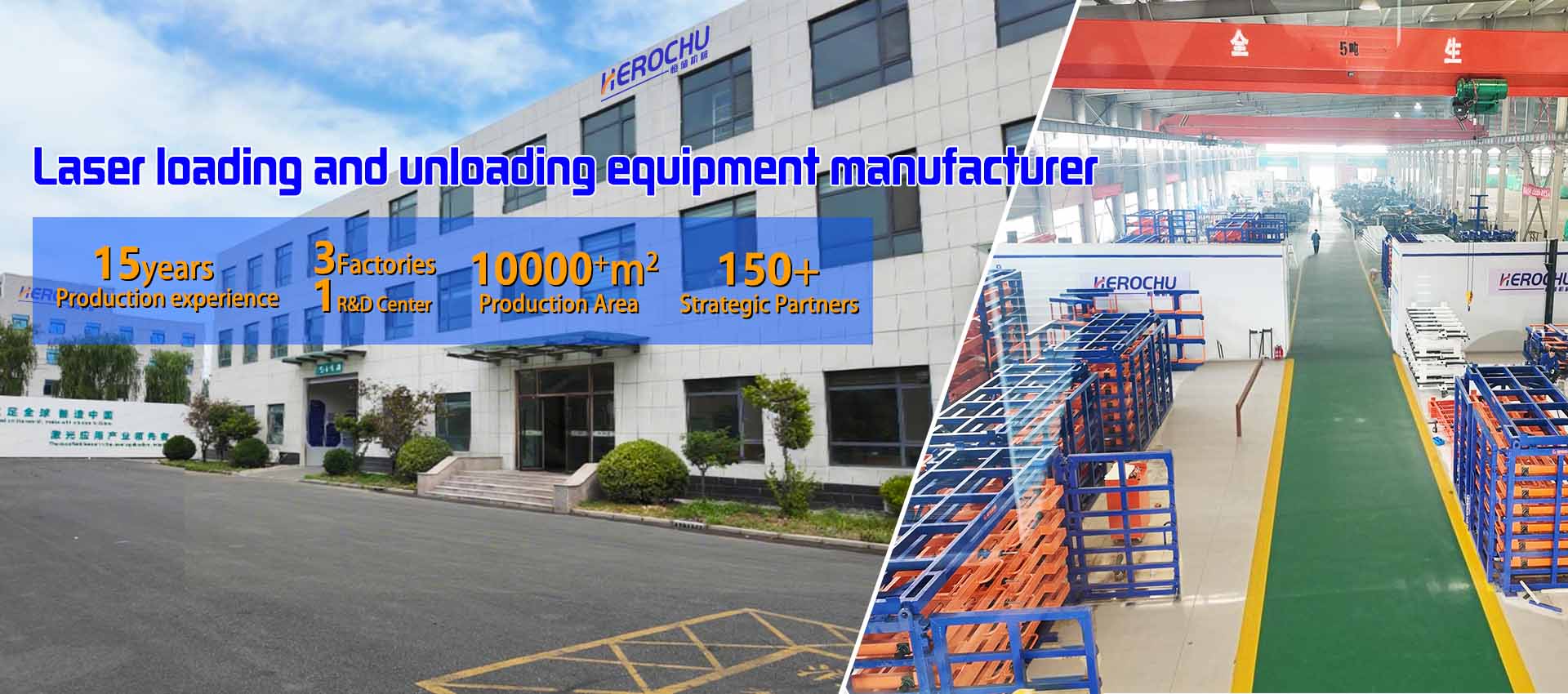
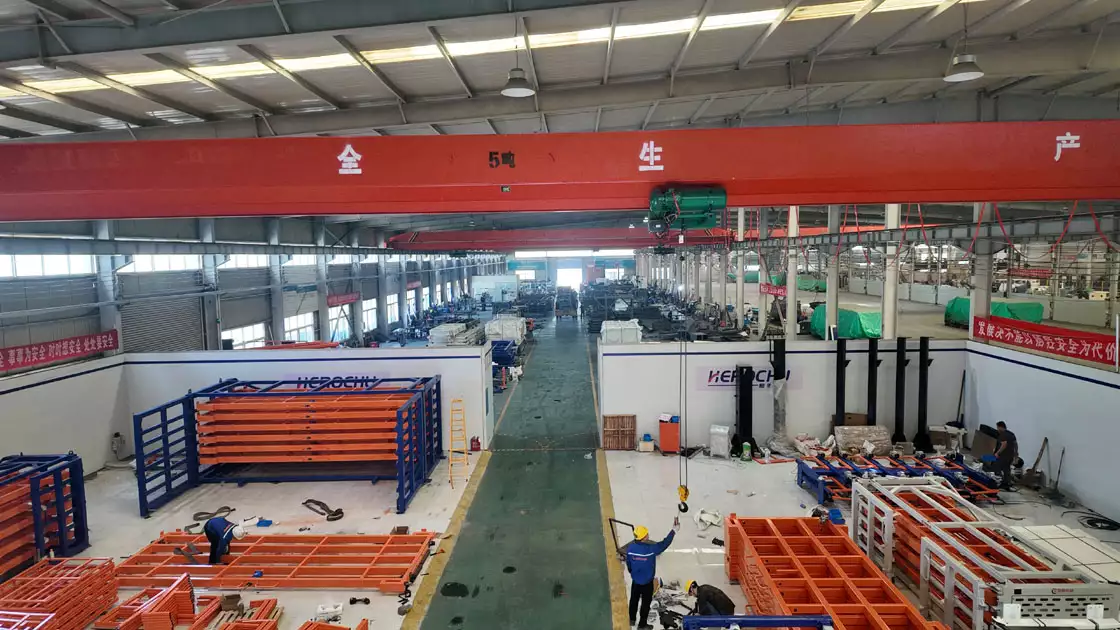
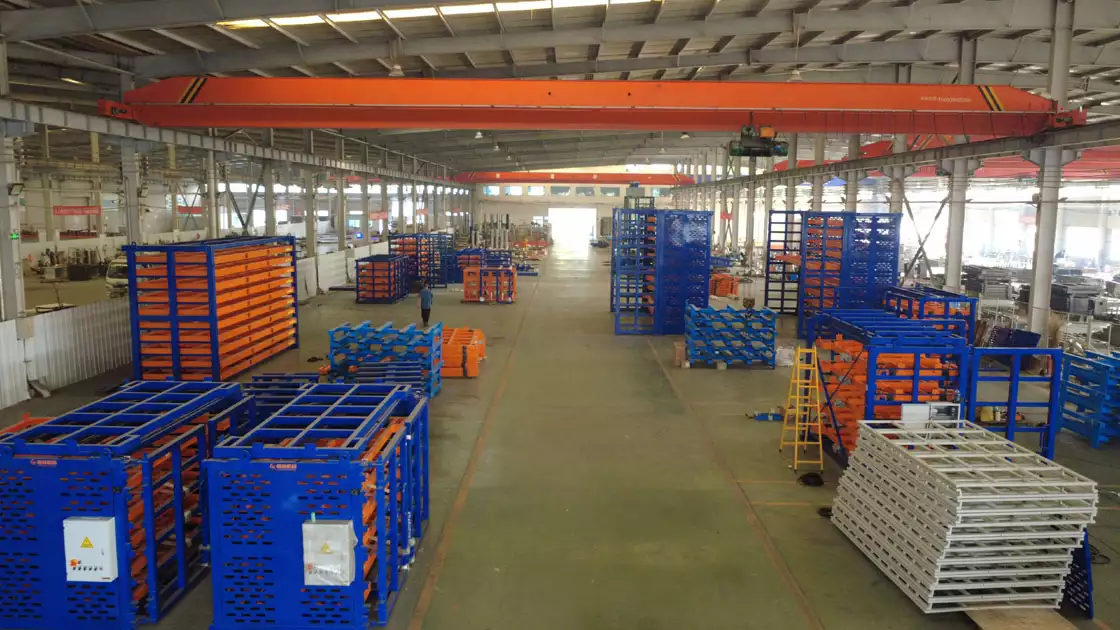
Herochu has always been adhering to the market-centric approach to meet customer requirements to the maximum extent, and the business philosophy of “creating brands with heart and gaining reputation with sincerity”. It provides customers with high-quality products and services with rigorous military quality, professionalism, and excellence, and has won unanimous praise in the Chinese aerospace, Chinese weapons, Chinese railways, automobile manufacturing, engineering machinery, non-ferrous metal titanium alloy and other industries.
Factory

Hot Selling Machines
-
Automatic Sheet Metal Storage System
Automated Multi-Level Plate Depot with Robotic Retrieval for Laser and Punch Fabrication
Read moreRated 0 out of 5 -
Automatic Sheet Metal Storage System
Smart High-Density Vertical Storage Carousel with Auto-Feeding for Laser Cutting
Read moreRated 0 out of 5 -
Automatic Sheet Metal Storage System
Intelligent 3D Automated Warehouse Rack for Steel Plate Storage
Read moreRated 0 out of 5 -
Automatic Sheet Metal Storage System
AI-Enabled Automated Sheet Metal Storage System for Laser Cutting Production
Read moreRated 0 out of 5 -
Sheet Metal Storage Systems
Sheet Metal Storage Racking System for Plasma Cutting Stations
Read moreRated 0 out of 5 -
Sheet Metal Storage Systems
Sheet Metal Stack Systems for Laser Cutting Stations
Read moreRated 0 out of 5 -
Roll out sheet metal racks
Roll-Out Sheet Metal Racks for Laser Cutting Center
Read moreRated 0 out of 5 -
Heavy duty sheet metal storage racks
Large Heavy Sheet Metal Storage for Metal Fabrication Shop
Read moreRated 0 out of 5
Related products
-
Heavy duty sheet metal storage racks
Hand-cranked Pull-out Carbon Steel Sheet Metal Storage Racks
Read moreRated 0 out of 5 -
Heavy duty sheet metal storage racks
Aluminum Sheet Storage Rack: Heavy-Duty Roll-Out Shelving Units
Read moreRated 0 out of 5 -
Heavy duty sheet metal storage racks
Modular sheet metal storage system for large quantities of flat goods
Read moreRated 0 out of 5 -
Heavy duty sheet metal storage racks
Heavy-Duty Multi-Layer Pull-Out Steel Plate Rack Forklift Drawer Type Factory Stacking Racks & Shelves
Read moreRated 0 out of 5
Product Categories