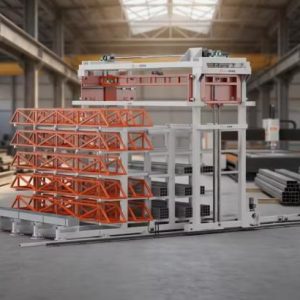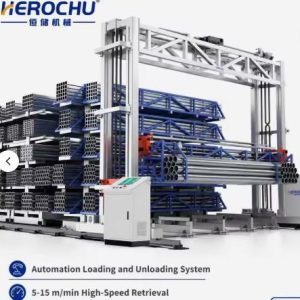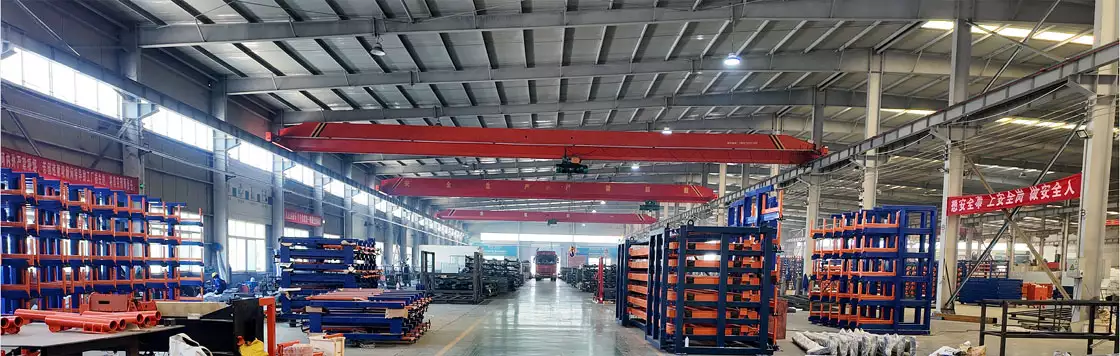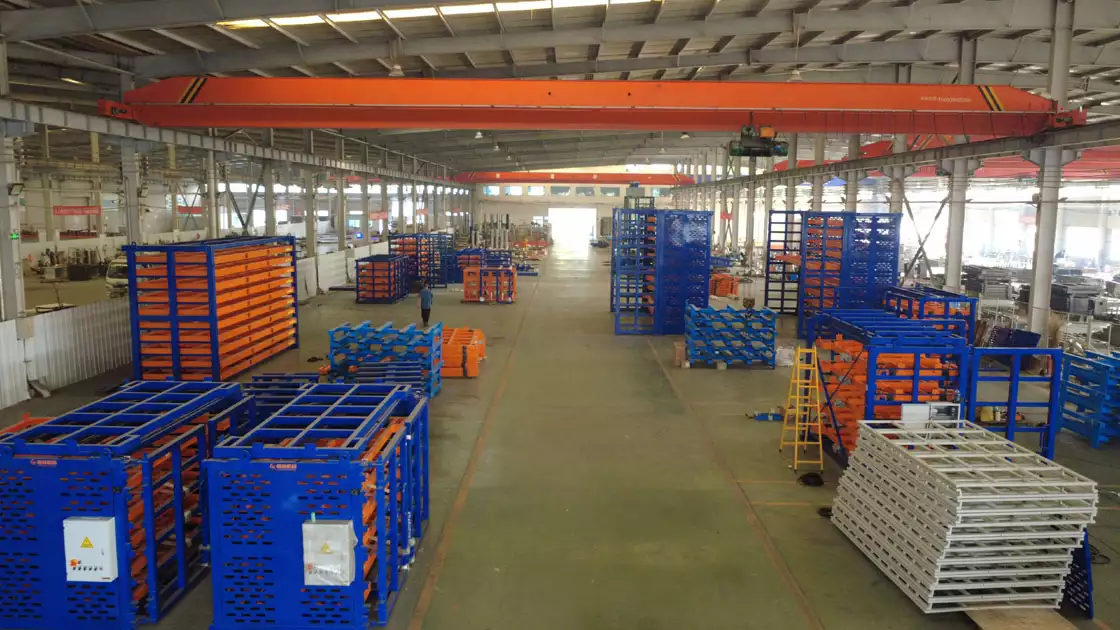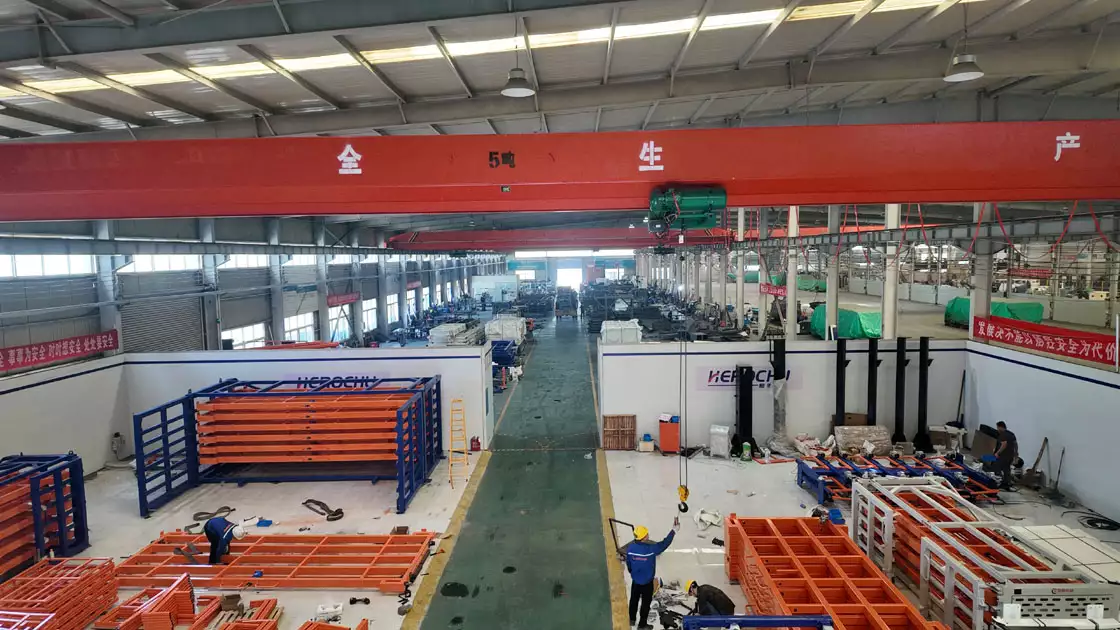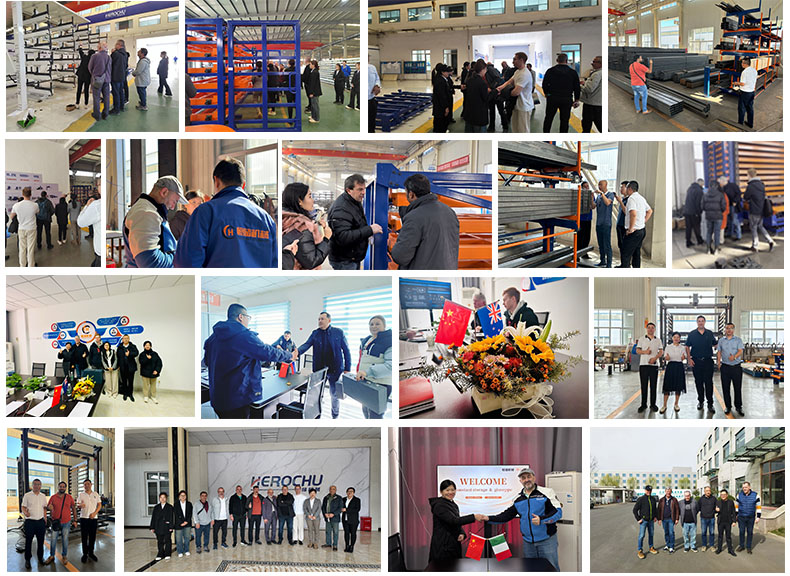
The hand crank roll-out steel storage rack system occupies a specific niche in industrial material handling. It is not powered automation, and it is not simple shelving. It sits between those extremes—a mechanical system that uses gear reduction and precision rollers to make multi-ton sheet metal accessible to a single operator without electrical power, compressed air, or complex controls. Understanding how this system works, and why it works, helps fabrication managers evaluate whether it fits their operation.
The Engineering Behind the Crank
At the heart of every Herochu roll-out rack is a gear and pinion drive. The operator turns a hand crank, which rotates a pinion gear engaged with a linear gear rack mounted along the drawer carriage. A reduction ratio—typically 1:1.5—multiplies the input torque, meaning the force required at the handle is a fraction of the force needed to move the drawer directly.
This mechanical advantage is what allows a single person to roll out a drawer loaded with 3 to 5 tons of steel. The operator supplies rotation, not lifting force. The gear system converts that rotation into controlled linear motion. There is no pushing, pulling, or prying at the material itself.
Industrial-grade pillow block bearings support the crank shaft and maintain gear alignment under side thrust. This detail matters over thousands of cycles. Without proper shaft support, the gear engagement degrades, backlash increases, and the crank develops play. Herochu specifies pillow block bearings to keep the drive mechanism stable throughout its service life.
Q235B Steel and Dual-Beam Construction
The main frame of every Herochu rack is constructed from Q235B high-strength steel. This material grade offers a minimum yield strength of 235 MPa and tensile strength between 375 and 500 MPa. It is chosen for its strength-to-weight ratio, weldability, and consistent performance under cyclic loading.

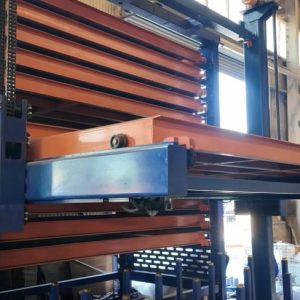
The dual-beam design distributes the drawer load across two parallel beams rather than concentrating it at a single midspan point. Beam deflection under full load drops roughly by half compared to a single-beam arrangement. The gear rack drive maintains its engagement geometry because the mounting surface stays stable. When a drawer extends outward, the load center shifts from inside the frame to a cantilevered position in the aisle. The dual-beam structure manages this transition by keeping the roller track supported at both the front and rear of the frame.
Guided Roller System and Controlled Motion
Each drawer carriage rides on heavy-duty solid steel load rollers and lateral guide wheels. The load rollers bear the weight; the guide wheels prevent the drawer from skewing as the load center moves outward. This guided roller system serves two purposes: it ensures smooth operation, and it protects the rack structure from cumulative wear caused by misaligned drawer movement.
The motion is smooth and predictable. There is no risk of sudden jerks or runaway drawers. This controlled extension is important when working near high-value equipment like laser cutting machines, where an uncontrolled drawer could cause collision damage.
Full Extension and Crane Integration
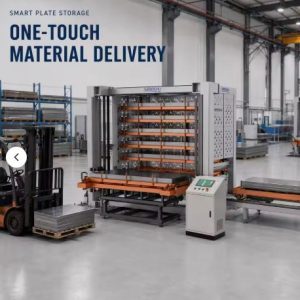
Each drawer extends 100 percent of its travel, clearing the rack frame entirely. This creates an unobstructed vertical path for overhead crane loading. The crane hook or vacuum lifter descends directly onto the exposed sheet without risk of snagging on the rack structure. The operator stands at a safe distance, managing the lift without placing hands or feet near the load.

Forklift compatibility follows the same logic. The drawer presents the sheet in an open area, and the forklift places or removes material without threading through narrow openings. The rack becomes an active part of the material handling process, not just a passive container.
Model Range and Load Classes
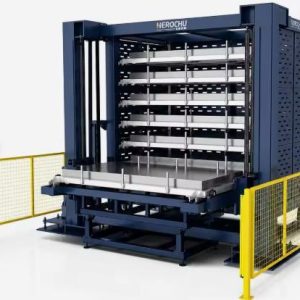
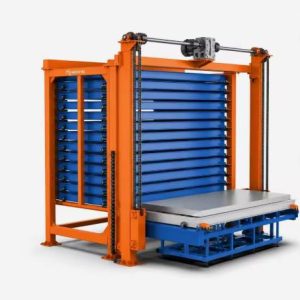
The Herochu HC-B series divides into two load classes based on per-tier capacity. The 3-ton class includes the HC-B2513-63 for 2500×1300 mm sheets, the HC-B3015-63 for 3000×1500 mm sheets, and the HC-B4015-63 for 4000×1500 mm sheets. The 5-ton class includes the HC-B4020-65 for 4000×2000 mm sheets and the HC-B6020-65 for 6000×2000 mm sheets.
Both load classes share the same dual-beam Q235B frame architecture. The difference lies in beam section dimensions, roller capacity, and connection detailing—all scaled to the target load. The number of layers is customizable, with 6 layers as a standard configuration. Clear space per tier is 120 mm as standard and can be adjusted.
Safety Systems
Safety in heavy material handling is not optional. Herochu incorporates multiple safeguards into the roll-out rack design.
Automatic locking pins engage when a drawer reaches its extended position. The operator does not need to remember to lock it; the mechanism is passive. The pin holds the drawer rigid against accidental retraction while the operator accesses material—the moment of highest risk in any drawer storage system.

Anti-tip mechanisms prevent the rack from tilting forward when a loaded drawer is extended. The rack must be anchored to a concrete floor with sufficient compressive strength to resist tipping forces. Drawer limiters and mechanical stoppers prevent over-extension beyond the designed travel distance.
Surface Treatment and Service Life
The rack surface must survive the same harsh environment it operates in. Herochu applies a multi-stage treatment: sandblasting to prepare the substrate, anti-oxidation treatment to inhibit corrosion initiation, and electrostatic powder coating or hot-dip galvanizing for the final protective layer. Under normal workshop conditions, the expected service life of the rack exceeds 15 years.
Maintenance Requirements
The hand crank roll-out system requires minimal maintenance. Ball bearing rails need lubrication every six months with a lithium-based grease. The coated surface cleans easily with mild detergent and water. Welds should be inspected annually for any signs of stress. Damaged rails are modular and can be replaced without welding.
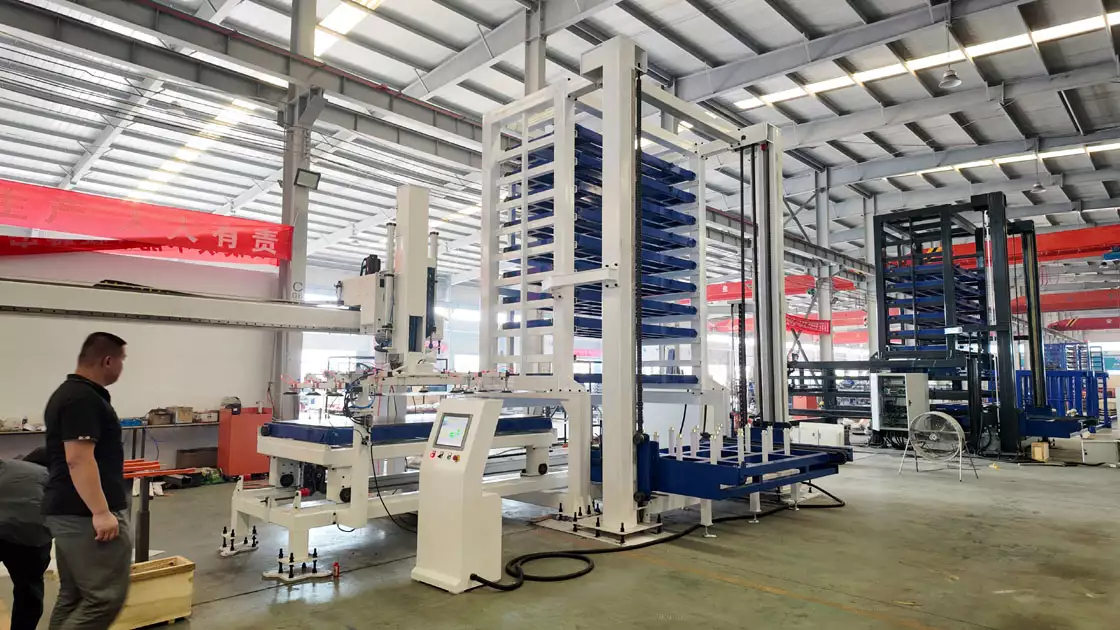
Compared to powered automation, the manual crank system offers mechanical simplicity and lower total cost of ownership. No motors, no sensors, no software updates. Just robust steel and precision bearings. For small and medium fabricators who cannot justify six-figure automated systems but still need high-density storage, the hand crank roll-out steel storage rack system is a practical solution.