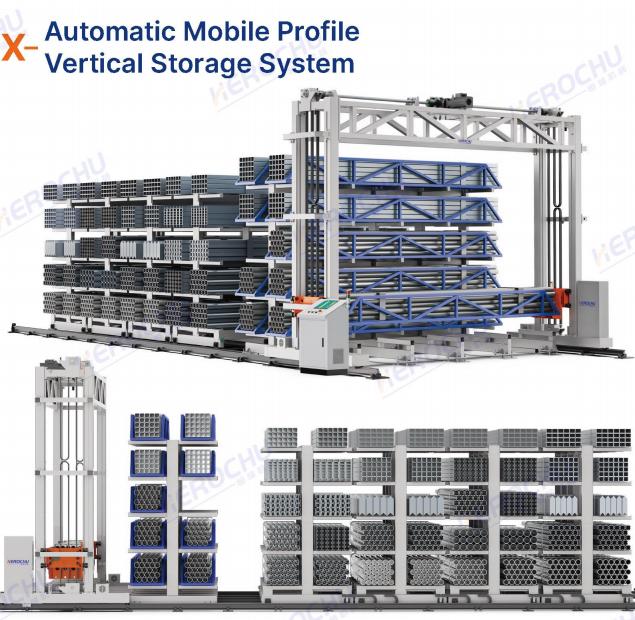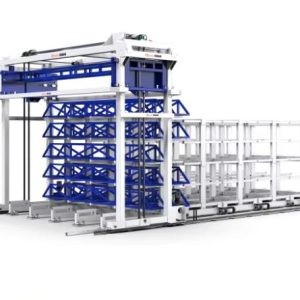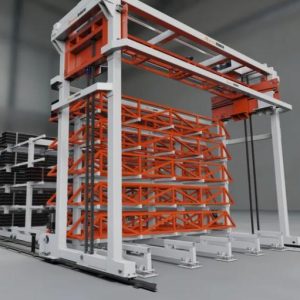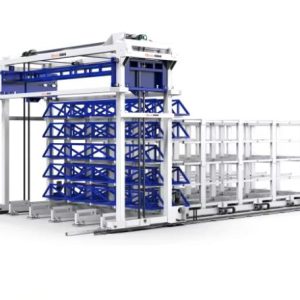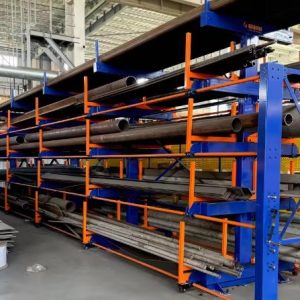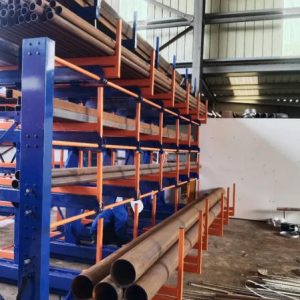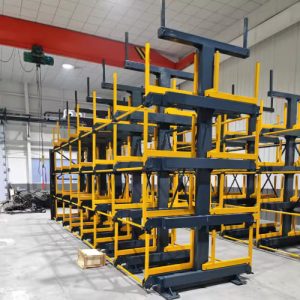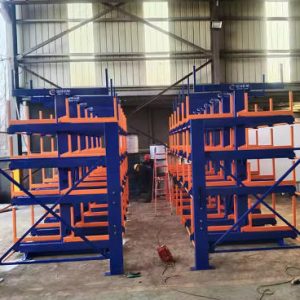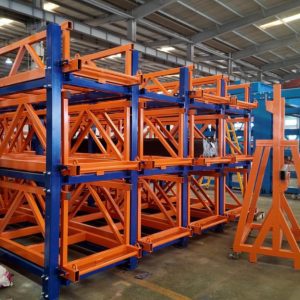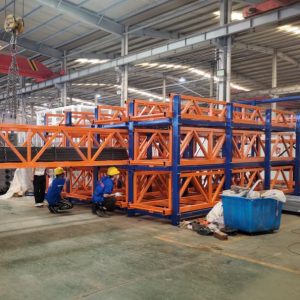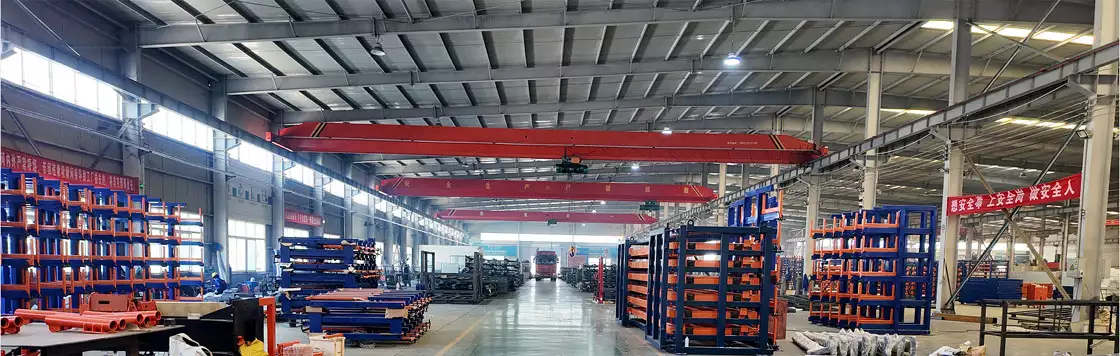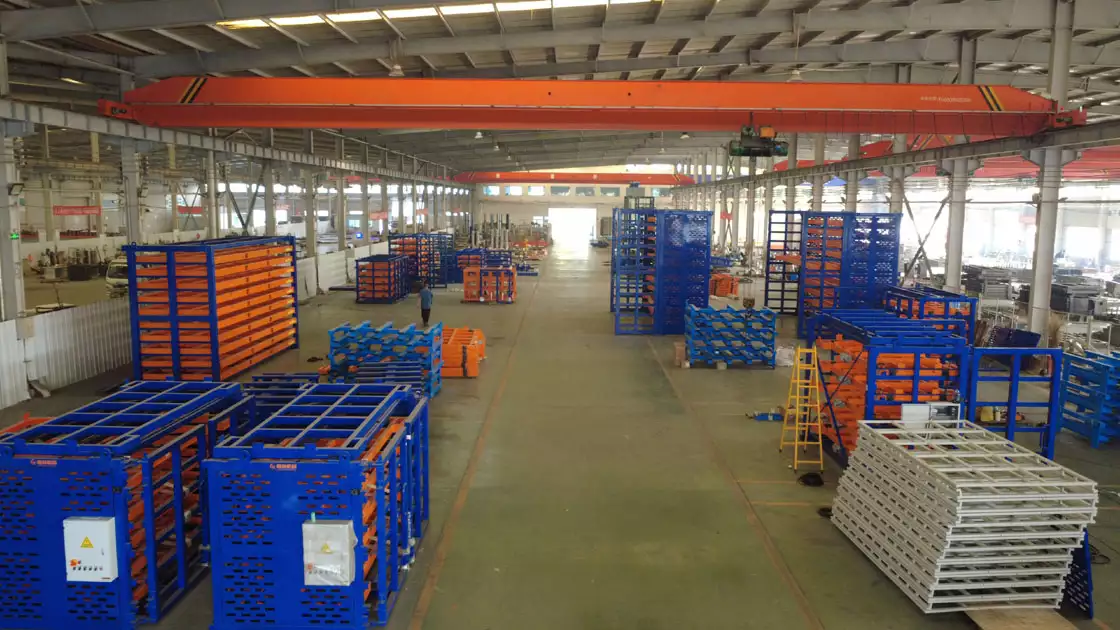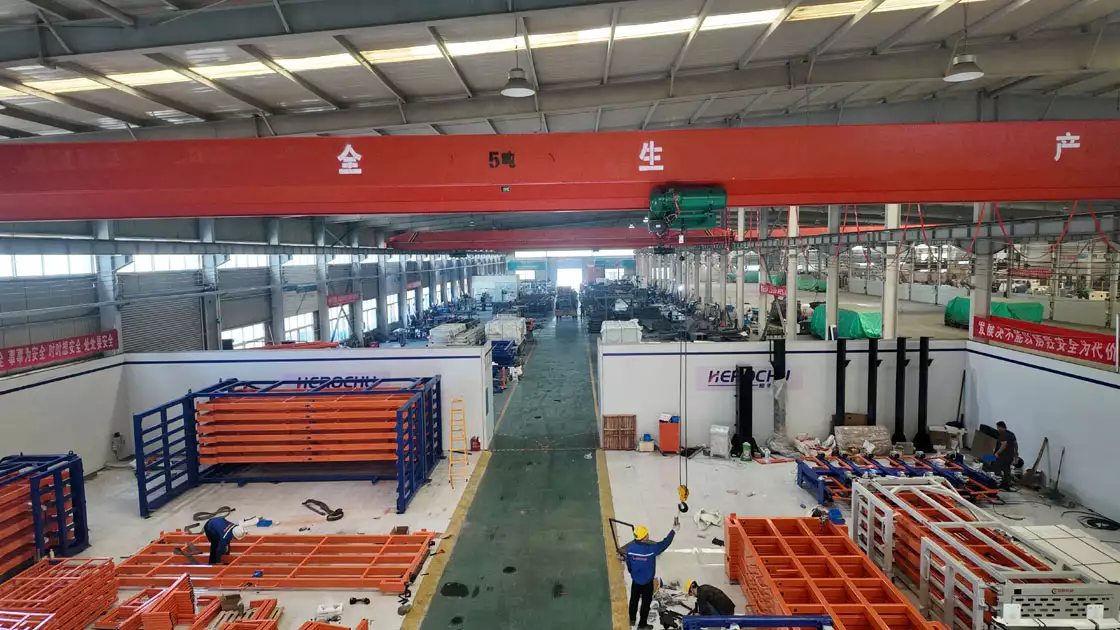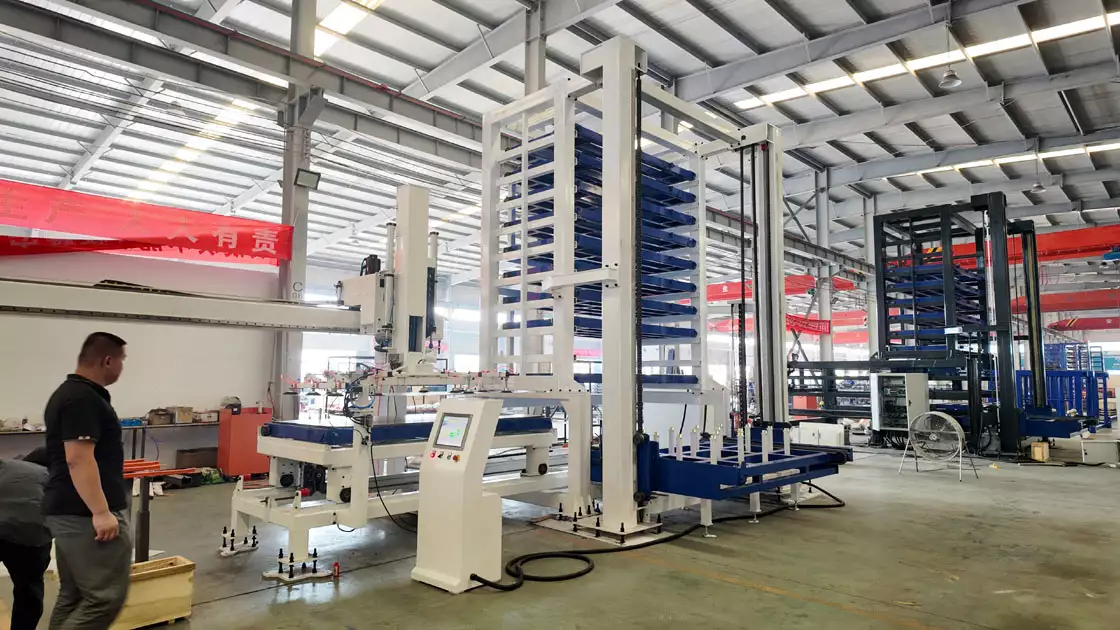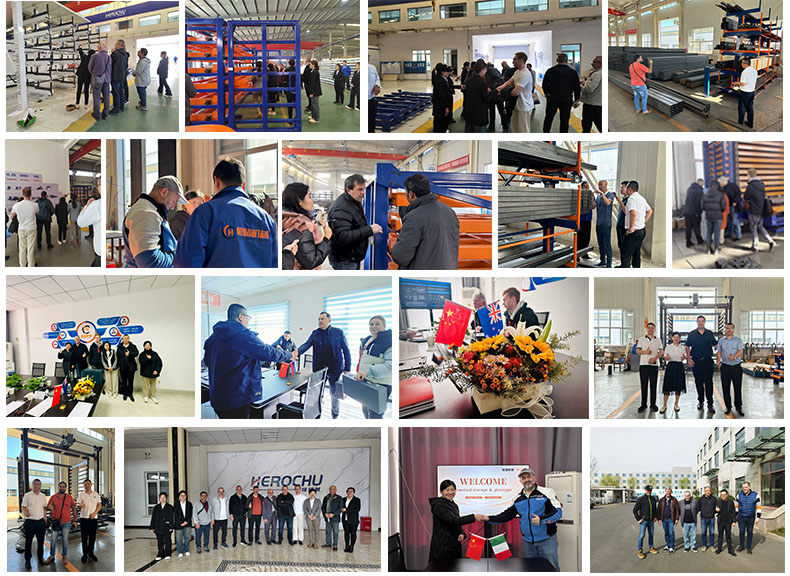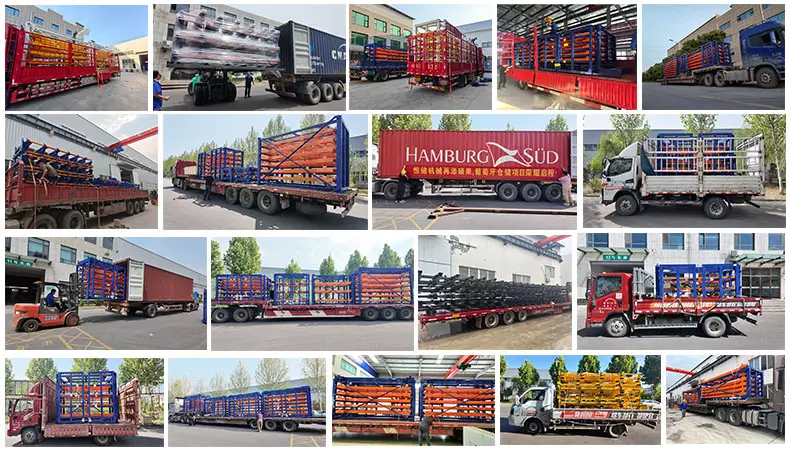
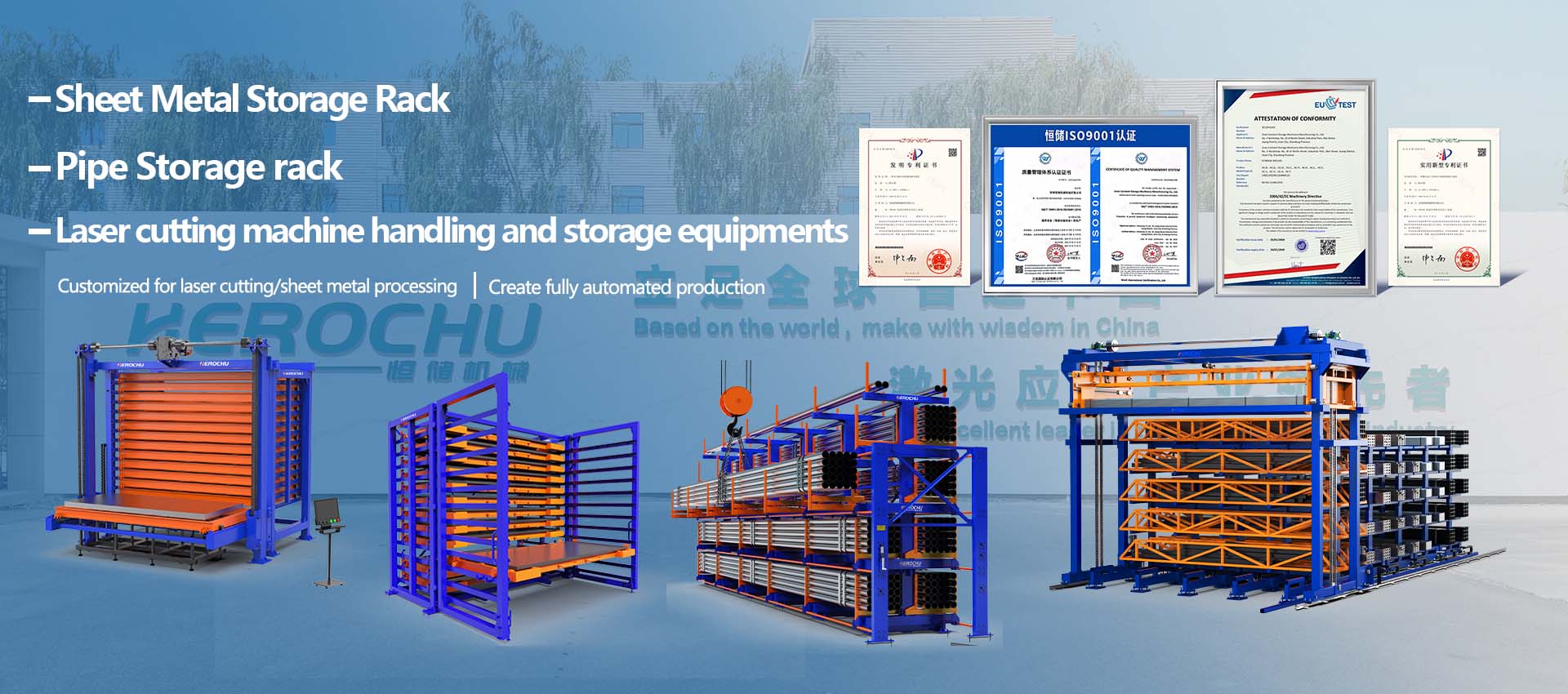
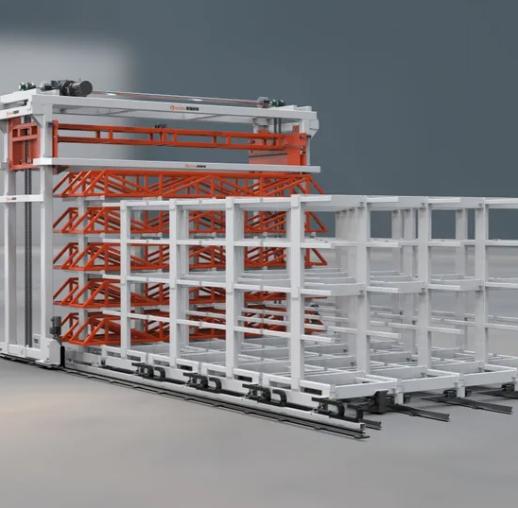
An automated gantry ASRS for metal fabrication is a rail-mounted crane that travels along a bank of vertical racks, lifts long profiles, pipes or beams with a customized fork, and delivers them to a cutting station or outfeed under WMS and WCS control. It replaces the forklift-and-cantilever routine with a machine that reaches any pocket in the row without needing an aisle in front of it.
Herochu engineers these systems around a plant’s actual material mix rather than a fixed catalogue tower. The storage block ends up behaving like a machine tool: defined input, known inventory, specific bundle on request.
How a gantry ASRS differs from a stacker crane
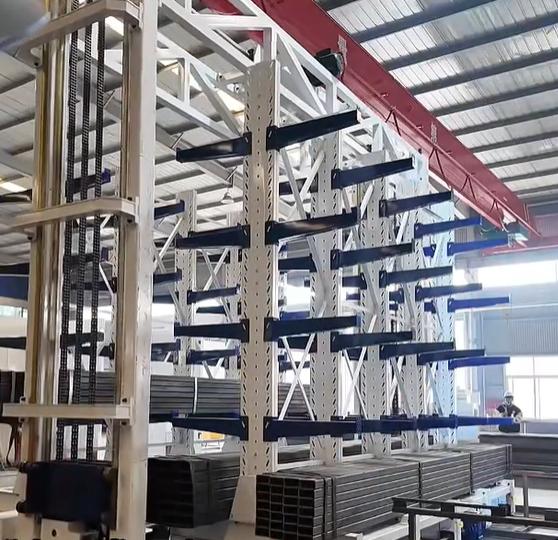
A stacker crane runs in a narrow aisle between two rack faces and serves both sides from one track. A long-material gantry works differently. It runs on floor-mounted rails alongside the rack row, so every rack face presents toward a single shared corridor. One machine serves the whole bank.
That layout choice is what makes density possible with 6 m to 8 m loads. Material lies across the rack width instead of along it, layers stack vertically, and the only floor consumed by handling is one rail corridor plus the outfeed zone.
Gantry motion: what the numbers mean in practice
Three specifications decide how the machine feels to the operators who depend on it.
Travel at 5 to 30 m/min. A 40 m row crossed at 20 m/min takes two minutes; at 30 m/min, about eighty seconds. At sixty picks a shift that gap is visible, which is why drive sizing should follow the real retrieval pattern rather than a headline maximum.
Lifting at 5 to 15 m/min. Vertical motion is slower because acceleration loads the frame and the bundle. A 5,000 kg beam accelerated too hard does not merely sway — it loads rack arms unevenly, and that is how pockets wear out over years.
Repeatability of ±2 mm. This is the figure that allows unmanned fork entry. Forks must slot under a bundle resting on arms with enough accuracy that sensors do not trigger a stop. ±10 mm would need vision correction on every cycle.
Capacity configurations
Herochu builds long-material gantries on three base frames, then customizes length, layers and column count.
| Model | Material length | Layers | Load per level | Columns |
|---|---|---|---|---|
| HC-X6053-8 | 6,000 mm | 5 | 3,000 kg | 8 |
| HC-X7065-10 | 7,000 mm | 6 | 5,000 kg | 10 |
| HC-X8085-10 | 8,000 mm | 8 | 5,000 kg | 10 |
Gantry travel is 5–30 m/min, lifting 5–15 m/min, repeatability ±2 mm across all three. Position capacity runs from 120 t on the 6 m frame to 400 t on the 8 m frame — useful arithmetic for early layout work, though practical capacity depends on bundle shapes and layer clearance.
Gantry ASRS versus cantilever racking with forklifts
| Factor | Cantilever + forklift | Automated gantry ASRS |
|---|---|---|
| Aisle | One per picking face | One shared corridor |
| Retrieval | Manual, two people | Machine-driven |
| Inventory | Paper or periodic count | Live WMS transaction |
| Height use | Limited by mast and visibility | Full tower, layer by layer |
| Damage risk | Load, rack and truck contact | Guided forks, anti-collision |
| Labor | Driver plus spotter | Supervisor, maintenance |
None of this makes forklifts disappear. Trucks still move material from receiving to infeed and from outfeed to the next process. What changes is the internal storage loop, where most handling time and most damage occur.
Safety and control architecture
Long loads swing, and a gantry carrying 5 t at height must be predictable. Four protections matter: anti-collision sensing on travel and lift axes, independent of the WCS position model; mechanical end stops that keep the gantry captured during an emergency stop; interlocked access gates so the rail corridor cannot be entered while the machine is live; and load confirmation in the fork cycle, which verifies a bundle is present before a lift and absent before a store completes.
The interface is a PLC touchscreen with rack map, request queue and manual jog. Herochu keeps manual control available, because a machine movable only by software stops the plant when the software stops.
Where the system fits in fabrication
Mill bundles arrive and are received into the tower. The ERP releases a cutting list, the WMS converts it into retrieval requests, and the gantry delivers to the saw or plasma infeed. Offcuts return to short-material pockets. The tower becomes a visible buffer between purchasing and production, and Herochu sizes that buffer to the plant’s cutting rhythm.
Frequently asked questions
What is the maximum length a gantry ASRS can store? Stock frames cover 6,000 mm to 8,000 mm; longer bays are engineered per project. The practical limit is usually building length and rail cost, not the structure.
Can one gantry serve two rack rows? Yes, with the corridor between rows, though most long-material installations stay single-sided because a 7 m load needs fork-side clearance.
How is a 5,000 kg level capacity verified? By design calculation and a load test before handover. The figure assumes a distributed bundle load, so single heavy beams must be declared at quotation.
Does it work in an unheated shop? Yes. Cabinet and drive components are specified for the plant’s ambient range, and the steel structure is unaffected within normal industrial limits. Positioning is what needs checking on very long rails.
What maintenance does it need? Rail alignment checks, chain and drive inspection, sensor cleaning, and periodic verification of the position model. The WMS logs every fault for trend analysis.
The case for the machine
An automated gantry ASRS earns its place when a plant stores long material at height, retrieves it often, and cannot afford to guess what sits on the rack. Density, speed and inventory truth arrive together — because machine, racks and software were designed as one system rather than bought as three.