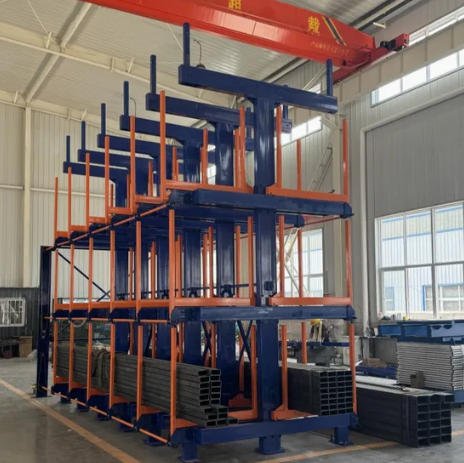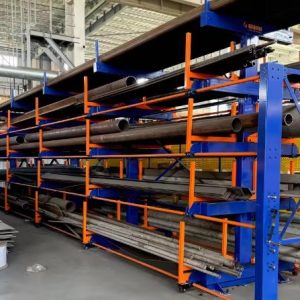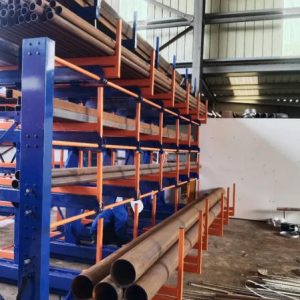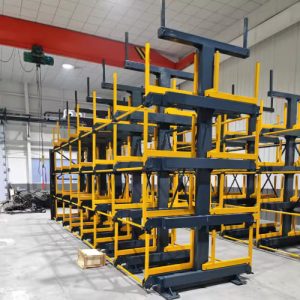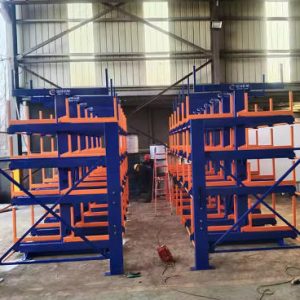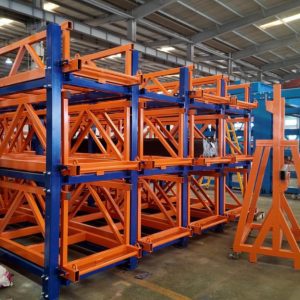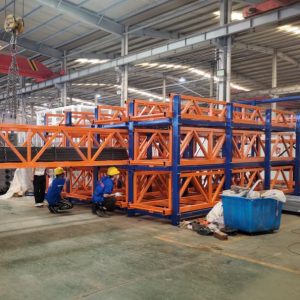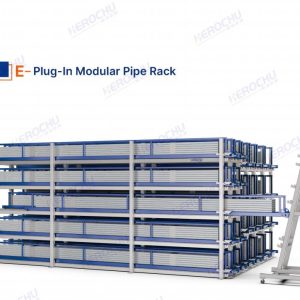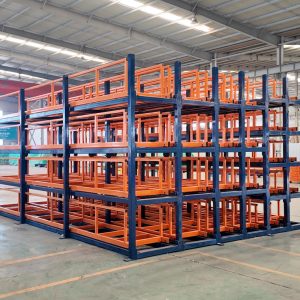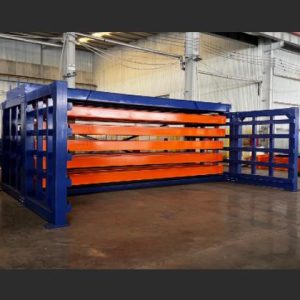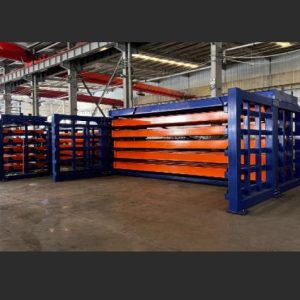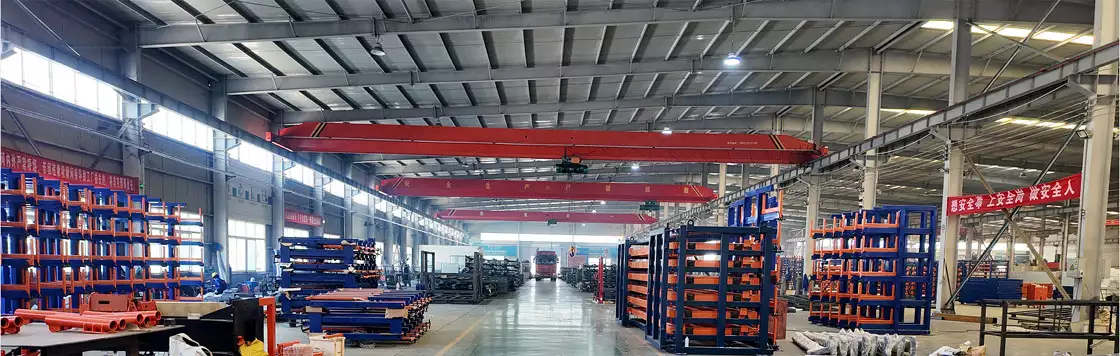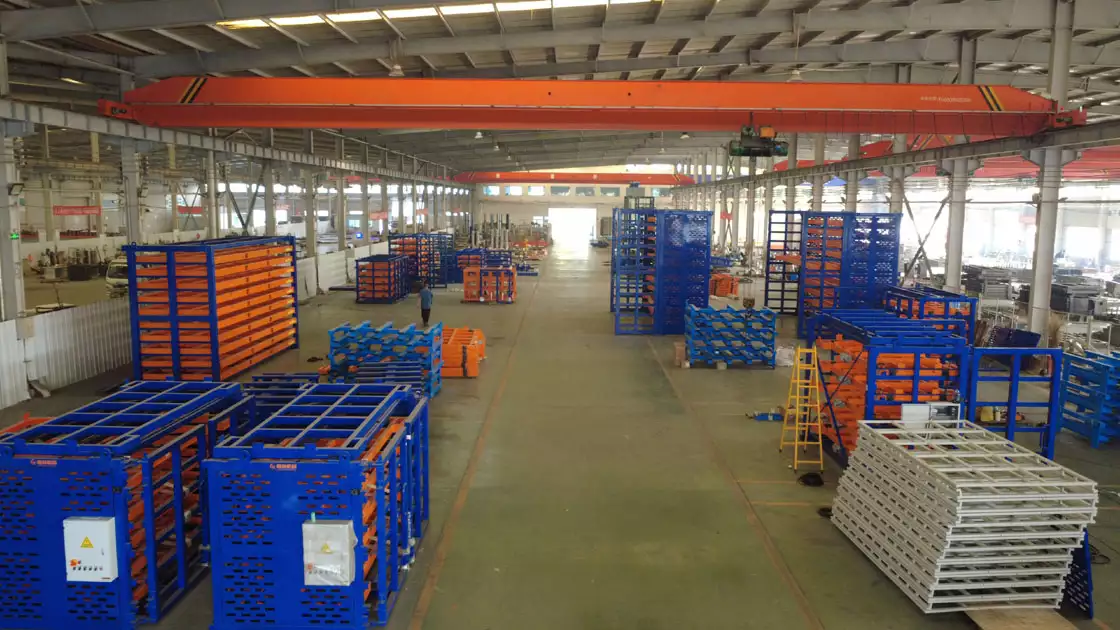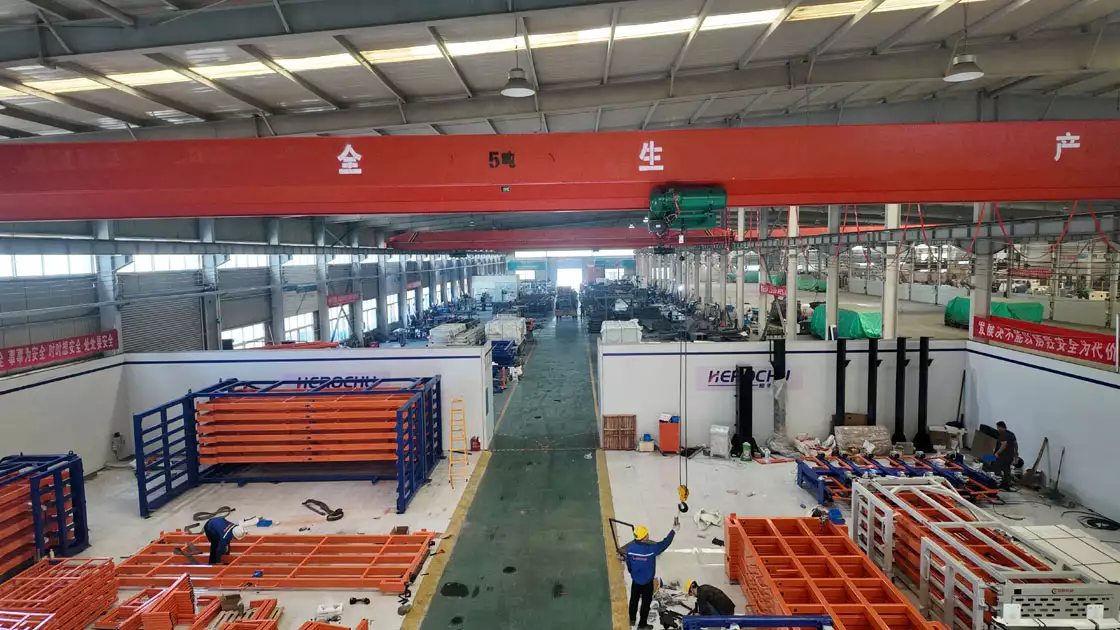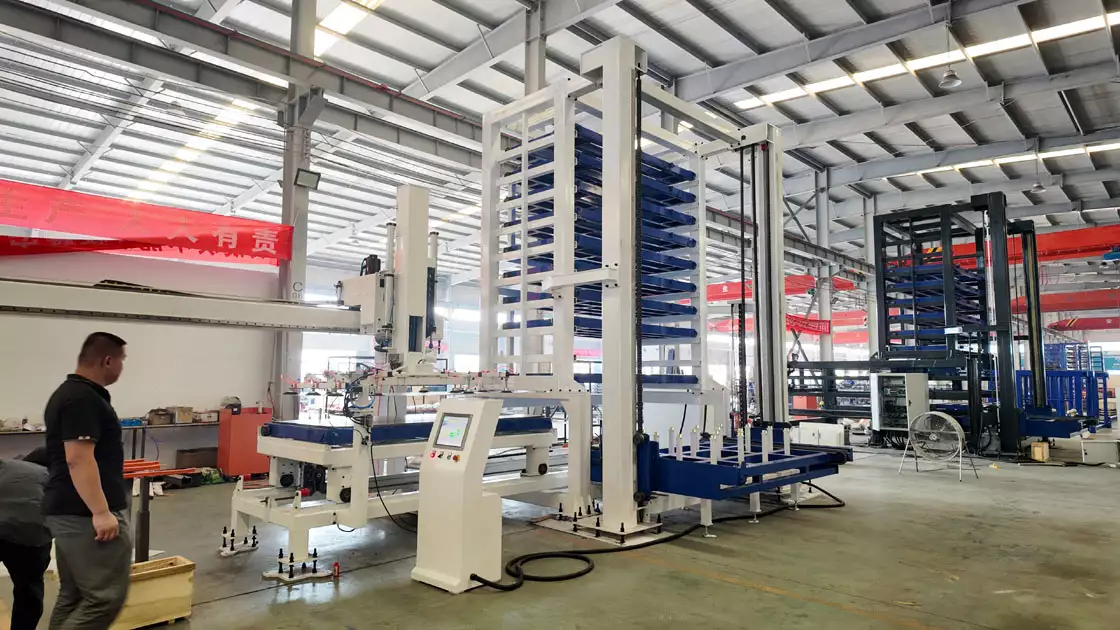
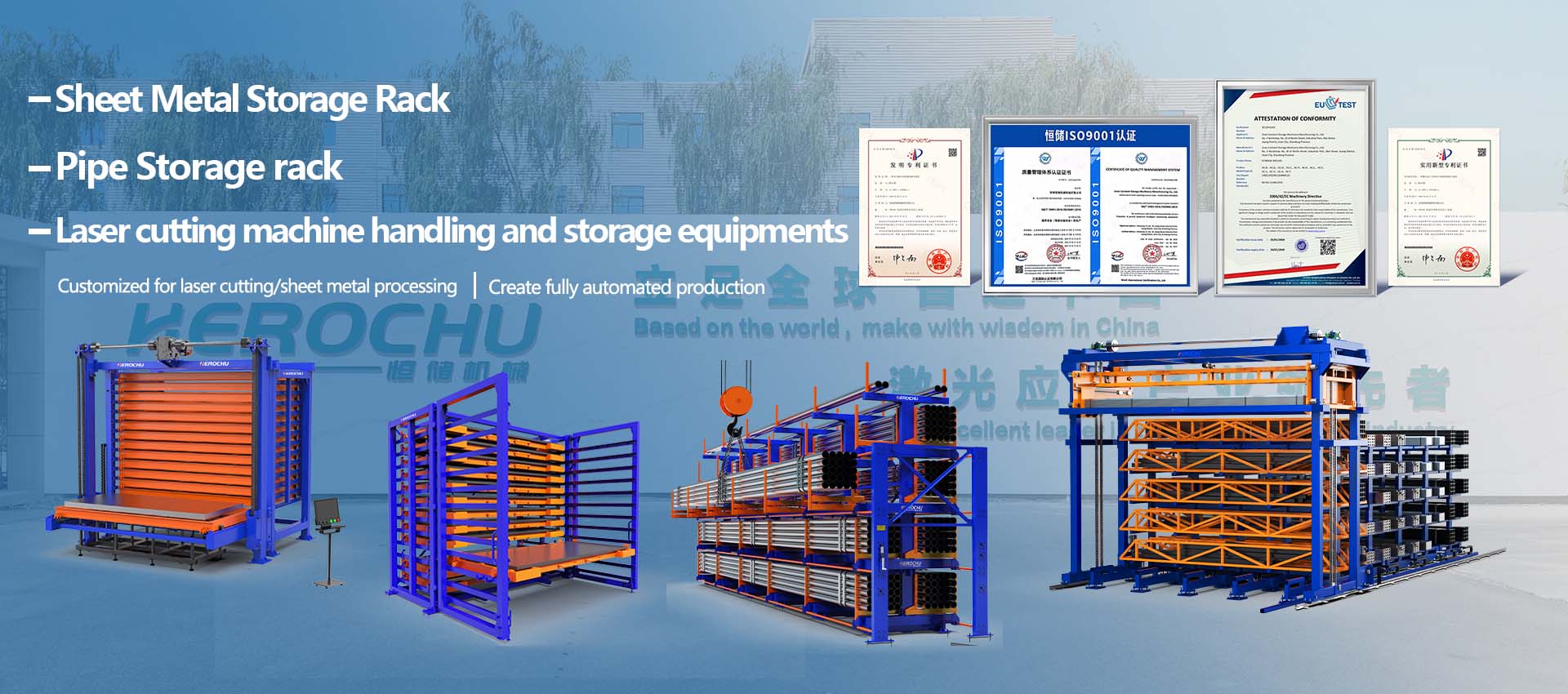
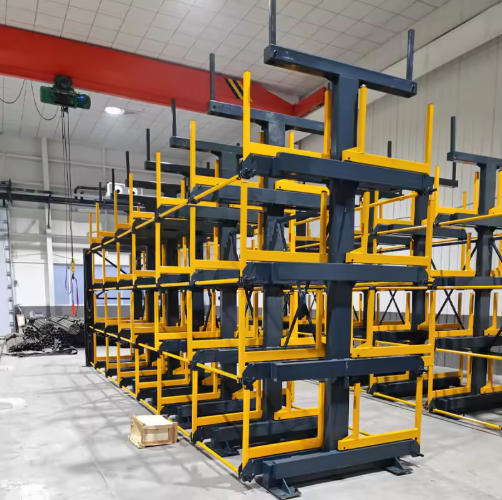
A manual telescopic cantilever racking system from Herochu stores profiles and long pipe in adjustable 5- and 6-layer bays. 100% arm extension, 3–5 t per level, CE and ISO certified.
Profile storage is a geometry problem before it is a racking problem. Angles, channels, hollow sections and long pipe share one trait: length. They differ in depth, in how they stack, and in whether they can be banded. A rack that handles all of them has to change shape, tier by tier, without losing stiffness — which is what the Herochu manual telescopic cantilever racking system does.
Quick answer: A manual telescopic cantilever racking system stores profiles and long pipe on arms that extend by crank, giving cranes vertical access to every tier. Layer count, arm pitch and clear space are customised per bay.
Telescopic arms versus fixed arms
A fixed cantilever arm is a bracket: the load sits on it and the operator works around its reach. A telescopic arm adds a travelling carriage — the arm body stays bolted to the column while an inner section extends on rollers driven by a manual crank.
The difference is where the load ends up relative to the rack face. With 100% extension, the bundle clears the tier above entirely. A crane or a forklift with a long spreader can service any level directly, including the bottom level of a six-tier bay, which is normally the hardest to reach.
Manual drive is a deliberate choice, not a cost compromise. The rack-and-pinion pair has a fixed ratio, so effort at the handle stays predictable regardless of load, and there is no motor to burn out in a dusty profiling shop, no festoon cable to snag on a crane hook, no controller to reprogram when a bay moves.
Built for the tolerance profiles actually need
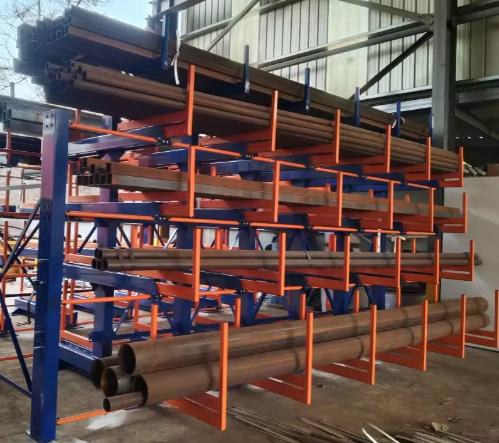
Profiles are stored by section, and section means spacing. A 5-layer bay set at 600 mm clear space suits 300 mm channels and 200 mm hollow sections; the same bay set at 900 mm suits stacked bundles of angle.
Herochu builds every bay with adjustable arms on a pitched column, so pitch changes on site with hand tools. Layer count is a build parameter, not a fixed frame — a 4-layer bay with generous openings and a 7-layer bay with tight ones come off the same design.
| Model | Material length | Max load per level | Layers |
|---|---|---|---|
| HC-G6053S | 6,000 mm | 3,000 kg | 5 |
| HC-G6053 | 6,000 mm | 3,000 kg | 5 |
| HC-G9065 | 9,000 mm | 5,000 kg | 6 |
| HC-G12065 | 12,000 mm | 5,000 kg | 6 |
Vertical utilisation is where the money is
Warehouses storing long profiles run out of height before they run out of floor. A single-tier ground rack holding 12 m beams uses about 1.5 m of the 9 m available under the crane rail. Five or six tiers at 600 mm clear openings put the same footprint to work across the full envelope, and most installations recover 40% to 50% of capacity without adding floor.
Two constraints govern height. The crane hook path must clear the top tier with sling and spreader fitted. Slab loading also needs checking: at six tiers a 5,000 kg level concentrates heavy point load at four base plates, so a suspended floor needs an engineer’s confirmation.
Framing details
Dual-beam crossbar. Each pair of arms is tied by two beams rather than one tube. Under an eccentric load at the arm tip, a single beam twists and transfers that twist into the column weld. Two beams share it, and the bay stays square.
Independent compartments per tier. Both sides of each level are closed by the frame, so a bundle cannot migrate into the next slot during a lift — the detail that lets a light extrusion bay sit beside a heavy channel bay.
Q235B and Q355B. Standard frames use Q235B; the 5,000 kg tiers use Q355B for the upright and arm root. Both ship with mill certificates, the only way a buyer can verify grade after delivery.
Powder coating. Electrostatic powder coat resists cutting oil, coolant and the abrasion that comes with sliding bundles.
Planning a layout around the system
The sequence that works: list every profile family with its longest length, heaviest bundle and stack height. Assign the two or three highest-turnover families to tiers at 800–1,200 mm working height, where the crank is easiest and the hook path shortest. Then set aisle width from the crane span plus hook drift, not from forklift turning radius.
On a 60 m run, a typical Herochu layout is eight free-standing frames at 3 m centres with a 3.2 m service aisle in front — roughly 48 crane-accessible positions across six tiers, with the forklift lane left free for transport.
When telescopic makes less sense
If a warehouse holds four profile families and turns them weekly, fixed-arm cantilever racking costs less and does the job. Under 3 m, a pallet rack or drawer system fits better, because cantilever geometry stops paying at that length.
Telescopic extension earns its cost when material runs over 6 m, mixed sections must share a bay, and handling rules out horizontal extraction. The alternative there is usually an automated vertical system at several times the capital cost.
Specification summary
Profile storage rewards a rack that adapts. The Herochu manual telescopic cantilever system keeps the frame heavy — Q235B or Q355B, dual-beam crossbars, tested base plates — and puts the flexibility where it costs nothing structurally: arm pitch, layer count and stopper type. Buyers who plan the layout around crane access rather than forklift reach usually find payback arrives inside the first year.