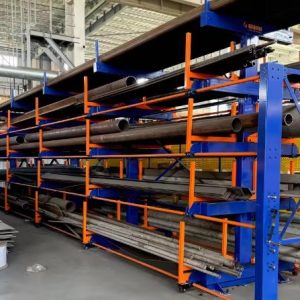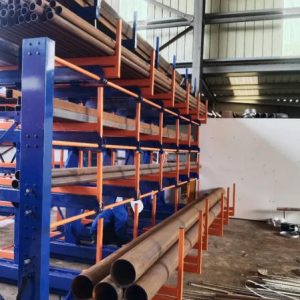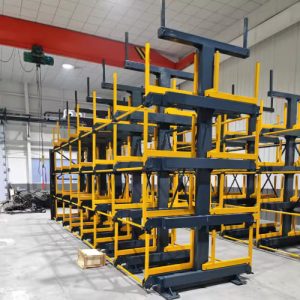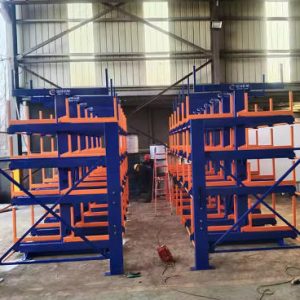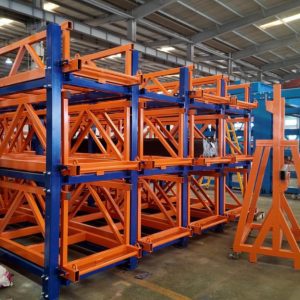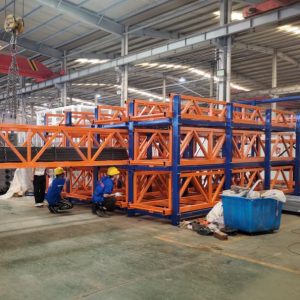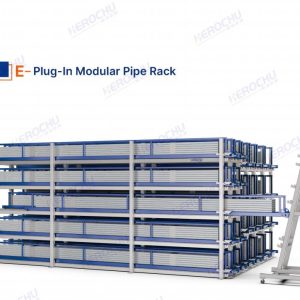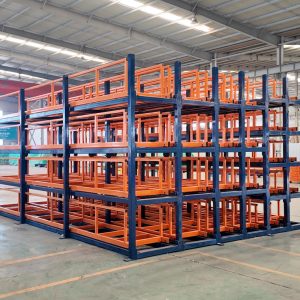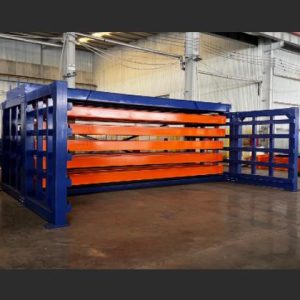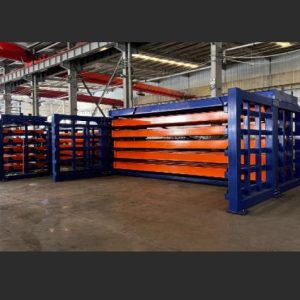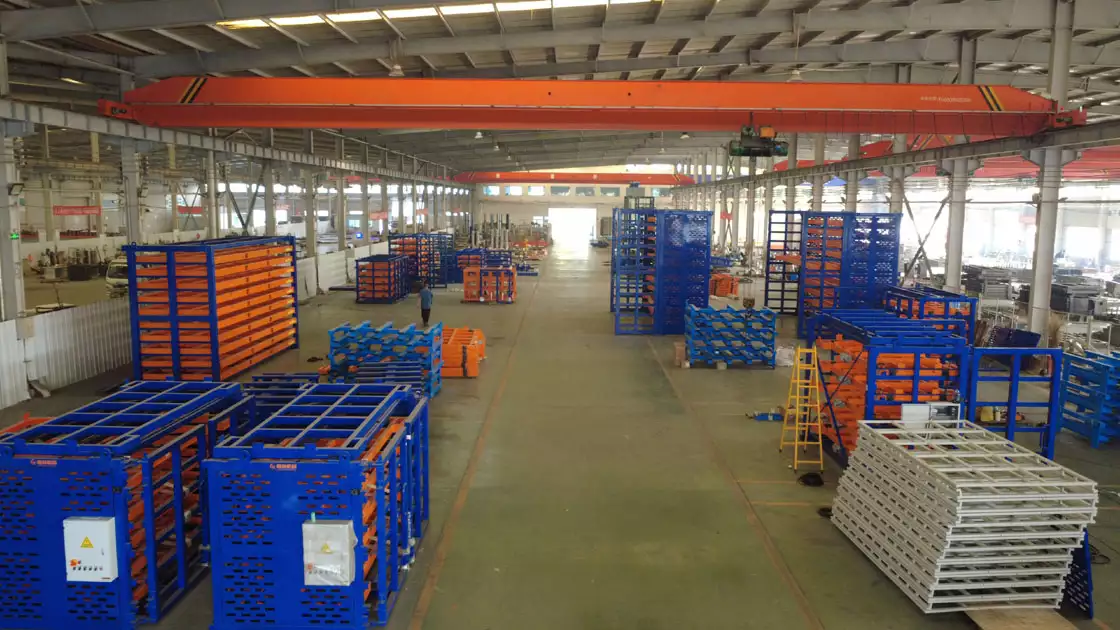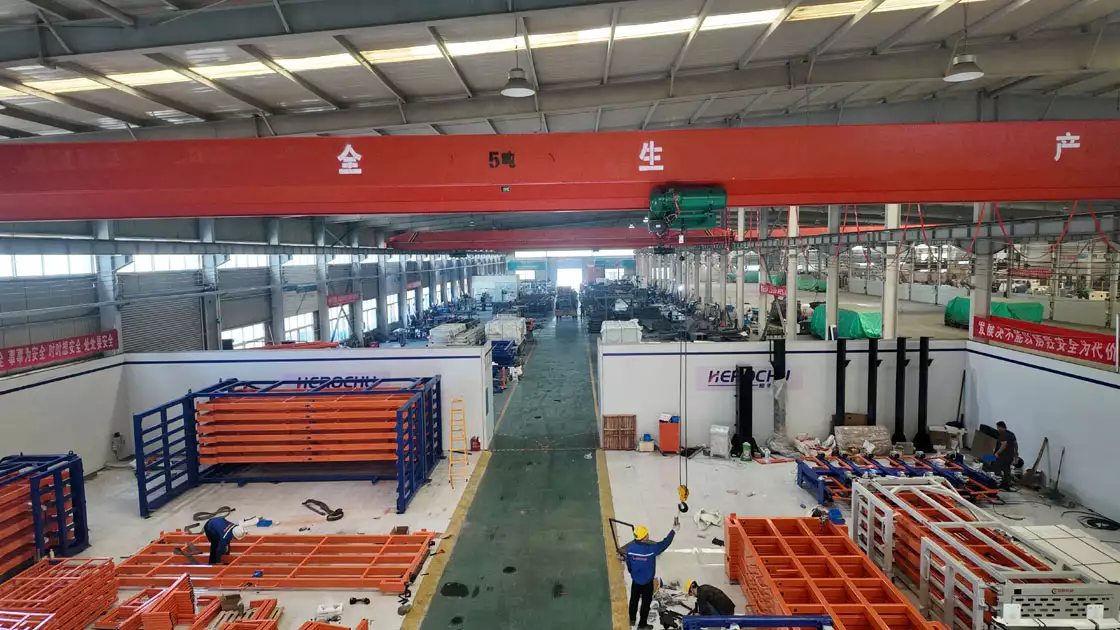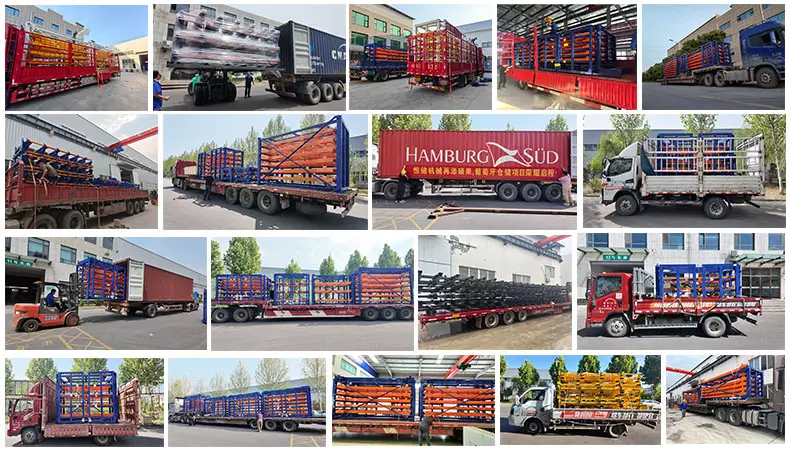
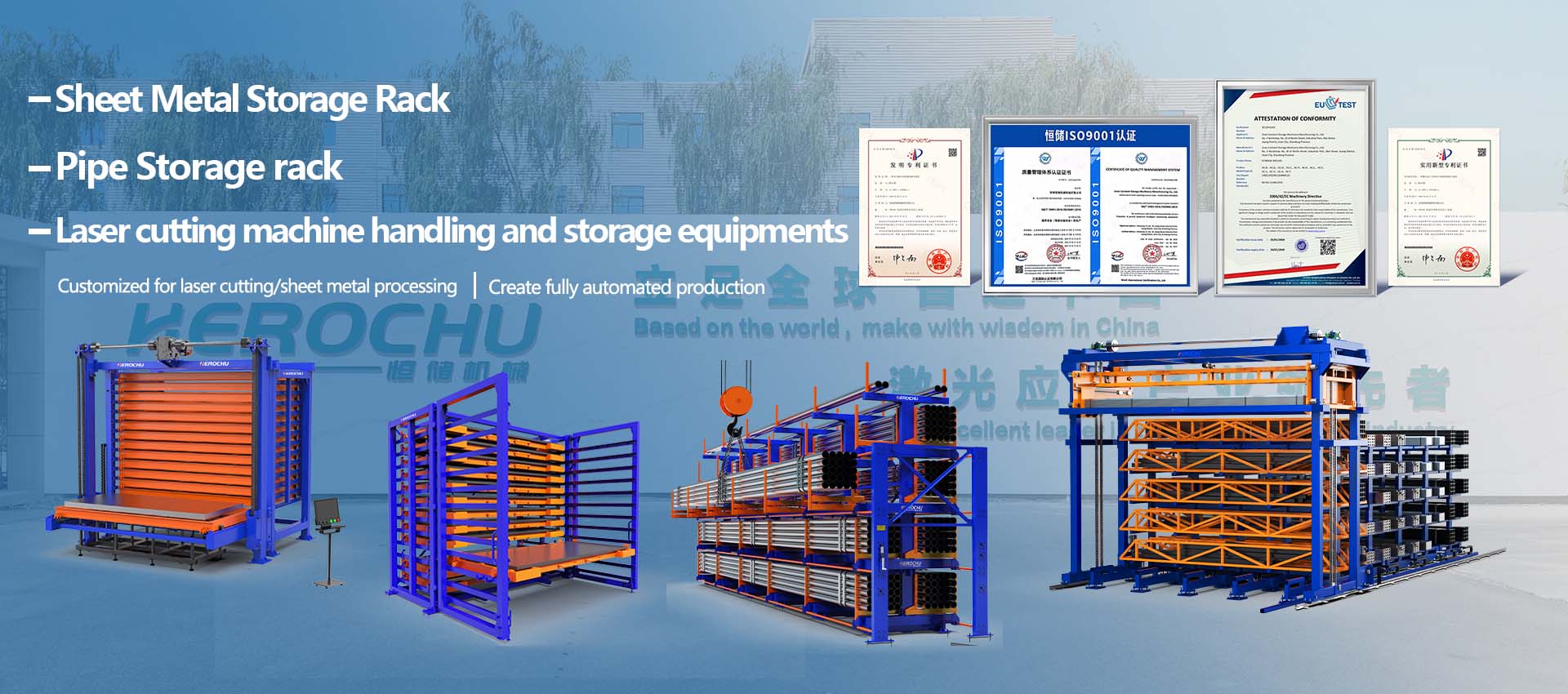
Herochu full-extension crank-out steel storage racks bring every bundle out to the crane. 100% arm travel, 3,000–5,000 kg per level, Q235B frame, CE and ISO 9001 tested.
Most racking specifications describe what a rack holds. Far fewer describe the moment of lifting, where the labour, the damage and the injuries actually occur. A full-extension crank-out steel storage rack is designed around that moment: the bundle comes to the lifting point instead of the lifting equipment going to the bundle.
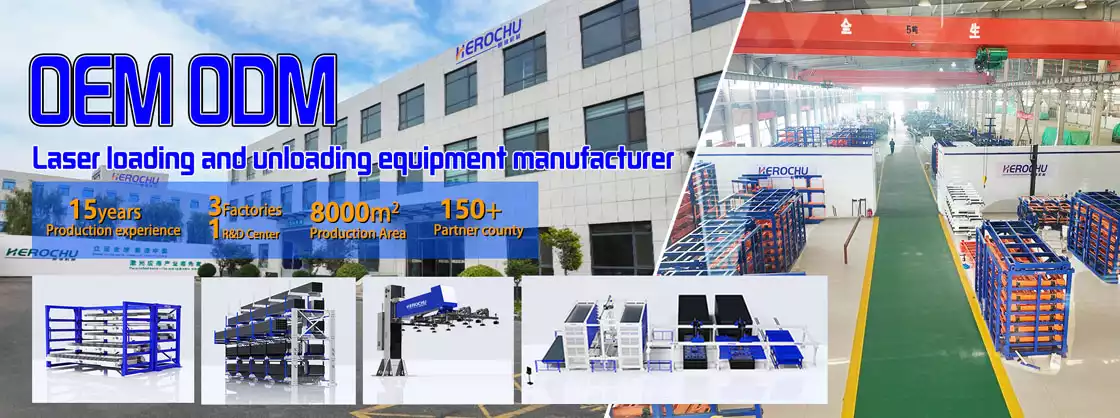
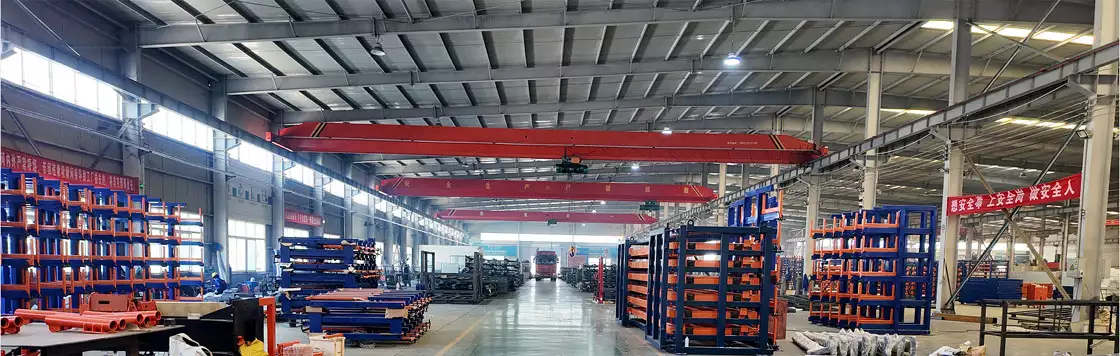
Herochu builds this frame for steel distribution centres, fabrication shops and industrial bar and pipe handling operations where a single bay has to serve both a crane and a forklift without compromise.
Quick answer: A full-extension crank-out storage rack extends each arm the full length of the load by manual crank, so bar and pipe bundles clear the rack and lift vertically. Rated 3,000 to 5,000 kg per level.
What full extension means in a working bay
An arm that extends partway solves nothing. If the load still sits under the tier above, the hook cannot descend onto it, and the operator falls back on dragging. Full extension means the carriage travels until the load clears the arm above — 100% of usable arm length — so the vertical lift path is unobstructed.
In practice that changes the lift sequence from five steps to three. Conventional: position the forklift, tilt the mast, slide the bundle, drag it clear, re-sling for the crane. Crank-out: turn the crank, lift, swing away. The eliminated steps are the ones that cause most surface damage on coated tube and most near-misses under the hook.
Zero-electricity drive, and why that matters
The extension is driven by a manual crank through a rack-and-pinion pair. Load is carried on rollers inside the arm, and the pinion holds position in both directions, so an extended arm cannot creep out or retract unexpectedly. Three practical effects follow:
- No electrical infrastructure. No motor, brake, drive or control cabinet. In a workshop where conductive dust settles on every horizontal surface, that removes a maintenance category and a fire risk in one step.
- Predictable effort. With a fixed gear ratio, handle effort rises with load in a known curve, so operators learn the feel of a 3 t bundle quickly and there is no powered override to misuse.
- Simple spares. Pinion, carriage rollers and stopper pins are all replaceable in place without dismantling the frame.
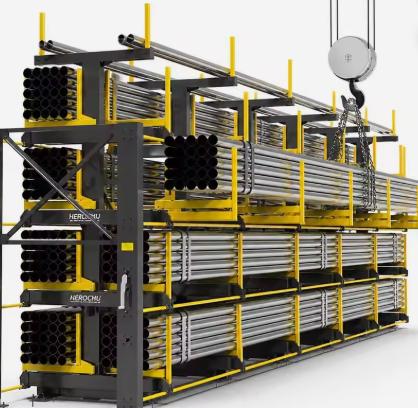
Structure: what carries 5,000 kg at six tiers
A load rating is only meaningful when the frame geometry is stated with it. Herochu quotes 3,000 kg per level on the 6 m models and 5,000 kg on the 9 m and 12 m models:
| Model | Material length | Max load per level | Layers |
|---|---|---|---|
| HC-G6053S | 6,000 mm | 3,000 kg | 5 |
| HC-G6053 | 6,000 mm | 3,000 kg | 5 |
| HC-G9065 | 9,000 mm | 5,000 kg | 6 |
| HC-G12065 | 12,000 mm | 5,000 kg | 6 |
The upright is fabricated I-section in Q235B, upgraded to Q355B on the 5,000 kg tiers. Arms are tied by a dual-beam crossbar, which is the detail that separates a rack holding well under working load from one at its limit: under an eccentric bundle the twin beams share torsion that a single tube would pass straight into the column weld.
Base plates are sized for anchor groups rather than single bolts, and each bay is load-tested as assembled before dispatch, with CE and ISO 9001 documentation.
Safety in a live handling zone
Stored energy is the core risk in bar and pipe handling. A six-tier bay holds up to 30 tonnes of steel, and a bundle that shifts during extraction turns that stored energy into a swinging load.
Four controls address it: independent compartments stop sideways migration between slots, arm stoppers sized to the load diameter stop round stock rolling during extension, full extension removes the drag force that makes bundles rotate, and the crank station sits outside the hook path so the operator never stands under a moving load.
Layout matters as much as hardware. The aisle in front of the bay is a drop zone, not a walkway, and marking it accounts for most of the practical safety gain at no cost.
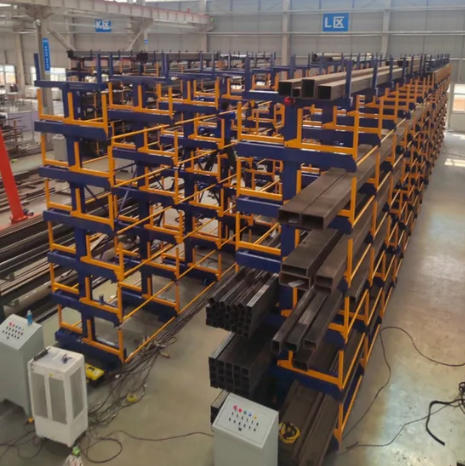
The handling arithmetic
A distributor moving 40 bundles a day at 18 minutes per pick spends 12 labour hours daily on retrieval. A crank-out layout typically brings that to 8–10 minutes per bundle, roughly 7 hours — five hours saved a day before counting forklift time released to transport and less damaged stock. Against the capital cost of a bay run, payback usually lands between 12 and 24 months. Below roughly 10 picks a day, fixed arms make better financial sense.
Installation and site preparation
Two site conditions decide whether a project runs smoothly: floor flatness and slab capacity. A six-tier bay at 5,000 kg per level delivers heavy point loads at the base plates, so suspended slabs and mezzanine decks need structural confirmation. Set and level the first frame, anchor it, then build out along the run using the crossbars as alignment guides. Set arm pitch before the tiers go up; changing it after the top tier is loaded means working at height.
Specifying with confidence
Racks that look alike on a quotation differ in what is not visible: steel certificates, weld procedure, whether the load test runs on the assembled frame, and whether the crank can be rebuilt in ten years. Herochu answers those in the documentation package rather than the sales conversation.