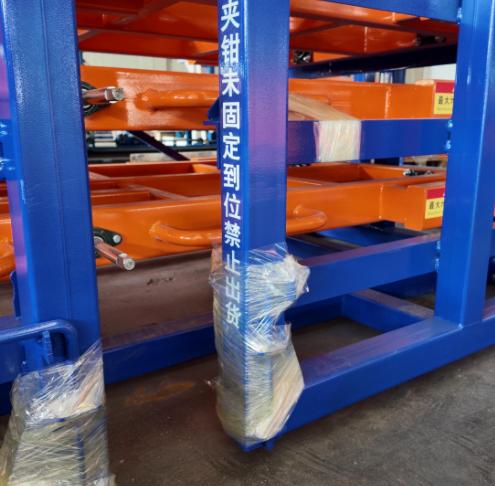
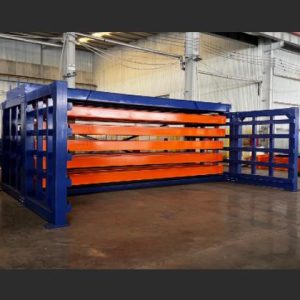
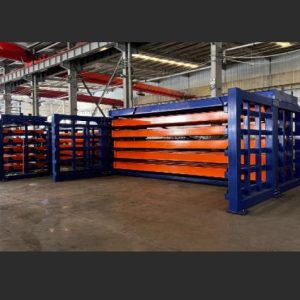
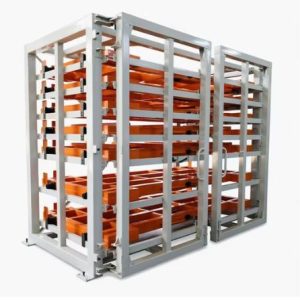
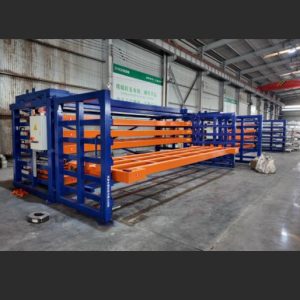
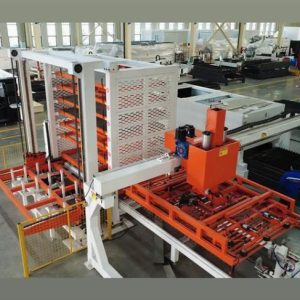
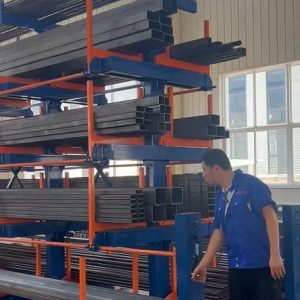
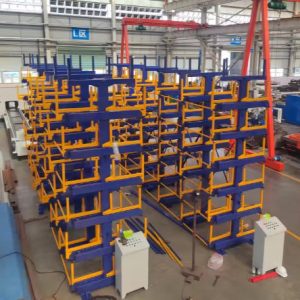
A heavy duty large format plate storage rack for 6000 × 2500 mm plate is a horizontal drawer system engineered around a 6-metre span, not a scaled-up standard rack. Herochu builds these frames with Q235B high-strength columns, dual-beam drawer arms and 5,000 kg rated levels, sized so the plate stays flat along its full length and a crane can lift the top sheet without dragging it across the one below.
The span is the engineering problem
A 6 m plate does not behave like a 3 m plate. Loaded horizontally, it deflects in the middle, and the drawer that carries it has to resist that deflection without a permanent set. Two things follow. The arms run as a dual-beam pair, so the load is shared across two members instead of one deep section. And the frame is designed with the plate’s own stiffness in mind: a 6 mm sheet sags under its own weight if it is supported only at the ends, while a 20 mm plate barely moves.
That difference is why large format racks are quoted per project. The sheet size sets the frame, the thickness mix sets the tier pitch, and the handling equipment sets the drawer rating.
What 6000 × 2500 mm means for the frame
The widest standard Herochu frame in this class is the HC-B6020-65, built for 6000 × 2000 mm plate at 5,000 kg per level. A 2500 mm width is a custom build: the columns move outward, the drawer base gains a third support line, and the arm section is recalculated rather than reused.
| Model | Sheet size (mm) | Levels | Load per level |
|---|---|---|---|
| HC-B4020-65 | 4000 × 2000 | 6 | 5,000 kg |
| HC-B6020-65 | 6000 × 2000 | 6 | 5,000 kg |
| Custom HC-B6025 | 6000 × 2500 | 6 or as specified | 5,000 kg + |
Three parameters get fixed early. The clear space above each plate, 120 mm as standard and opened up for thick plate with lifting lugs. The drawer travel, which is the plate length plus clearance. And the crane hook height available in the bay, which caps the usable tier count regardless of what the frame can carry.
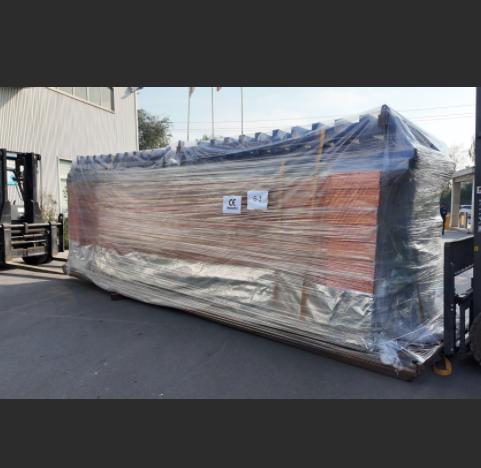
Handling a plate this size
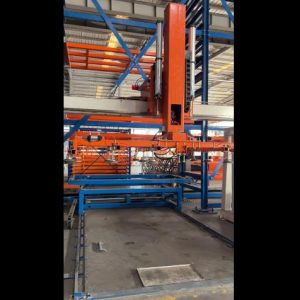
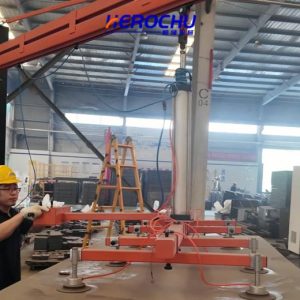
A 6000 × 2500 × 12 mm plate weighs about 1.4 tonnes. At 25 mm it is close to 2.9 tonnes, and at 40 mm it passes 4.7 tonnes. That puts the lift firmly in overhead crane territory: a spreader beam with four-point lifting, or a vacuum lifter rated for the surface finish and the plate thickness.
The rack is designed around that lift. Full extension brings the plate edge clear of the frame, so the crane hook is directly above the load and the plate rises vertically. A drawer that stops short forces the operator to angle the plate, and a 6 m sheet does not angle well inside a rack bay.
Where a crane is not available, Herochu builds forklift-loading frames with the drawer face held clear and fork pockets at the truck’s carriage height. The truck capacity, fork length and load centre all get checked before the drawing is released, because a 6 m plate on short forks is a lever, not a load.
Floor and building checks
A loaded six-tier bay at 5,000 kg per level puts 30 tonnes into a footprint of roughly 7 m × 3 m. That is a point load a standard warehouse slab may not be designed for. Herochu supplies base plate loading figures so a structural engineer can confirm the slab or specify a spreader foundation.
Height follows the same logic. Six tiers at 120 mm clear space plus drawer structure is not six times 120 mm; the frame depth per level is set by the plate thickness and the arm section. A bay that looks like it fits under a 6 m crane rail often loses its top tier once the real pitch is calculated.
Where these racks get used
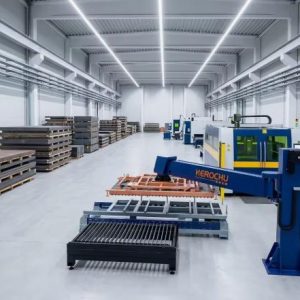
Large format storage shows up wherever plate is bought in full mill size and cut down on site: shipyards and offshore fabrication, pressure vessel shops, structural steel plants, heavy equipment manufacturers, and service centres holding stock for laser and plasma cutting.
In those plants the gain is not only density. Full-size plate is expensive, and a scratched or bent sheet becomes scrap or a rework item. Horizontal drawer storage keeps the surface off the floor, off other plates, and off the rack frame, which matters for abrasion-resistant grades and for plate that will be welded without re-finishing.
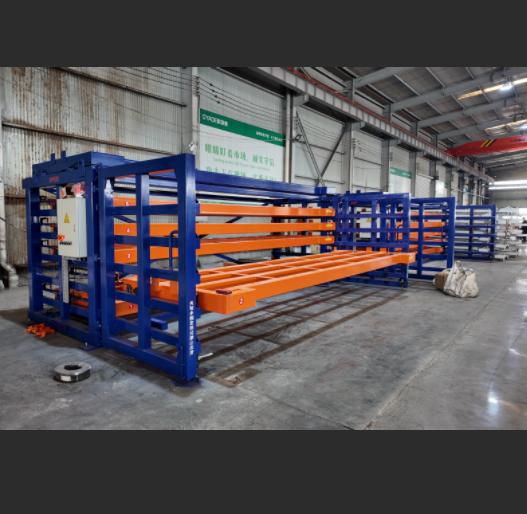
Density compared with cantilever
Cantilever racks are the usual alternative for long plate, and they work when the plate can stand on edge. They lose on two counts. A 6 m by 2.5 m sheet stored on edge needs a deep arm and a wide aisle, and every pick involves tilting the plate out of the rack, which is the moment edges get damaged.
Horizontal drawer racks stack the same plate in tiers, served from one aisle, with a vertical lift on every retrieval. Herochu quotes up to four times the capacity of conventional floor storage in the same bay, and the figure holds best where the plate is 6 m long, because the aisle saving compounds with every tier added.
Getting a layout
Send the plate sizes, thickness range, heaviest bundle and the crane capacity of the bay. Herochu returns a frame drawing with tier pitch, drawer travel, base loads and the aisle dimension the crane needs, and the build is load-tested before it ships.