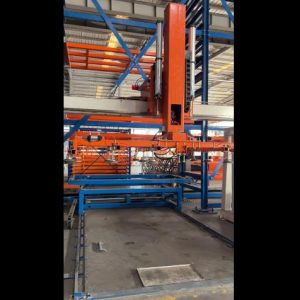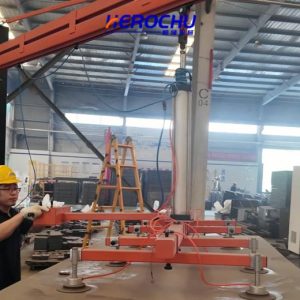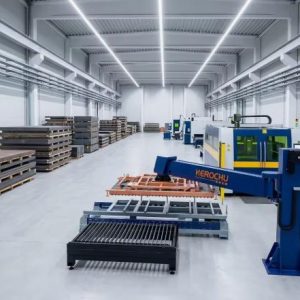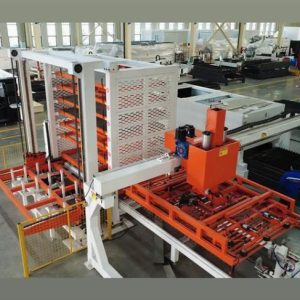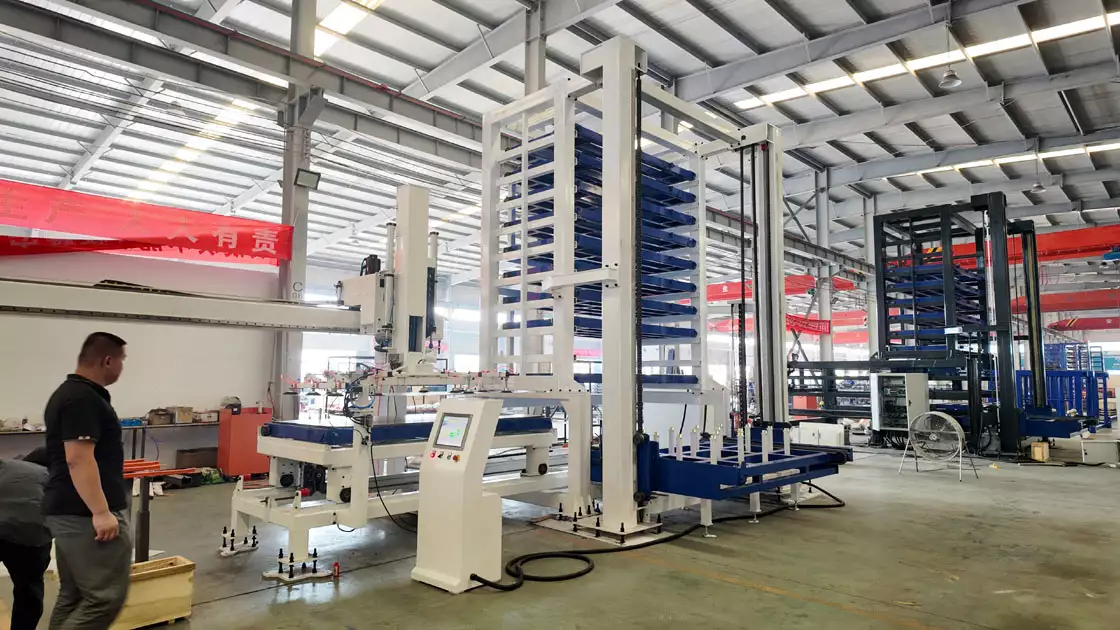
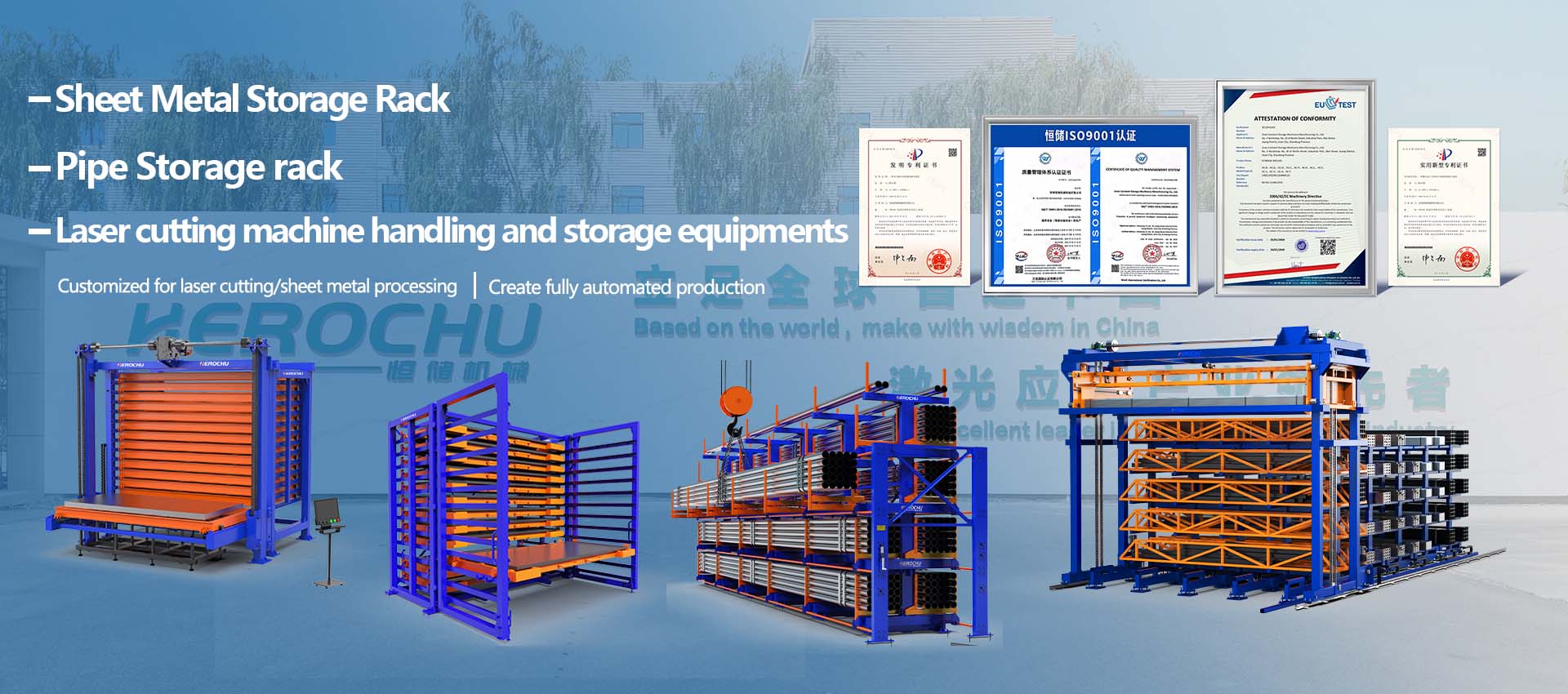
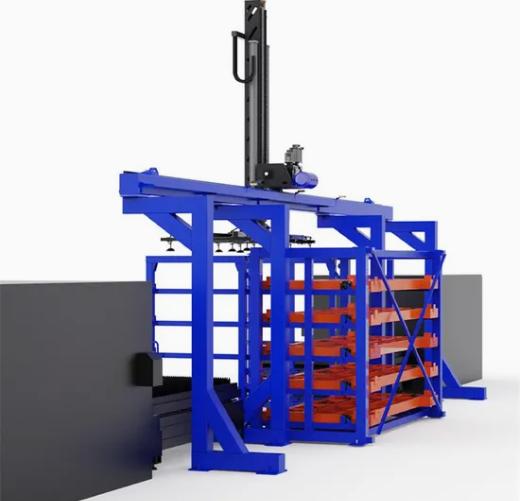
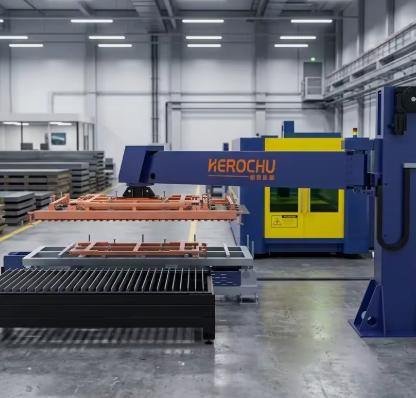
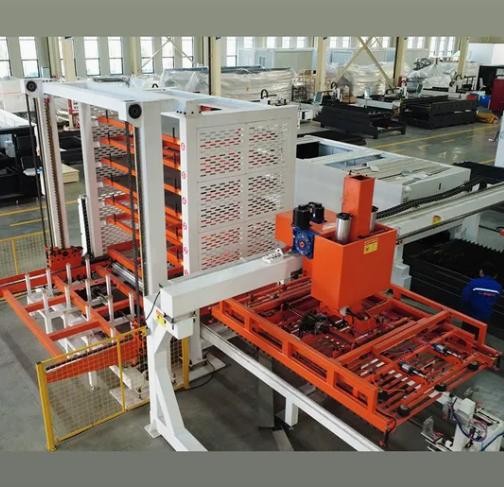
A flat sheet laser loading/unloading gantry is a bridge structure that travels above the cutting table, lifting blanks with vacuum cups and removing finished sheets with a tine fork. Herochu builds these for 2500×1300 mm and 3000×1500 mm formats, at 300 kg and 500 kg stack capacity, with 5–10 m/min travel and ±2 mm placement.
Why the gantry format suits flat sheet
Two architectures dominate laser automation: the articulated robot and the Cartesian gantry. Robots are flexible and compact, but they are serial machines — every joint adds deflection, and deflection shows up as placement error at the end of a 2.5 m reach. A gantry carries the load on a rigid bridge spanning the work area, so the sheet stays flat and square across its width.
For flat sheet, flatness is the job. A 3000×1500 mm blank that sags 15 mm at one corner will not sit against the stops, and the nesting origin is then wrong for every part on that sheet. Two parallel rails keep the vacuum frame level within ±2 mm wherever it stops.
Herochu’s HC-RL series applies that principle to a single unit servicing one laser cutter. It is not a storage system, and it is not a tower — it is the handling layer between your material pallet and your cutting bed.
What the structure carries
Four subassemblies do the work:
- Bridge and rails. Floor-mounted rails carry the bridge along the machine axis; the trolley moves the vacuum frame across it. Servo drives on both axes, rack-and-pinion on the long travel.
- Vacuum frame. A light beam with cup groups sized to the sheet envelope, holding a 1250×2500 mm blank and a 3000×1500 mm blank without hardware changes.
- Tine fork. Flat tines that slide under the cut sheet, lift it clear of the slats, and transfer it to the unload station.
- Control cabinet. Motion program, vacuum circuit, sheet-presence logic, and the handshake with the laser.
A beam carries a low mass of its own, so 5–10 m/min travel needs little settling time.
Stroke, clearance, and the 700 mm question
Lifting stroke is 700 mm on both models and it is the parameter most often customized. Stroke must cover three stacked dimensions: the height of a full pallet, the height of the cutting table, and the clearance needed to swing the sheet over the slats without touching them.
Deep pallets or a raised foundation can use up 700 mm. A low-profile table fed by conveyor will not. Measure from the top of a full pallet to the table surface, add 100 mm, and quote that number. Stroke is a cheap option at order time and an expensive retrofit afterwards.
Where cycle time is actually spent
Travel speed is the number buyers ask about and the number that matters least. At 5–10 m/min, a 3 m move takes 18–36 seconds, but the gantry also decelerates, settles, and verifies vacuum before releasing. The real budget runs about 30–60 seconds per load: descend, pick, travel, locate, return.
On a machine cutting 1.5 mm steel at 3–4 m/min, one nested 3 m sheet represents several minutes of cutting, so the loader finishes first. Handling should never become the constraint.
Placement accuracy: what ±2 mm means
Repeatability of ±2 mm sounds loose beside the laser head’s 0.05 mm positioning, but the two measure different things. The head determines where the cut lands on the sheet; the gantry determines where the sheet sits on the slats.
±2 mm is enough because nesting software leaves an 8–15 mm edge margin. What matters more is consistency. A sheet that lands 2 mm long every cycle is compensated once in the nesting template. A sheet that lands somewhere different each time cannot be compensated at all.
Floor space and traffic
A gantry occupies floor on both sides of the laser: a pallet position and park position on the load side, an unload station or a link to a storage tower on the discharge side. Route forklift traffic to the outer edge, never under the bridge.
Where depth behind the machine is limited, Herochu builds the same handling function into a compact tower format instead, with material stored vertically and delivered to the table without a long horizontal run.
Payback arithmetic
A shop cutting 120 sheets per shift, two shifts a day, spends about five minutes per sheet on loading, alignment, and clearing — 600 minutes, or ten hours, of machine time per shift producing nothing. Automating 70 percent of that returns roughly seven hours a day: at $60 per machine hour, $420 daily and about $92,000 a year, before any scrap reduction from consistent alignment. On high-utilization machines, that is commonly a sub-24-month investment.
FAQ
What is a flat sheet laser loading/unloading gantry? A bridge-type handling system running on rails beside a laser cutting table. It loads blanks from a stack with vacuum cups and unloads finished sheets with a tine fork, so both material movements happen without an operator.
How much floor space does it need? Allow the gantry travel length, a pallet position on the load side, and an unload station on the discharge side. As a rule, plan 1.5 times the sheet length along the machine axis, plus 2 m of clear approach at each end.
Can a gantry be retrofitted to an existing laser cutter? Usually. It needs a compatible table height, a clear path along the machine, and an I/O handshake for table-ready and program-end signals. Herochu builds loaders for existing fiber lasers as well as new installations.
What happens if vacuum fails mid-cycle? A pressure switch monitors the circuit continuously. If vacuum drops below the set point, the gantry stops and holds position instead of completing the transfer, and the fault is reported at the operator panel.
Key takeaways
- A rigid bridge keeps large blanks flat in a way an articulated arm cannot over 3 m.
- ±2 mm repeatability is sufficient when the error is consistent and margins absorb it.
- Verify the 700 mm stroke against your pallet height before ordering.
- A 30–60 second cycle stays well inside the cutting cycle.
- Payback tracks machine hour rate and sheet count, not headcount.