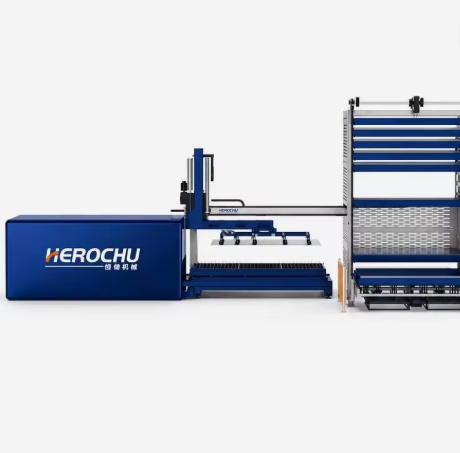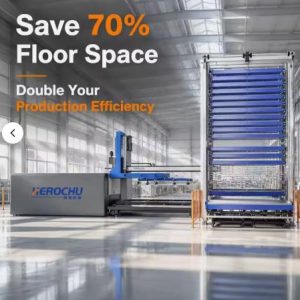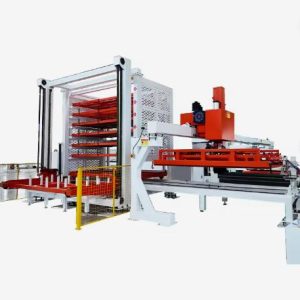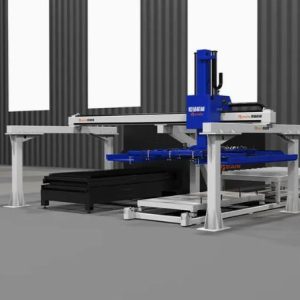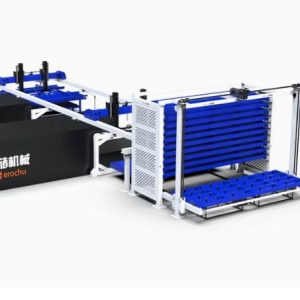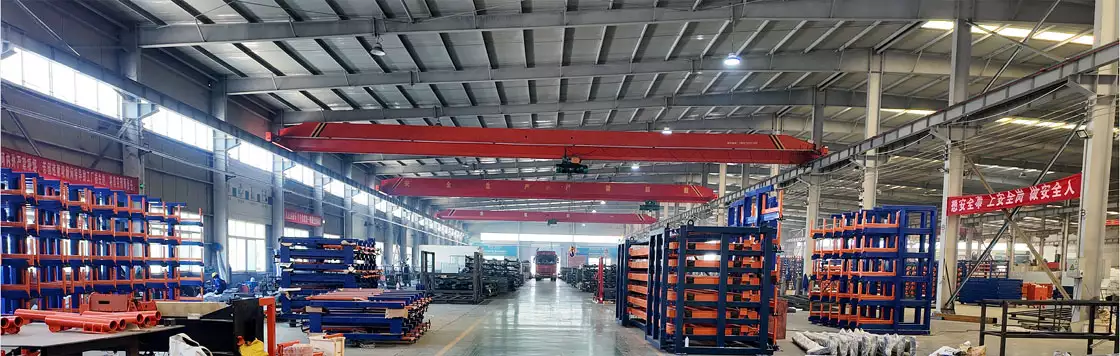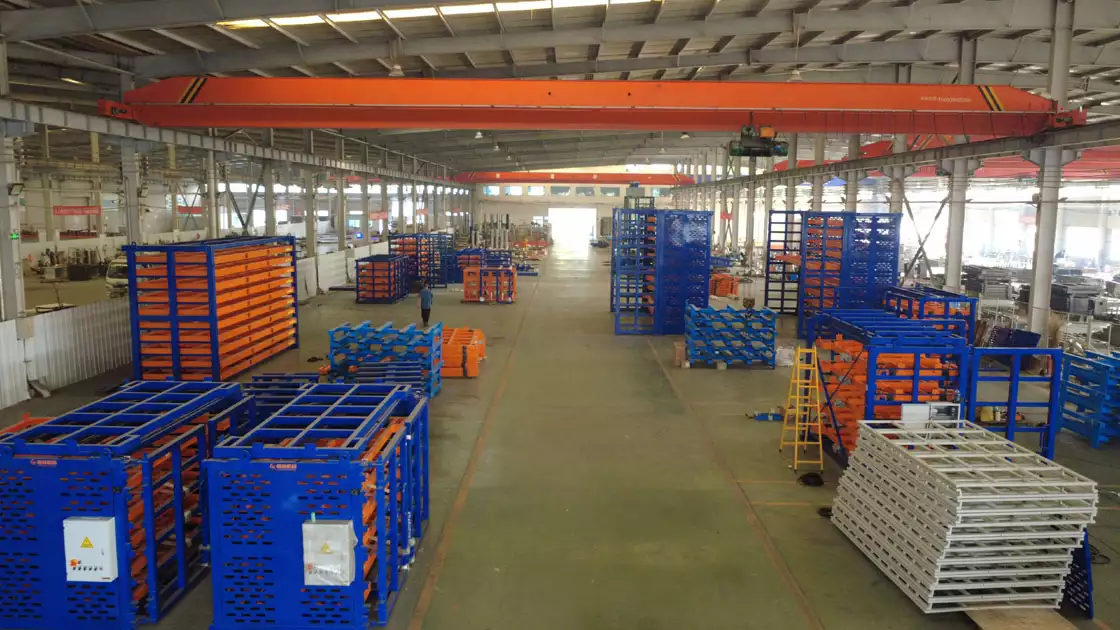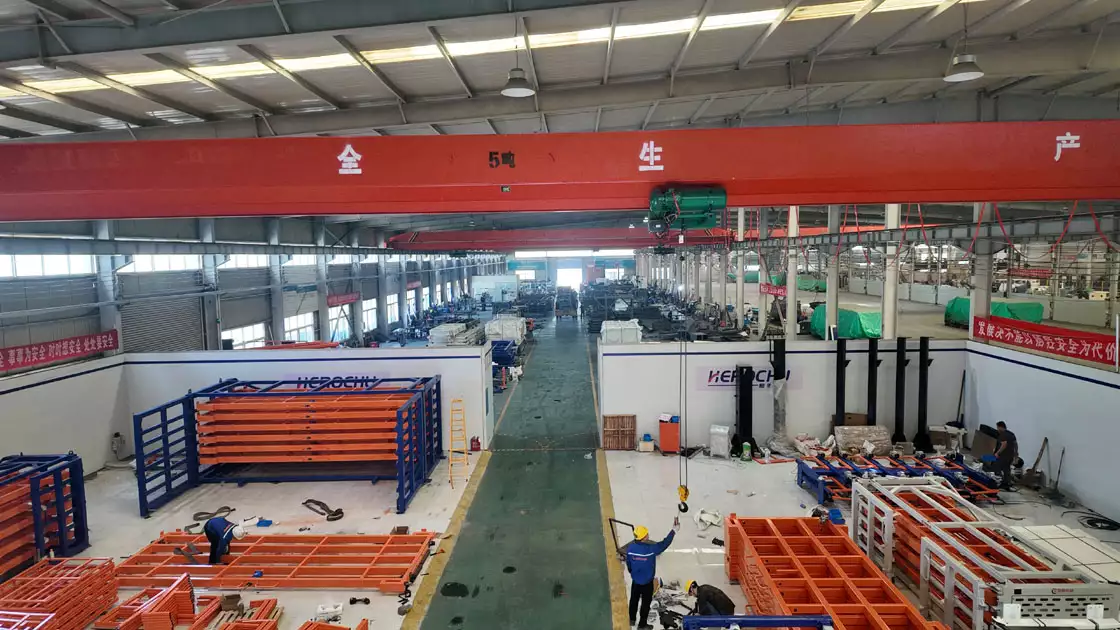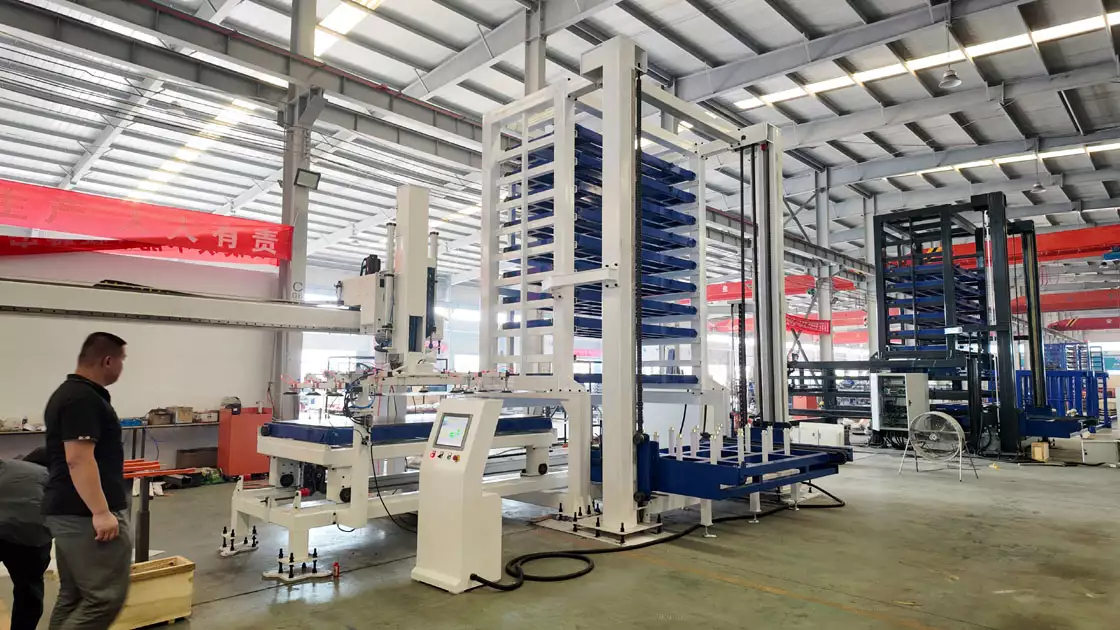
Metal fabrication shops that run laser cutting operations know that the cutting speed of the machine is only half the equation. The other half is how fast raw material reaches the bed and finished parts leave it. When operators manually load plates and unload skeletons, the laser sits waiting. An automated plate loading and unloading system for metal laser cutting from Herochu closes this gap by handling both material flow directions without human intervention during the cutting cycle.
Computer-Controlled Material Flow
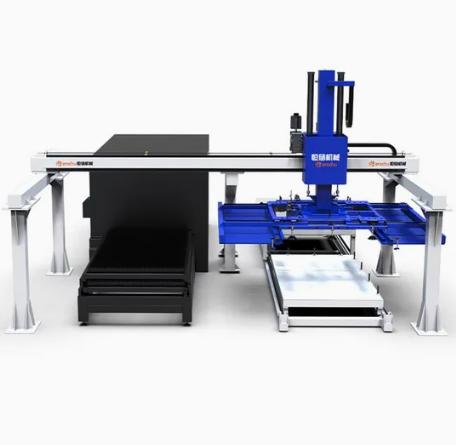
The Herochu HC-RT series operates under full computer control. An Omron CNC motion controller manages every axis of movement, coordinating the vacuum loading sequence, gripper unloading sequence, and sheet positioning with precise timing relative to the laser machine cycle status.
When the laser signals that a cutting program has finished, the controller initiates the unloading sequence. The gripper engages the skeleton and finished parts, lifts them from the slat bed, and transfers them to the unloading station. Simultaneously, the vacuum head picks the next raw sheet from the loading stack and moves it to the bed. The controller coordinates these two motions through dual independent Z-axes, allowing loading and unloading to overlap rather than occur in sequence.
This computer-controlled coordination eliminates the timing variability inherent in manual handling. A human operator might take two minutes to change a sheet on a good day and five minutes when fatigued or distracted. The automated system performs the same exchange in a consistent, repeatable cycle that does not degrade over the course of a shift.
Reducing Manual Loading Time
Manual sheet loading on a mid-size laser cutter typically requires two operators for plates weighing over 100 kg. They position a forklift or suction lifter, lift the sheet, maneuver it onto the bed, align it against the stops, and retreat before the cutting cycle begins. This process repeats for every sheet, every shift, every day.
The Herochu automated plate loading and unloading system replaces this multi-operator routine with single-operator oversight. One person monitors the system, replenishes the raw sheet stack, and manages finished part removal from the staging area. The physical lifting, positioning, and alignment are handled entirely by the gantry manipulator.
For a shop running two or three shifts, this labor reallocation is significant. The operators previously assigned to loading duties can be redirected to welding, grinding, assembly, or quality inspection—tasks that add value rather than move material. The reduction in manual loading time also means that the same workforce can support a higher volume of cutting output without adding headcount.
Compatibility with Multi-Size Laser Cutters
Metal fabrication facilities rarely standardize on a single laser cutter bed size. A shop might run a 1.5 × 3 meter machine for small parts alongside a 2 × 4 meter machine for large structural components. The Herochu system accommodates this reality through five standard models covering the most common bed dimensions:
- HC-RT2513-300 for 2500 × 1300 mm sheets up to 300 kg
- HC-RT3015-500 for 3000 × 1500 mm sheets up to 500 kg
- HC-RT4015-500 for 4000 × 1500 mm sheets up to 500 kg
- HC-RT4020-500 for 4000 × 2000 mm sheets up to 500 kg
- HC-RT6015-500 for 6000 × 1500 mm sheets up to 500 kg
Each model uses the same control architecture and vacuum-gripper end-effector design, so operators trained on one model can operate any other in the series. The gantry frame adjusts to the specific machine width and bed height during installation.
Gripper Unloading and Idle Time Reduction
The gripper unloading function is what separates a true loading and unloading system from a loading-only device. After the laser completes a cut, the slat bed holds a mix of finished parts nested within the skeleton. Removing this material manually requires reaching into the machine, lifting the skeleton (which may weigh nearly as much as the original sheet), and extracting small parts without losing them.
The Herochu gripper system handles this extraction automatically. The gripper jaws adjust to the skeleton dimensions, lift the entire cut sheet assembly, and deposit it on the unloading station. From there, operators can separate parts from the skeleton at a separate workstation without tying up the laser machine.
This automated unloading cuts laser machine idle time between cycles to a fraction of what manual operation requires. Facilities that previously achieved 55 to 65 percent machine utilization routinely reach 85 to 90 percent after implementing the automated loading and unloading system.
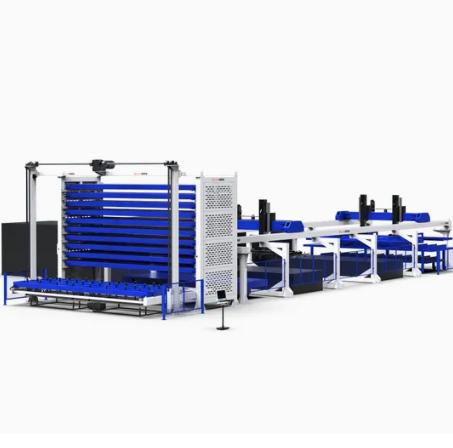
Sheet Separation for Reliable Single-Pick Loading
Stacked sheet metal sticks together. Oil, static charge, and surface tension from tight stacking all contribute to adhesion between adjacent plates. When an automated system lifts two sheets simultaneously, the results range from cutting program errors to damaged slat beds and nozzle collisions.
Herochu addresses this with an active sheet separation system. Before the vacuum cups engage, a mechanical separator inserts between the top two sheets in the stack, breaking the adhesion. A controlled air burst follows, further disrupting any remaining surface bond. The vacuum head then lifts only the top sheet, verified by load cell feedback that confirms the lifted weight matches a single plate.
This separation process repeats for every loading cycle, ensuring consistent single-sheet pickup regardless of material type, oil coating, or stack condition. The system handles plate thicknesses from 1 mm to 20 mm, with the separation force adjusted automatically based on the programmed material parameters.
Motion Performance Specifications
The system delivers consistent motion performance across all models:
- Robot arm traverse speed: 10–30 m/min
- Lifting speed: 5–10 m/min
- Fork adjustment speed: 5–20 m/min
- Repeatability: ±2 mm
- Air supply requirement: 0.6–0.7 MPa
These specifications ensure that the gantry moves fast enough to keep pace with modern fiber lasers while maintaining the positioning accuracy needed for reliable cutting program execution. The ±2 mm repeatability means that every sheet is placed on the bed within a 2 mm tolerance of the programmed position, eliminating the alignment errors that cause edge cuts to fall outside tolerance.
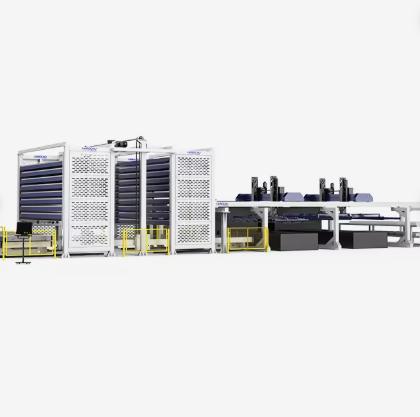
Controller Integration and Production Data
The Omron controller communicates with the laser machine via Ethernet, receiving cycle start and completion signals automatically. It also connects to the facility network, allowing production data—sheet count, cycle time, material consumption—to flow to manufacturing execution systems or ERP software.
This data visibility gives shop managers real-time insight into laser department performance. Instead of estimating utilization from operator reports, the system provides actual cycle counts and downtime records. This data supports informed decisions about capacity planning, maintenance scheduling, and additional automation investments.
For facilities pursuing lights-out manufacturing, the Herochu automated plate loading and unloading system provides the material handling foundation. Combined with automated storage racks and part sorting conveyors, the system enables extended unattended cutting runs that maximize equipment utilization during low-cost overnight power periods.
The economic case for automation is straightforward. A laser cutter running at 60 percent utilization produces 40 percent less output than the same machine at 90 percent utilization. The Herochu system closes that gap, typically delivering return on investment within four to six months through increased cutting capacity on existing equipment.