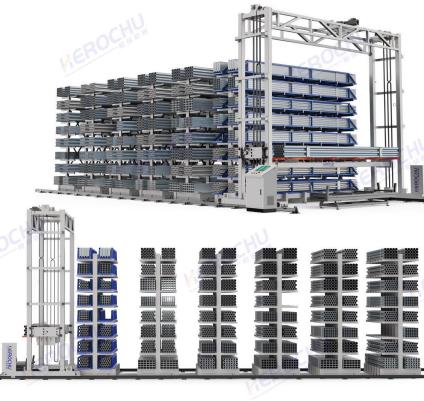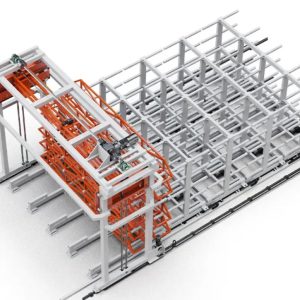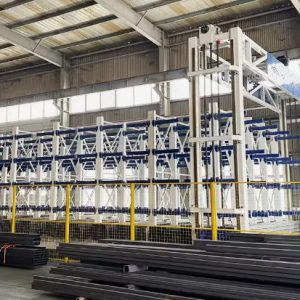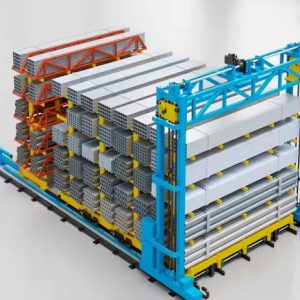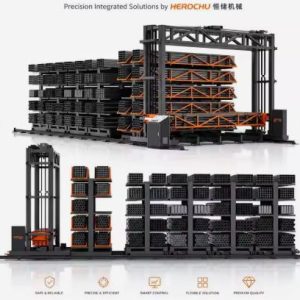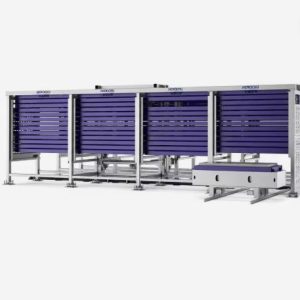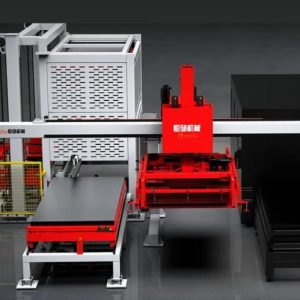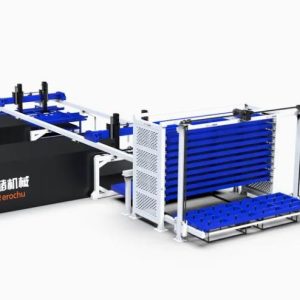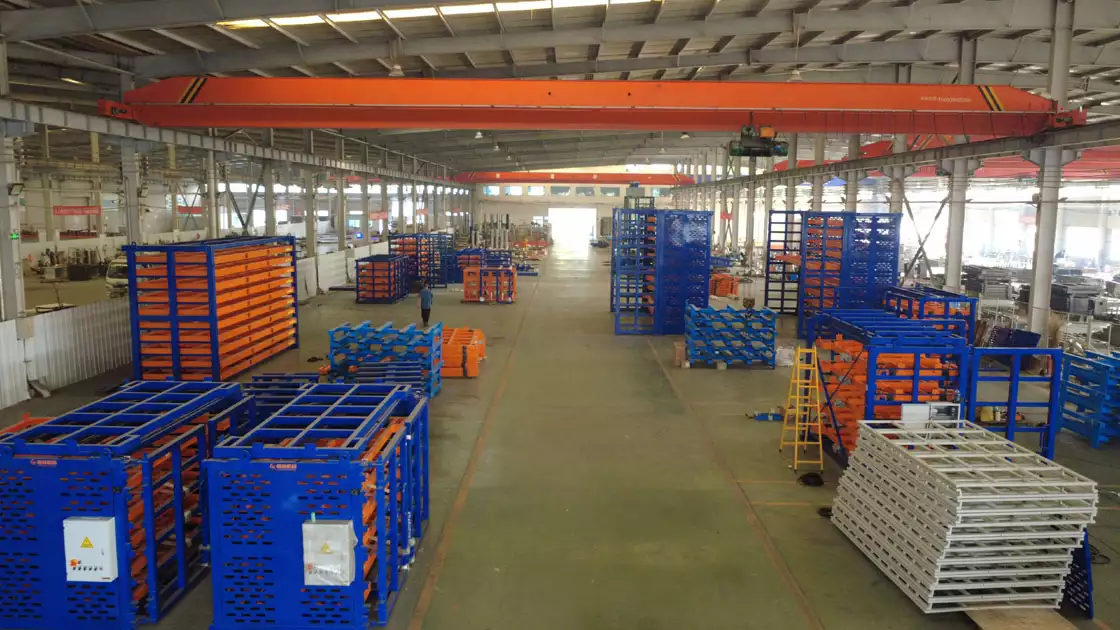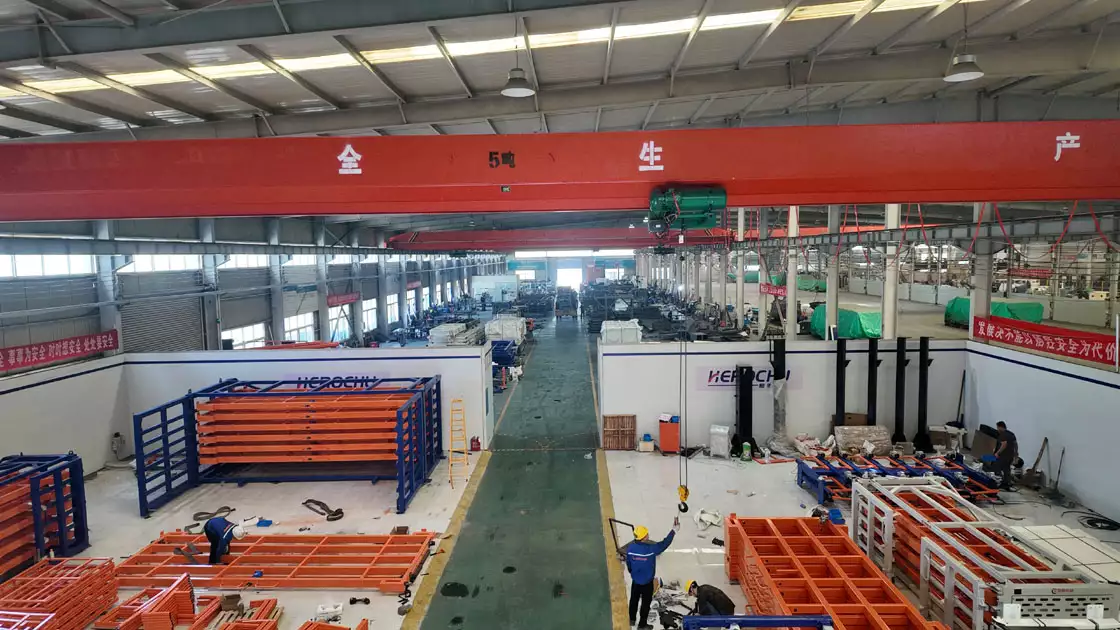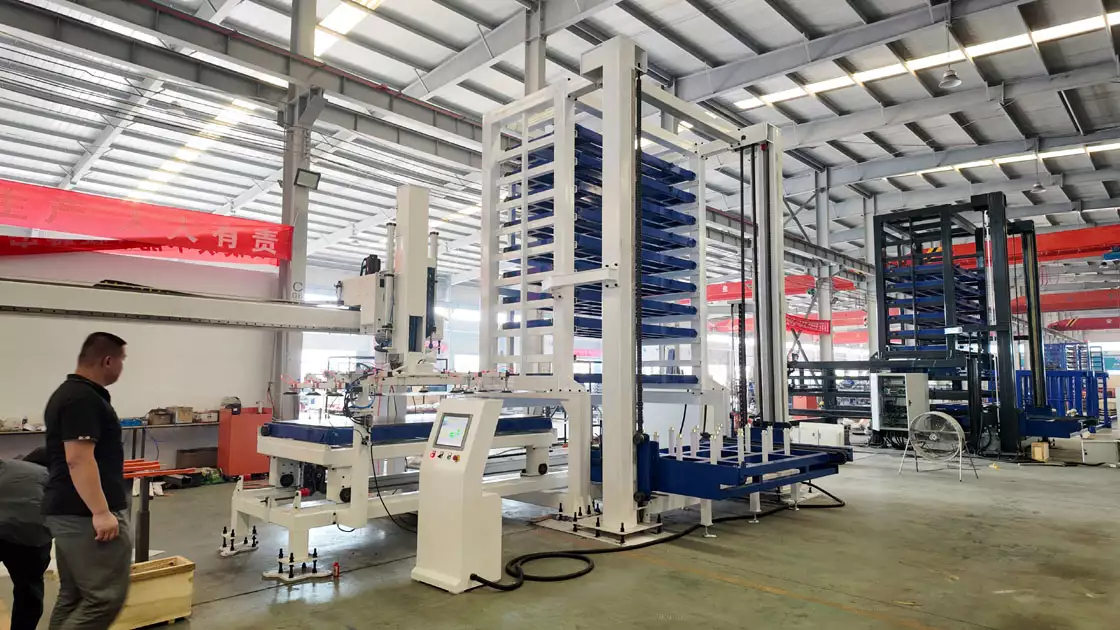
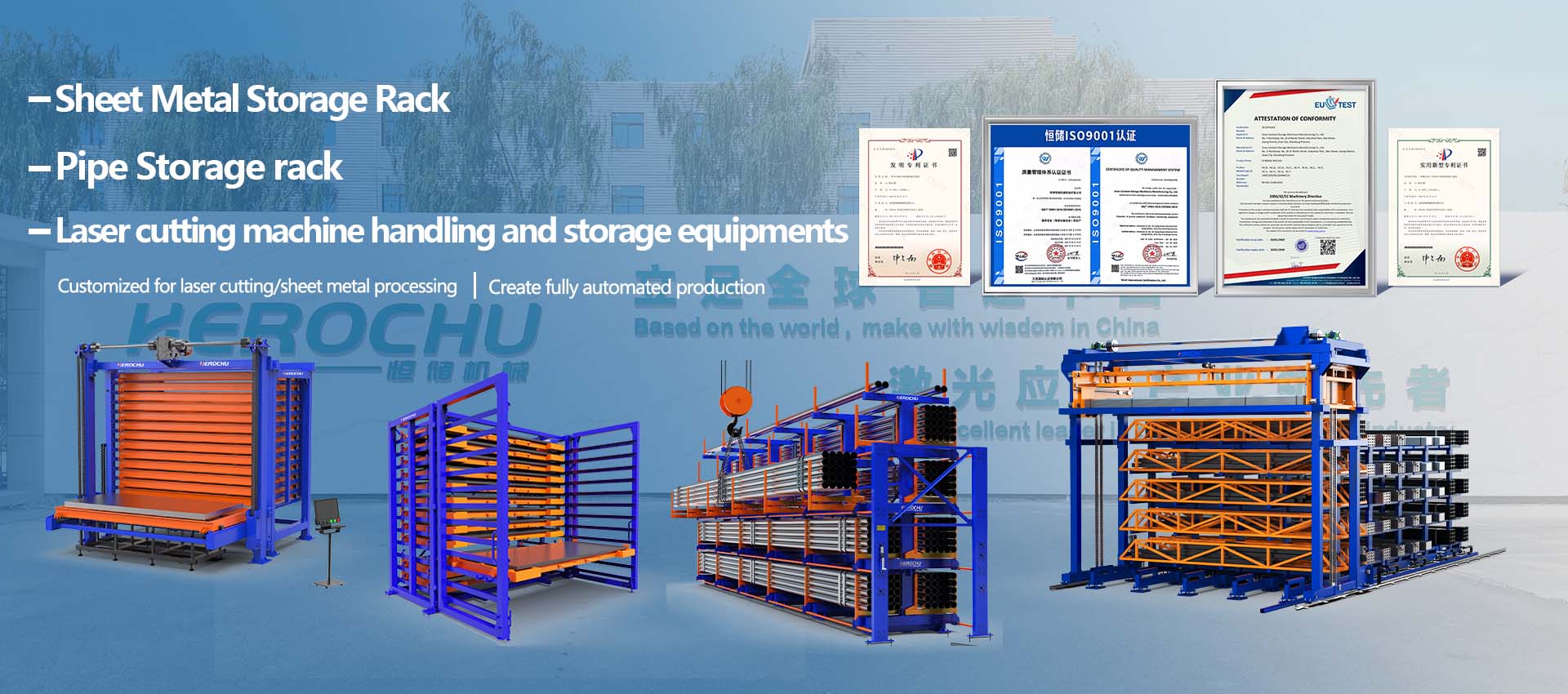
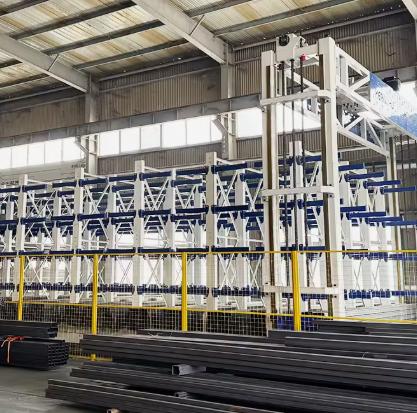
Herochu’s automatic overhead tube and pipe storage system places the traveling carriage on elevated runways, with a suspended lifting platform extending downward for storage and retrieval. The ground level remains completely open—no rails, no column array. The system handles 6,000–12,000 mm tube lengths, 5,000 kg per level, and ±2 mm repeatability for automated storage of steel pipe, tubing, and high-density tube bundles.
An Overlooked Constraint: Ground Is a Finite Resource
Marketing language around vertical storage systems usually revolves around space savings. But space is a broad concept. For plants already running lean material flow, the scarcity of ground space is far higher than that of vertical space. A floor rail crossing the shop—even as part of an automated system—can mean forklift aisles must detour, equipment layouts must compromise, or safety fencing must expand.
Herochu’s automatic overhead system starts from this distinction. The travel mechanism is located on elevated runways rather than floor guide rails. The suspended lifting platform extends downward from the carriage, executing storage and retrieval above the material. The ground level—from concrete slab to system clear height—is fully available for personnel traffic, forklift operations, and downstream equipment placement.
Overhead System vs. Floor Gantry: Architecture Comparison
Herochu offers both floor-rail gantry ASRS and top-mounted ASRS. The application scenarios differ.
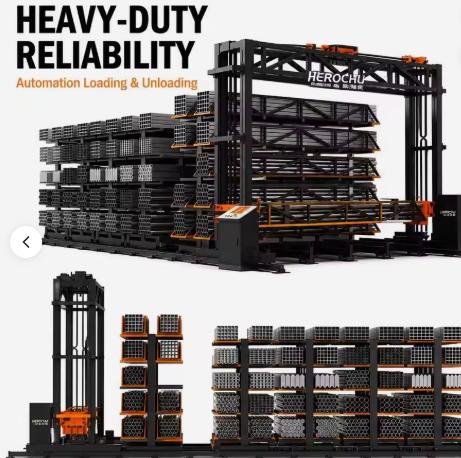
The floor-rail system (Gantry-Type Rail ASRS) uses a heavy gantry running on floor guide rails along multi-level towers. The shared-aisle mobile rack design eliminates redundant access aisles, while floor rails route heavy loads directly into the concrete slab. Structural efficiency is high, suited to scenarios requiring maximum load capacity and the most proven engineering.
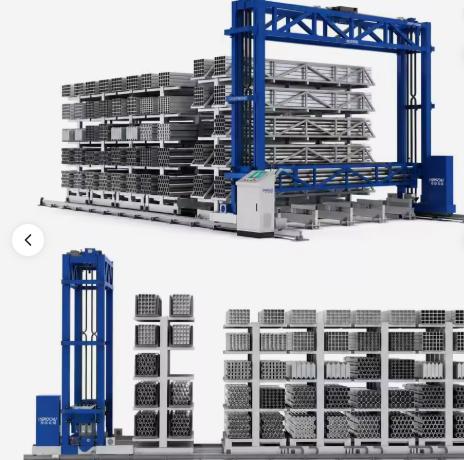
The overhead system (Top-Mounted ASRS) uses a traveling carriage on elevated runways with a suspended platform for retrieval. Ground level is 100% open, with unobstructed forklift traffic and downstream equipment integration. The center of gravity is lower than conventional top-running cranes, providing better stability for heavy-load handling.
The choice depends on plant priorities. If ground traffic flexibility is the primary constraint, the overhead architecture removes it. If maximum load capacity and the structural simplicity of floor rails are the primary considerations, the floor gantry is the more direct choice. Herochu’s engineering team makes recommendations during project evaluation based on customer CAD layouts and logistics flow.
Technical Implementation of Overhead Architecture
The core of the overhead system is a traveling carriage running on elevated runways. The carriage carries a suspended lifting platform that moves independently in the vertical direction. Horizontal travel and vertical lift are driven by independent servo axes.
The engineering significance of this separation lies in control precision and structural efficiency. Horizontal positioning is unaffected by floor unevenness or rail debris; vertical lift travel is not constrained by building floor conditions. The carriage drive system only handles horizontal inertial forces, while the lift system handles vertical loads. Each axis has a simpler motion profile and more direct fault diagnosis.
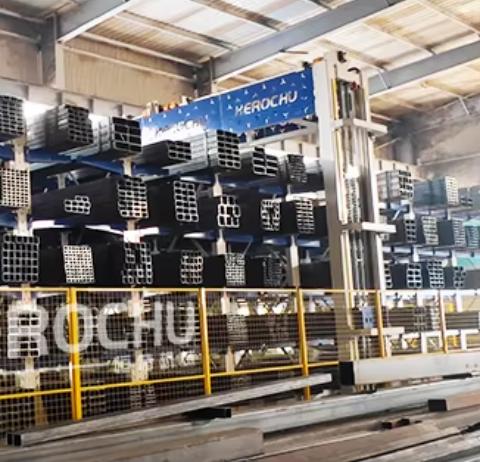
The elevated runway structure is designed considering existing building conditions. For steel-frame buildings, runways can be suspended from roof beams or dedicated support structures. For concrete buildings, chemical anchors or embedments transfer runway loads to structural members. Herochu performs structural load calculations for each project and coordinates with the customer’s structural engineer.
Engineering Details of Tube Storage
Tubes—whether round, square, or rectangular hollow sections—behave differently under dynamic loads than solid bars. Tube bundles tend to roll and slip during gantry acceleration and deceleration. Thin-wall tubes can ovalize under point-load support.
Herochu’s tube support configurations are designed for these characteristics. V-cradles provide self-centering restraint for round pipe, preventing rolling. For square and rectangular tube, flat supports with lateral stops maintain alignment. For thin-wall tube, support spacing is calculated to prevent ovalization—the distance between support points is determined by tube diameter, wall thickness, and material yield strength.
Open-bottom drawers are a practical design feature for tube storage. Cut and machined tubes may carry chips and coolant residue. Open bottoms allow this debris to fall through during storage rather than accumulating in the drawer. Preventing chip accumulation reduces cleaning downtime and lowers the risk of debris falling onto the aisle below during gantry movement.
Speed and Throughput
Motion speeds of the overhead system are optimized for production takt time. Lift speed reaches 40 m/min, carriage traverse reaches 100 m/min, and gantry handler exchange and lift speeds run 5–15 m/min. Retrieval cycles run under 90 seconds.
Speed adjustability is an often-overlooked operational feature. Operators can adjust speed profiles through the touchscreen to match material type and downstream process urgency. A bundle of thin-wall tube headed to a JIT cutting line can move at full speed; a bundle of precision-ground bar for finishing may receive a gentler speed profile, reducing inertial effects on surface quality.
Digital Integration and Lights-Out Operation
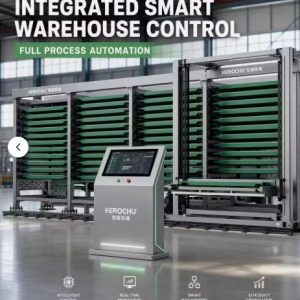
The overhead system operates as an active data node in a smart manufacturing execution system. Siemens S7-1200 PLCs communicate over PROFINET, and a 12-inch HMI provides real-time stock display and simple bundle calls. Closed-loop logging automatically tracks SKU locations, storage duration, and production orders.
When integrated with ERP or WMS, inventory data flows bi-directionally. Production scheduling can see what tube is physically on site; purchasing can see when replenishment is needed. The system’s transaction log provides an auditable path for every tube bundle from receiving to consumption.
For multi-shift operations, the system supports unmanned material delivery. During night shifts and shift gaps, bundles are automatically delivered to buffer positions, ready for direct feeding to cutting equipment when day shift begins. This capability extends equipment utilization from “hours with an operator present” to “calendar hours.”
Safety Architecture
A safety advantage of the overhead system is that the danger zone is above ground level. Suspended loads travel above personnel traffic areas, eliminating the pedestrian collision risk common in manual forklift handling.
The system includes multiple layers of safety protocol. Laser distance sensors scan ahead and behind the travel path, stopping travel immediately when obstacles are detected. Overload sensors prevent exceeding rated load. Emergency stop circuits and anti-collision algorithms provide redundant protection. Recovery requires manual reset, ensuring the cause of the stop is investigated before restart.
For scenarios requiring personnel passage beneath the system, safety light curtains and area scanners can be configured to restrict motion when personnel are detected entering the zone.
Customization Path
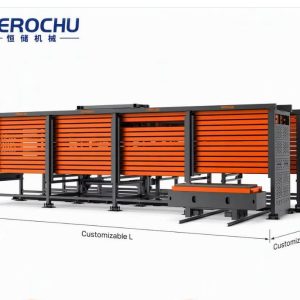
Herochu provides a free 3D layout design for every overhead project, based on customer-supplied CAD plant drawings and bill of materials. Configurable parameters include: tube length (standard 6,000–8,000 mm, custom to 12,000 mm), layer count, per-level load (standard 3,000–5,000 kg), rack quantity, support type, and pick point locations.
The system’s modularity allows phased expansion. Adding tower positions and software functions requires no rewiring or replacement of the core controller. For businesses using an 18–24 month payback as their investment criterion, scalability lowers the initial capital expenditure and the re-investment threshold at growth.
Conclusion
The value of the automatic overhead system is not what it stores but what it does not occupy. The integrity of the ground level—no rails, no columns, no enclosure array—transforms automated storage from an obstacle in production logistics into background infrastructure. For plants where ground space is already scarcer than vertical space, the significance of this architectural choice exceeds any single performance parameter. Herochu’s engineering approach treats that choice as the starting point, then builds load capacity, speed, and digital integration around it.