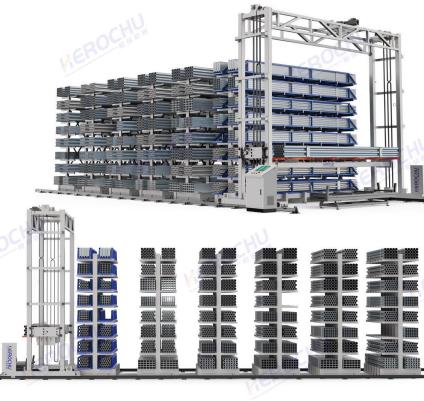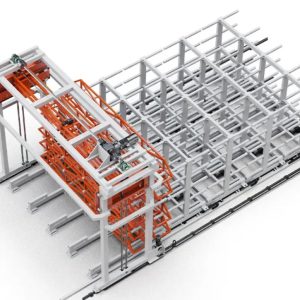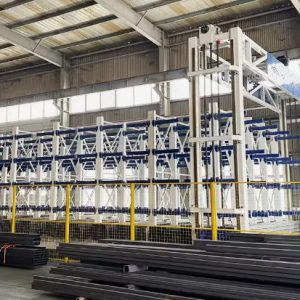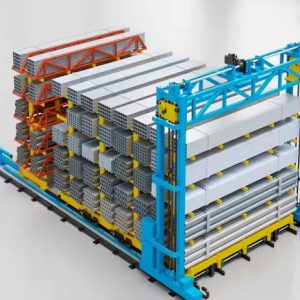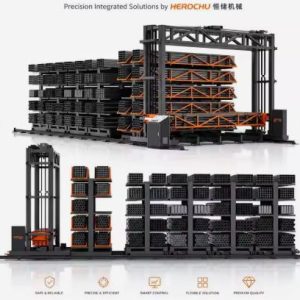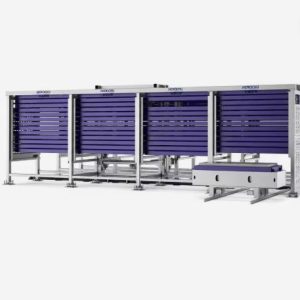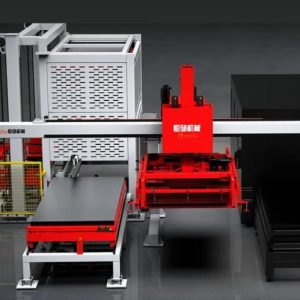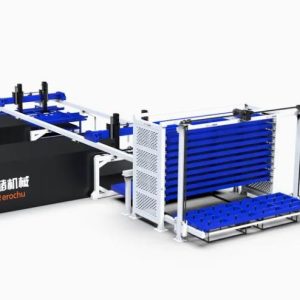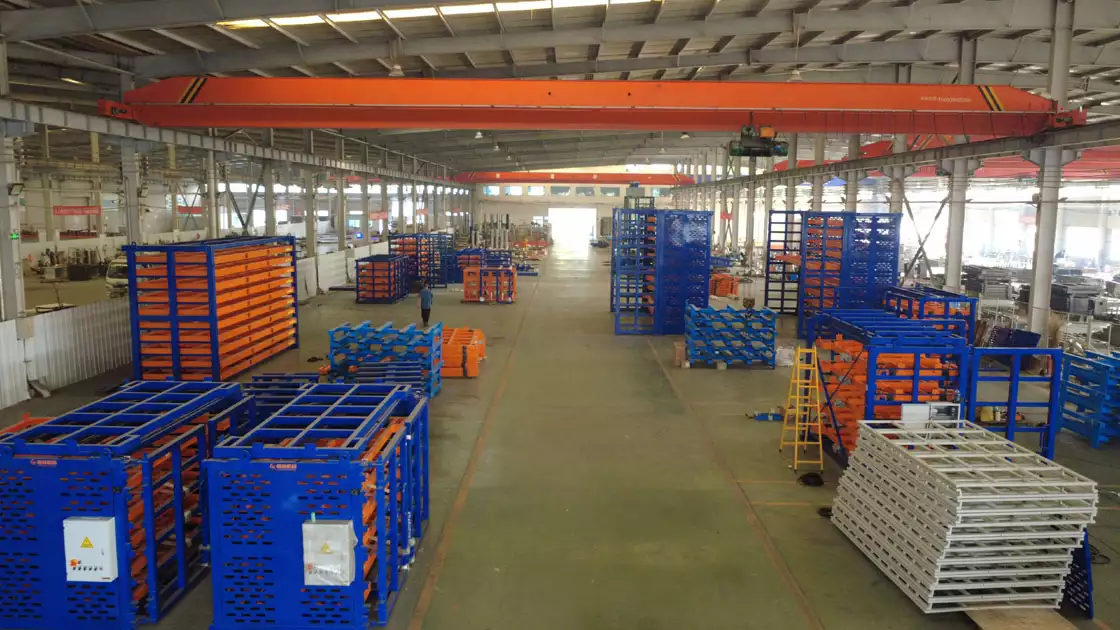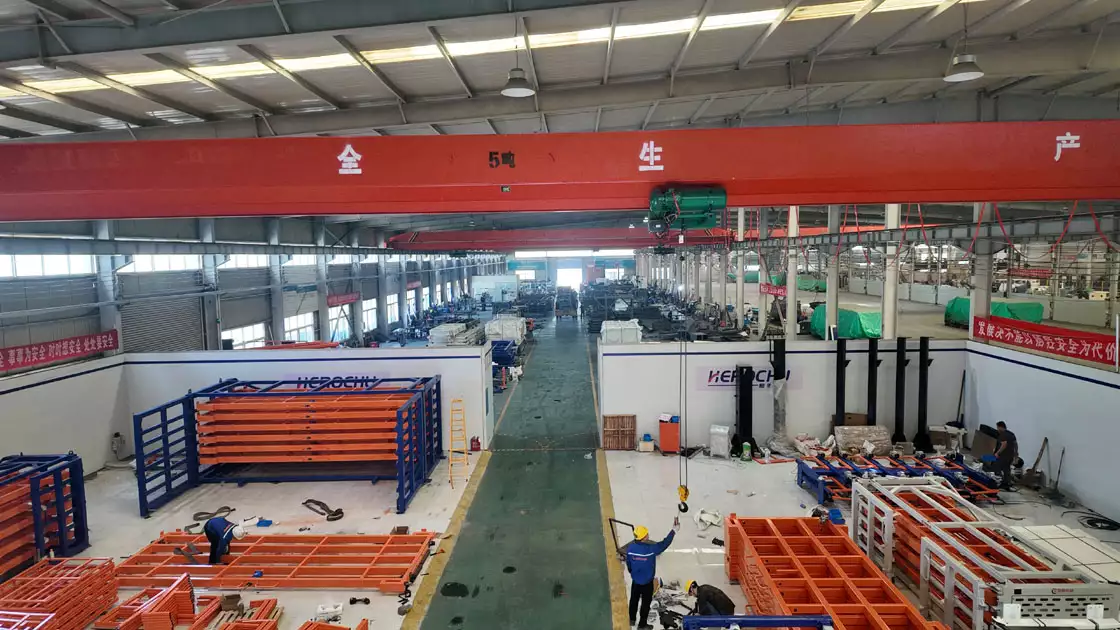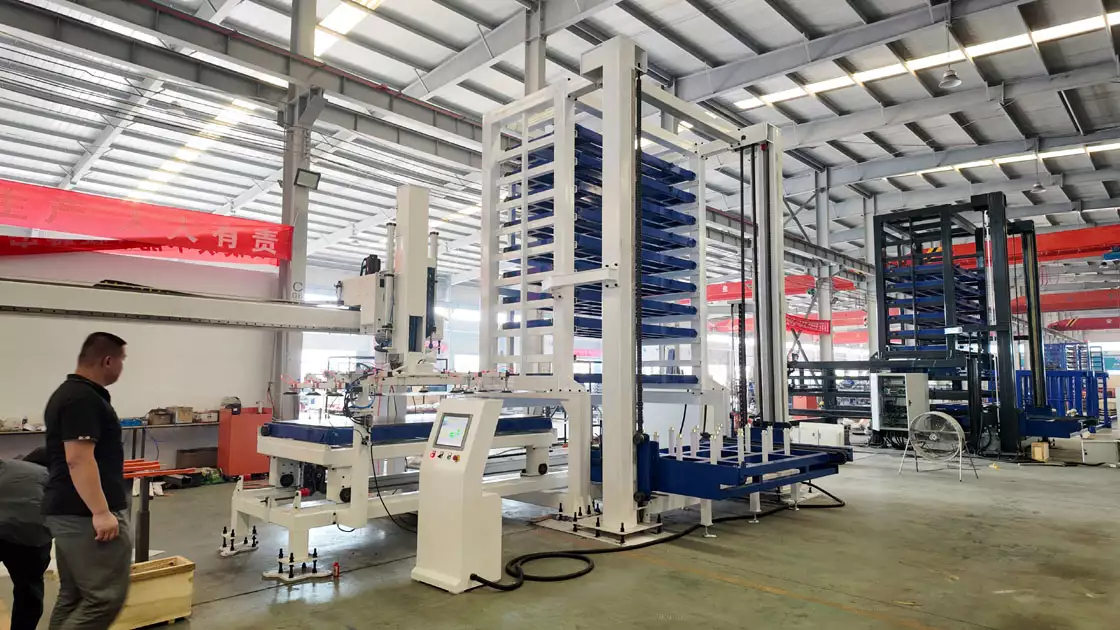
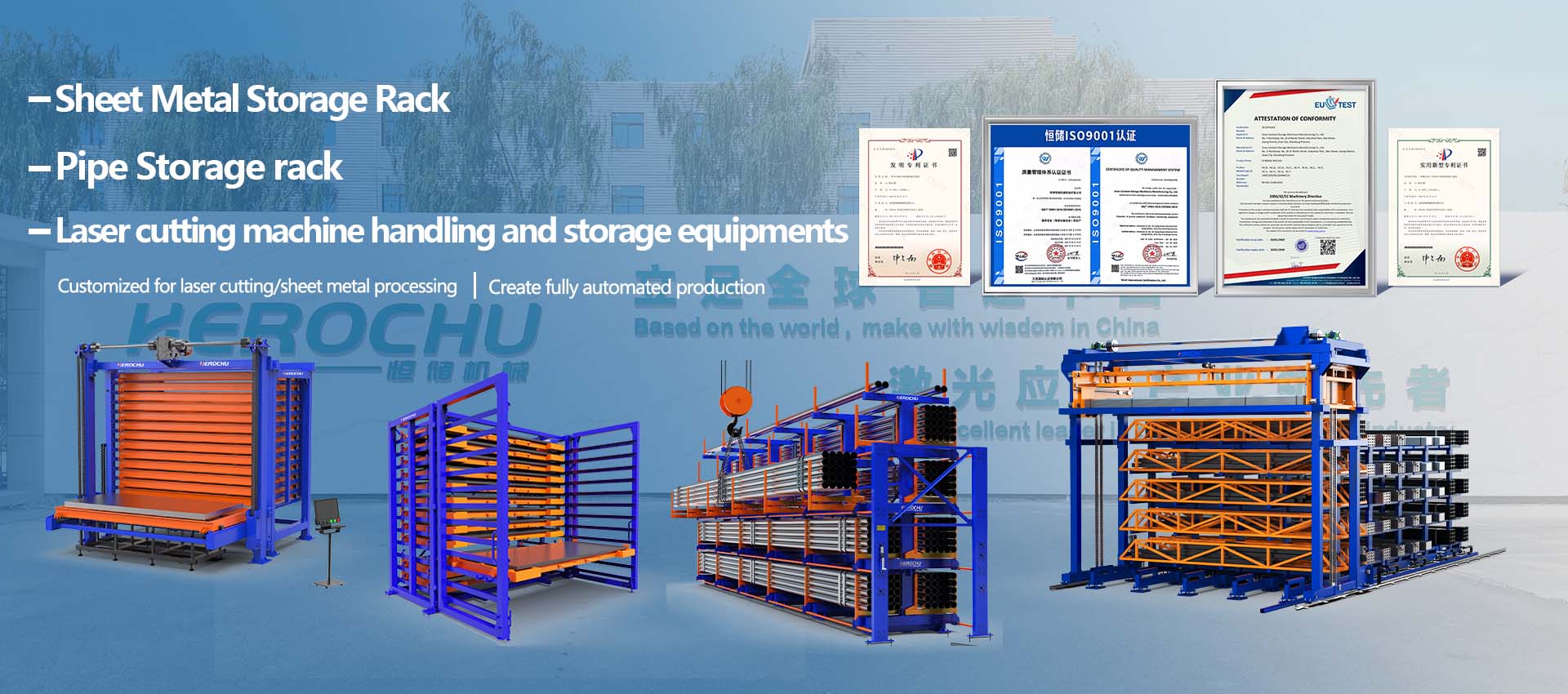
Herochu’s top-mounted automated storage and retrieval system places the traveling carriage on elevated runways with a suspended lifting platform running beneath it. This architecture keeps 100% of ground level open, with unobstructed forklift and downstream equipment access. The system supports 5,000 kg per level, handles heavy steel bar stock from 8,000 mm to 12,000 mm, and maintains ±2 mm positioning accuracy.
A Different Answer to the Ground-Space Problem
Most vertical storage systems free ground space by moving material upward, but the system itself still requires floor rails, column foundations, and some traffic zone. For an already congested shop floor—where forklift aisles, work-in-process buffers, and equipment operating envelopes compete—even a single floor rail can mean reduced traffic efficiency.
Herochu’s top-mounted AS/RS takes a different spatial approach. The traveling carriage runs on elevated runways rather than floor guide rails. A suspended lifting platform extends downward from the carriage, executing storage and retrieval above the material. The system’s root is in the building’s upper structure. The ground level is left completely clear.
The effect is direct: no floor rails, no array of gantry columns consuming footprint, no travel path requiring enclosure. Forklifts move freely beneath the system, and downstream processing equipment can be positioned directly beside the storage tower. For plants where ground-level logistics efficiency is the priority, this architecture removes the trade-off between automated storage and production flow.
The Engineering Logic of Top-Mounted Architecture
The defining engineering feature of the top-mounted system is the independent optimization of Y-axis and Z-axis motion. The lifting platform hangs beneath the traveling carriage, so vertical movement is unaffected by floor rail flatness or foundation settlement. Horizontal movement of the carriage on elevated runways is controlled by a separate drive system.
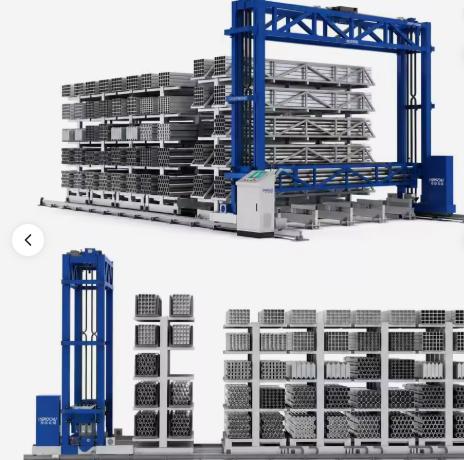
This separation delivers two performance advantages. First, positioning accuracy is easier to maintain: wear or debris accumulation on floor rails directly affects horizontal positioning, while elevated runways operate in a cleaner environment with more predictable load distribution. Second, vertical lift travel is not constrained by building floor conditions, allowing the system to use the building’s clear height—from 9 meters to 16 meters—for multi-level storage.
Compared with conventional top-running crane systems, Herochu’s top-mounted AS/RS maintains a lower center of gravity. The suspended load sits below the carriage rather than hanging from a hook, producing less sway during acceleration and deceleration. For handling 5-ton steel bar bundles, this stability difference translates into less material damage and lower drive system wear over years of operation.
Load Capacity and Material Compatibility
The top-mounted AS/RS is engineered for heavy industrial loads. Each storage level supports working loads up to 5,000 kg (5 metric tons). Standard configurations handle 8,000 mm material lengths, with custom configurations extending to 12,000 mm (12 meters).
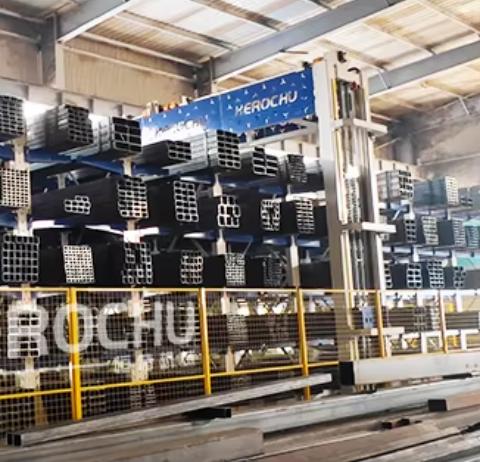
Storage cells function like intelligent drawers: each slot holds a precisely categorized bundle of steel bars, pipes, or structural profiles. Slots adapt to different bar diameters, square tube sizes, and profile shapes, allowing multiple material types to be stored centrally in one system. For round bars and pipes, V-cradles or profile recesses prevent rolling. For flat bar and profiles, flat supports with lateral restraints maintain position.
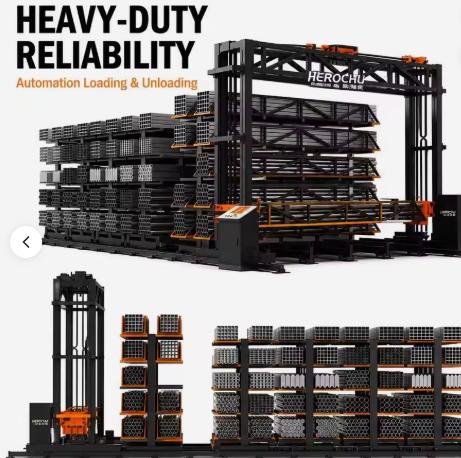
A critical engineering issue in bar stock storage is deflection from point loading. When a 12-meter bar is supported only at its ends, self-weight deflection over long storage periods can exceed straightness tolerance. Herochu’s bin cell grid provides intermediate support points at 600 mm × 500 mm intervals, distributing load across multiple contact points to prevent point-loading deflection and central sagging.
Precision, Speed, and Control Architecture
Motion performance of the top-mounted system is optimized for heavy-load duty. Lift speed reaches 40 m/min, carriage traverse speed reaches 100 m/min. Gantry handler exchange and lift speeds run 5–15 m/min. Across all motions, ±2 mm repeatability ensures each bundle is placed precisely at the target position, eliminating the alignment errors common in manual forklift operations.
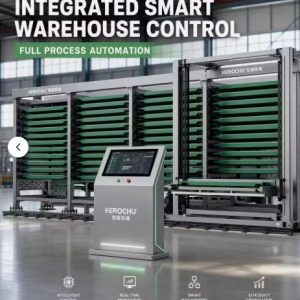
The control architecture centers on Siemens S7-1200 PLCs communicating with drive systems over PROFINET. A 12-inch color HMI displays real-time stock status. Operators execute retrieval commands with one-touch operation. The system supports barcode and QR code scanners for batch-level traceability required in aerospace and automotive industries.
The digital inventory module binds directly to the PLC. When the gantry stores a bar bundle into a tower position, the system records location, material grade, heat number, and remaining quantity. The touchscreen shows a live map of every occupied and empty slot, color-coded by material type or storage duration.
Coordination with Downstream Equipment
The open-ground characteristic of the top-mounted AS/RS gives it a natural advantage in downstream integration. With no floor rails or columns obstructing the path, the system can feed directly to adjacent saws, laser cutters, or machining centers.
The system’s goods-to-person model means operators no longer walk to storage positions. When a CNC band saw or laser cutter requests material, the system identifies the correct slot and delivers the bar bundle to an ergonomic-height pick point. The operator’s role narrows to picking and loading—precisely where their time should be invested.
For plants already running MES or ERP, the system exchanges data bi-directionally over PROFINET, Ethernet/IP, or Modbus TCP. When an ERP work order consumes specific material, the system’s actual issue quantity is written back. Differences between planned and actual consumption are flagged on the ERP dashboard without manual counting.
Customization and Scalability
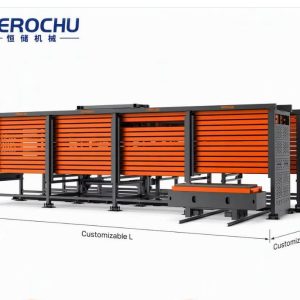
Herochu provides a free 3D layout drawing for every project based on the customer’s CAD plant layout. Storage layers (typically 5–8, customizable), rack quantity (standard 8–10, customizable), material length, and load rating are all configurable.
The modular design allows physical layers and software configurations to expand without stopping production. Adding tower positions requires no rewiring or controller replacement. For businesses with uncertain growth expectations or phased investment, this scalability lowers the pressure of initial capital expenditure.
Conclusion
The value proposition of the top-mounted AS/RS is not higher storage density—every vertical storage system claims that. The differentiation lies in uncompromised ground logistics. For plants already invested in lean material flow, cellular production, and rapid changeover, the top-mounted architecture makes automated storage a component of that system rather than a competing standalone facility. The 100% openness of the ground level is an engineering decision whose return shows up in every forklift pass and every equipment changeover.