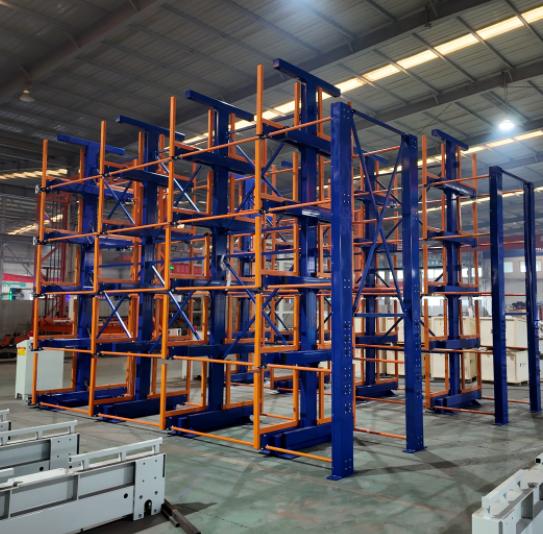
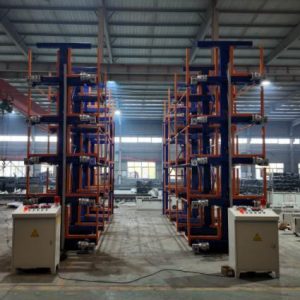
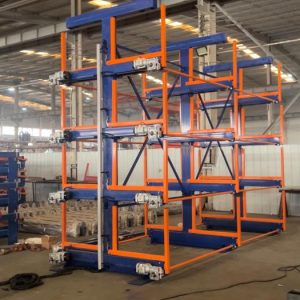
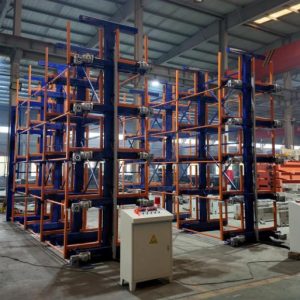
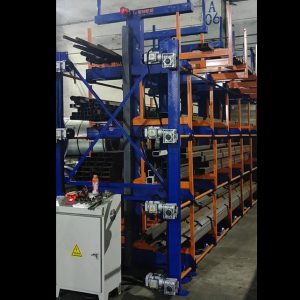
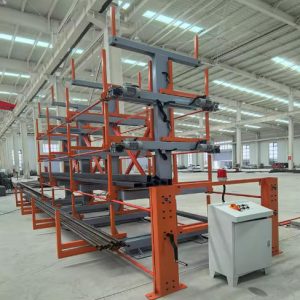
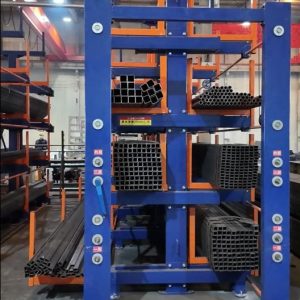
A motorized telescopic cantilever rack stores bar stock, profiles and other long items horizontally in tiered compartments and extends the arms to the crane hook, so nothing is dragged out of a floor stack. Herochu builds them for 6–12 m material at 5,000–8,000 kg per level, with electric extension up to 100% of arm stroke.
Bar stock is not tube with a different shape
A tube store and a bar store look similar on a drawing and behave nothing alike on a floor. Hollow section is light for its diameter, so a bay that looks full is often only half-loaded. Solid bar is the opposite. Weight arrives fast and it arrives low in the bundle.
Take one 100 mm round bar at 6 m: 0.047 m³ of steel, roughly 370 kg. Ten of them are 3.7 t in a single lift, in a bundle narrow enough to look harmless. A bay sized on the impression of “a few bars” is at its limit before the third layer is filled.
Bar storage fails quietly. Arms deflect a little more each year, bundles sit lower, and a tier rated 3 t ends up carrying 4 t because nobody recalculated when the product mix changed. Herochu’s heavy-duty line reaches 8,000 kg per level on the 9 m and 12 m models for that reason.
What counts as a long item
In practice the racks serve anything long, heavy and awkward to lift by hand: round, square and hexagonal bar in 3–12 m lengths, flat bar and strip in bundles, angle and channel, rail sections, and rod bundles lifted as one unit. The common thread is not the material. It is that the item has to be presented to a crane and come out in the order the schedule needs.
Design points that matter for bar
Arm spacing against bundle width. Solid bar bundles are narrow and dense. Arms set for a wide tube bundle leave the bar overhanging, which puts bending load on the ends instead of the supports. Spacing is set per compartment.
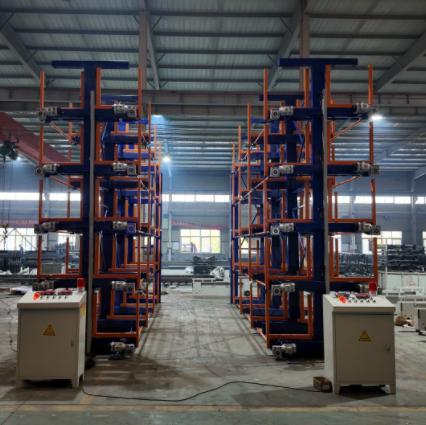
Arm rating against real bundle weight. Manual arms come in 0.5 t, 1.0 t, 2.0 t and 3.0 t ratings. Past about 2 t per bundle the electric version becomes the practical choice, because the arm still has to be positioned accurately with that load on it.
Extension to the pick point. Arms stroke 1.0–3.0 m and reach full extension, so the hook never travels into the bay and nobody stands under a partly extended arm guiding a bundle by hand.
Cradle or end stop. Round bar rolls exactly like round tube when lifted. A shallow cradle keeps a bundle square during the lift and keeps the bar surface off the arm edge.
Carriage speed is 27 mm/s, slow enough that a full extend-and-retract sits inside one crane cycle and a bundle can be set down without impact.
Model range for bar and long items
| Model | Stock length | Max. load per level | Levels | Extension |
|---|---|---|---|---|
| HC-G6055SE | 6,000 mm | 5,000 kg | 5 (customisable) | Electric, dual-side |
| HC-G6055E | 6,000 mm | 5,000 kg | 5 (customisable) | Electric, dual-side |
| HC-G9068E | 9,000 mm | 8,000 kg | 6 (customisable) | Electric, dual-side |
| HC-G12068E | 12,000 mm | 8,000 kg | 6 (customisable) | Electric, dual-side |
Column height ranges from 2.0 m to 6.0 m, tier clear space is 700 mm as standard, and both are set to the customer’s stock rather than to a fixed catalogue value.
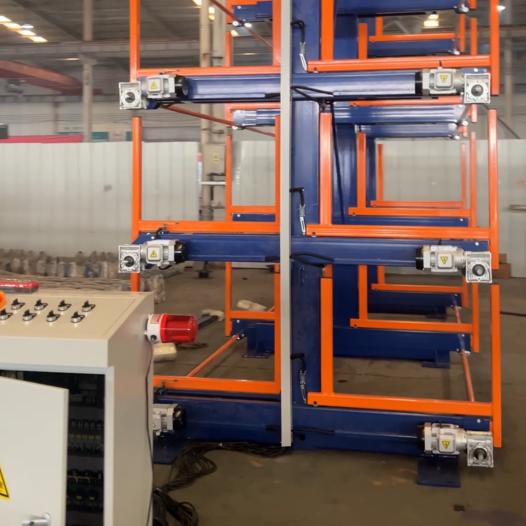
Putting the rack where the saw is
The largest gain in a bar store is usually layout, not hardware. Bar is consumed at the saw, so distance between rack and saw turns into crane travel and into handling steps that damage bar ends.
Two arrangements work.
Rack at the saw. The rack stands parallel to the saw infeed, highest-turnover sections nearest the blade. One lift puts a bundle on the infeed, and the extension stroke brings the next one forward without disturbing the rest.
FIFO lanes for traceable stock. Where heat numbers have to follow the material, each compartment becomes a lane: load one end, draw from the other. Because tiers are independent on both sides of the column, a lane can hold a single heat number without mixing it with the next delivery.
Herochu’s comparison for 6 m stock puts retrieval at under three minutes against 30–60 minutes for floor stacking, with one person instead of two or three plus a forklift.
Traceability and damage control
Bar dragged across a floor loses more than paint. It picks up grit and concrete dust, and that grit travels into guides and collets downstream. Lifting instead of dragging removes the contamination and the edge damage that turns a full-length bar into a short offcut.
Herochu builds the frame from Q235B high-strength steel with a dual-beam crossbar, so a bundle set down slightly off-centre does not twist the arm. Independent compartments keep material types, sizes and heats apart without extra racking.
Where Herochu fits
Herochu builds retractable cantilever racks in a 20,000 m² factory with a 300-person team, to ISO 9001 with CE marking on the electric drives. The specification conversation starts with the bar schedule, the bundle weights and the saw position, because those three inputs decide the tier geometry. Arm rating, extension length, clear space and column height then follow the building, not a standard model.