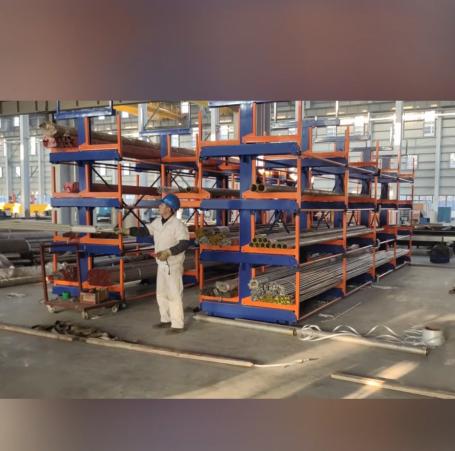
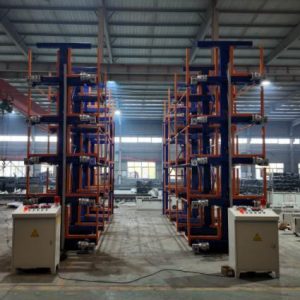
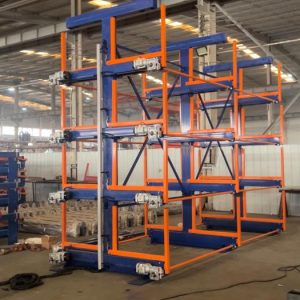
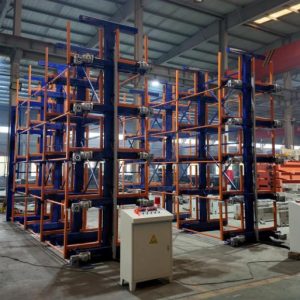
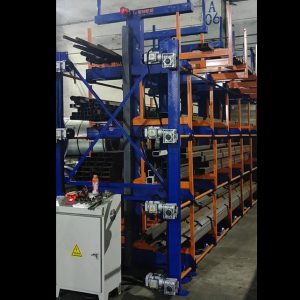
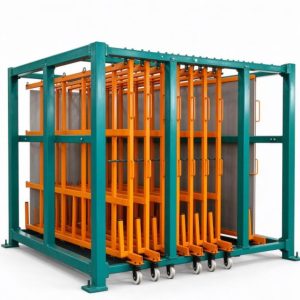
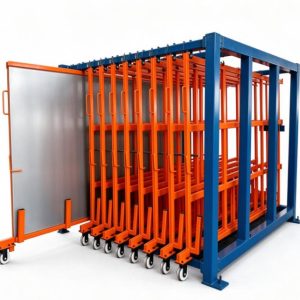
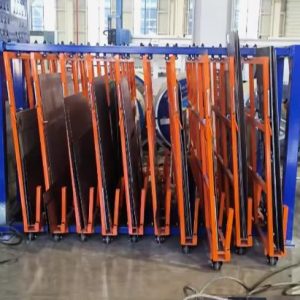
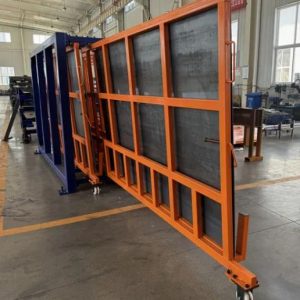
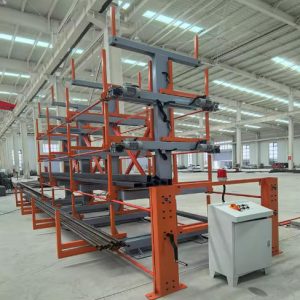
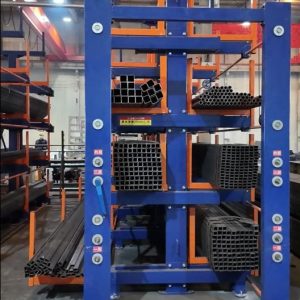
A heavy-duty electric pipe and tube storage system holds round, square and rectangular hollow sections in separate tiered compartments and moves them with powered arms instead of forklifts. Herochu rates these racks at 5,000–8,000 kg per level, six tiers high, for 6 m to 12 m stock, with dual-side electric discharge.
Why square and round stock need different rack design
Round tube rolls. Square tube does not. That difference changes how the rack has to be built, and it is why a general-purpose cantilever rack underperforms in a mixed tube store.
A bundle of round tube rests on two contact lines per arm. Arms too far apart and the bundle sags, so the bottom tubes carry everything above them; arms too close and the ends bell out. Square and rectangular hollow section sits flat, stacks on faces, and takes its stiffness from wall thickness and orientation rather than from where the arms touch.
A heavy-duty electric system handles both by treating tier design as a variable. Arm spacing, clear space and arm count are set per compartment, so a bay carrying 168 mm OD pipe does not share geometry with a bay carrying 200 × 200 × 8 mm box.
What “heavy-duty” should mean in a specification
In practice the word means four measurable things:
- Steel grade. Q235B high-strength steel, with columns sized for the bending moment at the base rather than a nominal tonnage.
- Crossbar. A dual-beam crossbar ties the column faces together, which stops arms twisting when a bundle lands off-centre.
- Load per level, stated honestly. 5,000 kg on the 6 m models, 8,000 kg on the 9 m and 12 m models, held across the full tier rather than at one point near the column.
- Drive sizing. The carriage motor is matched to the extension moment of a loaded arm; a drive sized for an empty arm stalls at half stroke.
Herochu’s electric range is built to those four points, with ISO 9001 manufacturing and CE marking on the drive package.
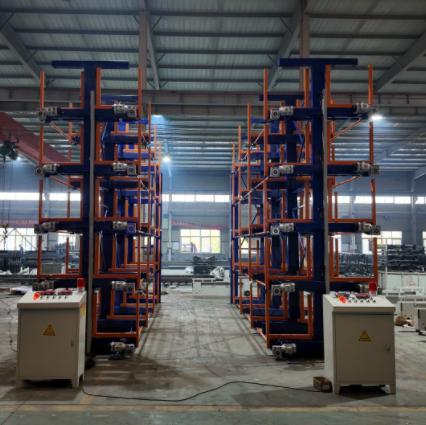
Round versus square: what changes on the rack
| Property | Round tube | Square / rectangular hollow section |
|---|---|---|
| Resting behaviour | Two line contacts, will roll if unrestrained | Flat face contact, stable when stacked |
| Failure mode in storage | Ovalisation at support points, end damage | Face scratching, corner denting, bundle topple if over-stacked |
| Useful arm spacing | Longest practical span to limit sag | Matched to bundle width, more arms per tier |
| Tier clear space | Set by OD plus sling clearance | Set by stack height, not by single piece |
| Retrieval risk | Need chocks or end stops on the arm | Need straight vertical lift to avoid face damage |
Two consequences follow. End stops and arm cradles matter more with round stock, because a slow roll during a lift is how tube ends get dented. Square stock tolerates narrower tier spacing, since nothing needs sling clearance over a curved face, so the same column height yields more usable layers.
The model range
| Model | Pipe length | Max. load per level | Levels | Clear space |
|---|---|---|---|---|
| HC-G6055SE | 6,000 mm | 5,000 kg | 5 (customisable) | 700 mm |
| HC-G6055E | 6,000 mm | 5,000 kg | 5 (customisable) | 700 mm |
| HC-G9068E | 9,000 mm | 8,000 kg | 6 (customisable) | 700 mm |
| HC-G12068E | 12,000 mm | 8,000 kg | 6 (customisable) | 700 mm |
Manual versions of the same frame are rated 0.5 t, 1.0 t, 2.0 t or 3.0 t per arm with 1.0–3.0 m extension and 2–6 layers, which suits slow-moving or short-length stock.
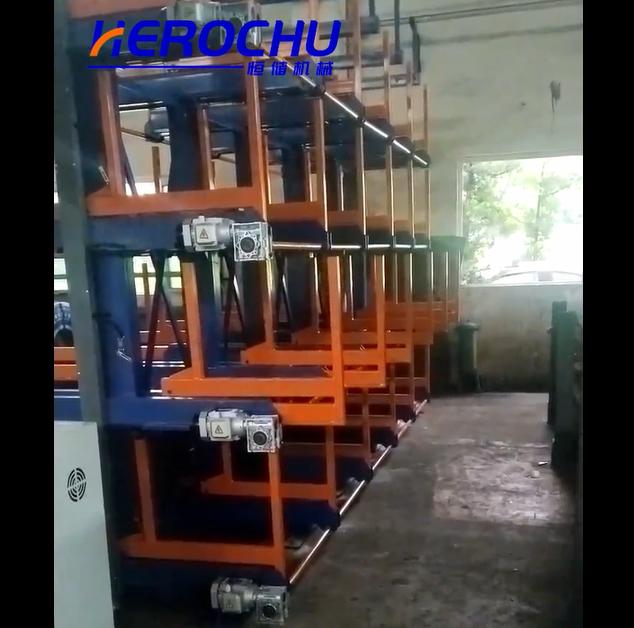
What an 8 t tier actually changes
Few plants lift an 8 t bundle daily. They buy 8 t tiers because a 4 t tier forces them to break bundles, and breaking bundles is where the hidden cost sits: extra crane cycles, extra handling, extra labour, more chances to damage material.
With a 5–8 t compartment a full incoming bundle goes from the delivery crane to a tier intact and comes out intact. In Herochu retrofit comparisons for 6 m pipe, retrieval falls from 30–60 minutes to under three, and storage area from around 100 m² of floor to a 20 m² vertical footprint.
Safety case
Crane access removes the forklift from the storage zone, which is the largest single risk reduction in a tube store: forklifts working inside racking are the classic collision and crush scenario. Herochu’s comparison puts accident rate 95% lower after conversion, with material damage close to zero because bundles are lifted, not dragged.
The electric drive adds a second layer. Arm position is set from a pendant, so nobody stands under a partly extended arm to guide it.
How to specify in five questions
- Longest stock length, and whether 20 ft or 40 ft containers arrive unbroken.
- Heaviest bundle, with sling and spreader included.
- Split between round and square stock, so compartments can be allocated.
- Number of material types in active circulation — this sets bay count, not pipe count.
- Crane hook height and floor slab capacity at the footplates under full load.
Where Herochu fits
Herochu builds the rack, carriage and drive as one system in a 20,000 m² factory with a 300-person team. That matters when tier geometry has to change because a customer’s square stock is deeper than the drawing suggested: the change stays a factory revision. Customisation covers extension length, layer count, clear space, arm rating and column height, set against the real pipe schedule.