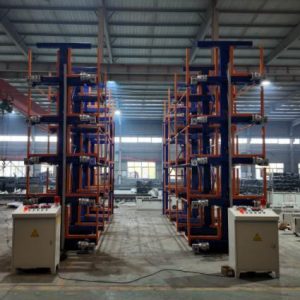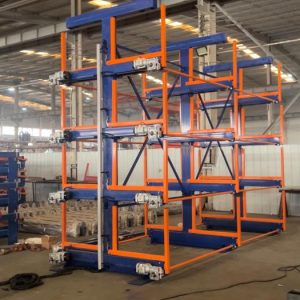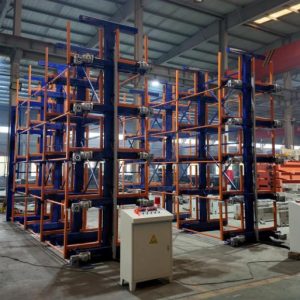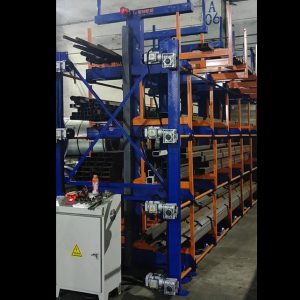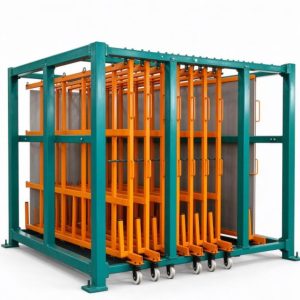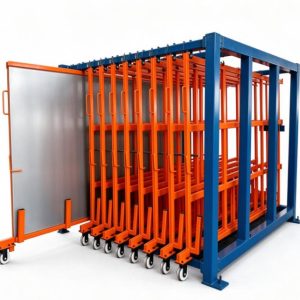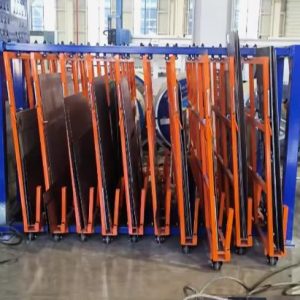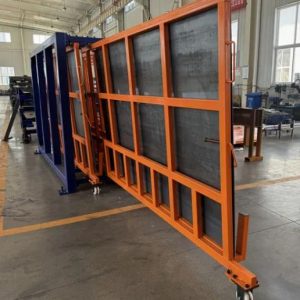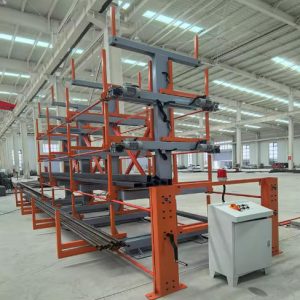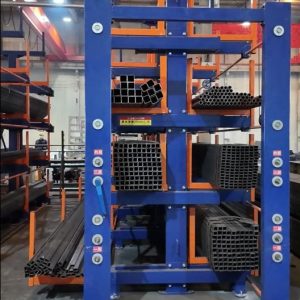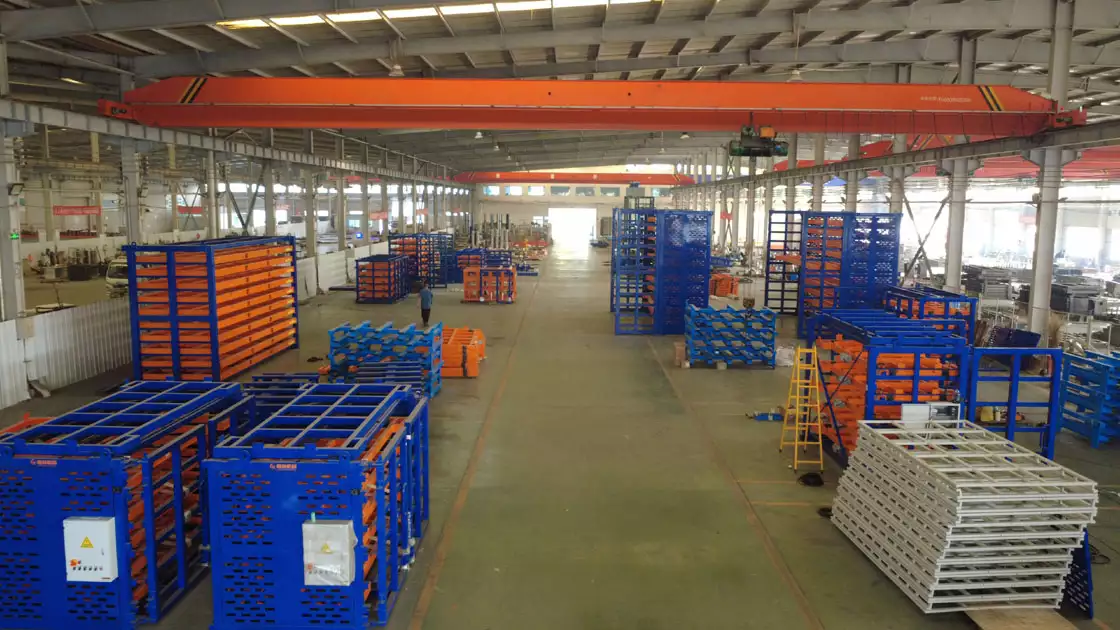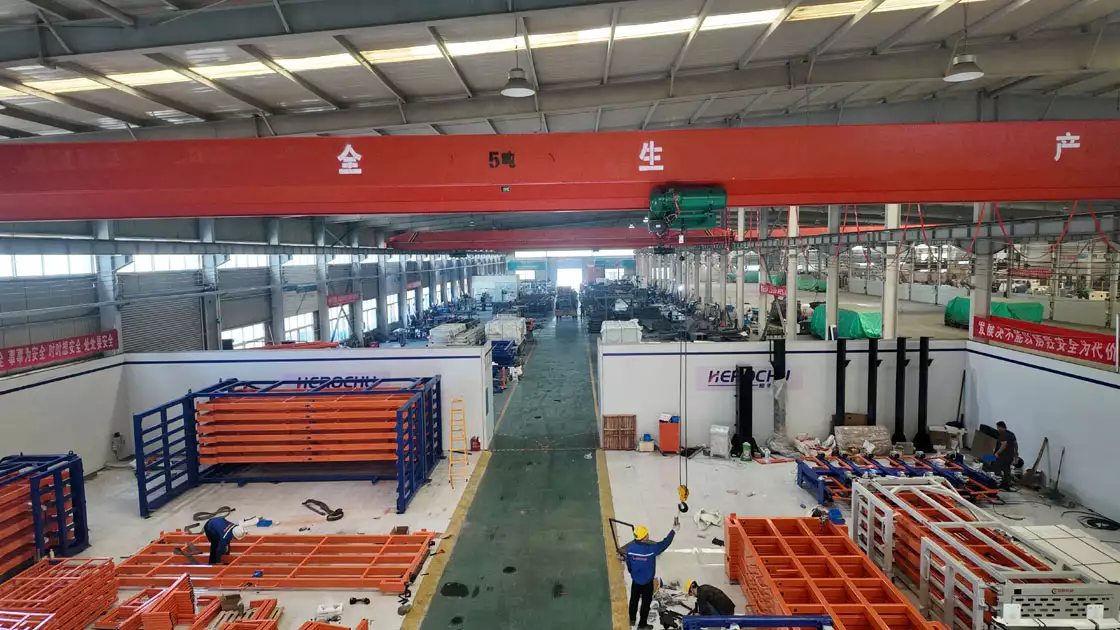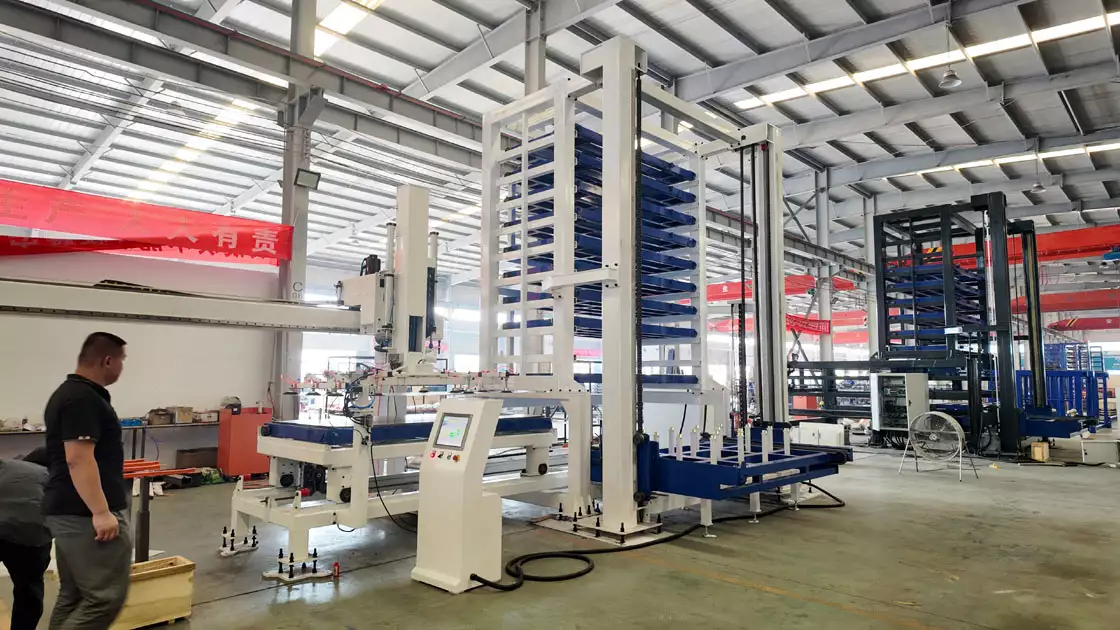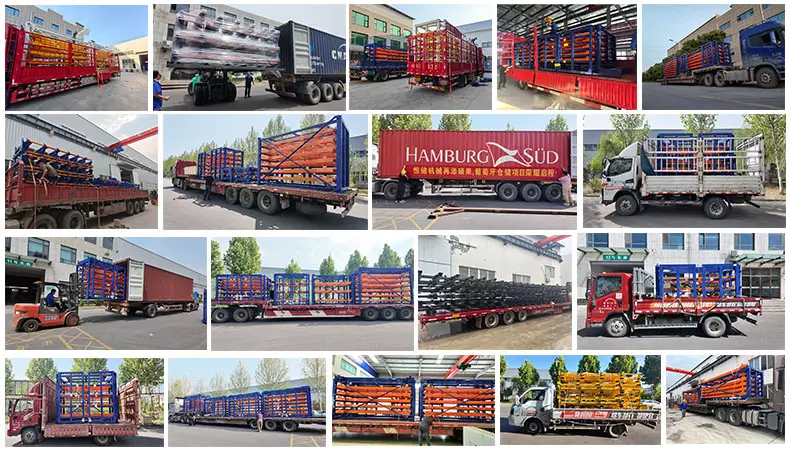
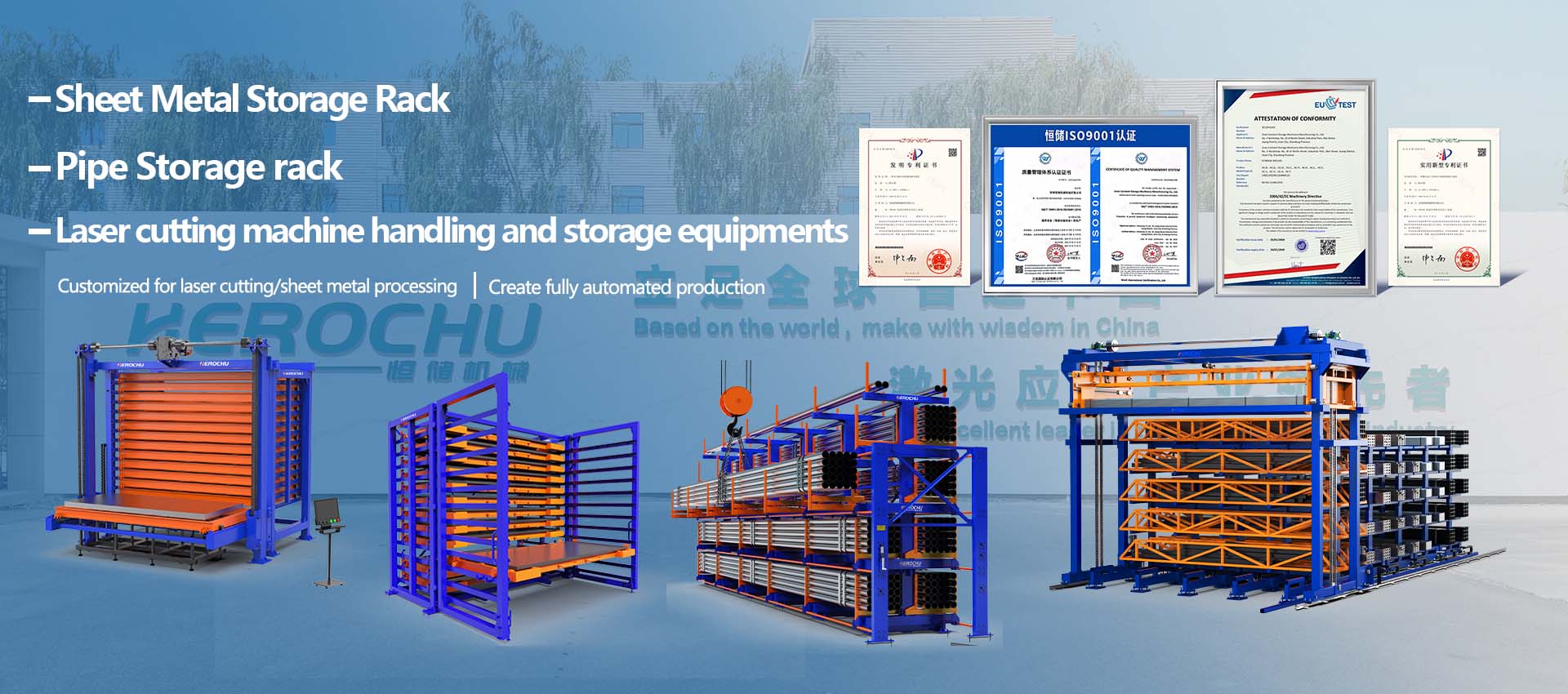
A motorized telescopic cantilever rack stores long pipes, tubes and profiles on powered arms that extend up to 3 m, so an overhead crane picks from the arm instead of a floor stack. Herochu builds them from Q235B steel at 5,000–8,000 kg per level for 6 m, 9 m and 12 m stock.
What a motorized telescopic cantilever rack replaces
Most pipe storage problems are not storage problems. They are handling problems. A 6 m bundle of steel tube lying on the floor cannot be lifted cleanly, counted without moving four other bundles, or reached without a forklift, a driver and a spotter. Multiply that by a few hundred bundles and the warehouse becomes a queue.
A motorized telescopic cantilever rack moves the material instead of the machine. Each arm slides out of the column on a powered carriage. The crane hook reaches the load at the extended position, lifts vertically, and the arm retracts under the remaining stock. Nothing is dragged, and no forklift aisle has to be reserved between rows.
Herochu supplies both manual and electric versions. The manual type uses a hand crank and suits low-turnover stock. The electric type drives arm extension and height from a pendant, and it is what most fabricators specify once they handle 9 m or 12 m material.
Why floor stacking wastes half of a pipe store
The numbers below come from Herochu’s own comparison of ground stacking against rack storage for 6 m pipe. They are typical figures, not a guarantee for every building, but they explain why the retrofit payback is usually short.
| Measure | Ground stacking | Motorized telescopic rack |
|---|---|---|
| Time to find and free one bundle | 30–60 minutes | Under 3 minutes |
| People needed per pick | 2–3 plus a forklift | 1 |
| Floor area consumed | ~100 m² of stack plus aisle | ~20 m² of vertical footprint |
| Edge damage and deformation | 3–5% of stock | Close to zero |
| Collision risk | Forklifts moving in the storage zone | Crane-only access, no aisle traffic |
Two rows carry the business case. A vertical rack puts six layers where a floor stack put one, so the footprint drops by roughly 80% and the released metres go back into production. The other is damage: scratched and ovalised tube ends become concessions, rework or scrap, and that loss repeats every time a bundle is dragged across concrete.
How the telescopic mechanism works
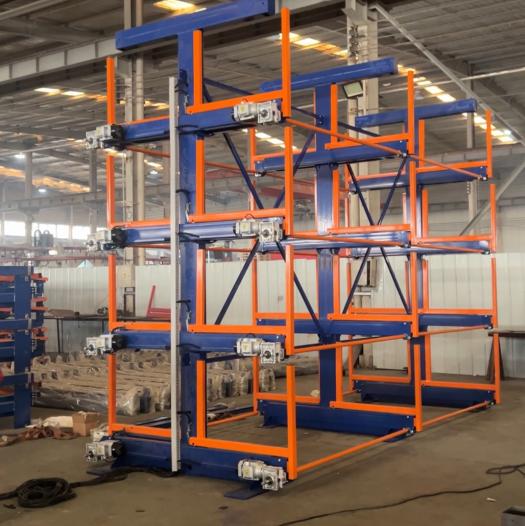
Herochu builds the unit as a column-and-arm structure: welded Q235B columns tied at the top and braced at the base, with arms carried on a carriage that runs in the column. The carriage motor drives at 27 mm/s — slow enough to position accurately, fast enough that a full extend-and-retract stays inside a normal crane lift.
Three details decide daily usability:
- Extension length. Arms travel 1.0–3.0 m and reach 100% of stroke, so a bundle at the back of the bay is presented at the front instead of fished out with a hook.
- Clear space between tiers. 700 mm as standard, adjusted to the tallest profile in the load. Too little and operators stop using the upper tiers.
- Independent compartments. Each tier carries separate loads on both sides of the column, so one bay can hold 114 mm round tube on the left and 100 × 100 box section on the right without mixing batches.
The crossbar between the column faces is a dual-beam design, which keeps a 12 m arm from twisting when a bundle lands off-centre — the usual failure point on light-duty cantilever racks.
Load, length and height range
| Model | Pipe length | Max. load per level | Levels | Discharge |
|---|---|---|---|---|
| HC-G6055SE | 6,000 mm | 5,000 kg | 5 (customisable) | Dual-side electric assistance |
| HC-G6055E | 6,000 mm | 5,000 kg | 5 (customisable) | Dual-side electric assistance |
| HC-G9068E | 9,000 mm | 8,000 kg | 6 (customisable) | Dual-side electric assistance |
| HC-G12068E | 12,000 mm | 8,000 kg | 6 (customisable) | Dual-side electric assistance |
How to size one for a real pipe mix
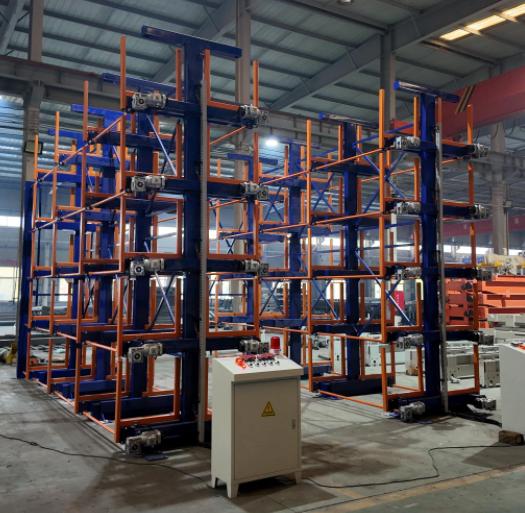
Start with the longest item, not the average. A rack sized for 6 m stock quietly becomes a 6 m rack holding 9 m tube at an angle, and angled storage destroys the load rating. Then answer three questions: what is the heaviest bundle including sling and spreader, how many material types must stay separate at once (that sets bay count, not pipe count), and what will the slab take under a loaded 8 t tier at the footplates.
Column heights run from 2.0 m to 6.0 m, set by the crane hook height. Manual arms are rated 0.5 t, 1.0 t, 2.0 t or 3.0 t each; the electric range holds 3–8 t per compartment.