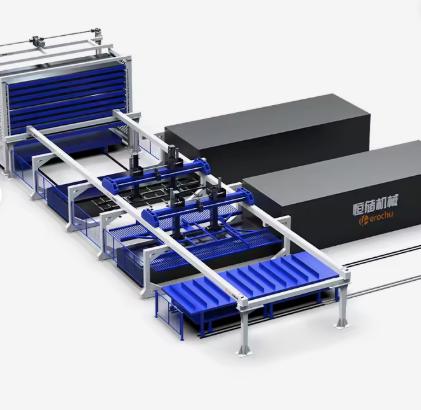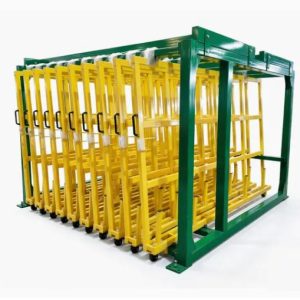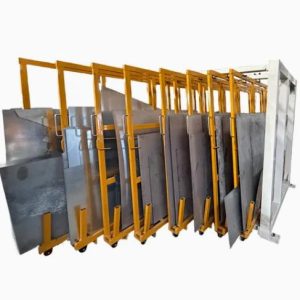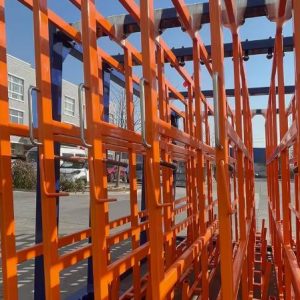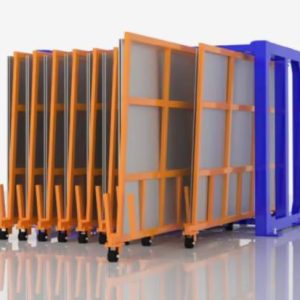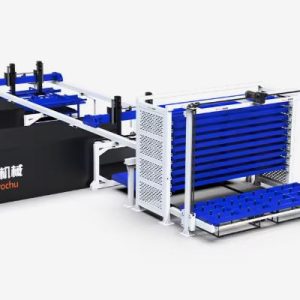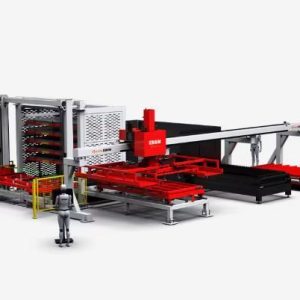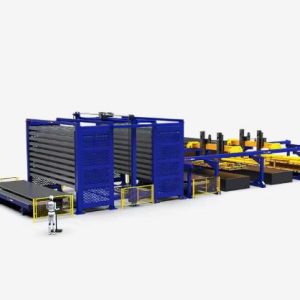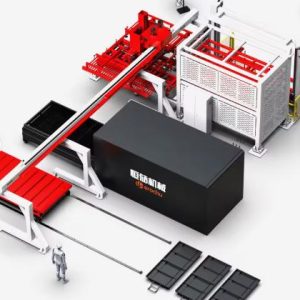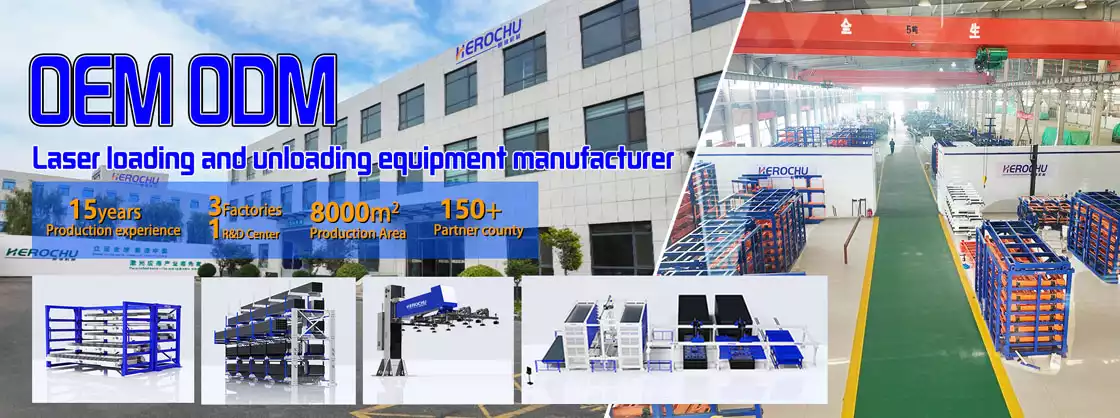
Fiber lasers cut faster than any crew can feed them. A modern fiber laser cutting line can finish a sheet in minutes, but if the next plate arrives only when an operator finds time to bring it, the machine idles, and idle time is the most expensive defect in the process. Herochu’s unmanned sheet storage and loading tower closes that gap: storage, retrieval, loading, and unloading run automatically for automated fiber laser cutting lines, so production continues after the last shift clock-out.
The full cycle runs without hands
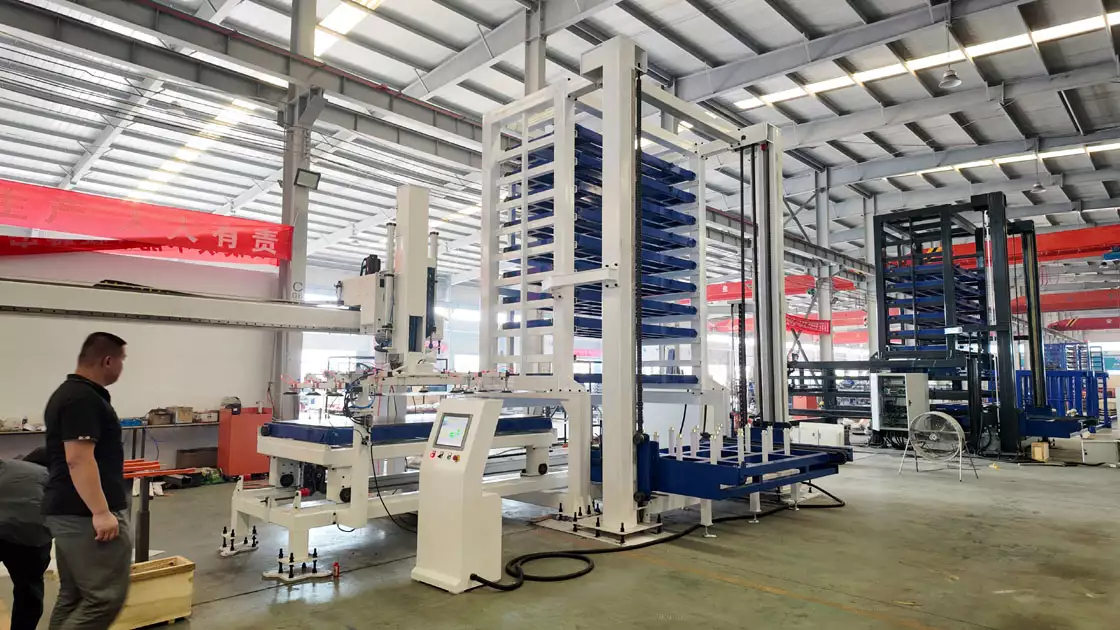
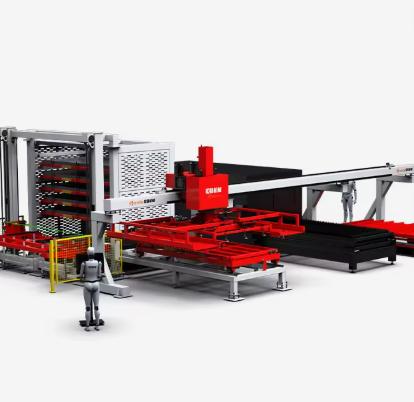
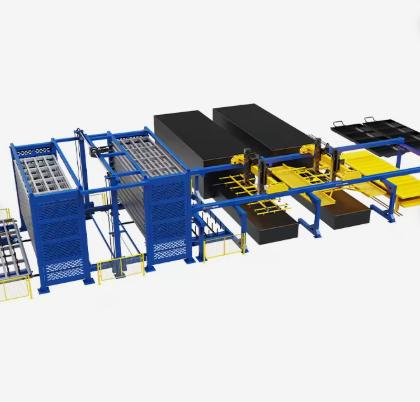
The system handles every step that used to require people. Raw sheets are stored in a vertical tower of 8 to 10 layers. A loading arm with vacuum suction retrieves the correct plate according to the schedule. A material cart transfers it at 5-15 m/min to the machine. The exchange table swaps the raw sheet into cutting position while the finished sheet is unloaded on the other side. The tower communicates with the machine exchange tables, so feeding and unloading stay in step with the cut cycle even when several programs run in sequence. Each step triggers the next under PLC control, with no operator in the loop.
The figures that matter for unattended operation: arm horizontal travel 10-30 m/min, lifting 5-10 m/min, fork speed 5-20 m/min, and a sheet payload up to 500 kg. These are the speeds that keep a fiber laser’s table full.
Buffer management turns scheduling into software
The word “unmanned” usually hides the real challenge: the tower must hold the right mix of material and feed it in the right order. The Herochu tower works as an automated buffer. Each tier holds a different sheet type, thickness, grade, or size, and the WMS/WCS software indexes the inventory and switches material according to the real-time cutting schedule.
This matters most at night. Overnight, a line can work through a stack of mixed jobs: several sheet types, several programs, no human to reset anything. The system reads the schedule, pulls the next plate, feeds it, unloads the finished parts, and moves to the next job. Small-batch and mixed-material production, the hardest part of the day to staff, becomes the easiest.
Built for continuous fiber laser production
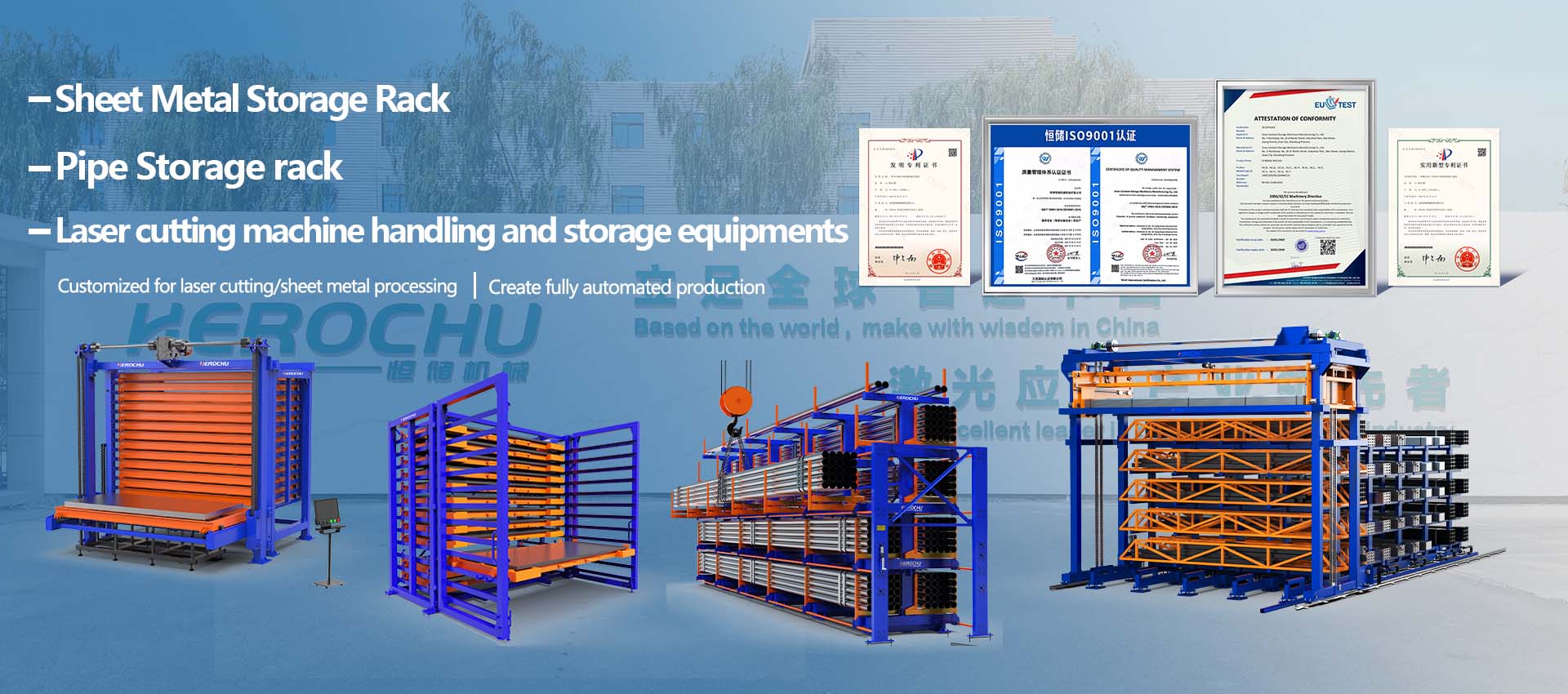
The Herochu tower is sized to the laser fleet, not to a single machine. Models run from the HC-A3015-83, for 3000 x 1500 mm sheets in 8 layers, to the HC-A6020-105, for 6000 x 2000 mm sheets in 10 layers at 5,000 kg per tier. Applicable sheet dimensions extend to 6000 x 2500 mm, and clear space between tiers is 350 mm as standard, customizable for thicker stock.
Fast indexing keeps the sequence tight. The tower pre-stages the next sheet while the current one is still cutting, so the exchange table is never waiting for material. With several lasers on one line, the cart serves them in rotation and the software balances demand across machines. That is what an automated fiber laser cutting line means in practice: material arrives exactly when the machine is ready, every cycle, all night. Operators can check remaining stock tier by tier from the HMI, without climbing ladders or walking the floor.
Safety engineered for an empty shop floor
Automation that runs unattended has to be safer than automation with operators, because no one is watching. The tower is enclosed and sensor-monitored: photoelectric sensors detect anything entering the movement envelope, weight detection modules verify the sheet is seated before any axis moves, and emergency shut-offs stop the system instantly. Movement envelopes are predictable and guarded, and no forklift traffic crosses the cell.
Removing forklifts from the material loop also removes their accidents, collisions, dropped loads, crushed sheets, and their cost. A forklift operator tied up between machines is labor spent on handling, not on production.
Traceability and the Industry 4.0 record
Unattended operation depends on data, and the system produces it continuously. WMS/WCS tracks every plate by specification, batch number, and location from the moment it enters the tower to the moment its parts leave the machine. The same data synchronizes with ERP/MES, so production planning and inventory control reflect what actually happened on the floor, not what someone recorded later.
That digital record is the foundation of the Industry 4.0 transition. Every raw plate has a history, every cut part can be traced back to its batch, and production reports generate automatically. For a plant working toward lights-out manufacturing, this is the difference between automation and traceable automation. It also simplifies audits: material certificates and usage records are available on request, organized by batch and by job.
Where the payback comes from
The economics are straightforward. Floor space for horizontal storage drops by up to 70-80%. Night shifts produce unattended. One supervisor covers more machines. Sheets are handled the same way every cycle, so scrap from handling damage disappears. Herochu configures the tower, cart, and docking to the fiber laser lines already on site, and the system pays for itself in the hours it puts back into cutting. A system that runs unattended also runs consistently, and consistency is what turns cutting capacity into finished output.