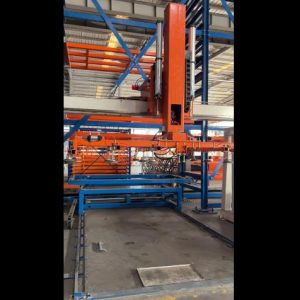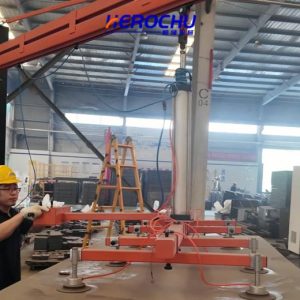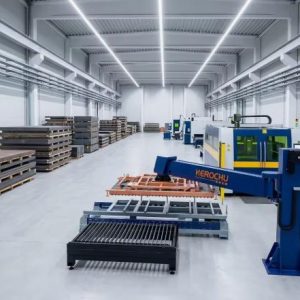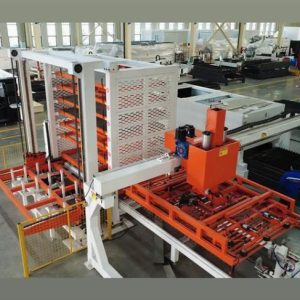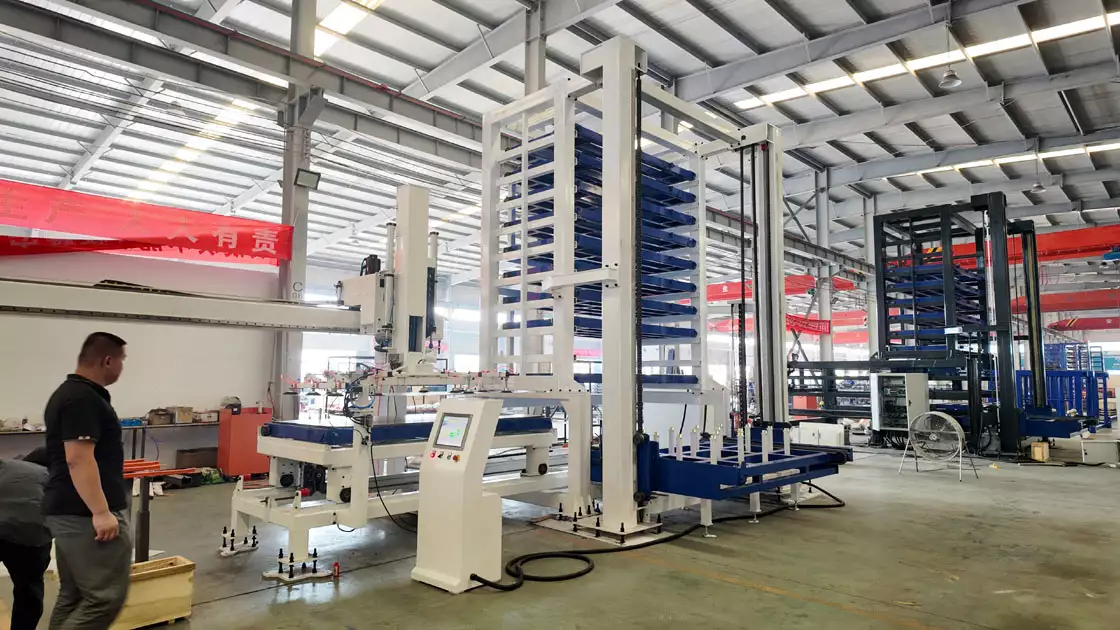
An industrial laser cutters feeding system moves sheet metal from a stack to the cutting bed without an operator lifting it. Vacuum cups pick one sheet, a sensor confirms separation, and the gantry sets the blank against the positioning stops. Herochu builds the HC-RL series for 2500×1300 mm and 3000×1500 mm sheets, at 300 kg and 500 kg stack capacity, with ±2 mm repeatability.
What a feeding system replaces
On a manual fiber laser cell the operator performs three tasks that have nothing to do with cutting: lifting a sheet off a pallet, aligning it to the stops, and dragging the cut skeleton away afterwards. Each one stops the machine. A modern source cuts 1 mm mild steel faster than a person can walk a sheet around the table.
Machine hour rates for a 6 kW fiber laser typically run several times the hourly cost of the operator standing beside it, so idle minutes cost more than the labor they save. Feeding automation closes that gap. It does not cut headcount.
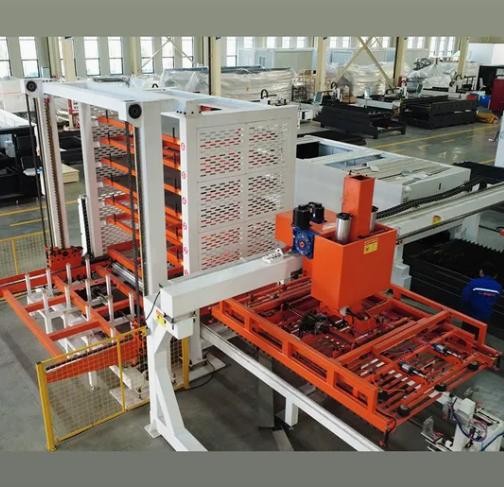
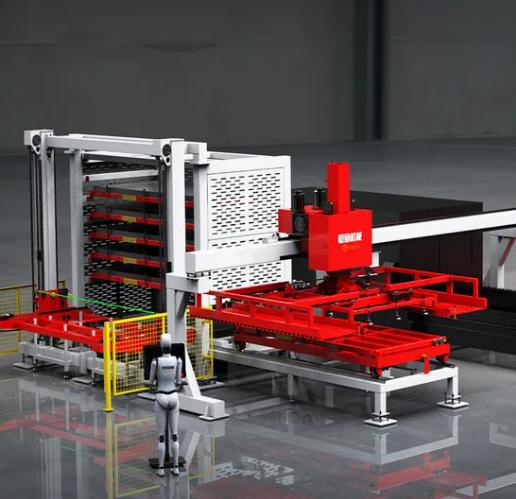
Herochu’s approach is mechanical: a bridge gantry over the sheet stack, a vacuum frame that lifts one sheet at a time, and a tine fork that slides under the finished part to unload it. No robot arm, no gripper changeover, no teaching routine when the job changes.
Four motions in every feed cycle
- Approach. The frame descends to the top of the stack. Lifting stroke is 700 mm as standard, customizable when pallet or table height differs.
- Pick and verify. Cups pull vacuum and a pressure switch confirms the sheet is held. If vacuum fails, the cycle aborts before the gantry moves.
- Transfer. The bridge carries the sheet at 5–10 m/min and lowers it onto the support slats.
- Locate and release. The blank is pushed against fixed stops, vacuum is vented, the gantry returns home, and the laser starts its program.
Unloading mirrors the sequence. Tines slide beneath the cut sheet, lift it clear of the slats, and carry it to the output stack. Because they support the material from below across its full width, tines handle skeletons and thin parts that vacuum would drop.
Sheet separation decides reliability
Double-pick is the most common feeding fault, and it is rarely a vacuum problem. Oil film, condensation, and the slight suction between two polished sheets hold them together. If two sheets reach the bed, the laser cuts the wrong thickness and the part is scrap.
Three countermeasures are standard on Herochu loaders: corner-only cup placement, where sheets are least likely to be sealed by oil; a separation cycle that lifts the sheet, breaks the edge seal with a short air pulse, then re-checks vacuum; and thickness confirmation at pickup, taken from a frame sensor or from the laser’s own sheet-detection signal.
Shops running hot-rolled or pickled material should specify the separation cycle. It costs roughly two seconds per sheet and removes most of the scrap risk.
Sizing the feeder to the cutter
| Model | Sheet size | Max. load | Lifting speed | Stroke | Repeatability | Air supply |
|---|---|---|---|---|---|---|
| HC-RL2513-300 | 2500 × 1300 mm | 300 kg | 5–10 m/min | 700 mm (custom) | ±2 mm | 0.6–0.7 MPa |
| HC-RL3015-500 | 3000 × 1500 mm | 500 kg | 5–10 m/min | 700 mm (custom) | ±2 mm | 0.6–0.7 MPa |
The load rating is a stack rating, not a sheet rating. A 500 kg unit covers a full pallet of 3 mm sheet at 3000×1500 mm, or a partial pallet of 8 mm. Size on the pallet weight your steel supplier actually delivers, then add margin for a wet or oily stack.
Where the time goes
Take a shop cutting 1.5 mm mild steel, 200 sheets a day across two shifts. Manual handling averages four minutes per sheet including walk time and skeleton removal — 800 minutes, or more than 13 hours of machine time. Automated load and unload usually returns three of those four minutes to cutting.
At that recovery the investment pays back against machine hour rate, not the wage bill — the framing that usually gets a capital request approved.
Settle layout and signals first
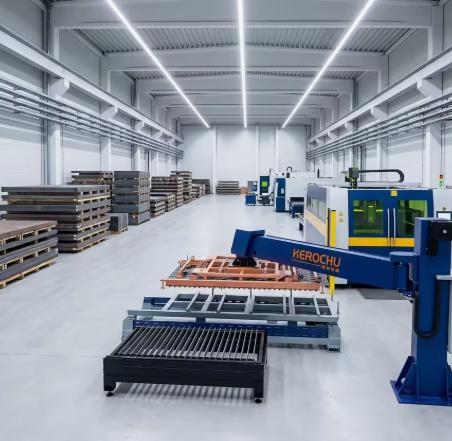
Two constraints decide feasibility before price does. Floor space: the gantry needs clearance on the loading side and a travel path clear of walkways, forklift lanes, and the chiller. Signal compatibility: the loader must read table-clear and program-end from the laser, and write sheet-present back.
Herochu systems use a standard handshake, which is why they fit existing fiber cutters as well as new installations. Ask both suppliers for the I/O list in writing before signing. Retrofits fail on documentation far more often than on mechanics.
FAQ
What is an industrial laser cutters feeding system? A gantry-mounted handling unit that lifts sheet metal from a stack with vacuum cups and places it on a laser cutting bed at a repeatable position, replacing manual loading. Most installations also unload cut sheets with a tine fork.
How long does one load cycle take? Typically 20–40 seconds including travel and stack approach, with lifting speed of 5–10 m/min and 700 mm standard stroke. On most jobs the laser is still cutting when the next sheet is staged.
Can it handle different sheet sizes without changeover? Yes. The vacuum frame is sized for the maximum format, and smaller blanks are held by the cup group that falls inside their outline. No mechanical retooling is required between sizes.
Does it prevent two sheets being picked at once? Corner cup placement, a short separation pulse, and a vacuum re-check before transfer. If separation fails, the cycle stops instead of feeding a double sheet into the laser.
Key takeaways
- Feeding automation pays back against machine hour rate, not labor cost.
- Sheet separation, not lifting capacity, is the reliability bottleneck.
- Verify the 700 mm stroke against your actual pallet and table heights.
- A standard I/O handshake makes retrofit on existing lasers practical.
- Tine unloading handles skeletons that vacuum cannot grip.