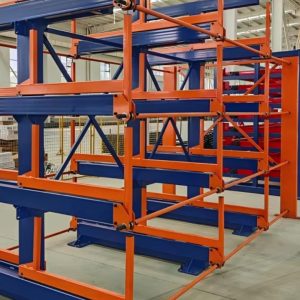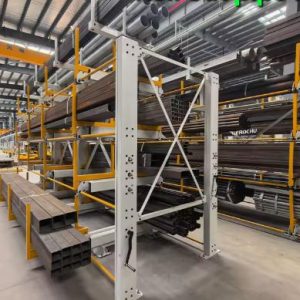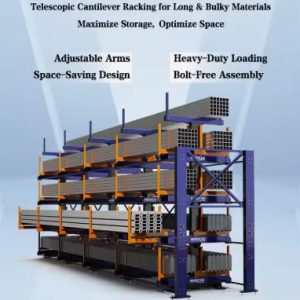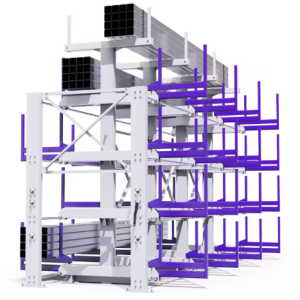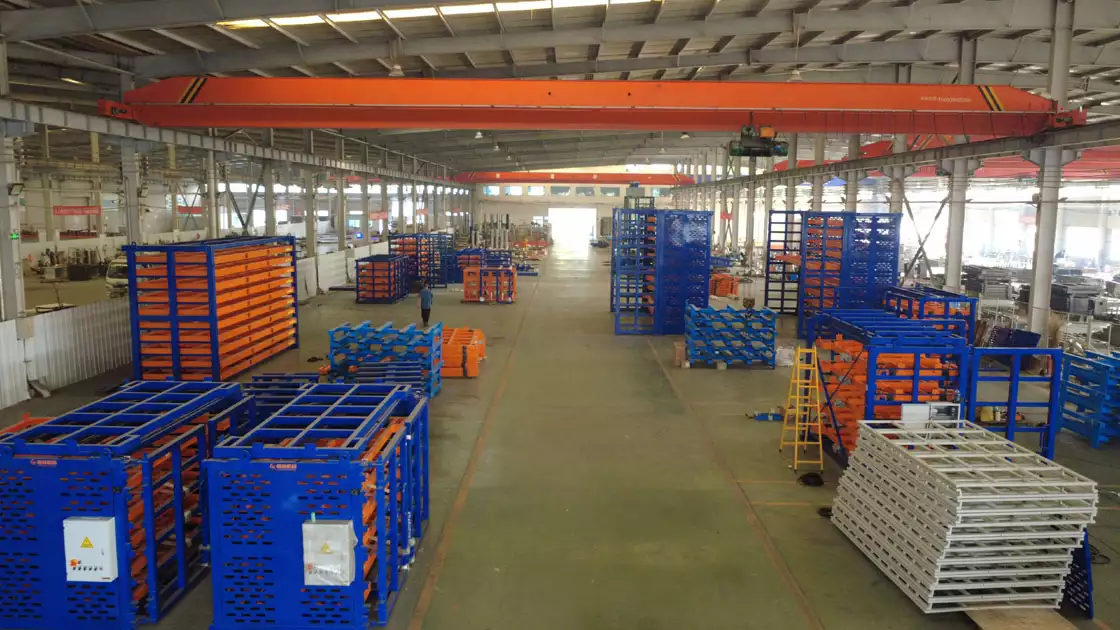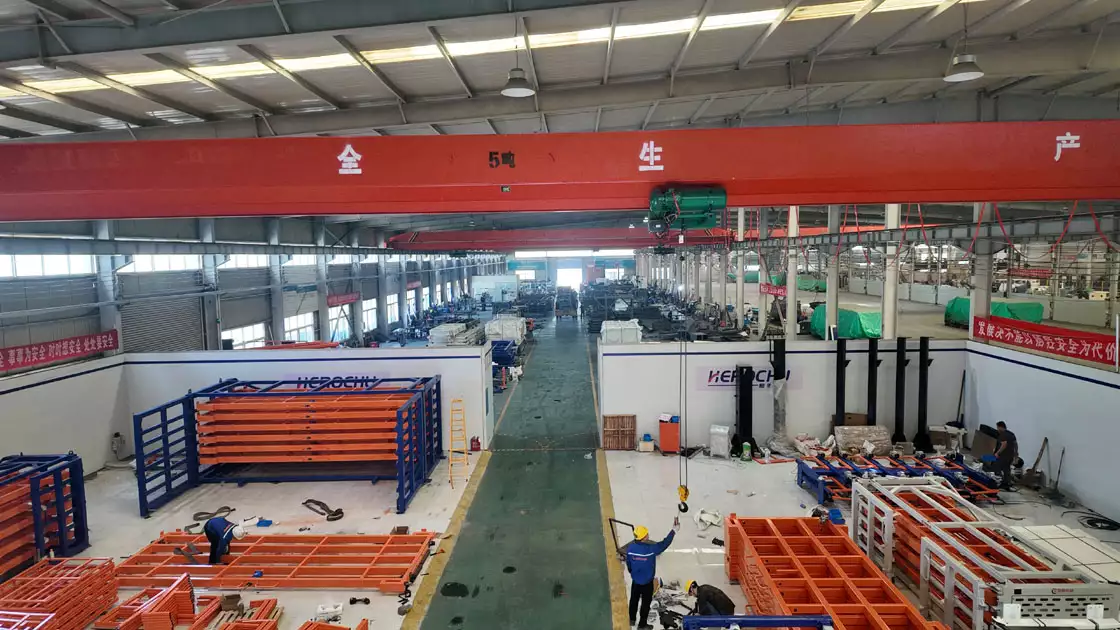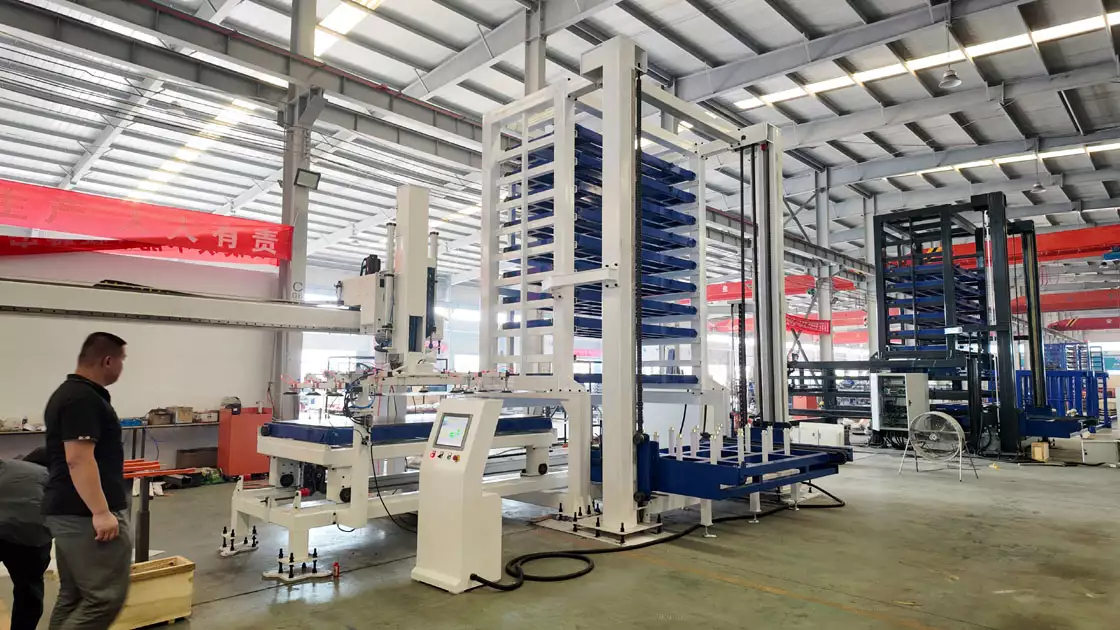
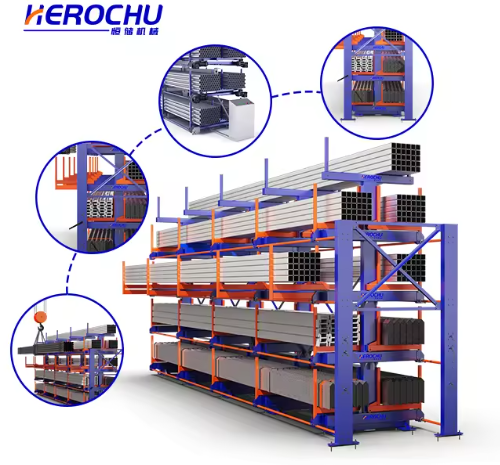
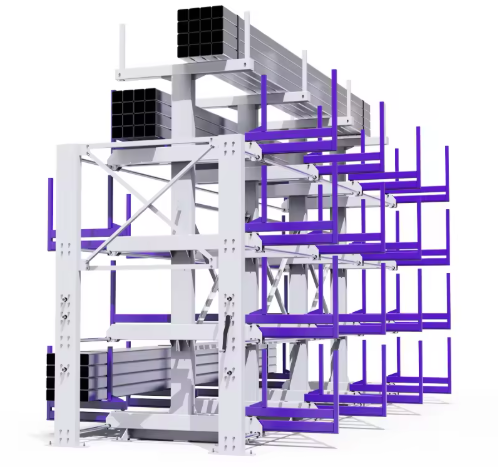
Steel pipes, channels, and hollow sections share a common storage difficulty: they are long, cylindrical or semi-cylindrical, and prone to rolling. On conventional fixed cantilever arms, round and hollow sections migrate under vibration, settle into gaps between bundles, and create unstable stacks that can discharge material when an adjacent bundle is removed. The Herochu roll out cantilever rack solves this through a telescopic tier mechanism combined with compartmented base trays that retain each material type in its designated position.
The Rolling Problem in Pipe and Section Storage
Steel pipes stored on flat arms behave according to their geometry. A round pipe on a flat surface contacts the surface at a single line along its length. Under the vibration transmitted by forklift travel, crane movement, and even building HVAC systems, the pipe rotates and migrates toward the lowest point — which, on a flat arm, is wherever an adjacent pipe has created a local depression. This rolling action compresses bundles, deforms protective end caps, and can cause individual pipes to roll off the arm end entirely.
Channels and hollow sections present a related but distinct problem. U-channels stored on their web (flat side down) are stable; stored on their flange, they tip. Hollow rectangular sections are stable in either orientation but stack irregularly when mixed with channels of differing dimensions. The Herochu rack addresses these behaviors through formed base trays with side guides that conform to the stored cross-section, preventing both rolling and tipping.
Telescopic Roll-Out Mechanism
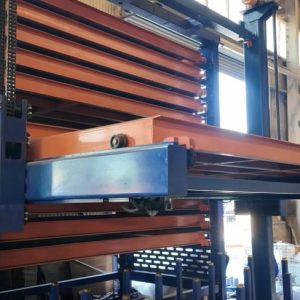
The defining feature of the Herochu rack is the roll-out tier. Unlike a fixed cantilever arm that extends permanently from the column, the roll-out tier slides outward on guide rails when the operator needs to load or retrieve material, then retracts into the rack body when the operation is complete. The guide rails are machined from galvanized steel and mounted to the Q235B steel columns, providing a travel path that maintains alignment under full load.
| Model | Pipe Length | Max Load per Level | Number of Layers | Clear Space |
|---|---|---|---|---|
| HC-G9065 | 9,000 mm | 5,000 kg | 6 (customized) | 600 mm (customized) |
The HC-G9065 configuration handles 9-meter stock — the standard mill length for seamless pipe, welded tube, and structural hollow sections. The 5,000 kg per-level capacity accommodates the heaviest bundles in this length range, including thick-wall seamless pipe and large-diameter hollow structural sections. Six layers on both sides of the rack provide 12 independent compartments, sufficient to segregate pipe by diameter, wall thickness, and material grade (seamless, welded, alloy).
Storage Density 2–3 Times Higher Than Traditional Racks
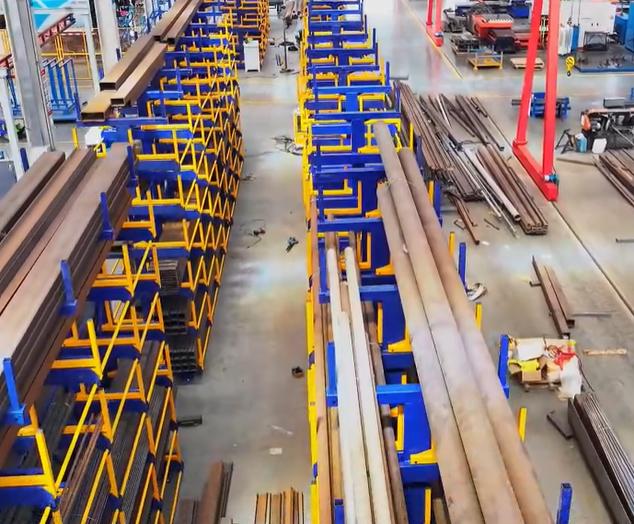
The storage density advantage of the Herochu roll out rack is a direct consequence of eliminating the forklift turning aisle. In a traditional fixed cantilever installation, the rack occupies approximately 40% of the storage zone and the turning aisle occupies the remaining 60%. When the rack extends and retracts on demand, that 60% is recovered for storage. The result is 2–3 times the storage capacity in the same floor area.
This density increase matters most in facilities where floor area is constrained — existing warehouses that cannot expand, urban fabrication shops with high land costs, and operations that have grown their inventory beyond the capacity of their original storage layout. Rather than leasing additional warehouse space, the operation recovers capacity within its existing footprint by converting fixed-aisle storage to telescopic storage.
Dual-Side Mechanical Assistance
The HC-G9065 employs dual-side mechanical assistance for tier extension. This means the drive mechanism engages both sides of the tier simultaneously, preventing the asymmetric loading that occurs in single-side drive systems. In a single-side drive, a tier loaded with pipe bundles biased toward one end creates a moment that resists extension on the loaded side and accelerates extension on the unloaded side, producing a racking (twisting) motion that stresses the guide rails and eventually causes misalignment.
The Herochu dual-side drive eliminates this by transmitting force through both guide rails simultaneously. The synchronization is achieved through a mechanical linkage — a torsion bar connecting the drive pinions on both sides — ensuring that both rails extend at identical speed regardless of load distribution within the tier. This mechanical solution is preferred over electronic synchronization because it cannot drift out of calibration and requires no sensor maintenance.
Compatibility with Bundled and Loose Materials
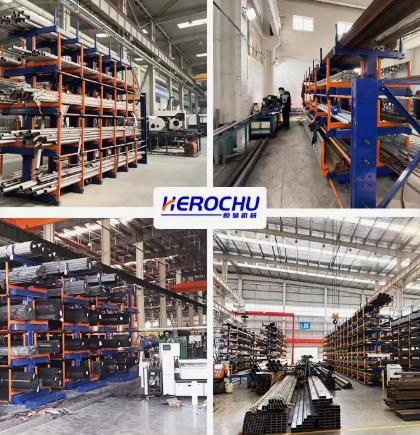
Pipe and section storage operations handle two material forms: mill bundles (strapped groups of identical sections) and loose material (individual pipes or sections left from partial bundle use). The Herochu base tray design accommodates both. The tray side guides are spaced to retain a standard mill bundle snugly — preventing lateral movement — while the tray depth is sufficient to hold loose individual pipes that have been unbundled for inspection or partial use.
This dual compatibility eliminates the need for separate storage zones for bundled and loose material. An operator can place a partial bundle back into its original compartment without re-strapping it, and the side guides prevent the loose pipes from rolling into adjacent compartments. The trays are fabricated from 2 mm formed steel sheet with rolled edges — no sharp burrs that could scratch pipe surfaces or cause injury during manual handling.
Material Classification and Inventory Control
Steel pipes and hollow sections arrive in categories that demand physical separation: seamless versus welded, carbon steel versus alloy, galvanized versus black finish, and primed versus bare. Mixing these categories during storage creates traceability failures that can cascade into quality nonconformances at the fabrication or installation stage. A welder who picks what appears to be a standard carbon steel pipe but is actually a low-temperature alloy will produce a weld that fails post-weld heat treatment.
The Herochu compartmented design enforces physical separation at the rack level. Each compartment stores a single material category. The compartment can be labeled with a durable tag — grade, diameter, wall thickness, heat number reference — that travels with the material through its storage cycle. When an operator needs a specific material, they extend the designated compartment, retrieve the required quantity, and retract the tier. No other compartment is disturbed, and the material inventory in each compartment remains accurate to the physical contents.
Drive Configuration: Hand-Cranked and Electric
The HC-G9065 is available in two drive configurations. The hand-cranked version uses a gear-and-rack transmission with a self-locking worm gear. The operator turns a handle positioned at the rack face at ergonomic height, and the tier extends smoothly. The gear ratio is calculated to keep input handle force below 15 kg at full 5,000 kg payload — within the sustained effort capacity of a single operator without mechanical assistance.
The electric version replaces the crank with a geared motor, controlled by a push-button station mounted on the rack face or on a pendant cable. The motor includes an integral holding brake that engages when the motor stops, and dual limit switches define the full-extension and full-retraction endpoints. For operations with high retrieval frequency — multiple extensions per hour — the electric drive reduces operator fatigue and cycle time, allowing a single operator to service a multi-rack installation without dedicating the full shift to crank operation.
Surface Treatment for Corrosive Environments
Pipe storage environments are frequently corrosive. Black steel pipe arrives with mill scale that retains moisture; galvanized pipe can develop white rust (zinc oxidation) in humid storage conditions; and primed pipe requires surface protection to prevent primer degradation. The Herochu rack addresses these environmental factors through a multi-layer surface treatment on all structural and contact surfaces.
The standard treatment is an electrostatic powder-coated finish: phosphate pretreatment, primer coat, and polyester topcoat with UV stabilizers, applied at 60–80 μm total thickness. For humid or marine environments, the cantilever arms are available in galvanized steel, and the base trays can be specified with a polymer liner that prevents metal-to-metal contact between the pipe payload and the tray surface. This liner is replaceable — it wears over time from pipe sliding during loading — and can be swapped without removing the tier from the rack.
Guide Rail Maintenance and Longevity
The telescopic guide rails are the most wear-exposed components in the roll-out rack. The Herochu guide rails are manufactured from galvanized steel with machined contact surfaces, and the sliding contact is facilitated by polymer glide pads inserted into the rail channels. These glide pads are designed as wear items — they absorb the friction of extension and retraction cycles, protecting the steel rail from wear.
Glide pad replacement is a scheduled maintenance task, not a breakdown repair. The pads are accessible from the rack face without disassembling the tier, and replacement takes approximately 15 minutes per rail. A rack installation with daily extension cycles should inspect glide pad condition quarterly and replace pads when wear exceeds 50% of the original thickness — a visual inspection that any maintenance technician can perform.
Pre-Shipment Testing
Each HC-G9065 rack undergoes a pre-shipment load test at 1.25 times rated capacity. Deflection is measured at the arm tip under test load and must recover to zero when the load is removed. This test confirms that the frame, the guide rails, and the tier assembly have not yielded during manufacturing and that the rack will perform to its rated specification in the field. The test report documents deflection values and recovery, providing the evidence required for quality assurance and for any CE or ISO conformity assessment that the installation site requires.