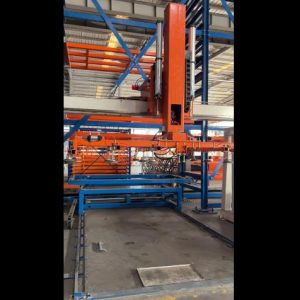
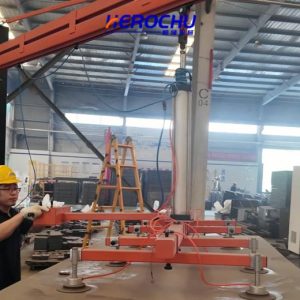
Pipe storage is a length problem before it is a weight problem. A 12 m bundle of 8-inch line pipe weighs several tonnes, but what makes it difficult is the span: it flexes in the middle, the ends swing wide on the crane, and any rack supporting it at two points will slowly build a permanent bend into the bottom layer.
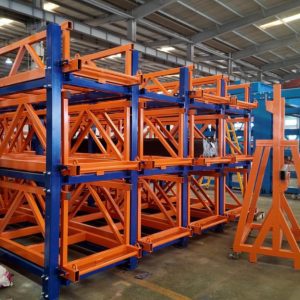
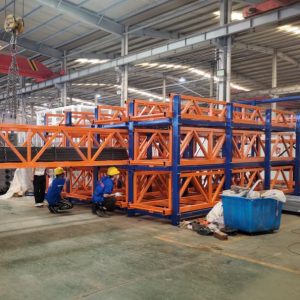
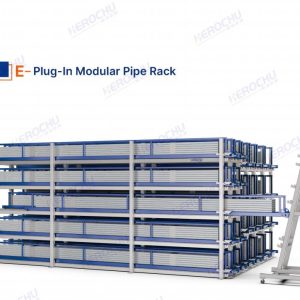
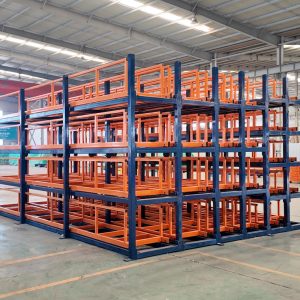
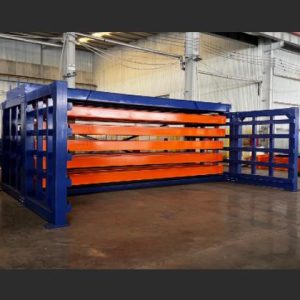
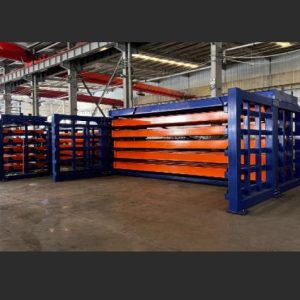
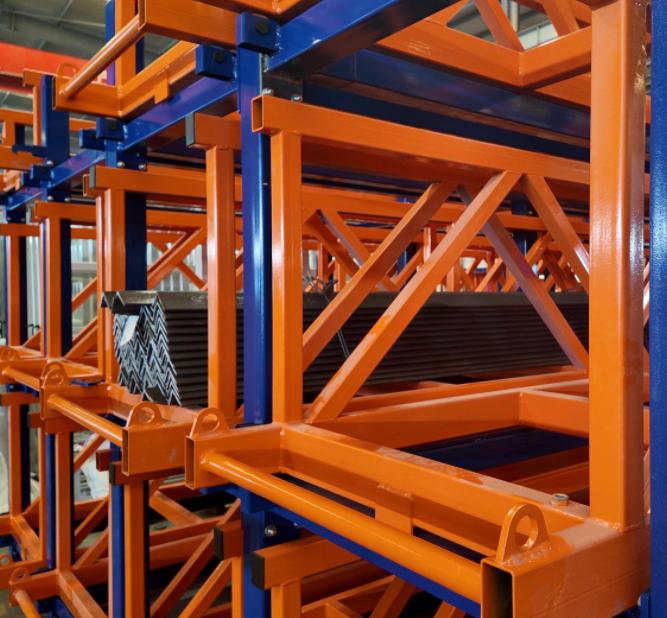
A heavy-duty roll out pipe storage rack with honeycomb structure changes the axis of storage. Pipe goes into vertically stacked cells instead of onto open arms, supported along the bundle, loaded by overhead crane and picked by drawing one cell out at a time. Herochu builds it in three lengths — 6,000, 9,000 and 12,000 mm — with level loads up to 3,000 kg.
Quick answers
What pipe lengths does the rack take? Three standard configurations: 6,000 mm (HC-H6024-02), 9,000 mm (HC-H9032-03) and 12,000 mm (HC-H12036-03), each matched to that pipe length.
How much does one level hold? 2,000 kg per level on the 6 m model, 3,000 kg per level on the 9 m and 12 m models.
How many pipe dimensions can be live at once? 24, 32 or 36 separate compartments depending on model, all customizable, one dimension per compartment.
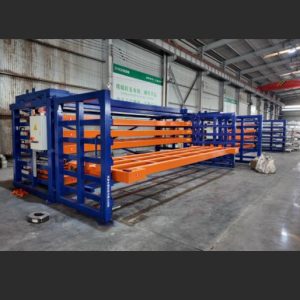
How is pipe loaded? A bridge crane lands the bundle on an extended cassette; the cassette is pushed back into the cell. Discharge uses mechanical assistance.
What changes when the material is pipe
Round stock behaves differently from bar or profile, and the difference drives the design.
Pipe rolls. A bundle set on two flat arms settles, spreads, and occasionally works its way off the end of a cantilever. In a closed cell it cannot migrate: the cassette walls contain it and the cell above caps it.
Pipe dents. Thin-wall and large-diameter pipe take permanent deformation from point loading, and a bundle resting on two narrow arms is a point load in all but name. A cassette that supports along the length keeps the round section round.
Pipe is counted by ends. Operators reconcile inventory by looking at bundle end faces. In a honeycomb stack every cell presents its own end face at the rack front, which is why stock counts get faster, not slower, as the range grows.
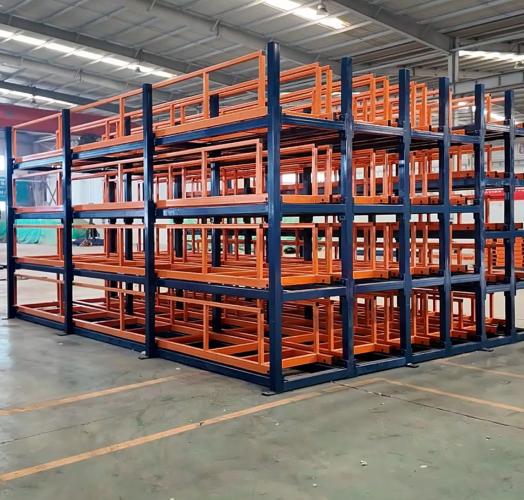
Length by length
The pipe length on the drawing sets the model; three site conditions refine it.
Crane hook height. The top level must clear the hook, the lifting gear and the bundle. A 12 m unit needs a taller building than a 6 m unit with the same number of levels, and hook height usually decides how many levels fit.
Bay approach. The crane must present the bundle square to the cell. Bays under a runway end, or behind a column line, may need a different orientation rather than a different rack.
Cells, clear space and load
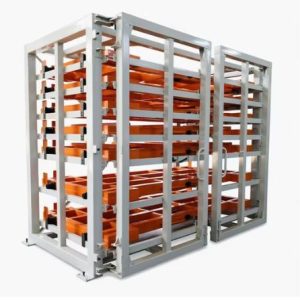
Internally the rack is a grid of cells stacked in rows and columns — the honeycomb pattern the name refers to. Each cell is an independent compartment with its own pull-out cassette, rated as part of a level.
| Parameter | Standard | What it controls |
|---|---|---|
| Clear space | 720 mm (customized) | Largest bundle diameter plus lifting gear |
| Level load | 2,000–3,000 kg | Heaviest single-dimension bundle |
| Bay count | 24 / 32 / 36 (customized) | Number of live dimensions |
Clear space is the figure buyers most often set too tight. A 720 mm opening is generous for small tube and marginal for a large bundle handled with a spreader beam, which is why Herochu treats it as a customized dimension rather than a fixed one.
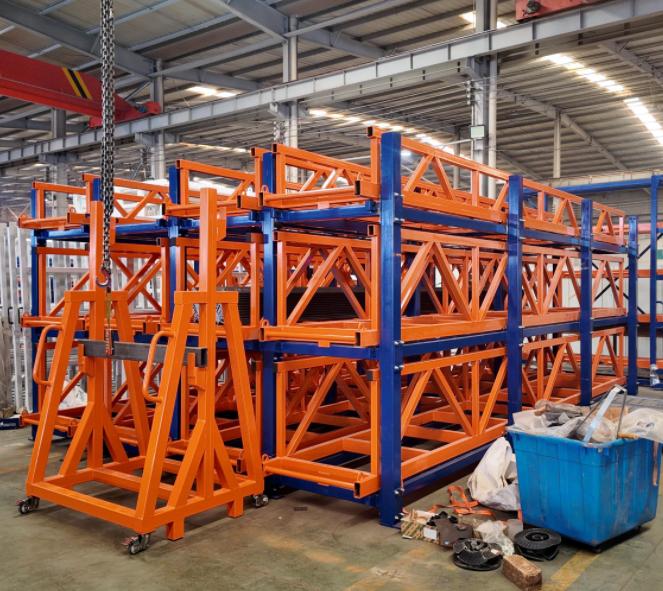
Model and capacity table
| Model | Pipe length | Bays | Max. load per level | Clear space |
|---|---|---|---|---|
| HC-H6024-02 | 6,000 mm | 24 (customized) | 2,000 kg | 720 mm (customized) |
| HC-H9032-03 | 9,000 mm | 32 (customized) | 3,000 kg | 720 mm (customized) |
| HC-H12036-03 | 12,000 mm | 36 (customized) | 3,000 kg | 720 mm (customized) |
Discharge on all models is by mechanical assistance, which keeps the draw force manageable when a cassette sits at its rated load.
Loading and picking
The loading sequence is short. The crane brings the bundle over the rack, the cassette for that dimension is drawn out, the bundle is lowered in, the cassette returns. The crane releases inside a minute and the next bundle can be handled.
Because the cassette carries the bundle, the crane never enters the structure. No fork pocket to align, no mast to strike, no forklift aisle in front of the rack — a saving that shows up directly in usable floor area.
Picking runs the other way and happens many times a day. A worker pulls the cassette for the required size, lifts the pieces by hand or with a light hoist at the face, and closes it. Cells are independent, so a size stored at the top is as quick to reach as one at the bottom. Because retrieval is a pull rather than a drag, the surface of coated or galvanized pipe survives storage.
FAQ
Can a 12 m rack hold 6 m pipe? Yes, though the extra depth is wasted floor. Match length to the dominant stock, not the occasional long item.
How many levels fit under a standard crane? It depends on hook height and clear space per level. Herochu sets the level count from a building survey rather than offering a fixed stack height.
Is the rack suitable for coated or galvanized pipe? Yes. Cassette support and pull-out retrieval avoid the dragging and point loading that damage coatings.
Can the bay count be increased later? Yes. Bay counts on all three models are customized, and the modular frame accepts additional bays and levels.
Specifying a pipe rack with Herochu
The brief that produces a correct rack is short: pipe lengths, outside diameters, wall thicknesses, bundle weights, the number of dimensions live at once, and the crane’s hook height. From those, Herochu fixes the pipe length model, level rating, bay count and clear space, and checks that the layout still leaves room for a mezzanine. Pipe storage is unforgiving of assumptions about length — get that one number right and the rest of the specification follows.