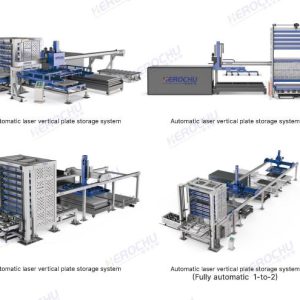
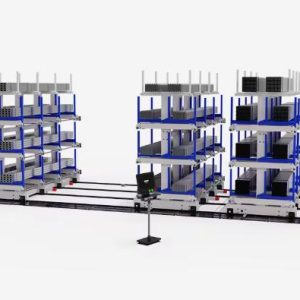
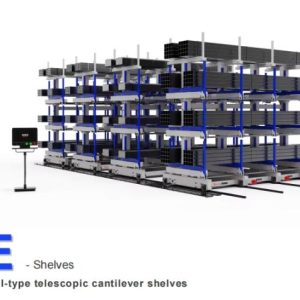
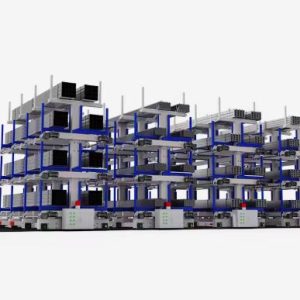
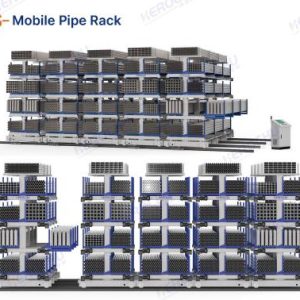
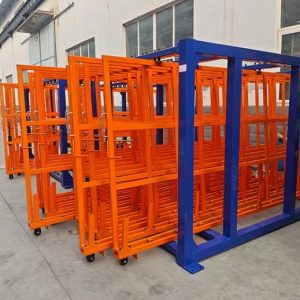
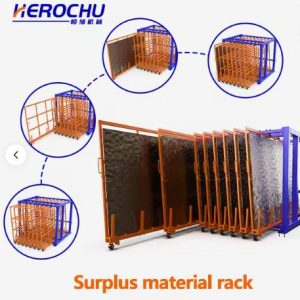
The term “smart storage” gets applied loosely across industrial automation, but in a laser cutting cell it has a concrete definition: a storage system that knows what plates it holds, where each plate sits, and when to release one to the gantry without operator instruction. Herochu builds exactly that — a laser smart storage and automated loading and unloading gantry that treats plate inventory as live production data rather than passive stock.
What Makes the Storage Smart
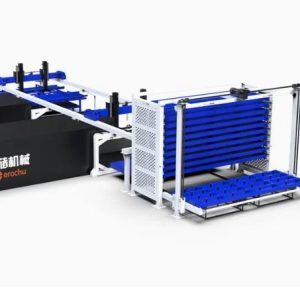
A conventional plate rack answers one question: where can I put this sheet? The Herochu smart storage tower answers several: which sheet size is needed next, how many remain, which layer holds it, and is the gantry ready to receive it. The difference comes from the control architecture. Every layer in the tower is addressable by the PLC, and every storage or retrieval action is logged against the production schedule. When the laser cutting machine signals completion of a job, the tower identifies the correct next raw sheet, positions it for pickup, and triggers the gantry loader — all without a human query.
This closed-loop coordination is what enables genuine unattended operation. The gantry loading arm moves at 10–30 m/min horizontally and 5–10 m/min vertically, with repeatability held at ±2 mm. That positioning consistency matters because the laser bed expects the sheet in a known orientation — a plate placed 5 mm off-register forces the operator to jog the machine, consuming the time the automation was supposed to save. The Herochu gantry delivers the sheet to the same position cycle after cycle, so the laser program runs from its origin without adjustment.
Loading and Unloading as One Gantry Motion
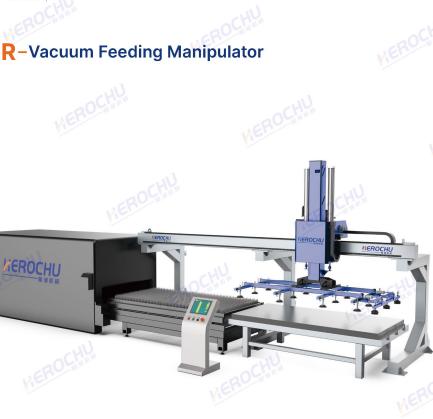
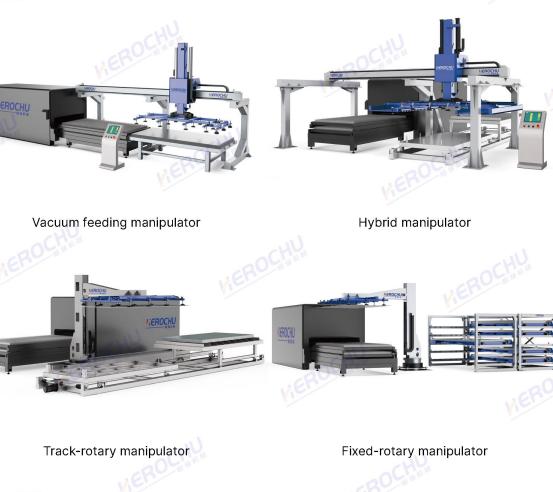
The system uses a bilateral gantry truss carrying two manipulators — one for loading, one for unloading. This is a deliberate design choice. Combining load and unload on a single arm would force sequential operation: unload the cut sheet, then load the next raw plate, then unload again. With two manipulators on the truss, the unloader clears the bed while the loader simultaneously retrieves the next sheet from the storage tower. The two actions overlap rather than queue.
The unloading manipulator uses a vacuum suction cup array to grip cut workpieces. Each suction cup has an independent control switch, so the grip pattern matches the part geometry — full suction for large parts, selective activation for smaller pieces. Cup spacing adjusts within a defined range to match sheet dimensions. The vacuum components are sourced from established brands, which matters for reliability: a suction failure mid-cycle means a dropped part, a jammed bed, and a stopped line.
For loading, the manipulator uses a pneumatic rotating structure that can turn the plate 90 degrees. This addresses a practical geometry problem: sheets stored longitudinally in the tower often need to feed laterally onto the laser bed, or vice versa. The 90-degree rotation lets the gantry adapt to both orientations without reconfiguring the storage layout.
Drive and Control Details
Movement is driven by a high-speed variable frequency motor. Variable frequency drive gives two benefits here — smooth acceleration that prevents plate slippage during transfer, and precise speed control that lets the system tune cycle time to the sheet weight and size. Heavier plates move at controlled velocity; lighter sheets can run at higher traverse speeds. The repeated positioning accuracy of the manipulator is maintained across this range, which is why the system holds ±2 mm repeatability regardless of load within the rated capacity.
The PLC control system ties everything together — tower, gantry, cart, and laser cutting machine. Through the operation box near each laser, the user can direct automatic feeding to either of two machines. The touch screen interface switches between automatic and manual feeding modes, giving the operator an override path for maintenance, testing, or non-standard jobs.
Air and Power Requirements
The vacuum system runs on 0.6–0.7 MPa compressed air — a standard industrial supply pressure that most shops already provide. The system does not require a dedicated high-pressure line, which simplifies installation in existing facilities. Fork adjustment speed of 5–20 m/min lets the system accommodate different sheet widths without manual reconfiguration.
Built for Two-Machine Cells
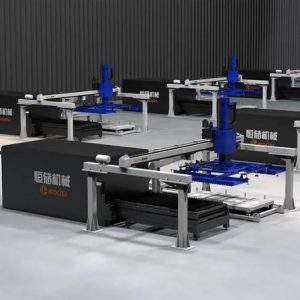
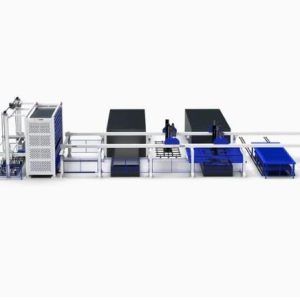
The one-to-two configuration is where the economics of an automated loading gantry become compelling. A single storage tower and gantry complex serving two laser cutters nearly doubles the utilization of the handling equipment per cutting machine. For shops that have invested in a second laser and found their bottleneck shift from cutting capacity to material handling, the Herochu system directly addresses that gap — turning two machines and one operator into a genuine production cell rather than two separate workstations.