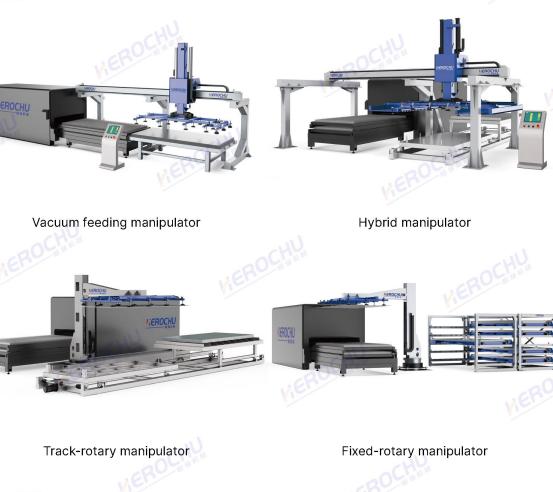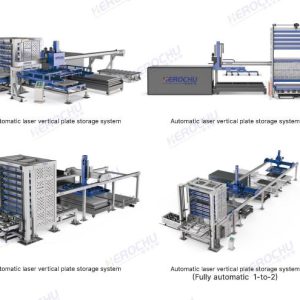
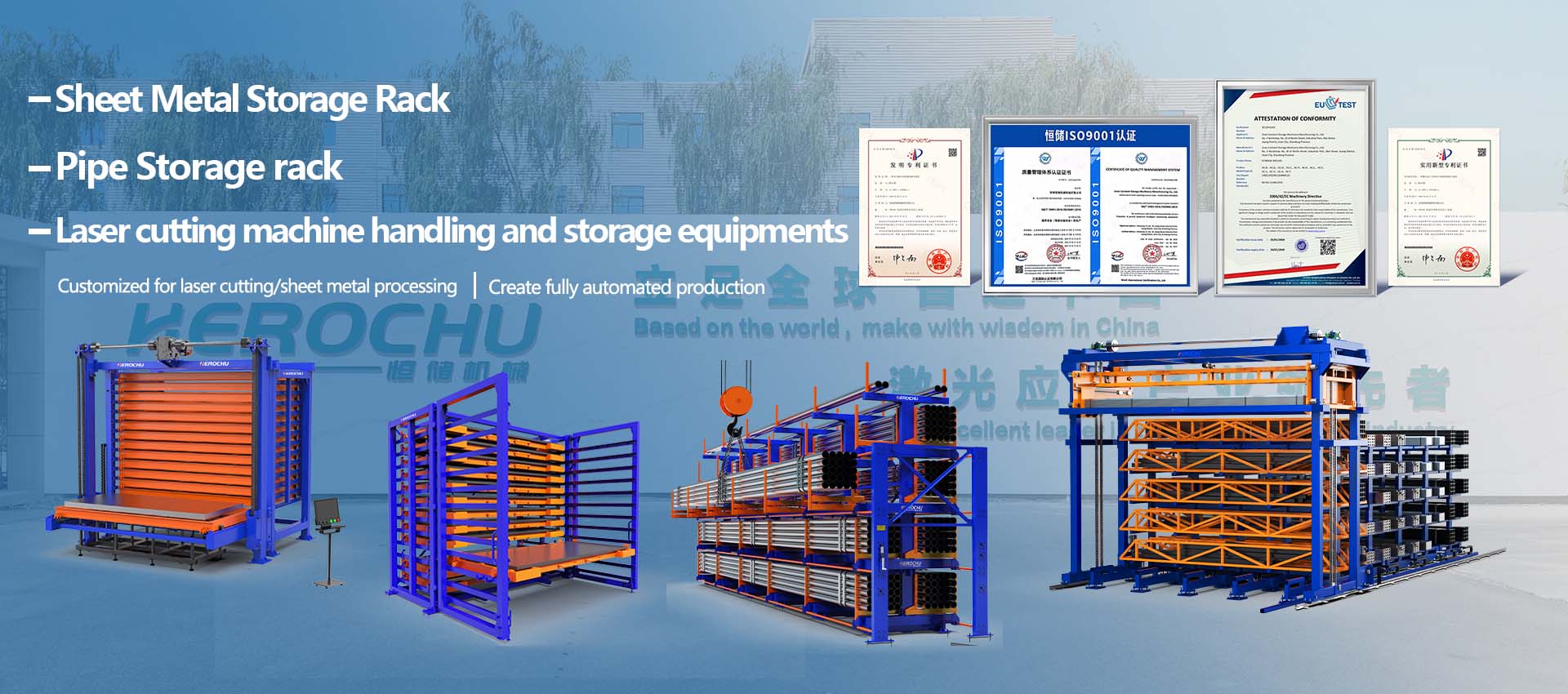
Fabricators looking to automate laser cutting cells often start with a loader — a single arm that puts sheets on the bed. That solves the immediate problem but leaves the larger one untouched: the material still arrives at the loader by forklift, stored in floor stacks that consume floor space, hide inventory levels, and require constant operator attention. An automatic gantry material handling system with an integrated storage warehouse addresses the entire material flow, not just the last meter of it.
From Floor Stacks to Structured Warehouse
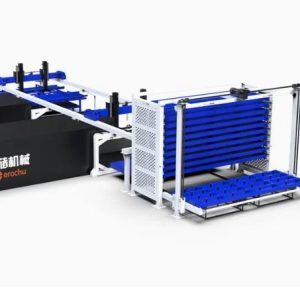
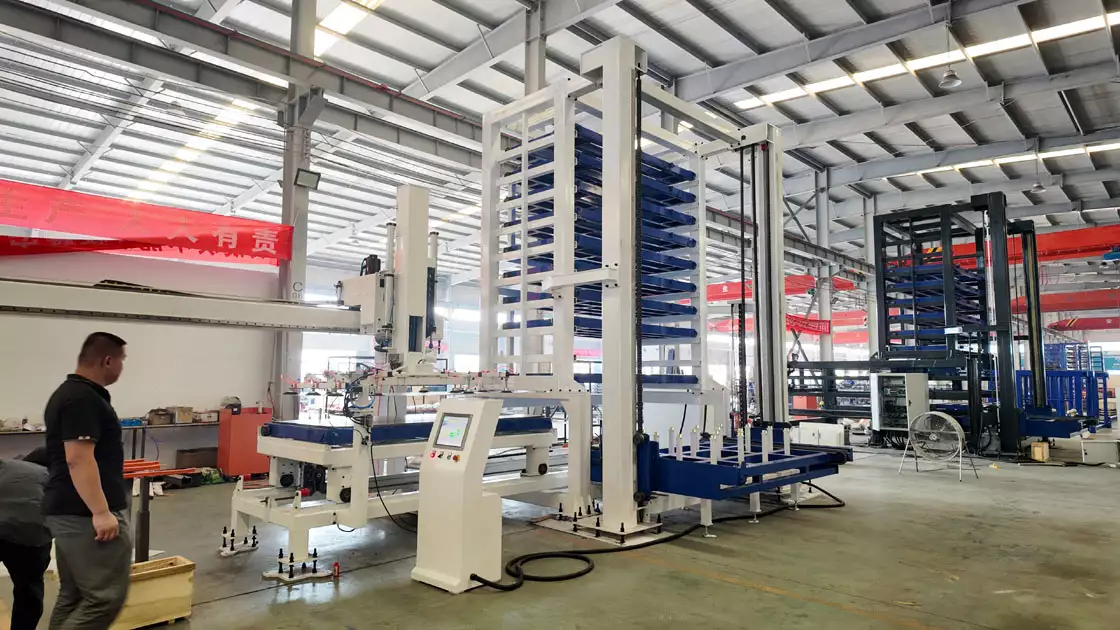
The shift from floor stacking to a structured storage warehouse changes how a fabrication shop operates. Herochu’s system stores plates in a three-dimensional tower where each layer is a defined storage location tracked by the central PLC. Raw sheets enter the warehouse, are assigned a layer, and remain there until the production schedule calls for them. The gantry retrieves the correct sheet on command and delivers it to the laser cutting machine — no forklift traversal across the shop floor, no manual plate sorting, no guesswork about what remains in stock.
For shops running steel and aluminum production lines, this organization pays off in three concrete ways. First, floor space previously consumed by sheet stacks becomes available for other operations. Second, inventory accuracy improves because every stored plate is logged — the controller knows how many sheets of each size remain, which feeds directly into purchasing and scheduling decisions. Third, plate condition improves because sheets are no longer dragged across each other during manual retrieval, reducing surface scratches that can affect cut quality.
The Complete Production Unit
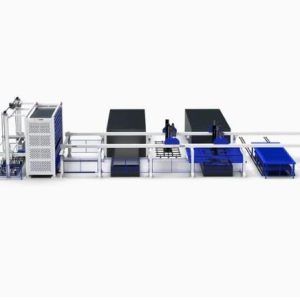
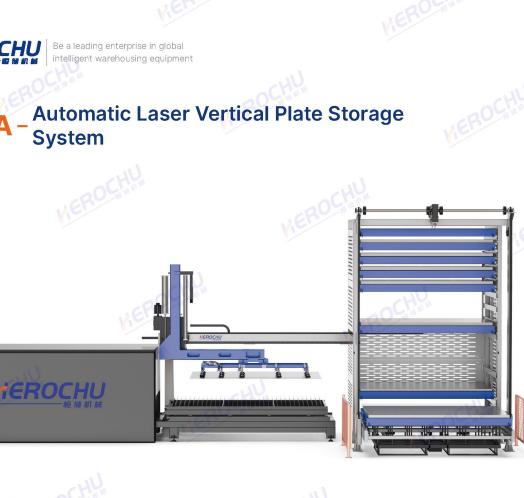
The Herochu system assembles several subsystems into one functional unit:
- Three-dimensional storage warehouse — the plate inventory hub, with layer count and spacing customized to the shop’s plate range
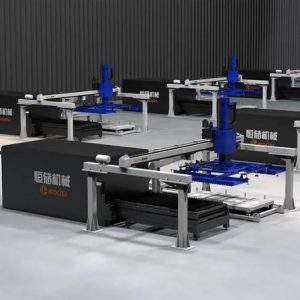
- Bilateral gantry truss — the structural bridge carrying the loading and unloading manipulators across the cell
- Loading truss manipulator — retrieves raw plates from the warehouse and places them on the laser bed
- Unloading truss manipulator — removes cut sheets from the bed and deposits them on the finished-material cart
- Double-layer finished material cart — receives cut sheets on two tiers, doubling the buffer between the gantry and downstream sorting
- PLC control system — synchronizes all subsystems with the laser cutting machine
The laser cutting machine is the seventh element, completing what Herochu calls a sheet metal automatic production unit. When all seven components run under unified control, the cell executes the full production sequence automatically: centralized three-dimensional storage, auto-issue of raw sheets, automatic reclaim, automatic sub-sheet separation, automatic feeding, and automatic blanking of cut parts.
Handling Mechanics
The loading manipulator uses vacuum suction to grip raw plates. Vacuum is the right choice for loading because raw sheet surfaces are flat and continuous — suction distributes grip evenly across the plate without concentrated pressure points. Each suction cup carries an independent control switch, so the grip pattern adjusts to sheet size. For a full 3000 × 1500 mm sheet, all cups engage; for a narrower plate, the operator deactivates the outboard cups from the controller to match the reduced footprint. Cup spacing is adjustable within a defined range, and the vacuum components come from established manufacturers to ensure reliable hold across thousands of cycles.
The unloading manipulator uses a gripper system rather than vacuum. Cut sheets have different characteristics — they may have internal cutouts, irregular edges, or residual tabs connecting parts to the skeleton. Grippers provide mechanical engagement that vacuum cannot reliably achieve on these geometries. This division — vacuum for loading, grippers for unloading — is a design decision grounded in the physics of the two operations.
The manipulator also incorporates a pneumatic rotating structure that turns the plate 90 degrees. This addresses the orientation mismatch between storage and cutting: plates stored in one axis often need to feed in the perpendicular axis to match the laser bed layout. The 90-degree rotation happens within the gantry cycle, so it adds no separate handling step.
Drive System and Precision
Movement is driven by a high-speed variable frequency motor, giving the manipulator fast traverse speed and high repeated positioning accuracy. Variable frequency control means the system can tune acceleration to the plate weight — a 500 kg steel sheet decelerates gently into position, while a lighter sheet moves at full speed. This adaptability is why the system maintains ±2 mm repeatability across its entire load range.
The gantry serves two laser cutters through the one-to-two configuration. An operation box near each machine lets the user direct the automatic feed to either cutter, and the touch screen switches between automatic and manual feeding modes for maintenance or non-standard jobs.
Sizing the System to the Shop
The Herochu HC-A series covers four standard configurations, from 3000 × 1500 mm sheets with 8 layers and 3000 kg capacity up to 6000 × 2000 mm sheets with 10 layers and 5000 kg capacity. Applicable sheet dimensions extend to 6000 × 2500 mm, and the system handles sheets up to 500 kg. Layer count, tower count, and clear space between layers are all customizable — the system is sized to the shop, not the other way around.
For fabricators moving beyond a standalone loader to a true storage warehouse integrated with material handling, the point is straightforward: automating only the loading step leaves the larger material flow manual. The gantry and warehouse together close that loop, turning a laser cutting machine into a fully automated production cell.