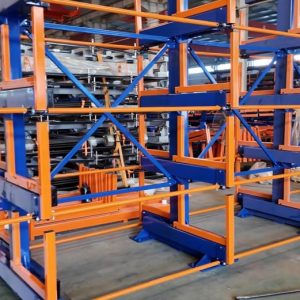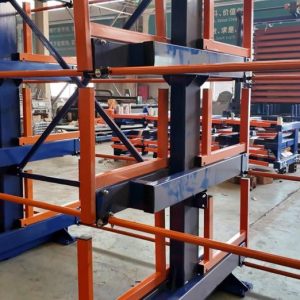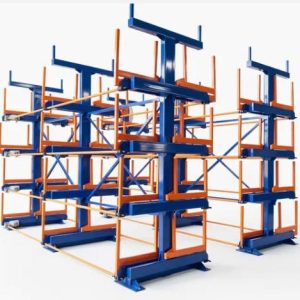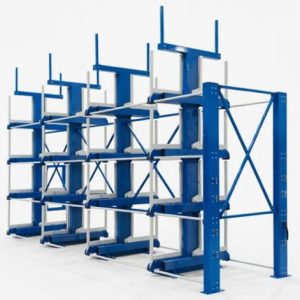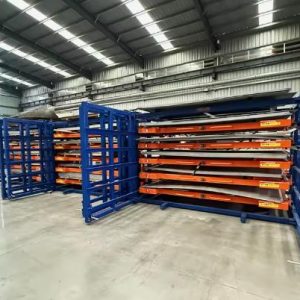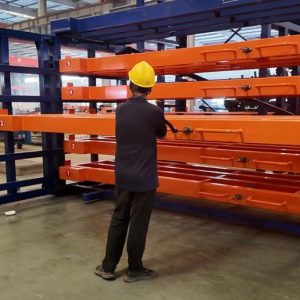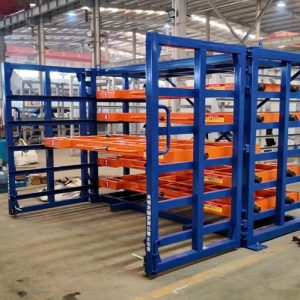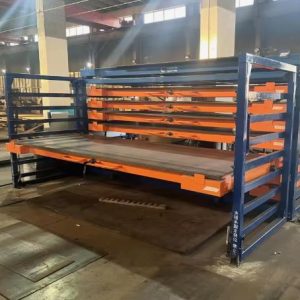
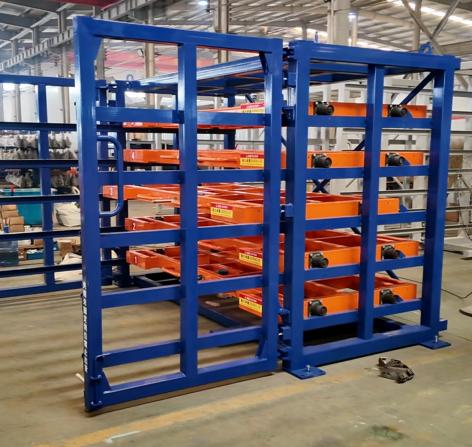
The moment a sheet metal storage drawer leaves its closed position, physics works against smooth motion. Five thousand kilograms of plate stock shifts its center of gravity outward into the aisle, and the drawer carriage must carry that mass on a roller track that was designed to keep it straight, level, and stable. The component that makes this possible is not the crank and not the frame — it is the guided roller system underneath the drawer. In the Herochu heavy-duty manual roll-out sheet metal storage rack, this system is the difference between controlled, ergonomic material handling and the jerky, binding motion that forces operators to improvise with brute force.
The undercarriage of each Herochu drawer carries two functional roller elements: a solid steel load roller and a lateral guide wheel. They serve different purposes, and their interaction defines the motion quality of the rack. The load roller bears the vertical weight of the drawer and its contents. The lateral guide wheel controls the horizontal trajectory, keeping the drawer from drifting sideways as it extends. Together, they create a motion path that is stable under full load and resistant to the skewing forces that would otherwise wear the track and degrade the extension quality over time.
Solid Steel Load Roller: Vertical Capacity
The load roller is the primary weight-bearing element in the drawer carriage. It is machined from solid steel — not cast, not stamped — because the load class demands a material that resists deformation under point loading. The roller contacts a steel track mounted on the dual-beam frame, and the contact patch between roller and track carries the full vertical load of the drawer. Under five tons per tier, that contact patch is small, and the contact pressure is high. A roller material that deforms under that pressure will flat-spot, develop play, and eventually compromise the drawer’s ability to track straight.
Herochu specifies solid steel rollers for the HC-B series because the load range — 3,000 to 5,000 kg per tier — exceeds what composite or cast rollers can sustain over thousands of extension cycles without measurable wear. The steel-on-steel rolling contact, with appropriate surface hardening, holds its geometry and maintains a consistent rolling resistance across the service life of the rack. This consistency is what the operator feels as smooth drawer motion: the effort required to turn the crank does not spike partway through the stroke, and the drawer does not lurch when the load transitions from static to dynamic friction at the start of extension.
Lateral Guide Wheel: Trajectory Control
While the load roller handles vertical mass, the lateral guide wheel handles horizontal trajectory. As a loaded drawer extends, the center of gravity moves outward, and the drawer tends to skew — to twist slightly in the horizontal plane because the load is not perfectly symmetrical or because the operator’s cranking force is not perfectly centered. The lateral guide wheel runs against a guide surface on the frame and prevents this skew from developing into a tracking error that would bind the drawer or cause it to ride off the roller track.
This lateral control matters most when the drawer is partially loaded or loaded asymmetrically — for example, when sheets of different sizes are stored on the same tier, or when the operator has removed some sheets from one side of the drawer, leaving an uneven load distribution. The guide wheel absorbs the lateral component of these asymmetric loads and keeps the drawer moving on its designed path. Without it, the drawer would drift, the gear rack drive would see side loading, and the crank would develop the binding resistance that operators instinctively fight with extra force.
The Ergonomic Consequence of Guided Motion
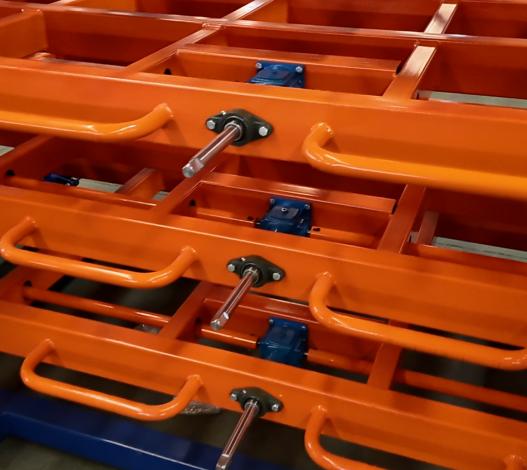
The guided roller system has a direct ergonomic consequence that operators feel immediately. When motion is smooth and controlled, the operator does not need to jerk the handle, brace against the rack, or call a second person to stabilize the drawer. The crank input translates into drawer output with minimal loss, and the physical demand stays within the range one person can manage across a full shift. The 1:1.5 reduction ratio on the Herochu crank means the operator supplies rotation at a comfortable pace while the mechanism supplies the pulling force, and the guided rollers ensure that force reaches the drawer as controlled linear motion.
This is the boundary that defines the product: the Herochu heavy-duty manual roll-out sheet metal storage rack is built for controlled shop handling. It is not a forklift collision target. It is not a rough-impact transfer point. The guided roller system is designed for the motion profile of a hand-cranked drawer — smooth starts, steady travel, clean stops — and the structural and mechanical components are matched to that profile. Operators who respect that boundary get years of reliable, low-maintenance service from the rack.
Roller Track and Frame Integration
The roller track is integrated into the dual-beam Q235B frame structure. The track surface is machined to match the roller diameter, and the track mounting is positioned so that the load roller and the lateral guide wheel engage their respective surfaces simultaneously when the drawer begins to move. This simultaneous engagement prevents the drawer from twisting at the start of the extension stroke, which is the moment when static friction is highest and the risk of binding is greatest.
The track is part of the frame, not a bolt-on component, which means the track alignment is set during frame fabrication and does not depend on field adjustment. This is a deliberate choice — field-adjustable tracks drift over time under cyclic loading, and the resulting misalignment is a common cause of premature roller wear and tracking failure. By integrating the track into the frame structure, Herochu locks in the alignment and makes the roller geometry a property of the frame rather than a maintenance variable.
Durability Under Production Conditions
In production environments, the guided roller system faces conditions that test every component. Dust, metal chips, coolant splash, and temperature variation all affect the rolling surfaces. The solid steel rollers and tracks resist contamination better than sealed bearing assemblies, which can seize when fine abrasive particles penetrate the seals. The steel-on-steel rolling contact can be cleaned, inspected, and re-lubricated without disassembling the drawer carriage, which keeps maintenance simple and visible.
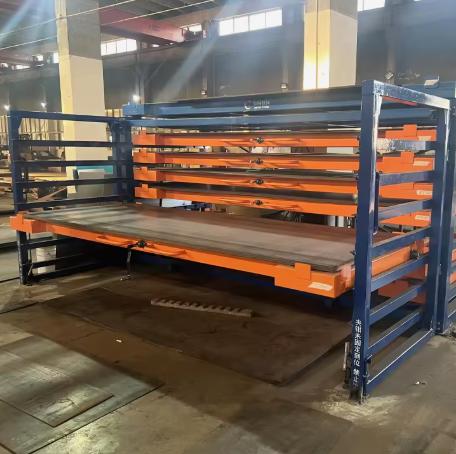
The service life of the roller system is matched to the service life of the frame. Both are designed for the same load class and the same cyclic loading profile, which means the roller system will not become the premature failure point in a rack that is otherwise structurally sound. When replacement is eventually needed — after years of daily use — the rollers are accessible from the drawer carriage without removing the drawer from the rack, and the replacement components are standard Herochu parts specified for the HC-B model in service.
The System as a Whole
The Herochu heavy-duty manual roll-out sheet metal storage rack works because its components work together. The Q235B dual-beam frame provides the stable platform. The gear rack drive and pillow block bearing provide the mechanical advantage. The hand crank gives the operator ergonomic control. And the guided roller system — the solid steel load roller and the lateral guide wheel — translates all of that into the smooth, controlled drawer motion that defines the product. Remove any one element and the system loses its coherence. Keep them all in balance, and the rack delivers what it is built to deliver: one-person handling of multi-ton sheet stock, safely and reliably, shift after shift.