How much weight can a heavy duty cantilever rack carry?
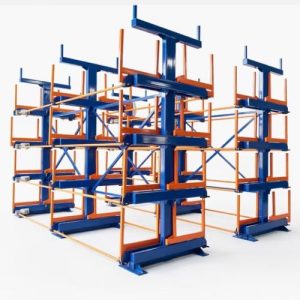
On the standard 36 ft double-sided build, each level is rated at 14,400 lb (6,532 kg). That figure is a starting point, not a guarantee for every bundle. Capacity falls as the load centre moves toward the arm tip, as arm depth shrinks, and where a bundle rests on two arms instead of four. The load chart for the specific rack governs.
The mechanics are simple. A bundle at the arm tip applies a larger moment to the upright than the same weight pushed back against the column, so that arm carries less. This is why a rack rated for a full-depth bundle should never be loaded with a narrow stack of bar stock perched on the outer 200 mm of the arms.
What makes the structure heavy duty?
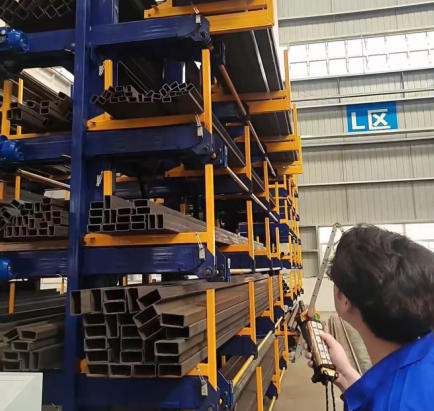
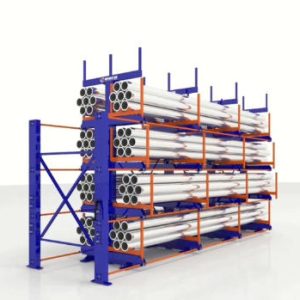
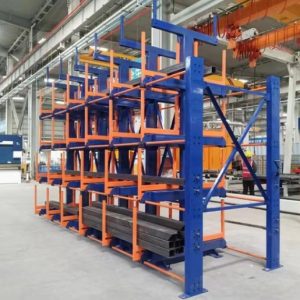
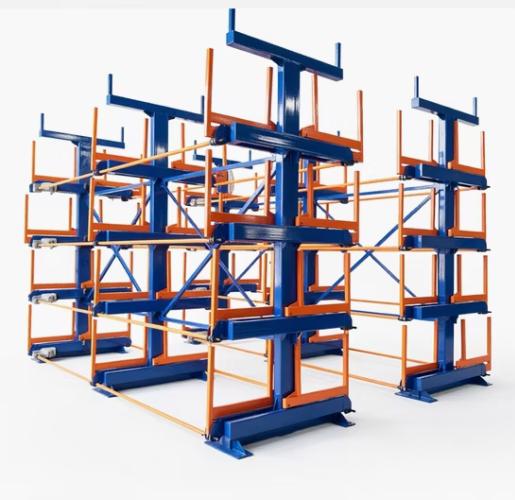
Uprights with a deep section, a base long enough to resist tipping, arms with welded gussets and bolted brackets, spanner tubes that tie the frame into one unit, and anchors that transfer the moment into the slab. The drive train is part of the structure too: shafts, chain and carriage rollers see the full load every time a level moves.
Herochu checks straightness at build. Drive shafts only run true if the uprights are square and in line, and a rack that binds on the third level usually has a base or squareness problem rather than a chain problem.
Why store 6 m steel overhead rather than on the floor?
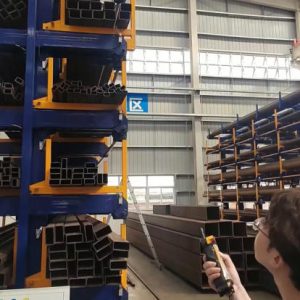
Floor storage of 6 m steel creates a stack, and a stack is last-in, first-out. The bundle a job needs is often at the bottom, so a forklift moves three bundles to reach it, and the bottom bundle collects the damage. Vertical storage uses the air above the rack, keeps each bundle separate and lets a crane reach any level without touching the others.
It also cuts forklift hours. One crane moves the bundle from delivery to the machine, and the forklift stays on pallet work instead of threading 6 m loads through aisles.
What does a 6 m heavy duty specification include?
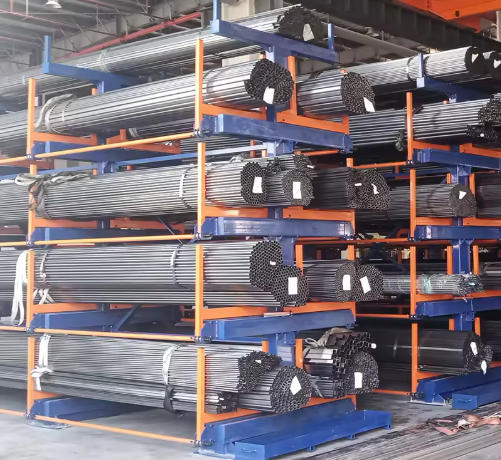
Heavy duty crank-out rack, standard 6 m configuration
| Item | Specification |
| Material | 6 m steel profiles and pipe in bundles |
| Rack length | 36 ft (10.97 m) |
| Levels | 4 standard; 3 to 8 available |
| Arm depth | 36 in (914 mm); 20 to 36 in available |
| End stop height | 12 in (305 mm) |
| Capacity | 14,400 lb (6,532 kg) per level |
| Sides | Double sided, shared upright line |
| Drive | Manual crank, guarded chain drive |
| Extension | Up to 100 percent of arm depth |
| Anchoring | Floor anchored uprights, cross-squared on site |
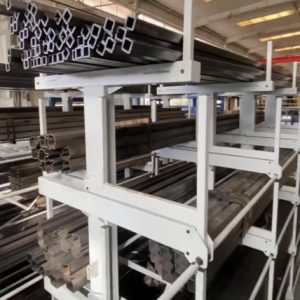
Arm depth and level count vary most between projects. A plant storing large-diameter pipe in wide bundles needs depth, dividers and cradles; a plant storing structural profiles needs flat support and 12 in end stops to keep bundles from sliding off the arms.
How is a loaded rack laid out and anchored?
Herochu lays out the rack where the crane can reach it without long travel, with the crank side open and the arm travel zone clear. Uprights are set, cross-squared, braced and then anchored to a slab that a structural engineer has checked for the imposed loads. A thin or cracked slab is the most common reason a loaded rack rocks.
Keep the top level for slow-moving stock. It is fixed, so it cannot be cranked into the crane path, and anything stored there has to be reached over the level below.
What maintenance keeps a heavy rack safe?
Herochu’s maintenance schedule starts with a daily look at chains, guards, arm brackets, end stops and anchor bolts, which catches most problems while they are still small. Chain lubrication follows the same three steps as any crank-out rack: guard off, lubricate, guard on. Bearings with zerk fittings take grease; sealed bearings need none.
After an impact, inspect before loading again. A bent arm is a capacity question rather than a cosmetic one, and straightening it in place does not restore the original rating.
Is 14,400 lb per level enough for 6 m pipe?
Work it out from the pipe: outside diameter, wall thickness and piece count give the bundle weight. Large-diameter pipe adds up quickly, so send the figures and let the load chart decide rather than estimating on the floor.
Can the top level be cranked out?
No. The top level is fixed storage. Every level below it extends up to 100 percent of arm depth for overhead access.
Can I add a level later?
Sometimes, if the uprights were prepared for it and the drive was sized for the extra carriage. It needs an engineering check, not just another set of arms.
What floor slab does the rack need?
A reinforced concrete slab sized for the loaded rack’s overturning moment, confirmed by a structural engineer. Slab thickness on its own is not enough information.
Herochu builds heavy duty crank-out racks for 6 m steel, with per-level load charts, anchored bases and guarded chain drives. Send the section list, bundle weights and hook height, and the specification comes back sized to the load rather than to a standard bay.