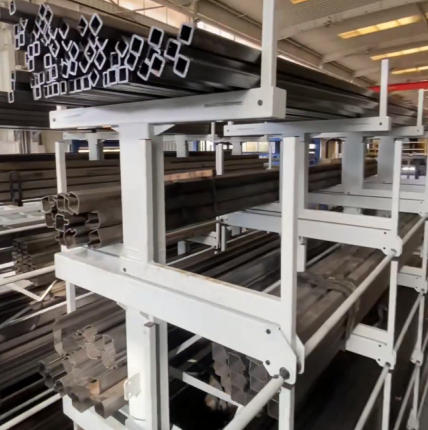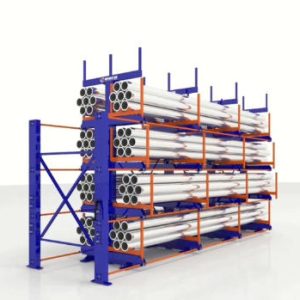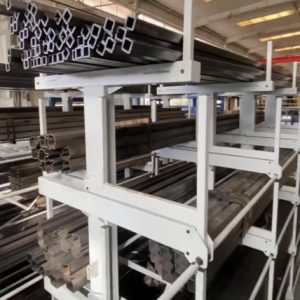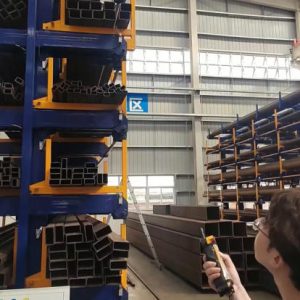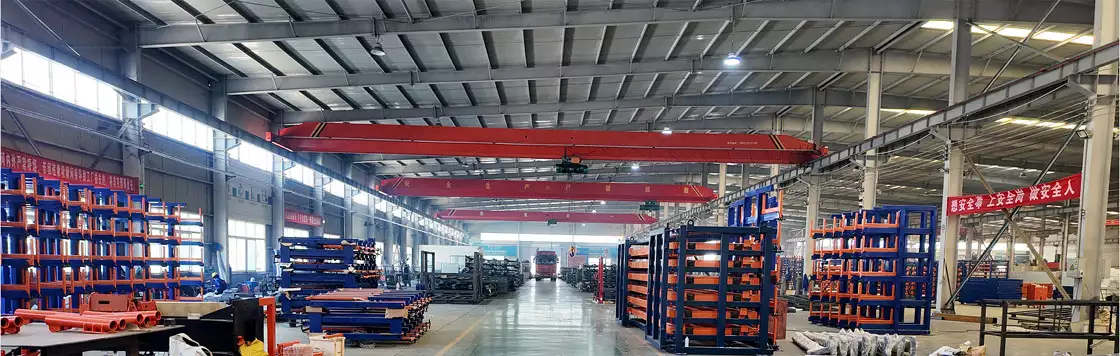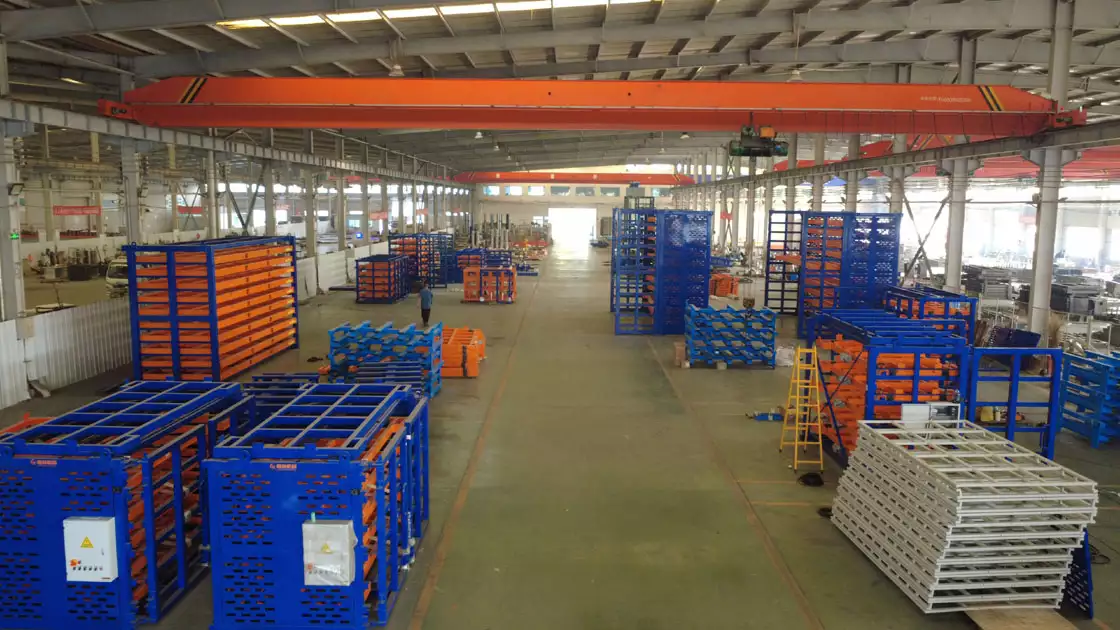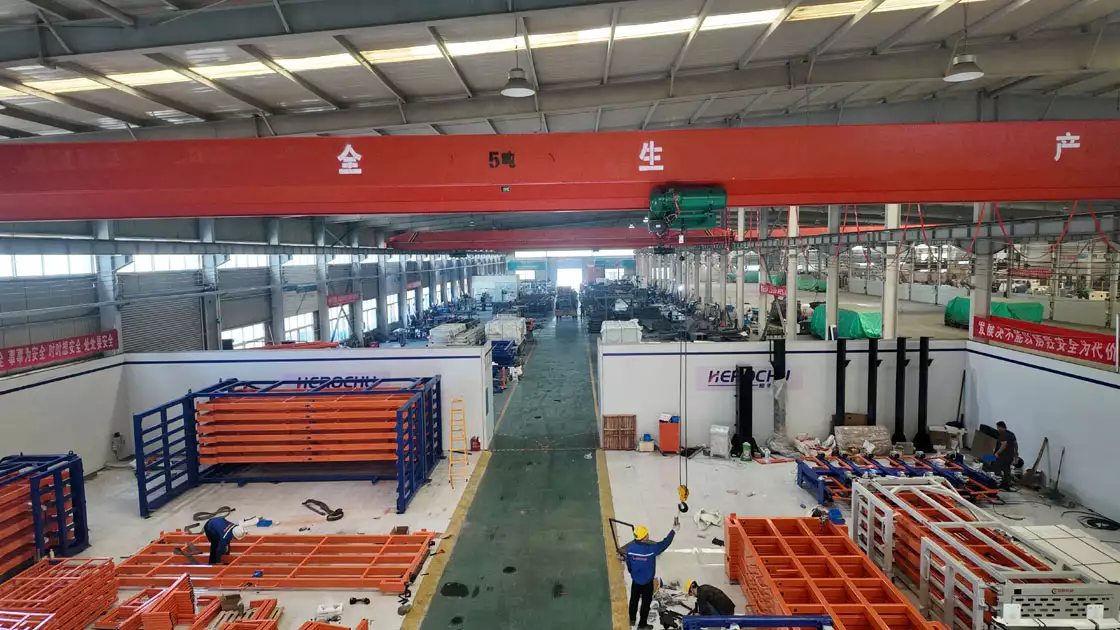
What makes 6 m aluminium extrusions difficult to store?
Aluminium is soft, and most extrusions arrive anodized, coated or wrapped in film. Set a bundle down hard on bare steel arms and the outer profiles take marks no downstream operation removes; drag it past an upright and the film tears. It is also light for its length, so a 6 m bundle sags when only its ends are supported.
Length brings a second problem. A forklift carrying 6 m stock needs a turning envelope close to twice the load length, so aisles widen and storage shrinks. Floor stacks make it worse: the oldest bundle sits at the bottom, and reaching it means moving three others.
How does the crank-out mechanism move a loaded level?
A hand crank on the control panel turns a drive shaft through a gear reducer. The reducer drives a chain that pulls the arm carriage along its track, and the arms glide out toward the aisle. Gearing trades speed for force, so a fully loaded level breaks away smoothly rather than with a jolt at the handle.
Each level runs independently and extends up to 100 percent of arm depth. Once the arms are out, the crane hook has a clear vertical path above the bundle; nobody reaches over a fixed arm or feeds a sling between uprights. The top level stays fixed and serves as static storage for slow-moving sections.
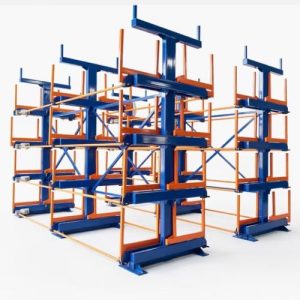
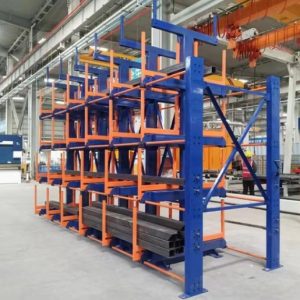
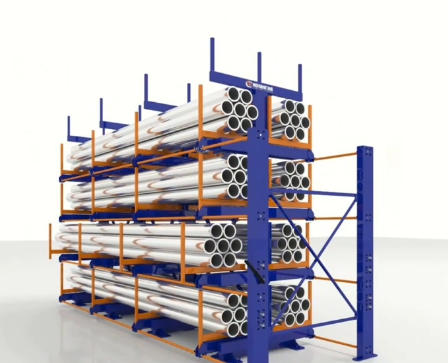
With arms on both faces of one upright line, the same footprint gives two storage faces: one base, one column line, twice the picking points. That is the practical difference between a double-sided crank-out rack and two single-sided racks bolted back to back.
Why is overhead access better than forklift handling for 6 m profiles?
A crane lifts a bundle vertically, travels a short distance and sets it down on extended arms. The load never swings through an aisle, never scrapes a column and never needs a second person to steady the trailing end. On anodized or thin-wall extrusions, that removes most of the handling damage a shop sees in a year.
Time follows the same logic. Forklift handling means a trip to the rack, a wide turn, fork positioning and a slow approach, usually with a spotter. Overhead access reduces the move to a lift and a bridge travel, which is why Herochu recommends siting the rack inside the crane’s normal working area.
What specification fits a 6 m aluminium profile line?
Standard crank-out configuration for 6 m aluminium profiles
| Parameter | Specification |
| Upright row length | 36 ft (10.97 m) |
| Levels | 4 standard; 3 to 8 available |
| Arm depth | 36 in (914 mm); 20 to 36 in range |
| End stop height | 12 in (305 mm) |
| Capacity | 14,400 lb (6,532 kg) per level |
| Configuration | Double sided, shared central upright line |
| Arm extension | Up to 100 percent of arm depth |
| Drive | Manual hand crank with guarded chain drive |
| Load protection | UHMW arm liners, dividers, support trays |
| Anchoring | Floor anchored, cross-squared at installation |
Arm depth decides how much of the bundle is supported. At 36 in (914 mm) a 6 m extrusion rests on a short span near each end, so flex stays low for thin-wall sections. Herochu fits UHMW liners to spread contact pressure, dividers to separate profile families, and support trays to catch small sections.
Where should the rack sit in an extrusion plant?
Put it beside the saw, the CNC or the bench that consumes the profiles. A crane takes a bundle, the saw cuts it, and offcuts return to a marked arm, one short move instead of a forklift round trip. Keep the crank side and the arm travel zone clear of benches, bins and pallets.
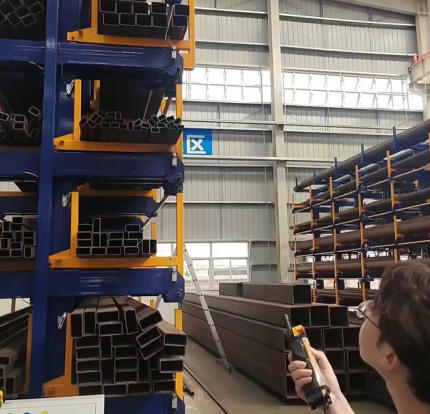
Check hook height before ordering: the crane must clear the top bundle and its sling, and the fixed top level suits slow movers rather than the sections the saw needs every hour.
How is the rack installed and maintained?
Herochu ships a set installation sequence. Stand the uprights, cross-square them until the diagonal X dimensions match, drop the spanner tubes into the welded U-brackets, fit cross bracing on the D-brackets, connect the long drive shafts, position and square the control panel, repeat the shorter spanners and shafts, bolt on the fixed top post, then level, anchor and cross-square.
Chain care takes three steps: remove the guard, lubricate the crank-out chains, refit the guard. The rack should never run without its guard. Bearings with zerk fittings take grease; sealed bearings need none.
Can both sides of the rack be loaded at the same time?
Yes. Each face has its own arm sets on the shared column line, and every level cranks out independently. A crane can work one face while the other stays loaded, which suits plants feeding two machines from the same stock.
How much weight can one level hold?
The standard four-level build is rated at 14,400 lb (6,532 kg) per level, assuming an evenly distributed bundle over the full arm depth. A load concentrated at the arm tip reduces it, and Herochu issues a load chart with each rack.
Do the arms extend while loaded?
Yes. The crank and reduction gearing start a loaded level from rest and glide it out to full extension. Partial extension is normal too; stop wherever the crane needs clearance.
Is an overhead crane essential?
The design assumes overhead access. Without a crane or hoist the rack still stores profiles, but extension loses its advantage and handling falls back to forklifts.
For a 6 m extrusion line, four answers decide the layout: profile section, bundle weight, hook height and crane travel. Herochu engineers crank-out racks around those answers, with arm depths, level counts and liners matched to the material.