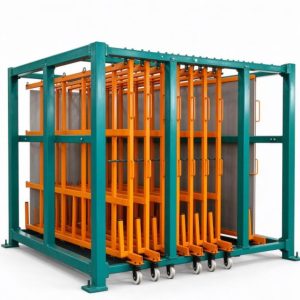
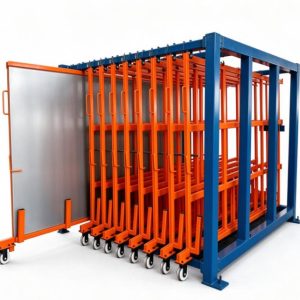
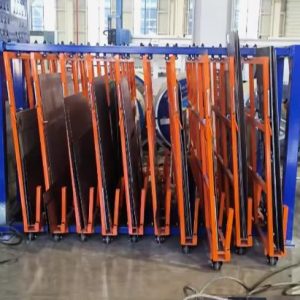
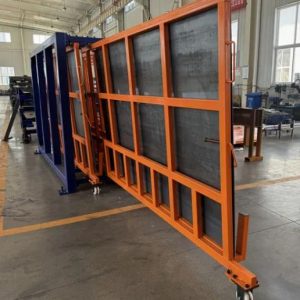
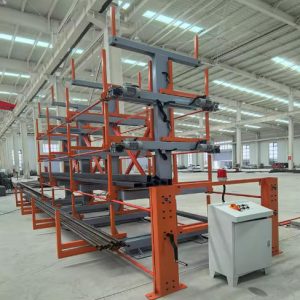
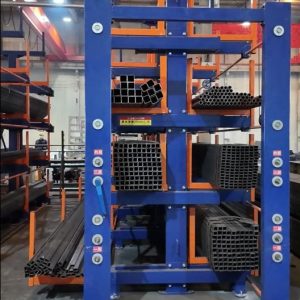
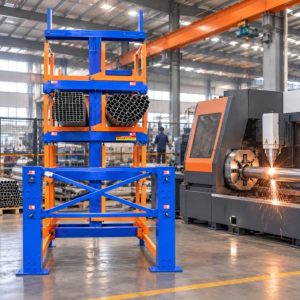
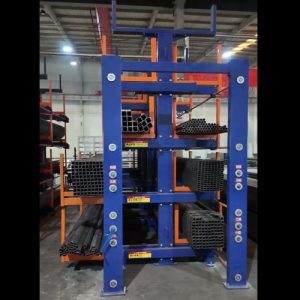
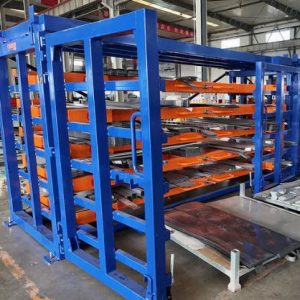
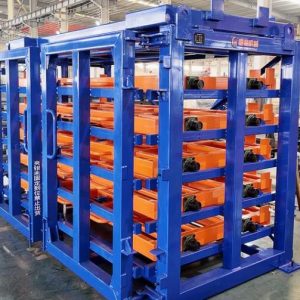
Can a vertical rack hold irregular offcuts, not just rectangular sheets? Yes. The tray supports material along its bottom edge, so L-shaped drops, strips and curved remnants store like full sheets, as long as the load stays within the rating and the tray depth.
Does vertical storage damage sheet surfaces? Less than flat stacking. Sheet stands on edge with the face free, so no weight rests on the surface and nothing slides during retrieval. Protective strips can be added for polished stainless.
How much faster is access than a floor stack? The gain comes from removing the search. A drawer exposes one group of remnants at a glance; a pile has to be moved before anyone can tell what is inside.
Is the rack CE marked? Yes, the series is CE marked for industrial safety and built under ISO 9001. Anchoring, load limits and drawer operation still belong in the site induction.
Is a vertical rack better than a pigeonhole rack for offcuts? They solve different problems. Pigeonholes suit small, uniform pieces; a vertical pull-out rack suits sheet-format remnants that need edge support and room to slide. Shops handling both run one of each.
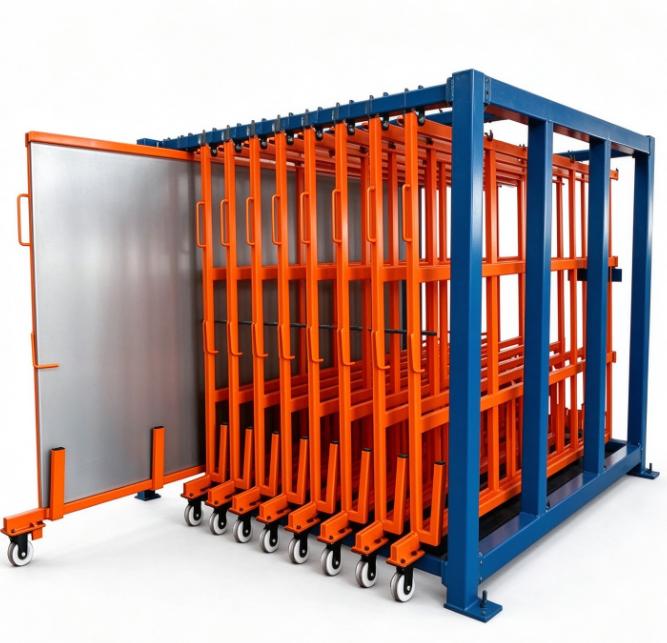
Can the rack be moved once loaded? The mobile wheel base allows repositioning within the storage area. Move a loaded rack slowly, on level floor, and inspect the wheels and frame afterwards.
How much floor space does it save? Eight sheet-format layers occupy one bay footprint instead of eight separate stacks and their aisles. The exact saving depends on tier count and sheet size specified.
Does the drawer need power? No. Operation is manual with mechanical assistance, so the rack works without power or air supply.