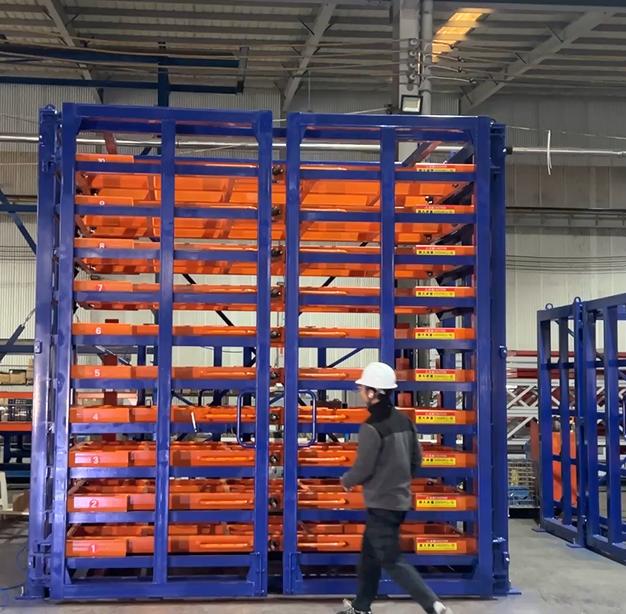
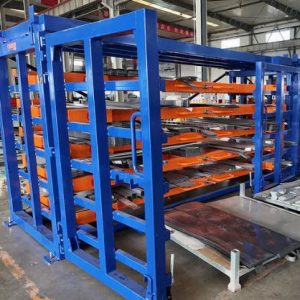
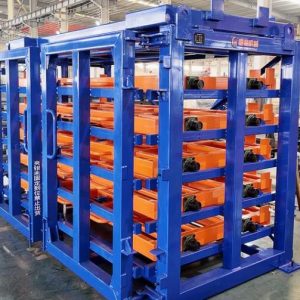
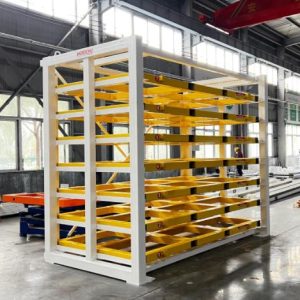
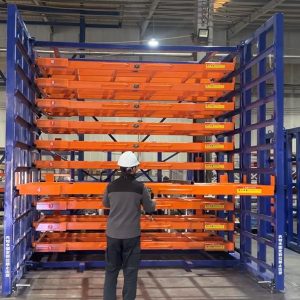
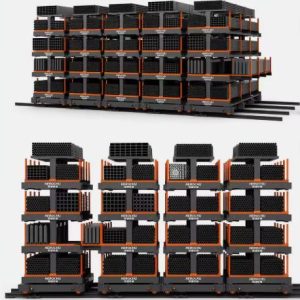
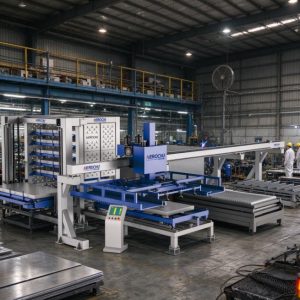
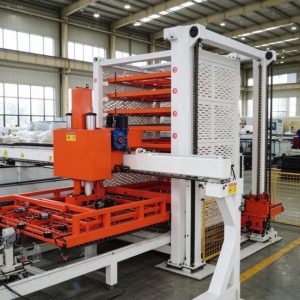
How much weight can one drawer hold? 500–5000 kg pulls out by hand on the roller track. The tray structure itself is rated to 3000 kg per layer as standard, with 5000 kg available on heavier frames.
Can I load aluminum plate with a crane instead of by hand? Yes. The drawer opens clear of the frame so a crane or vacuum lifter can lift a sheet vertically without the tray blocking the hook path.
Does the rack protect anodized or brushed aluminum? The tray surface and the absence of sliding contact across a stack are what protect it. Sheets rest flat, one per layer, and leave the rack horizontally.
How many layers fit in a 2100 mm unit? Three to four is typical at 2100 mm overall height. Six layers requires a taller frame, which is why layer count and building clear height need to be decided together.
Can the drawer size be non-standard? Yes, within the 800 × 800 mm to 6000 × 2000 mm envelope. Send Herochu your largest and smallest sheet and the frame is drawn to that pair.
How wide can a single drawer be? Up to 2000 mm as standard and 2500 mm on wider frames, with 6000 mm maximum length. The limit is structural deflection, not catalog choice.
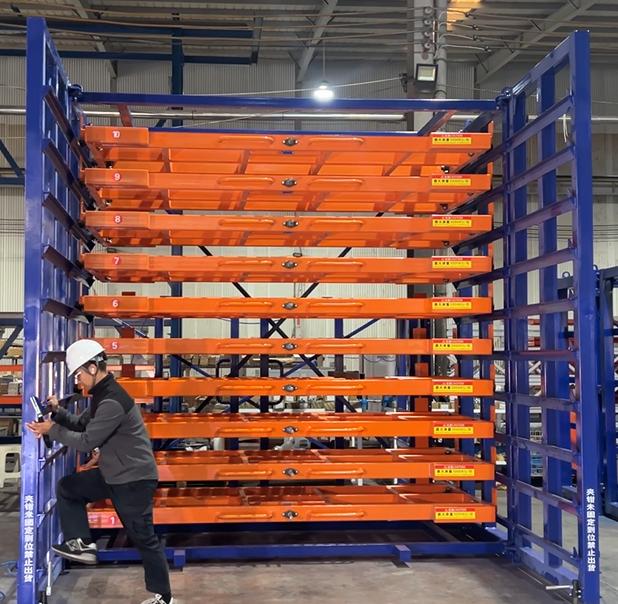
Can one rack hold different plate sizes? Yes, but specify it. Drawer widths can vary by layer, and a narrower top layer above a 6000 mm base layer is a normal configuration.
Is a manual drawer realistic at 3 tonnes? Yes, because the tray runs on a roller track. The pull force is a small fraction of the load, which is why 500–2000 kg per layer can be moved by hand.
How much floor space does one unit take? A single 3500 × 1700 mm unit with six layers replaces a flat stack that would need several times that footprint for the same sheet count.
Do the racks work outdoors or in unheated sheds? The double coating handles humidity and oil, but outdoor use should be confirmed with Herochu so the zinc specification matches the exposure.