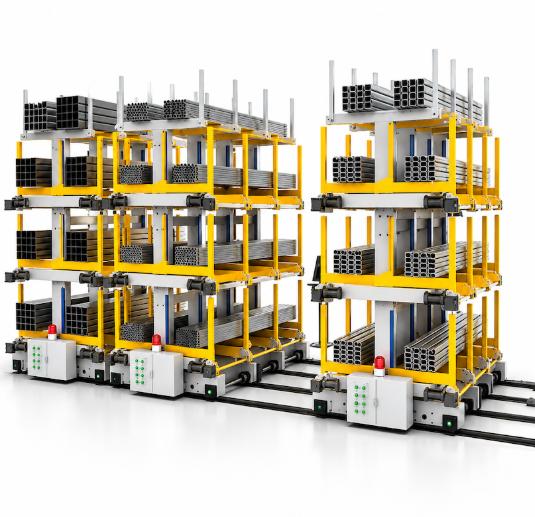
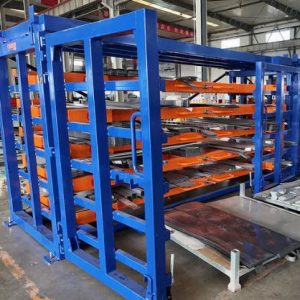
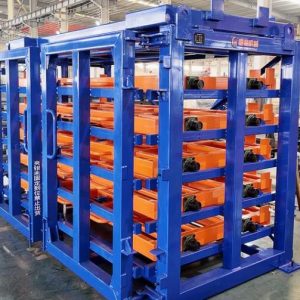
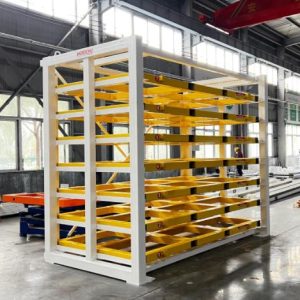
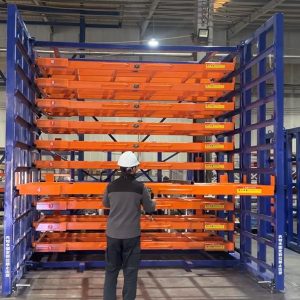
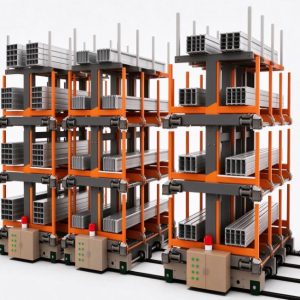
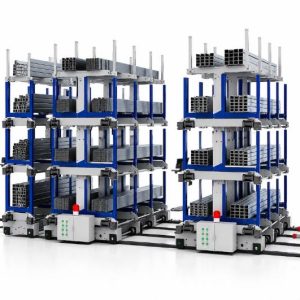
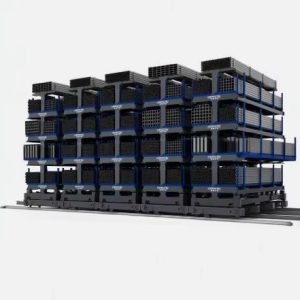
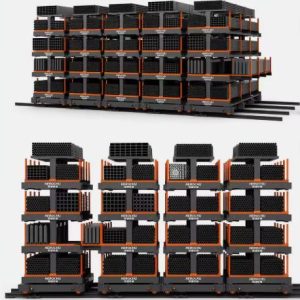
What can be customised on a mobile pipe warehouse rack? Material length, number of towers, number of levels, load rating per level, arm pitch, plate support and the control scope. The rail and drive platform stays common across the range.
How long does a typical project take from order to commissioning? It depends on tower count and control scope. The critical path is usually site readiness: slab condition, rail anchoring and power to the control panel. Confirm those early and delivery is predictable.
Can the block be extended later? Yes, if the rail run and slab are planned for it. Adding towers to an existing run is straightforward; extending the rail after the slab is finished is not.
Is a WMS required? No. The system runs standalone from its own panel. WMS integration is optional and specified at order stage.
Which model suits a 6-metre tube shop with mixed bundles? The HC-G6053EM-5 at 3,000 kg per level is the usual fit. If bundles run heavier, the 9,000 mm frame with 5,000 kg levels is the safer choice even where the material is shorter.
Is mobile cantilever shelving strong enough for 5-tonne bundles? Yes. The 9,000 mm and 12,000 mm Herochu models are rated at 5,000 kg per level on a single side. Rating assumes the load is distributed across the arms rather than concentrated at the tips.

Can it be installed in an existing building without civil works? In most cases the work is limited to a level, load-rated slab and rail anchoring. Ceiling height is the usual constraint, not structure.
How tall does the building need to be? Five and six level configurations are the design intent, which keeps the system viable in bays of roughly 4–7 m clear height.
Does staffing change? No automation of the picking decision is implied. One operator calls a tower and retrieves with electric assistance; the gain is density and safer handling, not headcount reduction.
Can more levels be added later? Mechanically yes, but it is a tower rebuild rather than an add-on. Decide the level count at specification stage.